AI Search Content Brief Template for In-House Teams: The Complete Framework for Getting Cited by ChatGPT, Gemini, and AI Overviews
Fewer than 9% of ChatGPT and Gemini citations come from URLs ranked in Google’s top 10 organic results (Ahrefs / eMarketer, 2025). Let that sink in for a moment. Your SEO-optimized content, the pages you’ve spent months ranking on page one, isn’t automatically visible to AI search engines.
I was reviewing content briefs with a B2B SaaS client last month, and their documentation looked exactly like what I would have written in 2019. Primary keyword placement. Meta description length. Header tag hierarchy. All important, certainly, but completely blind to how AI systems actually discover, evaluate, and cite content.
The problem isn’t that traditional SEO is dead. It’s that content briefs designed for Google’s blue links don’t translate to AI citations. The window for adaptation is closing fast: 54% of US marketers plan to implement a GEO strategy within 3-6 months (eMarketer / Scribewise, 2025/2026), while 47% of brands have no deliberate GEO strategy yet (Cordial). The competitive gap between early movers and everyone else is about to widen dramatically.
This article provides the exact AI search content brief template I use with enterprise clients at NAV43. A framework that bridges the gap between traditional SEO content briefs and the new requirements for AI citation visibility. You’ll walk away with a ready-to-implement template, integration workflow for existing processes, and a measurement framework to track what actually matters.
Why Your Current Content Briefs Are Failing AI Search
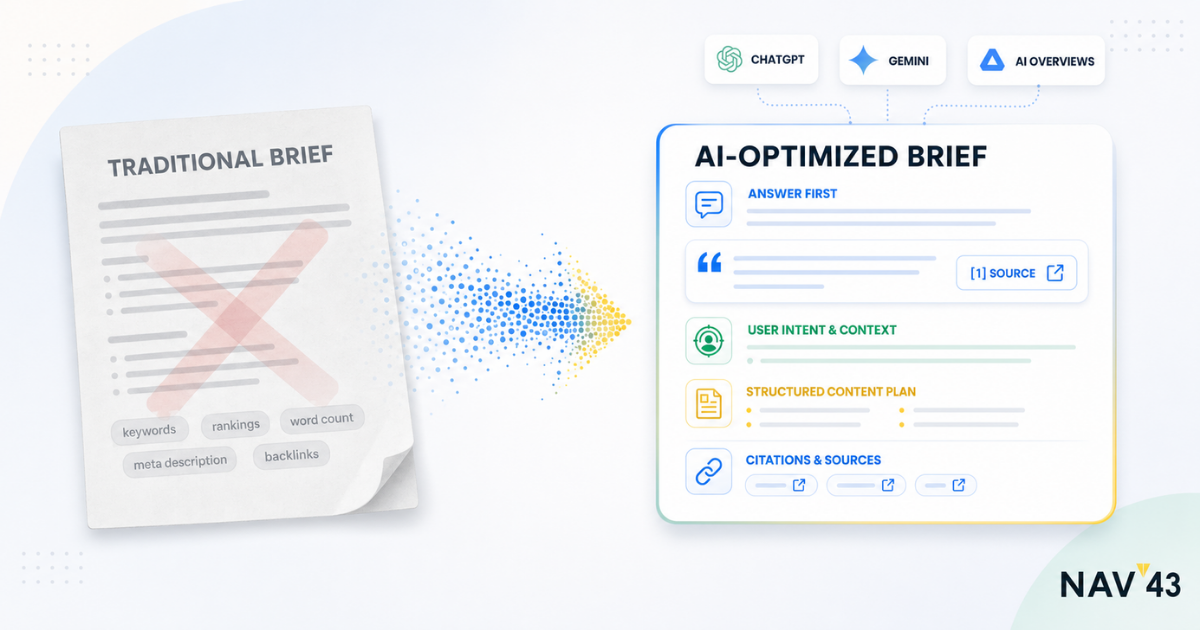
Traditional content briefs operate on a fundamental assumption: optimize for Google’s ranking algorithm, and traffic will follow. That assumption worked beautifully for two decades. It no longer holds.
AI search engines don’t crawl and rank pages the same way Google does. They extract and cite facts, snippets, and structured answers. ChatGPT doesn’t care if your primary keyword appears in the first 100 words – it cares whether your content contains a clear, extractable answer to the question a user is asking.
The keyword-density trap is perhaps the most costly mistake I see in legacy briefs. Traditional briefs optimize for keyword placement: “Include primary keyword in H1, first paragraph, and 3-5 subheadings.” AI engines, by contrast, favor comprehensive topic coverage and extractable statements. A page stuffed with keyword variations but lacking definitive answers is entirely ignored by AI systems.
The intro problem might be the most urgent issue to fix. According to research from Growth Memo (2026), 44.2% of all LLM citations come from the first 30% of text; 31.1% from the middle; and only 24.7% from the conclusion. Most traditional briefs don’t guide writers to front-load citable content; they guide them to “hook the reader” with a story or question. AI systems need answers, not hooks.
The depth paradox challenges another common assumption. Your homepage and category pages, typically the most SEO-optimized pages on your site, are rarely cited by AI. In fact, 82.5% of AI citations link to deeply nested content pages rather than homepages (Omnius AI Search Industry Report, 2025), and are almost never cited by AI. Research from the Omnius AI Search Industry Report (2025) found that 82.5% of AI citations link to deeply nested content pages, not homepages or category pages. Your briefs need to target specific, expert-level topics, not broad landing pages.
The freshness factor is perhaps the most overlooked requirement. According to Amsive, 50% of AI-cited content is less than 13 weeks old. Content briefs must include refresh cycles from day one – not as an afterthought, but as a core field.
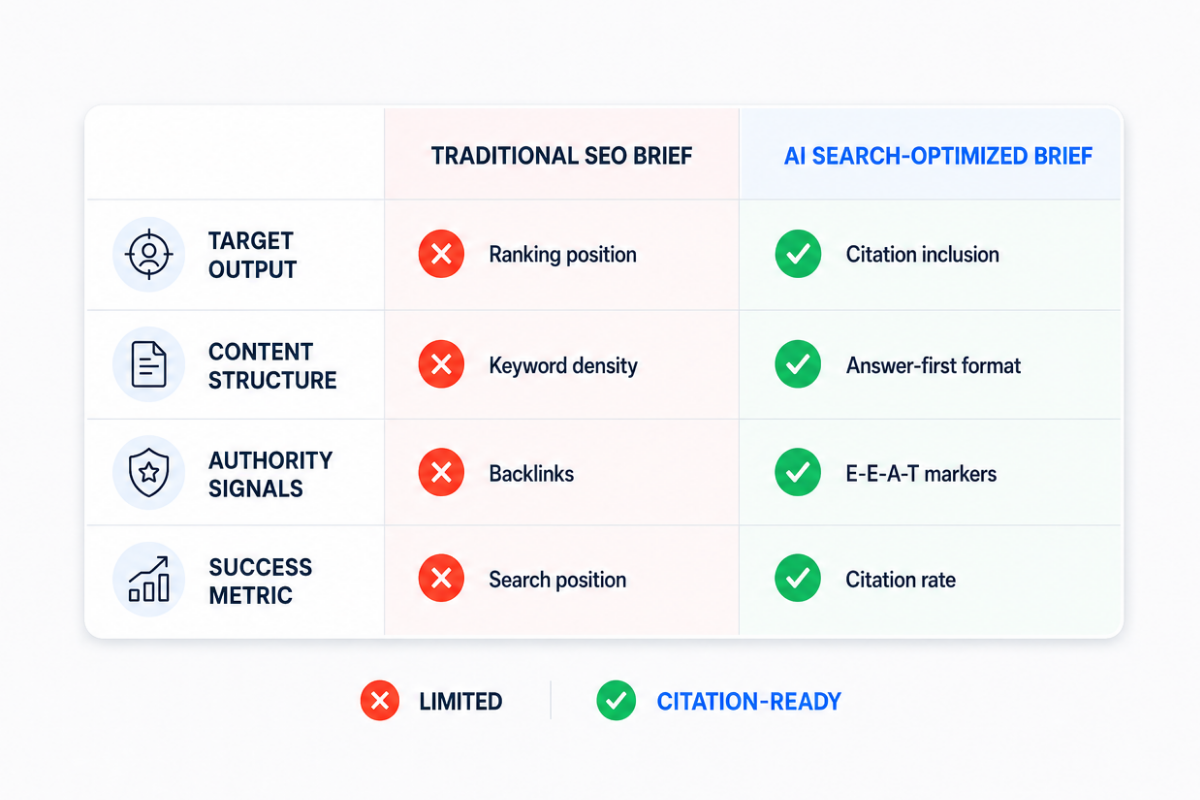
| Traditional SEO Brief Element | AI Search Brief Element |
|---|---|
| Include primary keyword in H1 and first paragraph | Open with a 40-60 word definitive answer to the target question that can stand alone as a citation |
| Target keyword density of 1-2% | Achieve comprehensive topic coverage with semantic completeness |
| Write a compelling hook to reduce bounce rate | Front-load extractable facts and statistics in the first 30% of content (Growth Memo, 2026) |
| Optimize for featured snippets | Create multiple standalone “citable chunks” throughout the piece |
| Build internal links to boost page authority | Include structured data markup that AI systems can parse |
| Publish and monitor rankings | Schedule content refresh every 8-12 weeks |
The AI Search Landscape: What In-House Teams Need to Understand
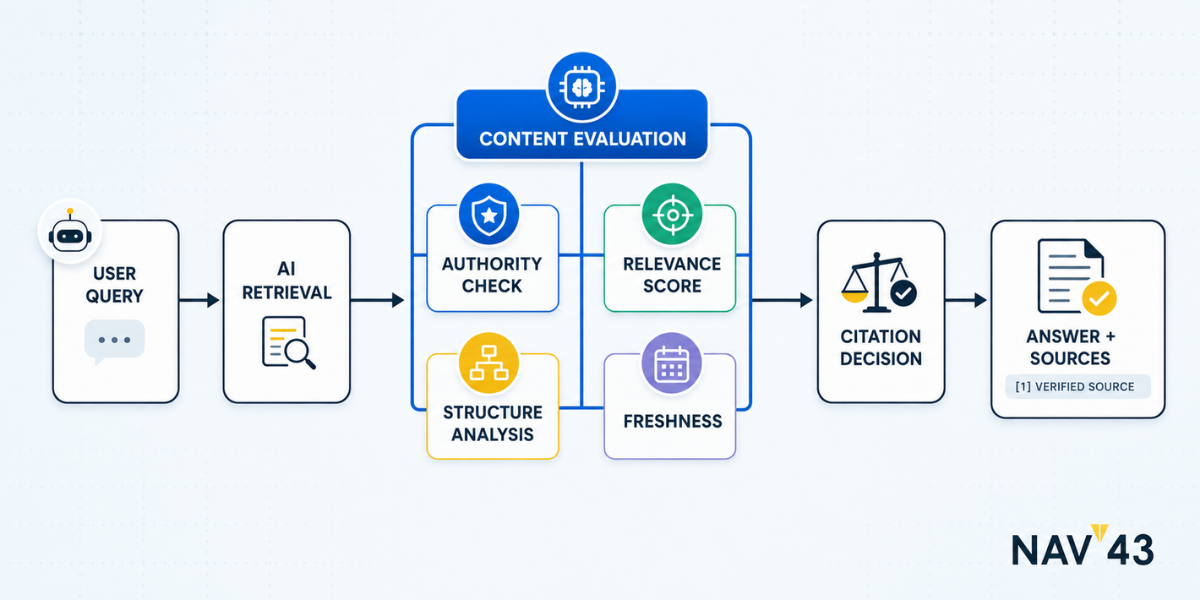
Before diving into the template itself, your team needs to understand how AI engines actually select and cite content. This isn’t academic knowledge. It directly shapes every field in your content brief.
How AI Engines Select and Cite Content
AI search engines don’t “rank” content the way Google does. They pull discrete facts from across the web, synthesize them, and cite sources for specific claims. Think of it this way: Google asks “which page best matches this query?” while AI engines ask “which page contains the most citable answer to this specific question?”
This distinction matters enormously for brief writing. A traditional brief might say, “write a comprehensive guide to X.” An AI-optimized brief says, “write a comprehensive guide to X, and ensure paragraph 3 contains a standalone 50-word definition that can be cited independently.”
E-E-A-T signals matter even more in AI search than in traditional SEO. AI systems favor content with clear expertise markers, citations to authoritative sources, and named author authority. Your brief needs to explicitly specify these requirements. Don’t assume writers will include them naturally.
The “fact level” optimization concept is new for most teams. AI might cite a single paragraph from a lengthy article – the rest of your content serves only to establish the authority that makes that paragraph worth citing. Writers need guidance on creating these citable chunks, which means briefs need to identify specific extractable statements in advance.
Content with statistics, citations, and quotations achieves 30-40% higher visibility in AI responses (Superlines, 2026). This isn’t a “nice to have,” it’s a structural requirement that belongs in every brief.
Here’s what a weak intro paragraph looks like versus a citable one:
Weak (not citable): “Content briefs have evolved significantly over the past few years. In this guide, we’ll explore what makes a great content brief in the age of AI.”
Citable (AI-optimized): “An AI search content brief is a structured document that guides writers to create content optimized for citation by AI assistants like ChatGPT, Gemini, and Perplexity, requiring specific fields for extractable answers, semantic completeness, and structured data markup that traditional SEO briefs lack.”
The second version can stand alone. An AI system can quote it directly. The first version is fluff.
The Multi-Platform Reality
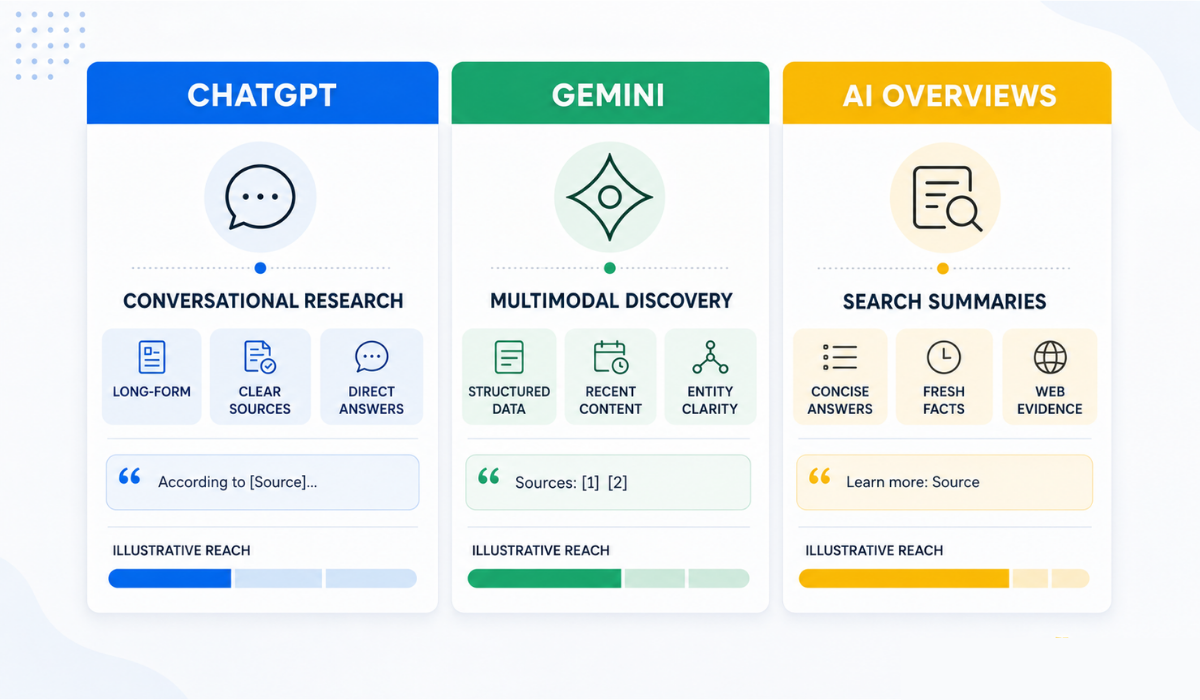
One complexity that traditional SEO never had to address: different AI platforms have vastly different citation behaviors. ChatGPT dominates referral traffic. 87.4% of all AI referral traffic comes from ChatGPT (Conductor, 2025), but Perplexity, Gemini, and AI Overviews have different content preferences and citation patterns.
AI Overviews now appear in 25.11% of Google searches, up from 13.14% in March 2025 (Conductor / Superlines, 2026). This is the bridge between traditional SEO and pure AI search: content that earns AI Overview inclusion gains visibility in Google’s interface and potentially in standalone AI tools.
Research from Semrush found that citation rates can differ by as much as 615x between platforms like Grok and Claude (Semrush, 2025). That’s not a typo. A piece of content that gets cited frequently by one AI might be completely ignored by another.
The implication for briefs: your team needs to specify which AI platforms are priority targets for each piece of content. A B2B technical guide might prioritize ChatGPT and Perplexity. A product comparison might prioritize AI Overviews. One-size-fits-all optimization no longer works.
Gartner predicted that traditional search engine volume will drop 25% by 2026 due to AI chatbots (Gartner, 2024). We’re now living in that prediction. Your briefs need to reflect this reality.
The NAV43 AI Search Content Brief Template
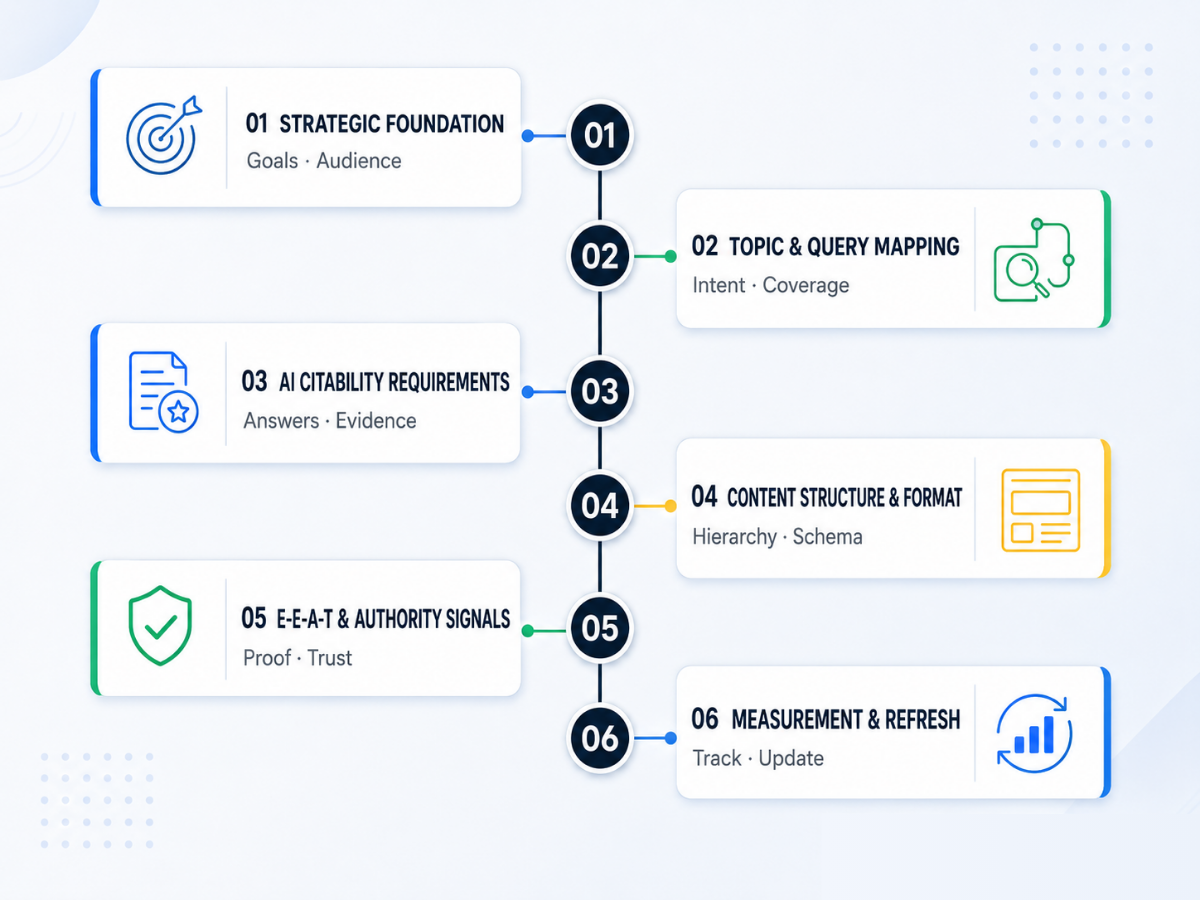
The template I’m about to share isn’t a replacement for your existing SEO content briefs – it’s an evolution. Every field serves a purpose for either human writers, AI citability, or measurement. We’ve tested and refined this framework with enterprise B2B clients across multiple industries, tracking actual AI citation performance to validate what works.
The philosophy behind this template: dual optimization. Every piece of content should be optimized for both traditional search rankings and AI citation potential. These goals aren’t mutually exclusive – in fact, the signals that drive AI citations (comprehensive coverage, expert authority, structured data) also improve traditional SEO performance.
Let me walk you through each section before presenting the complete template.
Section 1: Strategic Foundation
The strategic foundation sets the context that shapes every other decision in the brief. This section answers: why are we creating this content, and what does success look like?
Content Objective: Go beyond “awareness, consideration, decision” to include the AI visibility goal. Is this content meant to be cited as a definitive answer? A data source? An expert opinion?
Target Audience and AI Search Behaviors: Document not just who your audience is, but how they’re likely to encounter this content. Are they asking ChatGPT directly? Using Google and seeing AI Overviews? Researching on Perplexity?
Primary Topic Cluster: Think broader than a primary keyword. What subject matter territory does this content help you own? Topic clusters drive an average 74% organic traffic increase within six months (HubSpot, 2024) – and they’re even more important for AI citation authority.
AI Platform Priority Targets: Specify which platforms matter most for this piece. ChatGPT for general B2B queries? AI Overviews for high-search-volume terms? Perplexity for research-heavy topics?
Competitive AI Citation Analysis: Before writing, document what competitors are being cited for on this topic. Use ChatGPT and Perplexity to query your target questions and see who gets cited. This shapes your differentiation strategy.
TEMPLATE BOX: Strategic Foundation Fields
| Field | Description | Example Entry |
|---|---|---|
| Content Objective | Primary goal + AI visibility goal | “Establish thought leadership on marketing automation; become cited source for ‘HubSpot automation best practices’ queries” |
| Target Audience | Who + their AI search behaviors | “Marketing Directors at B2B SaaS companies; primarily use ChatGPT for vendor research, Google for implementation guidance” |
| Primary Topic Cluster | The broader territory this supports | “Marketing Automation Implementation” cluster under “MarTech” pillar |
| AI Platform Priorities | Ranked list of target platforms | 1. ChatGPT (primary), 2. AI Overviews, 3. Perplexity |
| Competitive Citation Analysis | Who gets cited now, gaps to exploit | “HubSpot cited for features, Salesforce for enterprise use cases; gap exists for mid-market implementation guidance” |
Section 2: Topic and Query Mapping
This section shifts from keywords to queries – the actual questions your content must definitively answer.
Core Topic: Broader than a keyword, this is the subject matter territory you’re claiming. “HubSpot automation” is a keyword. “B2B marketing automation implementation and optimization” is a topic.
Primary Target Query: The specific question this content definitively answers. Frame it as a question users would actually ask: “How do I set up automated lead nurturing in HubSpot?” not “HubSpot lead nurturing automation.”
Secondary Queries: 2-4 related questions to address within the piece. These become H2 or H3 sections and create additional citation opportunities.
Semantic Entities: The people, concepts, tools, and methodologies the AI will expect to see in comprehensive coverage of this topic. If you’re writing about marketing automation, AI systems expect to see mentions of HubSpot, Salesforce, lead scoring, workflow triggers, and similar entities.
The shift from “keyword density” to “topic completeness” thinking is crucial here. AI systems don’t count keyword appearances – they evaluate whether content comprehensively covers the expected semantic territory.
TEMPLATE BOX: Query Mapping Fields
| Field | Description | Example Entry |
|---|---|---|
| Core Topic | Subject matter territory | “B2B content brief development for AI search optimization” |
| Primary Target Query | The main question to answer | “How do I create a content brief that gets my content cited by AI search engines?” |
| Secondary Queries | Related questions to address | “What fields should an AI content brief include?” / “How is AI content brief different from SEO brief?” / “How do I measure AI content performance?” |
| Semantic Entities | Expected concepts, tools, people | ChatGPT, Gemini, AI Overviews, Perplexity, E-E-A-T, structured data, schema markup, content clusters, GEO |
| Topic Completeness Checklist | Concepts that must be covered | □ AI citation mechanics □ Brief field requirements □ Workflow integration □ Measurement framework |
Section 3: AI Citability Requirements
This is the critical section most briefs are missing entirely – the specific requirements that make content extractable and citable by AI systems.
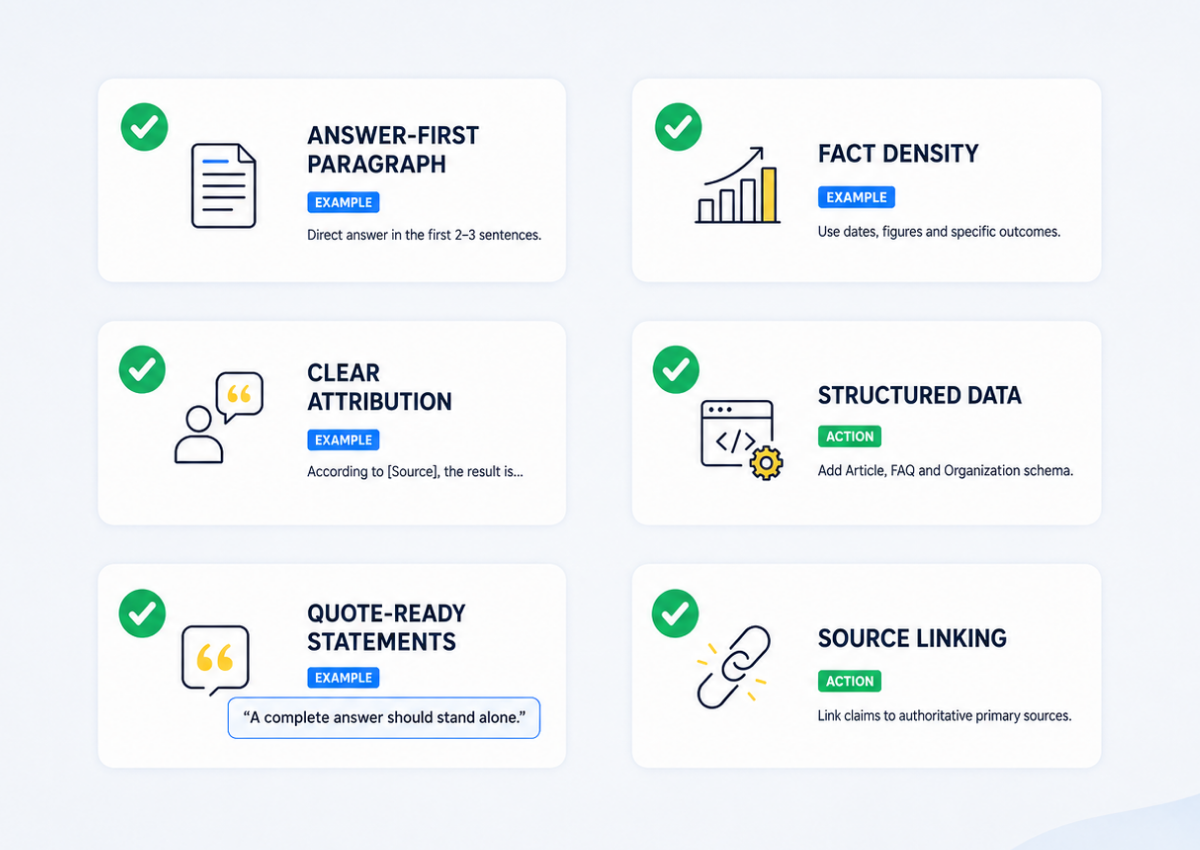
Quotable Answer Requirement: Specify that the writer must include a 40-60 word definitive answer to the primary query in the first 150 words. This is non-negotiable. Remember: 44.2% of citations come from intros (Growth Memo, 2026).
Extractable Snippet Targets: Identify 3-5 specific facts, definitions, or statements that should be written as standalone, citable chunks. Don’t leave this to chance – specify exactly what you want cited.
Statistics and Evidence Requirements: Set a minimum number of cited stats, expert quotes, or data points. Content with statistics and citations achieves 30-40% higher AI visibility (Superlines, 2026).
Structured Data Guidance: Specify what schema markup should accompany this content. FAQ schema, HowTo schema, Article schema with author information – these signals help AI systems parse and trust your content.
Here’s the difference in practice:
Weak intro (not citable): “Creating content briefs can be challenging. There are many factors to consider, and the landscape keeps changing. Let’s explore what makes a good brief.”
AI-optimized intro (citable): “An AI search content brief template is a structured framework that includes six critical sections missing from traditional SEO briefs: strategic foundation, query mapping, AI citability requirements, content structure, E-E-A-T signals, and measurement protocols. These additions ensure content is optimized for citation by ChatGPT, Gemini, and AI Overviews – not just Google rankings.”
The second version can be quoted directly. It defines the term, states the key components, and explains the purpose – all in standalone form.
TEMPLATE BOX: AI Citability Fields
| Field | Description | Example Entry |
|---|---|---|
| Quotable Answer (Required) | 40-60 word definitive answer to primary query, placed in first 150 words | “An AI search content brief is a structured document containing strategic foundation, query mapping, citability requirements, format specifications, E-E-A-T signals, and measurement criteria – enabling content teams to create assets optimized for AI citation, not just traditional search rankings.” |
| Extractable Snippet #1 | Standalone fact/definition to write as citable chunk | “Definition of AI content brief vs. traditional SEO brief – 2-3 sentences explaining key differences” |
| Extractable Snippet #2 | Standalone fact/definition to write as citable chunk | “The 6 sections every AI content brief must include – formatted as citable list” |
| Extractable Snippet #3 | Standalone fact/definition to write as citable chunk | “Statistic on AI citation patterns (44.2% from intros) with source attribution” |
| Minimum Statistics | Required number of cited data points | “Minimum 8 statistics with source and year attribution” |
| Minimum Expert Citations | Required external authority references | “Minimum 3 references to industry research or named experts” |
| Schema Markup Type | Structured data to implement | “Article schema with author, FAQ schema for common questions section, HowTo schema for template walkthrough” |
Section 4: Content Structure and Format
Structure requirements ensure consistency across your content program and guide writers on how to organize information for both readers and AI systems.
Target Word Count and Depth Level: Specify not just length, but depth expectations. A 3,000-word overview covers topics differently than a 3,000-word deep-dive on a narrow subject.
Required H2/H3 Structure: Provide specific headings, not just “suggested topics.” Writers should know exactly what sections to include and in what order.
Content Format Requirements: Tables, comparison matrices, step-by-step sections – specify which formats to use where. AI systems parse structured formats more effectively than prose blocks.
Summary Box Placement: Require TL;DR or key takeaway boxes at specific points. These become prime citation targets.
Internal and External Linking Requirements: Specify minimum link counts and priority targets. Internal linking builds the topical authority AI systems use to evaluate expertise.
TEMPLATE BOX: Structure and Format Fields
| Field | Description | Example Entry |
|---|---|---|
| Target Word Count | Length requirement | “3,500-4,000 words” |
| Depth Level | Comprehensive overview vs. deep-dive | “Expert-level practitioner guide – assume reader has basic SEO knowledge” |
| Required H2 Sections | Specific headings to include | “Why Current Briefs Fail / AI Search Landscape / Template Section 1-6 / Integration Workflow / Common Pitfalls / Measurement” |
| Required Content Formats | Tables, lists, templates to include | “□ Comparison table (old vs. new brief) □ Complete template box □ Integration checklist □ KPI framework table” |
| Summary Box Requirements | Placement of TL;DR elements | “Include executive summary after intro (100 words max); include key takeaways box before conclusion” |
| Internal Link Targets | Priority pages to link | “Link to: GEO content strategy guide, AI SEO measurement article, HubSpot automation guide” |
| External Citation Targets | Authority sources to reference | “Cite: Gartner AI predictions, Growth Memo citation research, Conductor AI traffic study” |
Section 5: E-E-A-T and Authority Signals
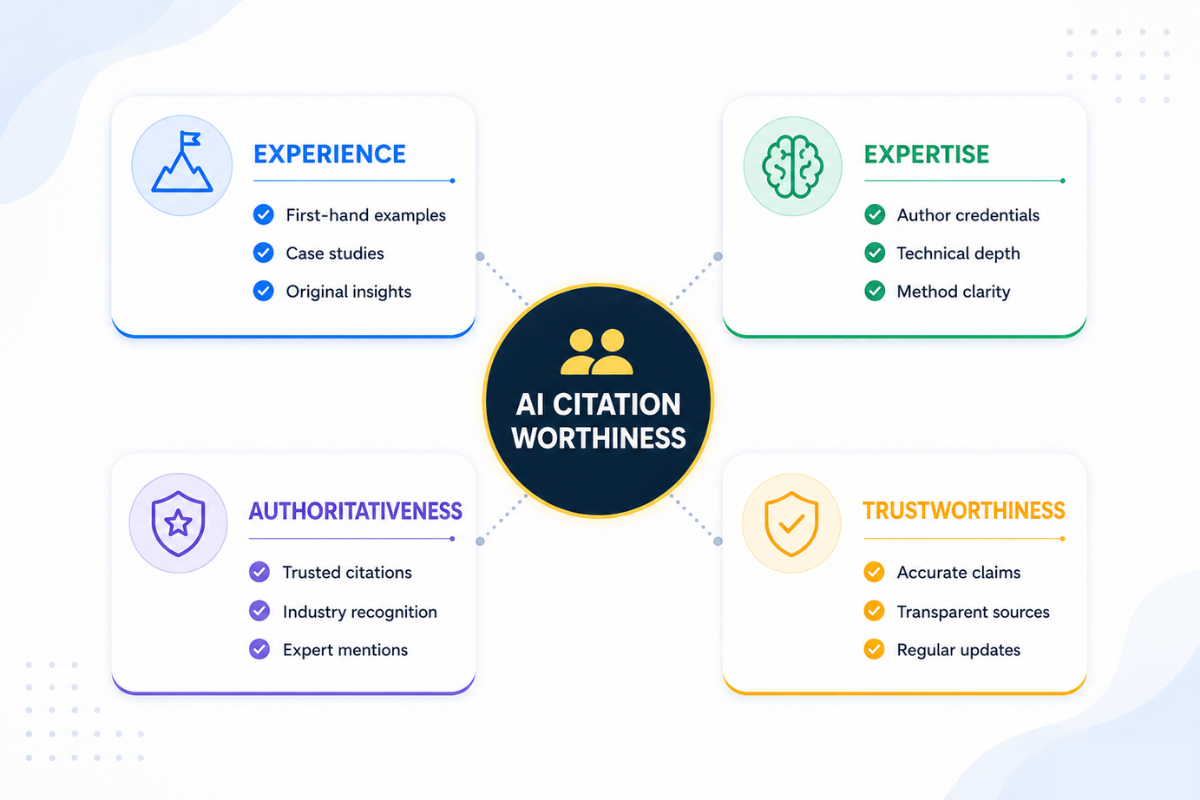
E-E-A-T – Experience, Expertise, Authoritativeness, and Trustworthiness – matters even more for AI citation than for traditional SEO. AI systems evaluate source credibility before citing, and they’re looking for explicit signals.
Author Attribution Requirements: Specify that content must be attributed to a named author with demonstrable expertise. Include requirements for author bio, credentials, and schema markup.
Expert Sources to Cite or Quote: Identify specific authorities to reference. Named experts and recognized institutions carry more weight than anonymous “industry sources.”
First-Party Data: Include requirements for original research, client case studies, or proprietary frameworks. First-party data is increasingly valuable as AI systems seek differentiated sources.
Credential and Experience Signals: Specify how to incorporate signals of practical experience – “in our work with clients,” “based on implementation across 50+ projects,” etc.
TEMPLATE BOX: E-E-A-T Fields
| Field | Description | Example Entry |
|---|---|---|
| Author | Named author with credentials | “Peter Palarchio, Founder & Digital Strategist, NAV43” |
| Author Bio Requirements | Expertise signals to include | “Include 15+ years experience, enterprise client work, specific AI SEO expertise” |
| Expert Sources to Cite | Named authorities to reference | “Cite research from: Gartner, HubSpot, Conductor, Semrush” |
| First-Party Data to Include | Original insights to incorporate | “Include NAV43 framework (AI Content Brief Template), reference anonymized client implementation results” |
| Experience Signals | Practical experience markers | “Include at minimum 2 ‘in our work with clients’ references and 1 specific implementation example” |
Section 6: Measurement and Refresh
Content without measurement is hope, not strategy. This section ensures every piece has clear success criteria and built-in refresh cycles.
Traditional SEO KPIs: Target rankings, organic traffic goals, time on page, bounce rate. These still matter.
AI Visibility KPIs: Target AI platforms for citation, citation tracking methodology, and brand mention monitoring.
Refresh Schedule: When this content should be reviewed for freshness. Remember: 50% of AI-cited content is less than 13 weeks old (Amsive). Build refresh dates into every brief.
Success Criteria: Define what “winning” looks like for this specific piece. Is it a ranking position? Citation count? Traffic? All three?
TEMPLATE BOX: Measurement Fields
| Field | Description | Example Entry |
|---|---|---|
| Target Ranking Position | Traditional SEO goal | “Page 1 (positions 1-5) for ‘AI content brief template’ within 90 days” |
| Organic Traffic Goal | Expected monthly sessions | “500+ monthly organic sessions within 6 months” |
| AI Platform Citation Targets | Where you want to be cited | “Cited in ChatGPT responses for ‘how to create AI content brief’ queries; included in relevant AI Overviews” |
| Citation Tracking Method | How you’ll monitor AI visibility | “Weekly manual query testing across ChatGPT, Perplexity, Google AI Mode; monthly brand mention report” |
| Refresh Schedule | Content update timeline | “Initial review at 8 weeks; full refresh at 12 weeks; statistics update quarterly” |
| Success Criteria | Definition of “winning” | “Success = Position 1-3 ranking + verified ChatGPT citation + 500 monthly sessions within 6 months” |
Complete Template: Ready to Implement
Here’s the full NAV43 AI Search Content Brief Template in a single, copyable format. This template works in Google Docs, Notion, Asana, Monday.com, or any documentation system your team uses.
THE NAV43 AI SEARCH CONTENT BRIEF TEMPLATE
Brief Created: [Date]
Brief Owner: [Name]
Assigned Writer: [Name]
Target Publish Date: [Date]
SECTION 1: STRATEGIC FOUNDATION
| Field | Entry |
|---|---|
| Content Title | [Working title] |
| Content Objective | [Primary goal + AI visibility goal] |
| Target Audience | [Who + their AI search behaviors] |
| Primary Topic Cluster | [Broader subject territory] |
| AI Platform Priorities | [1. Primary, 2. Secondary, 3. Tertiary] |
| Competitive Citation Analysis | [Who gets cited now, gaps to exploit] |
SECTION 2: TOPIC AND QUERY MAPPING
| Field | Entry |
|---|---|
| Core Topic | [Subject matter territory] |
| Primary Target Query | [The main question to definitively answer] |
| Secondary Query #1 | [Related question to address] |
| Secondary Query #2 | [Related question to address] |
| Secondary Query #3 | [Related question to address] |
| Semantic Entities | [Concepts, tools, people AI will expect] |
Topic Completeness Checklist:
– [ ] [Concept that must be covered]
– [ ] [Concept that must be covered]
– [ ] [Concept that must be covered]
– [ ] [Concept that must be covered]
SECTION 3: AI CITABILITY REQUIREMENTS
Quotable Answer (REQUIRED – Place in first 150 words):
[Write the 40-60 word definitive answer to the primary target query. This must be able to stand alone as a citation.]
Extractable Snippet Targets:
1. [Specific fact/definition to write as citable chunk]
2. [Specific fact/definition to write as citable chunk]
3. [Specific fact/definition to write as citable chunk]
| Requirement | Target |
|---|---|
| Minimum Statistics (with source + year) | [Number] |
| Minimum Expert/Authority Citations | [Number] |
| Schema Markup Types to Implement | [Types] |
SECTION 4: CONTENT STRUCTURE AND FORMAT
| Field | Entry |
|---|---|
| Target Word Count | [Range] |
| Depth Level | [Overview / Intermediate / Expert-level] |
Required H2 Sections (in order):
1. [H2 heading]
2. [H2 heading]
3. [H2 heading]
4. [H2 heading]
5. [H2 heading]
Required Content Formats:
– [ ] [Format – e.g., comparison table, checklist, template box]
– [ ] [Format]
– [ ] [Format]
Summary Box Requirements:
– [ ] Executive summary after intro: [Yes/No, word count]
– [ ] Key takeaways before conclusion: [Yes/No]
Linking Requirements:
– Internal links (minimum): [Number]
– Priority internal targets: [URLs]
– External citations (minimum): [Number]
– Priority external sources: [Sources]
SECTION 5: E-E-A-T AND AUTHORITY SIGNALS
| Field | Entry |
|---|---|
| Author | [Name, Title, Company] |
| Author Bio Elements | [Credentials to emphasize] |
| Expert Sources to Cite | [Named authorities to reference] |
| First-Party Data to Include | [Original research, frameworks, case studies] |
Experience Signals to Incorporate:
– [ ] [E.g., “In our work with clients…”]
– [ ] [E.g., “Based on [X] implementations…”]
– [ ] [E.g., Specific anonymized case reference]
SECTION 6: MEASUREMENT AND REFRESH
| Metric | Target |
|---|---|
| Target Ranking Position | [Position by timeframe] |
| Organic Traffic Goal | [Sessions by timeframe] |
| AI Platform Citation Targets | [Platforms + query types] |
| Citation Tracking Method | [How you’ll monitor] |
Refresh Schedule:
– Initial Review Date: [Date – typically 8 weeks]
– Full Refresh Date: [Date – typically 12 weeks]
– Statistics Update: [Frequency]
Success Criteria:
[Define what “winning” looks like for this specific piece]
ADDITIONAL NOTES:
[Any context, background, or special requirements]
Integrating AI Brief Requirements Into Your Existing Workflow
Let’s be realistic: in-house teams have existing processes. Brief templates live in established systems. Writers have learned specific workflows. I’m not asking you to burn everything down and start over – that approach fails 90% of the time.
Instead, take the additive approach. The NAV43 template is designed to integrate with existing SEO content brief workflows, not replace them entirely.
Which fields to add versus modify:
Add these entirely new fields:
– AI Platform Priority Targets
– Competitive AI Citation Analysis
– Quotable Answer Requirement
– Extractable Snippet Targets
– Citation Tracking Method
– Refresh Schedule with specific dates
Modify these existing fields:
– Change “Primary Keyword” to “Primary Target Query” (question format)
– Expand “Keyword Research” to “Topic and Query Mapping”
– Add semantic entities to topic research
– Include E-E-A-T requirements in author/voice guidelines
– Add AI visibility KPIs to the measurement section
Workflow integration points:
The critical change is adding a GEO review checkpoint before content goes to final production. This review validates:
– Does the intro contain a quotable, standalone answer?
– Are extractable snippets clearly written as citable chunks?
– Are statistics properly sourced and formatted?
– Is structured data markup specified?
– Is the refresh schedule documented?
Teams using structured content briefs experience 40% fewer revision cycles (HubSpot, 2024). Adding these fields upfront, rather than retrofitting content after drafting, reduces back-and-forth and improves content quality from the start.
Cross-functional collaboration:
For many organizations, optimizing for AI search requires collaboration beyond the content team. SEO provides query research. Content creates the draft. Product marketing validates technical accuracy. PR monitors brand mentions and citations.
Document who owns each review checkpoint:
– SEO team: Query mapping, competitive analysis, measurement framework
– Content team: Writing, structure, E-E-A-T signals
– Technical: Schema markup implementation, structured data validation
– Analytics: Citation tracking, AI visibility monitoring
Addressing the underlying problem: 73% of in-house teams report struggling with unclear request processes and shifting priorities (2025 In-House Creative Management Report). A structured brief template with clear fields and ownership eliminates ambiguity. Writers know exactly what’s expected. Reviewers know exactly what to check. Leadership knows exactly how to measure success.
GEO BRIEF INTEGRATION CHECKLIST
Use this checklist to add AI citability requirements to your existing content brief workflow:
- [ ] Add “AI Platform Priority Targets” field to strategic section
- [ ] Add “Competitive AI Citation Analysis” as pre-brief research requirement
- [ ] Convert primary keyword to primary target query (question format)
- [ ] Add semantic entities field to topic research
- [ ] Create “Quotable Answer” required field (40-60 words, first 150 words of content)
- [ ] Add “Extractable Snippet Targets” section (3-5 per piece)
- [ ] Add minimum statistics requirement with source/year attribution
- [ ] Add schema markup specification field
- [ ] Add AI visibility KPIs to the measurement section
- [ ] Add refresh schedule with specific dates (8 weeks initial, 12 weeks full)
- [ ] Create GEO review checkpoint before final production
- [ ] Document cross-functional ownership for each section
Common Pitfalls: What In-House Teams Get Wrong
After implementing this framework with dozens of enterprise clients, I’ve seen the same mistakes repeatedly. Here’s what to avoid.
Pitfall 1: Treating GEO as Separate from SEO
The mistake: creating entirely separate briefs for “AI content” versus “SEO content.” Some teams I’ve worked with maintain two parallel processes. One for content targeting Google and another for content targeting ChatGPT.
The reality: all content should be optimized for both. The signals that drive AI citations, comprehensive coverage, expert authority, and extractable answers also improve traditional SEO performance. Separate workflows create redundant work and inconsistent quality.
The fix: use an integrated template (like the one above) that addresses both in one document. Every piece of content gets AI citability fields. Every piece follows the same quality standards.
Pitfall 2: Ignoring the Intro
The mistake: burying the best content deep in the article. Traditional SEO wisdom says to hook readers with a story, build tension, and deliver the payoff later. Many briefs still follow this structure.
The reality: 44.2% of AI citations come from the first 30% of content (Growth Memo, 2026). If your definitive answer appears in paragraph 15, AI systems might never find it. They’re extracting from intros, not reading entire articles.
The fix: require a “quotable answer” in the first 150 words of every brief. Make this field mandatory, not optional. Train writers to lead with answers, then expand with context.
Pitfall 3: One-Size-Fits-All AI Targeting
The mistake: assuming all AI platforms cite content the same way. Teams often optimize generically for “AI search” without specifying platforms.
The reality: citation behavior varies dramatically across platforms. Semrush research found citation rates can differ by as much as 615x between platforms like Grok and Claude (Semrush, 2025). ChatGPT dominates referral traffic, but your specific audience might use Perplexity for research or encounter AI Overviews in Google.
The fix: specify priority AI platforms in each brief and tailor extractable snippets accordingly. A technical deep-dive for developer audiences might prioritize different platforms than an executive overview.
Pitfall 4: No Refresh Schedule
The mistake: publishing and forgetting. Once content goes live, teams move on to the next project.
The reality: 50% of AI-cited content is less than 13 weeks old (Amsive). Stale content gets deprioritized by AI systems seeking current information. Your perfectly optimized piece from six months ago might be invisible now.
The fix: build refresh dates into every brief from day one. Not as an afterthought, as a required field with assigned ownership. Initial review at 8 weeks. Full refresh at 12 weeks. Statistics are updated quarterly.
Pitfall 5: Missing Measurement Framework
The mistake: not tracking AI visibility at all. Teams measure rankings and traffic, but have no visibility into whether content is being cited by AI systems.
The reality: without measurement, you can’t prove GEO ROI or iterate on what works. You’re optimizing blind.
The fix: include AI-specific KPIs in every brief. Define citation tracking methodology. Establish baselines before investing in optimization. Our guide on how to measure brand visibility in ChatGPT, Perplexity, and AI covers this in detail.
Measuring Success: KPIs for AI Search Content
Traditional metrics still matter. Rankings drive visibility. Traffic drives engagement. Time on page indicates content quality. But none of these metrics alone tell you whether your content is actually being surfaced, cited, and trusted by AI systems.
AI search requires an expanded measurement framework that captures not only performance but also the presence of AI-generated responses.
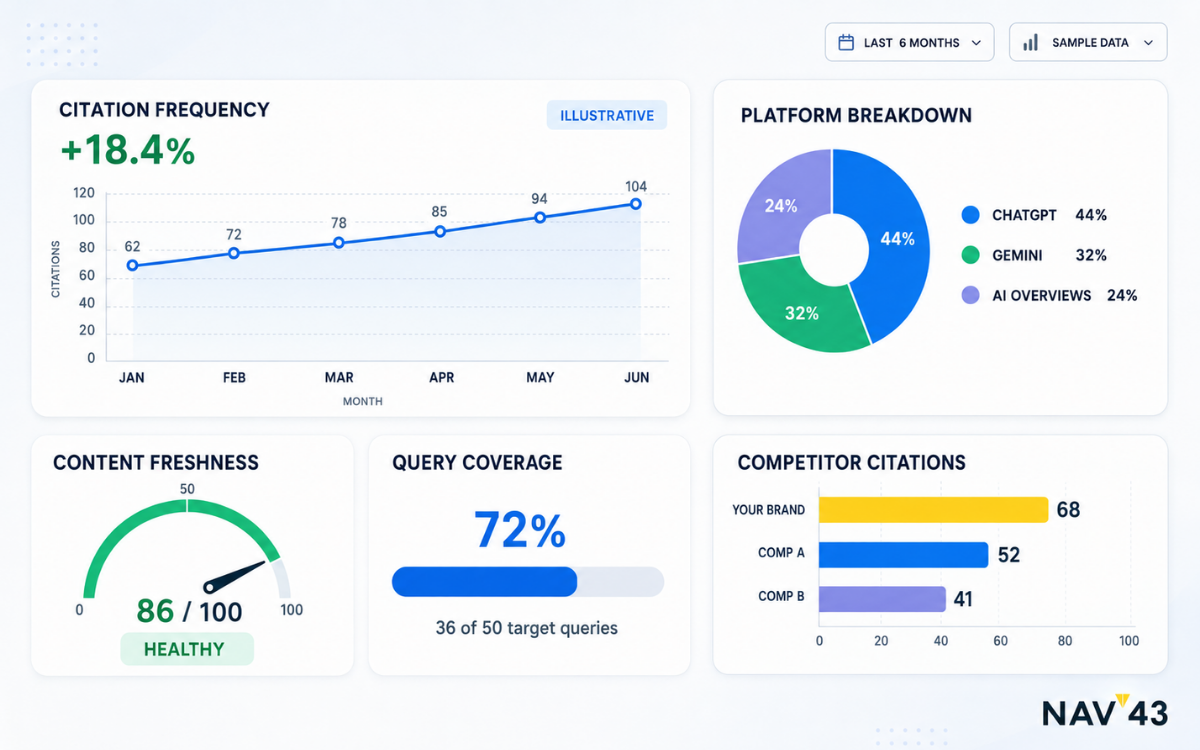
Start with AI citation visibility. Are you being cited when you (or your customers) ask target queries in ChatGPT, Perplexity, or Google AI Overviews? This can be tracked through structured manual testing, prompt libraries, and emerging third-party tools. While imperfect, directional visibility is far better than no visibility.
Next, track brand mentions without links. AI systems frequently reference sources without sending traffic. A mention in a synthesized answer still builds authority, even if it doesn’t generate a click. Monitoring tools and prompt-based audits can help surface these patterns.
Third, measure query-level coverage. Instead of asking “Does this page rank?”, ask “For how many relevant questions does this page appear in AI responses?” This shift from keyword tracking to query coverage aligns directly with how AI systems retrieve information.
Finally, connect AI visibility to downstream impact. Are leads mentioning ChatGPT? Are prospects arriving more informed? Are sales cycles shortening because buyers already trust your perspective? These signals are harder to quantify, but often more valuable than raw traffic.
The goal isn’t to replace traditional SEO metrics. It’s to layer AI visibility on top of them.
