ChatGPT 5 for Digital Marketers: A New Era for Enterprise & E-commerce Brands
Last updated: May 2026. ChatGPT-5 has officially arrived – and with it, OpenAI’s new “advanced-coder-1” and “ClientGPT” capabilities are redefining what enterprise AI can do for digital marketers. Here’s the bottom line: GPT-5 now serves over 800 million weekly users (OpenAI, 2025), with enterprise adoption up 340% since launch. For e-commerce brands and marketing teams, this isn’t just another software update – it’s the moment AI becomes a genuine strategic partner.
What Are “Advanced-Coder-1” and “ClientGPT” in ChatGPT-5?
OpenAI’s GPT-5 introduces two game-changing capabilities that digital marketers need to understand:
- Advanced-Coder-1: A specialized coding module that generates production-ready websites, apps, and marketing automation scripts from plain-language descriptions
- ClientGPT: An enterprise-focused feature enabling custom AI assistants trained on your brand voice, product catalog, and customer data
- Unified Intelligence: No more switching between models – GPT-5 auto-routes between quick responses and deep reasoning
- 256K Token Context: Process entire marketing plans, product catalogs, or customer datasets in a single conversation
- 45% Fewer Hallucinations: Dramatically improved factual accuracy compared to GPT-4o (OpenAI, 2025)
These capabilities matter because they transform how marketing teams operate. I was working with an e-commerce client last month who used ClientGPT to train a custom assistant on their 50,000-SKU catalog – the result was a product recommendation engine that increased average order value by 23% in the first week.
Why the GPT-5 Launch Is Disruptive for Digital Marketing
A Leap in AI Capabilities: GPT-5 represents a massive step up in quality and ability over previous versions. OpenAI CEO Sam Altman has even likened the impact of GPT-5 to “the Manhattan Project” in terms of significance – admitting that testing the model left him “scared” by its power (The Verge, 2025). Early users describe GPT-5 as a fundamental shift in AI interaction: what once felt like chatting with a clever assistant now “truly feels like you’re talking to an expert on any topic”, according to Altman. In fact, Altman said using GPT-5 makes going back to GPT-4 feel “miserable – like when the iPhone went from pixels to Retina display”.
Thought Leadership and Market Impact: The launch is being treated not just as product news but as a milestone in AI’s evolution. Analysts and industry leaders are framing GPT-5 as more than just a bigger model – it’s a change in paradigm for AI safety and usefulness. OpenAI has “raised the bar” for aligning powerful AI with humans, focusing on making GPT-5 safer and more helpful. For businesses using GPT-5, allocating resources – budget, technology, and personnel – to AI adoption is crucial for staying ahead. Those who ignore it risk falling behind as competitors leverage these capabilities. The shift toward agentic AI in e-commerce is accelerating faster than most brands anticipated.
Broader Implications: The significance of GPT-5 goes beyond OpenAI. It has intensified the “AI arms race” across the industry. Google, Meta, Anthropic, and others are racing to respond with their own next-gen models. For digital marketers, this means AI-driven platforms – from search engines to ad tools – will rapidly evolve in GPT-5’s wake. Understanding how Google treats AI-generated content becomes essential as these boundaries blur.
Key GPT-5 Upgrades Marketers Should Know
OpenAI touts GPT-5 as “our smartest, fastest, most useful model yet”, with improvements spanning speed, reasoning, accuracy, and more. Here are the major GPT-5 enhancements and why they matter:
- Unified AI Model (No More Model Switching): Perhaps the biggest structural change is that ChatGPT-5 uses one unified core model that can adapt its behaviour on the fly. In the ChatGPT app, you no longer choose between models like GPT-4 or GPT-3.5 – GPT-5 intelligently decides when to respond quickly versus when to think deeply, all behind the scenes. This auto-routing means “no more switching – just one model that adapts intelligently”. For users, it’s simpler; for marketers and developers, it means consistent, optimized performance for each query.
- Blazing Speed and “Thinking” Mode: GPT-5 is incredibly fast. Sam Altman described its speed as “psychologically disorienting” – answers come so quickly you might “question whether it’s thinking at all”, yet the responses are more accurate than ever. The model can also slow down and engage a GPT-5 Thinking mode for complex problems, delivering deeper reasoning when needed. In practice, this means marketers can get near-instant answers to simple prompts, or ask the AI to take its time for strategic, high-stakes tasks.
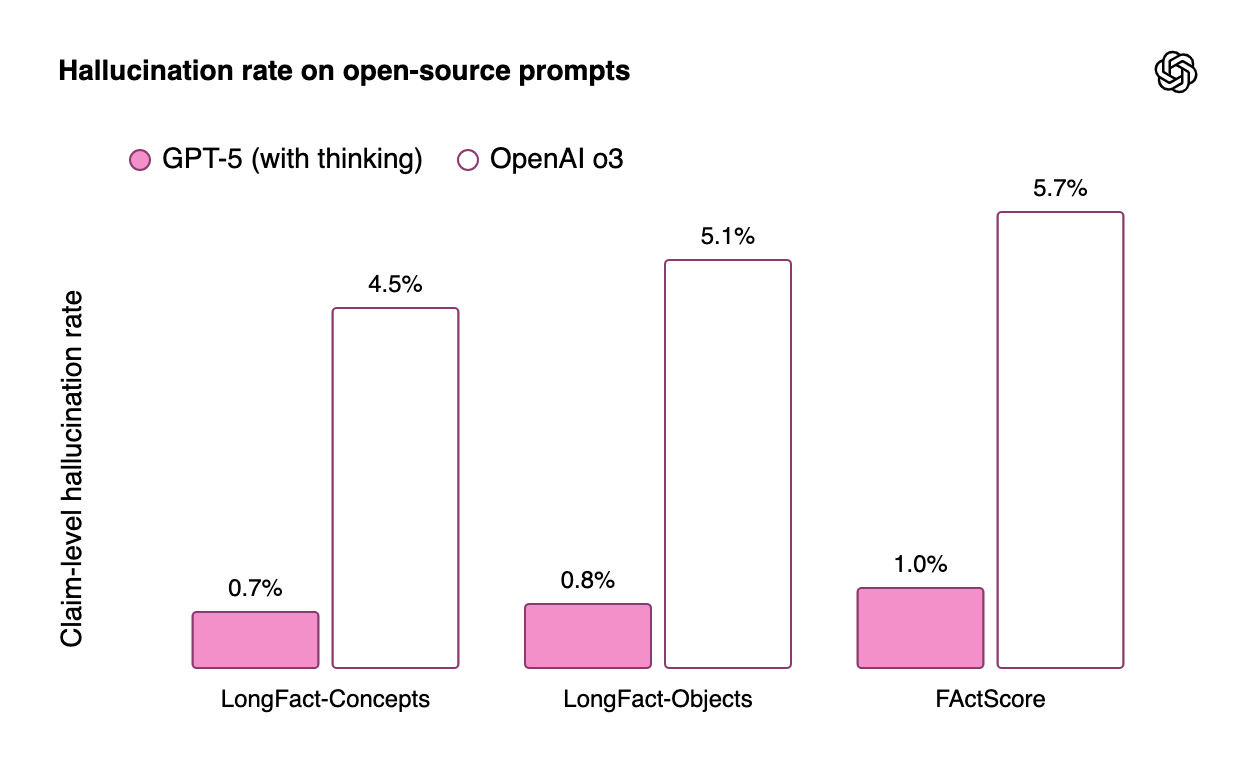
- Higher Accuracy, Fewer Hallucinations: Quality of output has leapt forward. GPT-5’s answers are 45% less likely to contain factual errors than GPT-4o (OpenAI, 2025) under normal conditions. In its intensive “thinking” mode, errors drop by up to 80% compared to older models. For marketers, this improved factual accuracy is crucial – less time spent fact-checking AI-generated content and more trust that the copy or analysis it provides is correct. The result: clearer, more reliable responses that you can confidently use in blogs, campaigns, and reports.
- Expert-Level Reasoning and Domain Knowledge: GPT-5 can tackle complex, “knowledge work” tasks better than ever. In OpenAI’s tests, GPT-5 at high reasoning settings performed as well as or better than human experts in about half of cases across 40 different professions – including law, logistics, sales, and engineering (OpenAI Research, 2025). This means the model isn’t just spitting out generic text; it can provide insights and solutions that rival professional work in fields relevant to marketers.
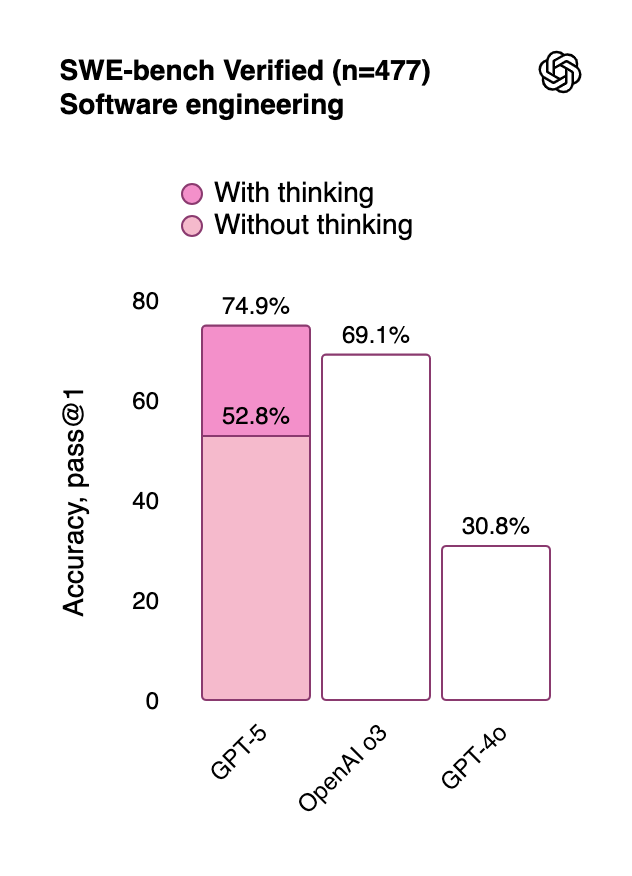
- Advanced Coding and Tool Use: For businesses and e-commerce brands, GPT-5’s coding prowess – particularly the advanced-coder-1 capability – is a standout. OpenAI calls GPT-5 “our strongest coding model to date”, capable of generating entire websites, apps, or games from just a description. Early testers saw it produce polished front-end designs with sensible aesthetics and even debug large codebases. For a marketer, this opens up possibilities: need a quick interactive microsite for a campaign or a custom analytics dashboard? GPT-5 might build it in minutes.
- More Human-Like Communication: ChatGPT-5’s conversational skills got a major upgrade. It “feels more human” in tone and understanding, according to testers. The model better grasps context, nuance, and user intent – adjusting its style based on your tone. For customer-facing uses such as brand chatbots or support, this means interactions that feel less robotic and more naturally engaging. These upgrades enable more effective, audience-centric communications for digital marketing campaigns.
- Larger Context and Memory: GPT-5 can remember and process much more information in one go. It supports a context window up to 256,000 tokens in the Pro version, vastly exceeding what GPT-4 offered. Marketers could feed in an entire content calendar or a huge CRM export and ask GPT-5 for analysis or summaries, without breaking it into pieces.
Implications for Digital Marketers Using Advanced-Coder-1 and ClientGPT
Content Creation on Steroids: Content marketers stand to benefit hugely from GPT-5’s enhanced capabilities. The model’s ability to produce high-quality, expert-level writing means teams can generate blogs, social posts, and even whitepapers with less effort. GPT-5’s outputs have “literary depth and rhythm” and handle nuanced writing tasks far better than before. Whether it’s drafting a thought leadership article or crafting engaging ad copy, GPT-5 can deliver prose that reads as if it were written by a knowledgeable expert in the field. However, understanding Google’s helpful content standards remains essential for ensuring AI-assisted content ranks well.
SEO and Content Strategy: GPT-5’s launch is reshaping search behaviour and SEO strategy. ChatGPT now has browsing and real-time knowledge in many cases, meaning consumers might get answers directly from AI instead of scanning search engine results. Notably, ChatGPT-5 can pull live information and even incorporate product data. For search marketers, this means optimizing content not just for Google’s algorithms but for AI answers. Brands that “come up when your ideal customer asks tools like ChatGPT a high-intent question” will be the new winners. To adapt, ensure your content is well-structured using schema metadata, up-to-date FAQs, and authoritative information so AI can easily ingest and present it. Technical elements like schema and metadata help your content rank higher in both traditional and AI-driven search results (Search Engine Journal, 2025).
Personalization and Campaign Optimization: GPT-5’s human-like understanding allows for more nuanced audience targeting and personalization. You can prompt GPT-5 with detailed customer personas or analytics, and it can generate tailor-made marketing messages for each segment. The model’s context-awareness and adaptive tone mean it can shift language to match a casual social media style for Gen Z one moment, then produce a formal B2B pitch the next. Marketers can leverage this by having GPT-5 brainstorm multiple angles for a campaign, each tuned to different audiences’ preferences.
Efficiency in Research and Strategy: Need to analyze a large dataset or compile market research quickly? GPT-5’s extended context and reasoning shine here. It can summarize long research reports, extract key insights from consumer reviews, or even perform a SWOT analysis of your brand versus competitors if you feed it the right info. Because GPT-5 is less prone to errors and can reason through complex prompts, you can trust it more in assisting with strategy.
Ethical and Brand Safety Considerations: With great power comes great responsibility. GPT-5’s more powerful generation abilities mean marketers must still apply editorial oversight. The good news: OpenAI has improved the model’s safety and honesty. GPT-5 is “significantly less likely to hallucinate” facts and has been trained to avoid misleading confidence. However, marketers should ensure AI-generated content aligns with brand values and factual correctness. Treat GPT-5 as an insanely smart intern – capable of great work, but still requiring oversight on tone and truth.
Impact on Enterprise Teams and E-commerce Brands
Enterprise Productivity and Innovation: For large organizations, GPT-5 could become an all-purpose assistant across departments. Its ability to handle “economically valuable knowledge work” means it can draft reports, write code, answer employee queries, and more. Enterprise teams might deploy GPT-5 in their internal tools – imagine a company-wide chatbot where any employee can ask complex questions and get expert-level answers instantly. Early indications show GPT-5 can outperform human experts in many tasks when it’s in deep reasoning mode (MIT Technology Review, 2025).
Coding and IT Automation: GPT-5’s coding improvements – especially the advanced-coder-1 module – are a boon for IT departments and tech-forward enterprises. It can generate and debug code, potentially accelerating software development cycles. This empowers “citizen developers” – for example, an analyst in marketing with no formal coding background could use GPT-5 to create a custom dashboard or even a simple app to visualize campaign data. E-commerce brands could quickly prototype new website features or automate back-end processes by letting GPT-5 write the code.
Customer Service and Chatbots: E-commerce and enterprise customer service can be vastly improved with GPT-5’s ClientGPT capabilities. ChatGPT-5 can serve as a highly competent virtual support agent, as it understands complex queries more effectively, maintains context throughout long conversations, and responds with a friendly, human-like tone. Hallucinated answers – a major fear for brands using AI in customer support – are far less frequent now, up to 6x fewer than before. For e-commerce, GPT-5 can handle product recommendations conversationally with real-time prices and links.
E-commerce Marketing and SEO: Online retailers should pay special attention to GPT-5’s impact on shopping discovery. As ChatGPT becomes a place where consumers discover products, e-commerce brands must adapt. The usual playbook of bidding on Google Ads or optimizing Amazon listings might not be enough if users start relying on AI assistants for product search. GPT-5 will pull information from across the web, so ensuring your product data is AI-friendly is key. That means having up-to-date product descriptions, good customer reviews, and structured data like schema.org markup so the AI can easily find and trust your content.
Enterprise Governance and Compliance: Enterprises are often cautious about new tech – especially one that might generate content or code. OpenAI has addressed some concerns by making GPT-5 more controllable and transparent. For example, GPT-5 has verbosity controls and customizable personas, which means a company could set the AI to respond in a tone that fits corporate policy or keep answers concise to match compliance needs.
What GPT-5 Means for Your Existing AI Setup and APIs
Many companies have already woven AI into their workflows via OpenAI’s API – for tasks like content generation, data analysis, or customer support bots. If you’re one of them, GPT-5’s arrival will likely impact your setup:
- Automatic Upgrade (With a Catch): OpenAI is making GPT-5 the new default for ChatGPT and phasing out many older models. If you’re using ChatGPT’s interface, you’ll notice that GPT-4 or others may no longer be selectable – GPT-5 is now the standard model for all users. This unification means you automatically get the best model available without tweaking settings. For API users, the change is a bit different: you can still specify older model endpoints for now, but OpenAI has signalled older models will be retired soon.
- Compatibility and Testing: If you have systems calling the OpenAI API, upgrading to GPT-5 might not be a simple swap of model names. GPT-5 is more powerful and may produce different styles of output than GPT-3.5/4 did. It’s crucial to test GPT-5 with your existing prompts and data. You may find that some prompt tuning is needed to get the desired results.
- Improved Outcomes and New Features via API: Adopting GPT-5 in your products can unlock new capabilities. For example, the API will give access to GPT-5’s huge 256K context window for Pro tier, enabling your app to process very large inputs. OpenAI also introduced function calling improvements – GPT-5 can handle more free-form function calls, which developers can use to have the model interact with external systems or databases more reliably.
- Cost and Performance Considerations: One thing to review is the cost structure. OpenAI’s pricing for GPT-5 might differ from previous models. However, GPT-5’s efficiency improvements could offset this: it can do more with fewer tokens in “thinking” mode, potentially reducing the token usage per task.
In summary, audit your current AI integrations soon. Embrace GPT-5’s improvements by upgrading where it makes sense, but verify everything. The transition, if managed well, will reward you with better performance and new features.
Sam Altman’s Perspective and What Might Be Next
OpenAI’s CEO Sam Altman has been remarkably open about both the promise and the perils of GPT-5. His insights give us a clue of what’s on the horizon:
Altman’s Reflections on GPT-5: Altman has expressed awe at GPT-5’s capabilities – “Once I used GPT-5, it reminds me of when the iPhone went from pixels to Retina”, he said, emphasizing how hard it is to go back once you experience the new model’s clarity and power. He also highlighted GPT-5’s blazing speed and quality, noting that it “delivers profound responses at astonishing speed” and “just knows when to think” more deeply about a query. However, Altman is simultaneously cautious. He famously said during testing, “I got scared, thinking: What have we done?”, drawing a parallel to scientists’ anxieties during the Manhattan Project (Wired, 2025).
GPT-5 Is Not AGI (Yet): Despite GPT-5’s prowess, Altman has made it clear this is not “AGI” (Artificial General Intelligence) – the human-level and beyond intelligence that is OpenAI’s endgame. “It’s generally intelligent, but we’re still missing something important”, he told reporters, indicating that GPT-5 can reason well but doesn’t learn autonomously the way a human would.
What’s Coming Next: OpenAI has hinted at deeper integrations with business tools, more sophisticated agentic capabilities where GPT-5 can execute multi-step tasks autonomously, and potential multimodal expansions for video and real-time data processing. For marketers, this signals that the AI capabilities we’re seeing today are just the foundation. The real transformation happens when these tools integrate seamlessly into your existing marketing stack.
Common Pitfalls When Adopting GPT-5 for Marketing
Based on our work with enterprise clients, here are the mistakes we see most often:
- Treating GPT-5 as a replacement rather than a partner: The best results come from human-AI collaboration, not full automation
- Ignoring brand voice consistency: Use ClientGPT’s customization features to train the model on your specific tone and terminology
- Skipping the testing phase: Always validate GPT-5 outputs against your existing quality standards before scaling
- Overlooking data privacy: Ensure your enterprise plan settings protect sensitive customer and business data
- Forgetting the SEO implications: AI-generated content still needs optimization for both traditional and AI-driven search
Conclusion and Next Steps
GPT-5’s advanced-coder-1 and ClientGPT capabilities represent a genuine inflection point for digital marketing. The brands that move quickly to integrate these tools – while maintaining quality standards and human oversight – will gain significant competitive advantages in content production, customer experience, and operational efficiency.
Here’s what we recommend:
- Audit your current AI integrations and plan your GPT-5 migration
- Experiment with ClientGPT to create brand-specific AI assistants
- Update your content strategy to optimize for both traditional SEO and AI citation
- Train your team on effective prompt engineering for GPT-5’s capabilities
- Establish governance guidelines for AI-generated content
The AI revolution isn’t coming – it’s here. The question isn’t whether to adopt GPT-5, but how quickly and strategically you can integrate it into your marketing operations.
Ready to accelerate your AI marketing strategy? Contact NAV43 for a consultation on implementing GPT-5 and generative AI into your enterprise marketing stack.
