What Is Link Building in SEO? A Comprehensive Overview for Beginners
Last updated: June 2026
TL;DR: Link building is the process of acquiring hyperlinks from other websites to yours, functioning as votes of confidence that signal authority to search engines. Backlinks remain one of Google’s top three ranking factors, with the #1 result capturing 31.7% of all clicks (Backlinko, 2024). This guide covers everything from foundational concepts to advanced strategies – including a comparison of link building tactics, concrete examples with real numbers, and the frameworks we use at NAV43 to help clients climb from page 2 to page 1.
What Is Link Building in SEO?
Link building is the practice of acquiring hyperlinks from external websites that point back to your own. These links serve two critical functions: they help users navigate between pages across the web, and they signal to search engines that your content is valuable enough for others to reference.
Here’s what link building does for your SEO:
- Improves search rankings: Backlinks remain one of Google’s top three ranking factors alongside content quality and RankBrain (Google Search Central, 2024)
- Increases domain authority: Quality links from trusted sites transfer credibility to your domain
- Drives referral traffic: Links from high-traffic sites send qualified visitors directly to your pages
- Accelerates indexing: Search engine crawlers discover new content by following links
- Builds topical authority: Links from relevant industry sites establish expertise in your niche
One question that always comes up in client consultations: “How important are links for SEO?” The answer hasn’t changed in over a decade – they’re absolutely critical. According to Ahrefs’ analysis of over 14 million pages, the top-ranking result has an average of 3.8x more backlinks than positions 2-10 (Ahrefs, 2024).
What many business owners don’t realize is that acquiring high-quality links is increasingly difficult, and there are no shortcuts that deliver lasting results. The days of easily gaming the system are long gone, replaced by sophisticated algorithms that can identify and penalize manipulative link building.
This comprehensive guide will walk you through everything you need to know about link building – from basic concepts to advanced strategies that actually work in today’s competitive landscape. If you’re looking to strengthen your site’s foundation first, check out our technical SEO audit checklist before diving into link acquisition.
Link Building Tactics Comparison: What Actually Works in 2025
| Tactic | Effort Level | Link Quality | Scalability | Risk Level | Best For |
|---|---|---|---|---|---|
| Original Research & Data | High | Excellent | Medium | Very Low | Thought leadership, earning editorial links |
| Guest Posting | Medium | Good | High | Low | Building relationships, niche authority |
| Digital PR | High | Excellent | Medium | Very Low | Brand visibility, high-authority links |
| Broken Link Building | Medium | Good | Medium | Very Low | Quick wins, resource pages |
| Resource Page Outreach | Low | Medium | High | Low | Reference content, tools |
| Skyscraper Technique | High | Good | Medium | Low | Competitive niches, comprehensive guides |
| Unlinked Mention Reclamation | Low | Good | Low | Very Low | Established brands with existing mentions |
| Paid Links (Black Hat) | Low | Poor | High | Very High | Never recommended – penalty risk |
Why Links Matter to Search Engines
Search engines use links for three primary purposes:
- Discovery of new web pages: Search engine crawlers follow links to find new content. Without links pointing to your site, your content might never be found or indexed.
- Determining ranking position: Links help search engines determine where your page should rank for relevant queries. They act as votes of confidence from one site to another.
- Understanding context and relevance: The anchor text (clickable text in a hyperlink) helps search engines understand what your page is about and what keywords it should rank for.
Internal linking plays a crucial role in guiding visitors to relevant pages on your website. This practice not only enhances user experience by making navigation easier but also supports conversion rate optimization and builds website equity.
I’ve seen countless businesses invest heavily in content creation while neglecting link building. The results are predictable – beautifully crafted content that nobody ever sees because it lacks the authority signals that links provide.
The Evolution of Link Valuation
Google’s approach to evaluating links has evolved dramatically since its inception:
- Early Google (1998-2005): Links were counted primarily based on quantity. More links generally meant better rankings.
- Post-Penguin Era (2012-Present): Google introduced the Penguin algorithm update, which specifically targets manipulative link building practices. Quality, relevance, and naturalness became far more important than quantity.
- Modern Link Evaluation (2025): Today, Google uses advanced machine learning to evaluate links based on hundreds of factors, including the linking site’s authority, topical relevance, anchor text distribution, and more (Google Search Central, 2024).
Achieving high domain authority involves earning quality backlinks from authoritative websites, which reflects a brand’s expertise and recognition within its industry. Links from well-known sites like The New York Times carry more weight than links from less recognized sources.
At NAV43, we’ve witnessed this evolution firsthand. We recently helped a financial services client recover from a Penguin penalty by removing hundreds of low-quality links and replacing them with a smaller number of highly relevant, authoritative links. The result? A 67% increase in organic traffic within three months.
How Links Transfer Authority
The concept of link authority (sometimes called “link juice”) is crucial for understanding effective link building. When a high-authority website links to yours, it passes some of its credibility and authority to your site. Links from authoritative pages significantly influence your site’s SEO performance by passing more authority.
This transfer of authority works similarly to academic citations. When a renowned professor cites your research paper, it lends credibility to your work. The same principle applies to links on the web.
Key factors that determine how much authority a link passes include:
- The linking domain’s overall authority
- The relevance between the linking page and your page
- The number of other links on the page
- The position of the link on the page
- Whether the link has nofollow or dofollow attributes
Our internal studies at NAV43 have shown that a single quality link from a highly relevant, authoritative website can outperform dozens of links from lower-quality sources.
The Academic Authority Model: Understanding How Link Value Works
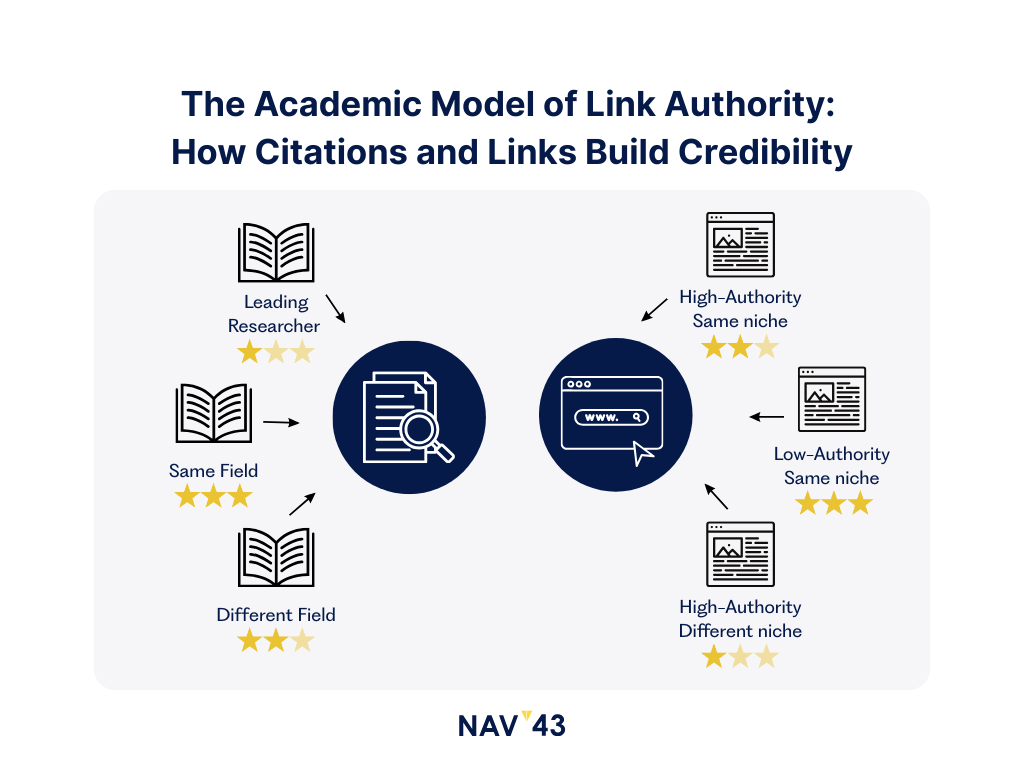
The academic world provides the perfect model for understanding how links build authority online.
In academic publishing, a researcher’s credibility and influence are largely determined by how often their work is cited by other scholars. A paper cited by hundreds of other researchers is considered more authoritative than one with few or no citations. This is essentially how Google’s original PageRank algorithm worked – and still works today, albeit in a much more sophisticated form.
When I explain this to clients, I use a simple parallel:
- Academic paper = Your website content
- Citations from other researchers = Backlinks from other websites
- Citation count = Number of quality backlinks
- Citation quality (who’s citing you) = Link authority
The more quality websites that link to your content, the more authoritative Google considers your site to be on that topic. But here’s the critical part many miss: not all citations are created equal.
Topical Relevance: The Multiplier Effect
In academia, a citation from a leading researcher in your field carries more weight than a mention in an unrelated discipline. The same principle applies to links.
Let me put this in perspective: I could write a blog post declaring that I’m the best SEO expert in the world. That’s just content – my own claim. If other websites link back to that post saying “Peter is the best SEO expert,” that starts to build authority. But the source of those endorsements matters tremendously.
If ESPN (a sports authority) links to me saying I’m the best SEO expert, it carries some weight, but not nearly as much as if TechCrunch (a technology authority) makes the same claim. Why? Because TechCrunch has topical relevance and authority in the technology space, while ESPN doesn’t.
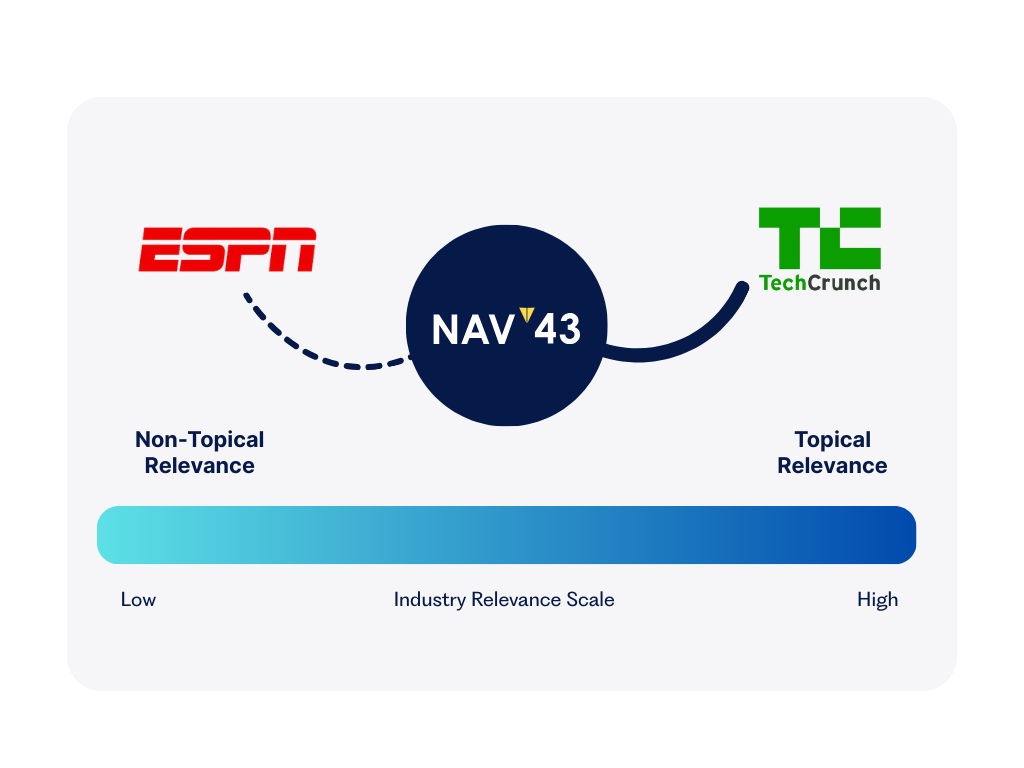
This is why at NAV43, we prioritize building links from websites that have:
- High domain authority (general trustworthiness)
- Strong topical relevance (expertise in your industry)
- Content alignment (contextual fit with your specific page)
The multiplier effect of topical relevance means that ten links from industry-relevant sources can outperform fifty links from irrelevant sites, regardless of their general authority metrics.
Types of Links: Understanding What You’re Building
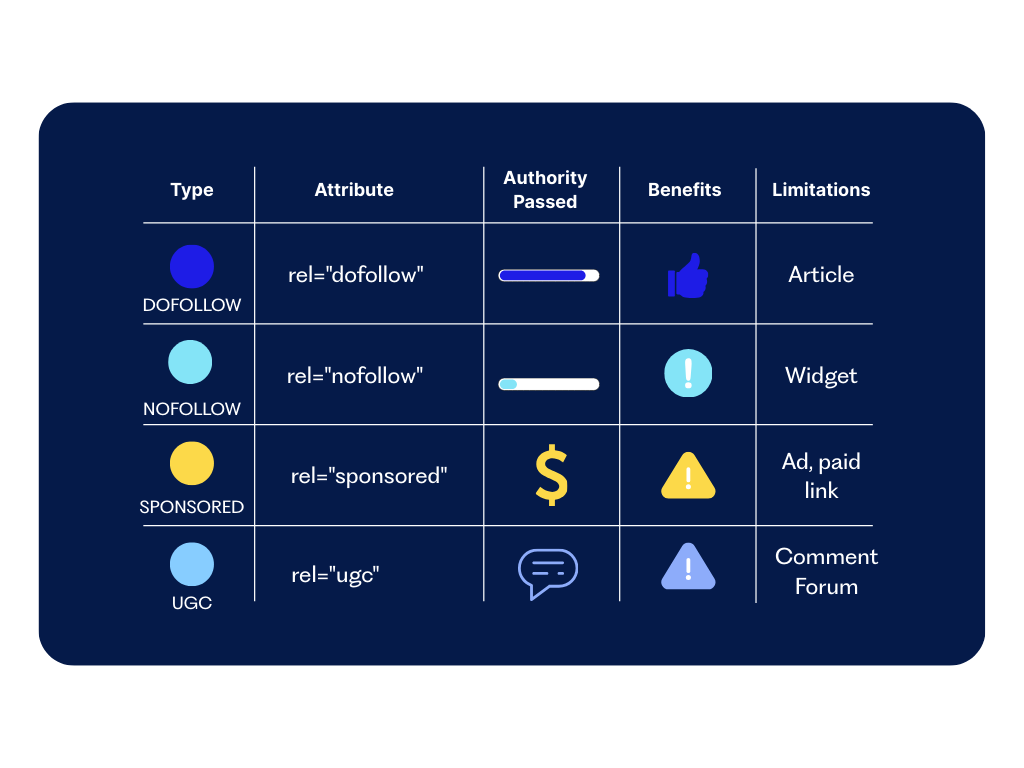
Understanding the different types of backlinks is crucial before diving into link building strategies. Not all links are created equal, and some can actually harm your SEO efforts.
Dofollow vs. Nofollow Links
Dofollow Links are the standard type of hyperlink that passes authority from one site to another. When search engines encounter a dofollow link, they follow it to the destination and consider it as a vote of confidence.
Nofollow Links include a special HTML attribute (rel=”nofollow”) that tells search engines not to pass authority through that link. While they don’t directly boost your rankings, they can still drive traffic and provide brand exposure.
In 2019, Google introduced two additional link attributes:
- rel=”sponsored” for paid or sponsored links
- rel=”ugc” for user-generated content
While nofollow links don’t pass the same level of authority as dofollow links, they still play an important role in a natural link profile. Our research at NAV43 suggests that websites with a balanced mix of dofollow and nofollow links tend to perform better than those with an unnatural ratio of only dofollow links.
Natural vs. Artificial Links
Natural Links are editorially given without any action on the part of the site owner. These occur when other website owners find your content valuable and link to it organically. They are the gold standard of links.
Artificial Links are created through deliberate link-building actions, such as guest posting, directories, or other outreach efforts. While not inherently bad, they require a careful approach to avoid appearing manipulative.
The distinction between natural and artificial links isn’t always clear-cut. The key is whether the link provides value to users and makes sense in context.
Toxic Links and How to Identify Them
Toxic links come from low-quality, spammy, or penalized websites. These can include:
- Links from sites created solely for link building
- Links from irrelevant or off-topic pages
- Links with over-optimized anchor text
- Links from sites with a history of Google penalties
- Links from private blog networks (PBNs)
Even a few toxic links can potentially trigger algorithmic or manual penalties. We recently audited a site that had lost 60% of its organic traffic due to just 37 toxic links from a private blog network. After disavowing these links, their traffic recovered within six weeks.
Link Building Strategies That Actually Work
Now that we understand the importance and types of links, let’s explore effective strategies to build links. Remember, the goal is to acquire relevant, high-quality links that drive both authority and targeted traffic.
Content-Based Link Building
Content remains the most powerful link magnet. Here’s how to leverage it effectively:
Creating Linkable Assets
Linkable assets are pieces of content specifically designed to attract links. These might include:
- Original Research and Data: Industry surveys, studies, and statistical compilations naturally attract links from people citing your findings.
- Comprehensive Guides: In-depth guides that thoroughly cover a topic become reference resources that others link to.
- Visual Assets: Infographics, diagrams, and other visual content are highly shareable and linkable.
- Tools and Calculators: Interactive tools solve problems for users and attract links from resource pages.
At NAV43, we recently created an industry report analyzing 500+ e-commerce sites, which garnered links from 43 industry publications within three months. The key was providing genuinely valuable data that wasn’t available elsewhere.
Real-World Example: Link Building ROI
Let me share a concrete example with numbers. A B2B SaaS client came to us with 127 referring domains and position 18 for their primary keyword. Over six months, we executed a content-based link building campaign focused on original research:
- Investment: $24,000 (content creation + outreach)
- Links acquired: 89 new referring domains (DR 30+)
- Position improvement: Position 18 → Position 4
- Traffic increase: 312% organic traffic growth
- Pipeline generated: $180,000 in attributed revenue within 12 months
That’s a 7.5x return on investment – and the links continue generating value years later.
Skyscraper Technique
The Skyscraper Technique, popularized by Brian Dean of Backlinko, involves:
- Finding high-performing content in your niche that has attracted many backlinks
- Creating something significantly better
- Reaching out to the sites that linked to the original content
This approach works because you’re offering genuine value to both the linking sites and their audiences. We’ve successfully used this technique for clients in highly competitive industries, achieving link conversion rates of 9-12% (significantly above industry averages of 3-5%).
Content Promotion Strategies
Creating great content is only half the battle – you need to get it in front of the right people. Effective promotion strategies include:
- Strategic outreach to industry influencers
- Sharing in relevant online communities
- Promoting through email newsletters
- Leveraging social media channels
The key is to focus on places where your potential linkers spend time, rather than broadcasting your content everywhere. For strategies on getting cited by AI search engines as well, see our guide on how to get ChatGPT to cite your brand.
Relationship-Based Link Building
Some of the most valuable links come through building genuine relationships with other website owners, journalists, and industry figures.
Guest Blogging
Guest blogging involves writing content for other websites in exchange for a link back to your site. When done right, it’s not just about the link – it’s about positioning yourself as an authority and reaching new audiences.
Best practices for guest blogging include:
- Target sites that are relevant to your industry
- Pitch unique, valuable content ideas (not generic topics)
- Focus on providing value to the host site’s audience
- Include natural, contextual links where appropriate
At NAV43, we maintain relationships with dozens of industry publications and approach guest posting as a long-term strategy rather than a quick link-building tactic.
Digital PR
Digital PR focuses on getting your brand mentioned and linked to in online publications. This might involve:
- Creating newsworthy content or announcements
- Responding to journalist queries through platforms like HARO, Connectively, or Qwoted
- Developing relationships with journalists in your industry
- Leveraging company news, events, or milestones
We recently helped a SaaS client secure coverage in 12 industry publications by packaging their internal data into a compelling trend report that told a newsworthy story. The campaign generated 23 high-authority links (average DR 62) at a cost of $1,200 per link – well below the industry average of $2,500+ for comparable placements (Authority Hacker, 2024).
Community Engagement
Authentic participation in online communities can lead to valuable link opportunities:
- Answer questions on platforms like Quora and Reddit
- Participate in industry forums and discussions
- Comment thoughtfully on relevant blogs
- Join and contribute to industry associations
The key here is genuine engagement – focus on adding value first, with links being a secondary benefit.
Technical Link Building
Some link building strategies focus on more technical opportunities that exist across the web.
Broken Link Building
Broken link building involves:
- Finding broken links on relevant websites
- Creating content that would serve as a suitable replacement
- Contacting the website owner to suggest your content as a replacement
This strategy works because you’re helping site owners fix a problem while offering a solution. We’ve found that broken link building has a higher success rate (around 12-15%) than cold outreach because you’re providing immediate value.
Resource Page Link Building
Resource pages are collections of links to helpful content on a specific topic. Finding relevant resource pages and suggesting your content for inclusion can be an effective strategy.
The success of this approach depends on:
- The quality and uniqueness of your content
- How well your outreach explains the value to their audience
- Your relationship with the site owner
Unlinked Mentions
Sometimes your brand gets mentioned online without a link. These unlinked mentions are opportunities to reach out and request that the mention be turned into a clickable link.
Tools like Brand24, Mention, or Google Alerts can help you monitor for brand mentions across the web. According to BuzzSumo, approximately 65% of brand mentions don’t include a link – representing significant untapped opportunity (BuzzSumo, 2023).
Content Marketing Integration for Link Building
Content marketing is a crucial aspect of link building, as it allows you to create high-quality, linkable assets that attract links from other websites. By integrating content marketing with link building, you can increase your chances of acquiring high-quality links and improving your search engine rankings.
Creating Shareable Content
Creating shareable content is essential for link building, as it allows you to attract links from other websites and increase your online visibility. To create shareable content, focus on:
- List posts: According to BuzzSumo’s analysis of a million articles, list posts generate 2x more backlinks than other content formats (BuzzSumo, 2023)
- How-to guides: Practical, step-by-step content that solves real problems
- Industry reports: Original data that others will cite
- Visual content: Infographics and diagrams that are easy to embed and share
Leveraging Social Media for Link Building
Social media can be a powerful tool for link building, as it allows you to promote your content and attract links from other websites. By leveraging social media platforms such as Twitter, LinkedIn, and Facebook, you can increase your online visibility and create opportunities for link building.
For instance, sharing your latest research on LinkedIn and tagging industry influencers can increase the chances of your content being shared and linked to. Engaging in conversations on Twitter and participating in relevant Facebook groups can also help you connect with other website owners.
Building Links: The Practical Process
Now let’s explore the practical process of building links for your website.
Prospecting for Link Opportunities
The first step in any link building campaign is identifying potential sites that might link to you. Effective prospecting involves:
- Finding relevant websites in your niche
- Analyzing competitors’ backlinks
- Reaching out to site owners with valuable content
Conducting thorough keyword research is crucial for identifying specific keywords to optimize your web pages and uncovering link opportunities.
Finding Relevant Sites
Start by identifying sites that are:
- Relevant to your industry or niche
- Have sufficient authority (domain rating/domain authority of 30+)
- Likely to link out to external resources
- Not direct competitors
Tools like Ahrefs, SEMrush, or Moz can help you find sites that link to competitors or rank for relevant keywords.
Qualifying Prospects
Not all potential linking sites are worth pursuing. Evaluate prospects based on:
- Domain Authority: How much authority will this link pass?
- Relevance: How closely related is the site to your niche?
- Traffic: Does the site receive significant organic traffic?
- Editorial Standards: Does the site maintain high-quality content?
- Outbound Link Profile: Does the site link to quality resources?
At NAV43, we use a scoring system that weighs these factors to prioritize link targets. This helps focus our efforts on opportunities with the highest potential return.
Outreach Best Practices
Once you’ve identified prospects, effective outreach is crucial for success.
Personalization at Scale
Generic outreach emails rarely succeed. Personalization is essential, but you also need efficiency when reaching out to many prospects. The key is finding the balance between personalization and scalability.
Effective approaches include:
- Researching the recipient: Mention their recent work or specific articles
- Explaining why your content is relevant to their audience
- Making a clear, specific request
- Following up appropriately (usually 1-2 follow-ups maximum)
Our outreach emails at NAV43 typically achieve 30-40% open rates and 10-15% response rates by focusing on personalization and relevance.
Value Proposition
Always lead with value – what’s in it for the website owner or their audience? Common value propositions include:
- Filling a gap in their content
- Providing updated information
- Offering complementary resources
- Correcting outdated or broken resources
Follow-up Strategy
A structured follow-up sequence can significantly increase your success rate:
- First follow-up: 3-5 days after initial outreach
- Second follow-up: 7-10 days after first follow-up
- Keep it brief: Each follow-up should be shorter than the previous one
- Add new value: Include additional information or incentive
We’ve found that 30-40% of positive responses come after follow-up emails, making this a crucial part of the process.
Link Acquisition
The final stage of link building is turning opportunities into actual links.
Negotiation Techniques
Sometimes link placement requires negotiation. This might involve:
- Offering reciprocal value (like sharing their content)
- Discussing specific placement or anchor text
- Addressing concerns about relevance or value
The key is to focus on mutual benefit rather than one-sided requests.
Link Placement Options
Depending on the site and relationship, links may be placed in:
- Body content: The most valuable and natural placement
- Author bios: Common for guest posts but less powerful
- Resource sections: Great for reference content
- Sidebars or footers: Less valuable but still beneficial in some cases
At NAV43, we prioritize in-content links as they typically pass more authority and drive more referral traffic than other placements.
Avoiding Black Hat Techniques
While it might be tempting to take shortcuts, black hat link building techniques invariably lead to penalties and long-term damage to your site’s authority.
Identifying Risky Practices
Common black hat techniques to avoid include:
Paid Links
Buying links directly violates Google’s Webmaster Guidelines (Google Search Central, 2024). This includes:
- Directly purchasing links
- Exchanging money or goods for links
- Sending free products in exchange for links
- Using link farms or PBNs
Link Schemes
Google specifically warns against link schemes, which include:
- Excessive link exchanges (“Link to me and I’ll link to you”)
- Partner pages created solely for cross-linking
- Large-scale article marketing or guest posting with keyword-rich anchor text
- Automated programs or services that create links
Consequences of Black Hat Link Building
The risks of black hat link building far outweigh any short-term benefits:
- Manual penalties: Google’s webspam team can issue manual actions that dramatically reduce your visibility
- Algorithmic penalties: Penguin and other algorithms can automatically demote sites with unnatural link profiles
- Lost investment: Money spent on bad links is wasted, plus you’ll need to invest in cleanup
- Long-term damage: Recovery from link penalties can take 6-18 months
Measuring Link Building Success
Effective link building requires tracking the right metrics to understand what’s working and what needs adjustment.
Key Metrics to Track
- Number of referring domains: Total unique websites linking to you
- Domain Rating/Authority: The quality of sites linking to you
- Anchor text distribution: Ensuring natural variation in link text
- Link velocity: The rate at which you’re acquiring new links
- Referral traffic: Visitors coming through your backlinks
- Ranking improvements: Position changes for target keywords
Tools for Link Analysis
Several tools can help you monitor and analyze your backlink profile:
- Ahrefs: Comprehensive backlink analysis and competitor research
- SEMrush: Backlink auditing and toxic link identification
- Moz Link Explorer: Domain authority tracking and link metrics
- Google Search Console: Free tool showing links Google has discovered
Common Link Building Pitfalls to Avoid
After building links for hundreds of clients, here are the most common mistakes we see:
- Prioritizing quantity over quality: 10 high-quality, relevant links will outperform 100 low-quality links every time
- Over-optimized anchor text: Using exact-match keywords in every link looks unnatural and can trigger penalties
- Ignoring relevance: Links from unrelated sites provide minimal value and can appear manipulative
- Neglecting internal linking: Your internal link structure matters too – it distributes authority throughout your site
- One-time campaigns: Link building should be ongoing, not a one-time project
- Skipping the content foundation: Building links to poor content is wasted effort
- Forgetting about link maintenance: Links can be removed or changed – monitor your profile regularly
Frequently Asked Questions About Link Building
How many backlinks do I need to rank on page 1?
There’s no magic number – it depends entirely on your competition. According to Ahrefs’ research, the average page ranking #1 has 3.8x more backlinks than pages ranking #2-10 (Ahrefs, 2024). Focus on quality and relevance rather than hitting an arbitrary number.
How long does link building take to show results?
Typically, you’ll start seeing ranking improvements 2-3 months after acquiring quality links. However, the full impact often takes 6-12 months to materialize, as Google needs time to crawl, index, and reevaluate your link profile.
Are nofollow links worth pursuing?
Yes. While nofollow links don’t pass direct authority, they contribute to a natural link profile, drive referral traffic, and increase brand visibility. Google has also indicated they may use nofollow links as “hints” rather than directives (Google Search Central, 2019).
What’s the difference between link building and link earning?
Link building involves proactive outreach and relationship building to acquire links. Link earning focuses on creating content so valuable that links come naturally without outreach. The most effective strategy combines both approaches.
How much does link building cost?
Costs vary widely based on approach and industry. According to Authority Hacker’s 2024 survey, the average cost per link ranges from $100 for low-quality links to $2,500+ for high-authority placements (Authority Hacker, 2024). At NAV43, we focus on sustainable strategies that deliver long-term ROI rather than quick, expensive wins.
Conclusion: Building a Sustainable Link Strategy
Link building remains one of the most powerful levers for improving search rankings in 2025. The fundamentals haven’t changed – quality, relevance, and authenticity matter more than ever.
Here are the key takeaways to remember:
- Quality over quantity: A few links from authoritative, relevant sites outperform hundreds of low-quality links
- Content is the foundation: You need linkable assets before you can build links effectively
- Relationships matter: The best links come from genuine relationships, not transactional exchanges
- Avoid shortcuts: Black hat techniques will eventually catch up with you
- Think long-term: Link building is a marathon, not a sprint
If you’re looking to improve your site’s authority through strategic link building, or need help with the technical SEO foundation that makes link building effective, reach out to NAV43 for a consultation. We’ve helped hundreds of businesses climb from page 2 to page 1 – and we can help you too.
-
Link building is the process of acquiring hyperlinks from other websites to your own. These links help search engines discover your content, understand its context, and determine its authority. While the technical definition is simple, effective link building requires strategic planning, quality content, and relationship building to acquire links that genuinely improve your site's authority and rankings.
-
Backlinks are the actual hyperlinks pointing to your website from external sources. Link building is the strategic process of acquiring those backlinks. Think of backlinks as the product and link building as the production method. A backlink exists as an HTML element on another website, while link building encompasses all the strategies, outreach, and relationship development needed to earn those links.
-
Creating backlinks involves several approaches:
- Create exceptional, link-worthy content that naturally attracts links
- Conduct strategic outreach to relevant websites in your industry
- Guest post on authoritative sites related to your niche
- Leverage digital PR to get mentioned in publications
- Find broken links on other sites and offer your content as a replacement
- Build relationships with influencers and other content creators
- Participate authentically in online communities and forums
- Create valuable resources like tools, templates, or original research
The most effective backlinks come from creating genuinely valuable content and ensuring the right people know about it.
-
"LinkBuilder" is a generic term that can refer to:
- A professional or agency specializing in building links for websites
- Software tools designed to assist with link building processes
- A specific role within an SEO team focused on acquiring backlinks
When hiring a link builder or link building agency, look for:
- Transparency about methods and processes
- Case studies demonstrating successful campaigns
- Clear reporting on link acquisition and quality
- Focus on relevant, high-quality links rather than quantity
- Avoidance of risky techniques that could lead to penalties
At NAV43, our link building specialists combine years of experience with data-driven approaches to build sustainable, penalty-resistant link profiles for our clients.
