Agentic AI for CRM Hygiene: Autonomous Data Normalization Guide
Here’s a paradox that should keep every revenue operations leader up at night: 76% of CRM users say less than half of their organization’s CRM data is accurate and complete (Validity, 2025). Yet the same companies rushing to deploy AI features are about to amplify those data problems at scale.
The stakes couldn’t be higher. Companies lose an average of $12.9 million annually to poor-quality data (Gartner, 2025). And while 2026 is being called “the year of AI agents,” Gartner predicts that over 40% of agentic AI projects will be canceled by the end of 2027 due to escalating costs, unclear business value, or inadequate risk controls.
CRM data quality sits at the center of this collision. AI systems trained on dirty data don’t just fail quietly. They fail expensively, at speed, with compounding errors.
This article is the practitioner’s framework for deploying agentic AI for CRM hygiene, developed from real-world implementation experience. You’ll learn what distinguishes true agentic AI from rebranded automation, how to build a phased rollout that mitigates the 40% failure rate, and which tools actually deliver on their promises. We’ll address the questions we hear most often: What’s the difference between CRM and agentic AI? How do you maintain CRM hygiene at scale? Is AI replacing CRM? And what’s the best AI for CRM data quality?
Let’s get into it.
The CRM Data Crisis: Why Traditional Cleanup Isn’t Working
Before we talk about solutions, let’s be honest about the scope of the problem.
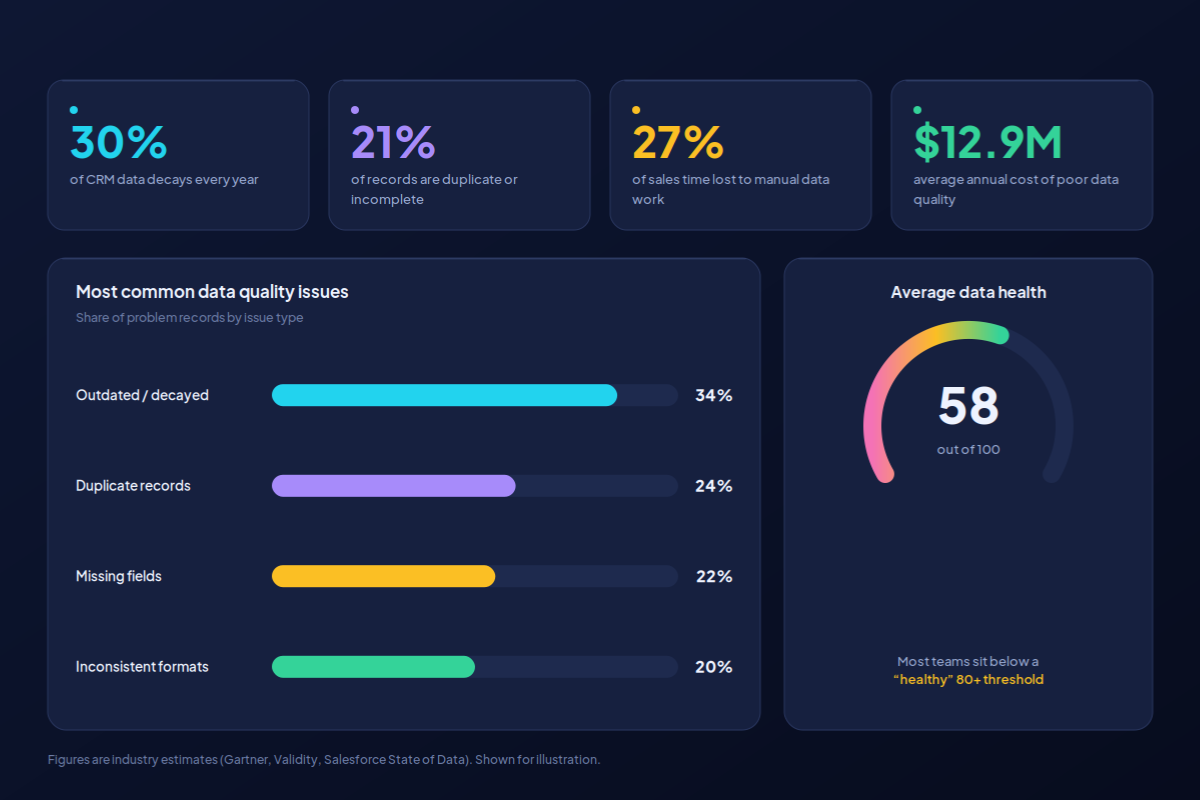
B2B contact data decays at an average rate of 22.5% per year, which works out to approximately 2.1% per month (Digital DI Consultants, 2026). Think about that for a moment. If you ran a perfect data cleanup project today and walked away, nearly a quarter of your database would be degraded by this time next year.
This is why periodic batch cleanups fail. By the time you finish cleaning, new decay has already started. It’s like mopping the floor while the roof leaks.
The human cost compounds the problem. According to CRM.org (2026), 32% of sales reps spend more than 1 hour per day on manual data entry rather than selling. Let me do that math for you: a sales team of 20 reps losing one hour daily equals 5,000+ hours annually spent on work that an AI agent could handle. That’s not a rounding error. That’s a full-time employee’s worth of productivity, multiplied by 2.5.
And the revenue impact is measurable. Validity’s 2025 research found that 37% of CRM users reported losing revenue as a direct consequence of poor data quality. Not “experiencing challenges.” Losing revenue.
The traditional approach to CRM hygiene treats it like a periodic event, something you schedule quarterly alongside your sales kickoff and your office plant watering. But data decay doesn’t respect your calendar. It’s continuous, relentless, and cumulative.
This is the shift that agentic AI makes possible: moving from reactive cleanup to proactive, continuous maintenance. Not replacing your data governance team, but eliminating the tedious work so humans can focus on strategy, edge cases, and the judgment calls that actually require human expertise.
What Is Agentic AI – And How Is It Different From Your CRM’s AI Features?
Let’s clear up a term that’s being thrown around with abandon in 2026: agentic AI.
Agentic AI refers to autonomous systems that can plan, reason, and execute multi-step tasks without constant human prompting. The keyword is “autonomous.” These systems don’t wait for you to click a button or type a prompt. They identify problems, evaluate solutions, and take action within defined guardrails.
This is fundamentally different from the AI features already in your CRM.
Your current CRM probably has AI-powered lead scoring, email suggestions, maybe a chatbot or two. These are useful features. But they’re reactive. They require human initiation. You ask, they answer. You click, they execute.
Agentic AI operates continuously. An agentic system monitoring your CRM for data quality issues doesn’t wait for you to run a report. It detects a duplicate record, evaluates the merge logic, checks for downstream dependencies, and either executes the merge or flags it for human review, all while you’re in your morning meeting.
The Agentic AI vs. CRM AI Feature Comparison
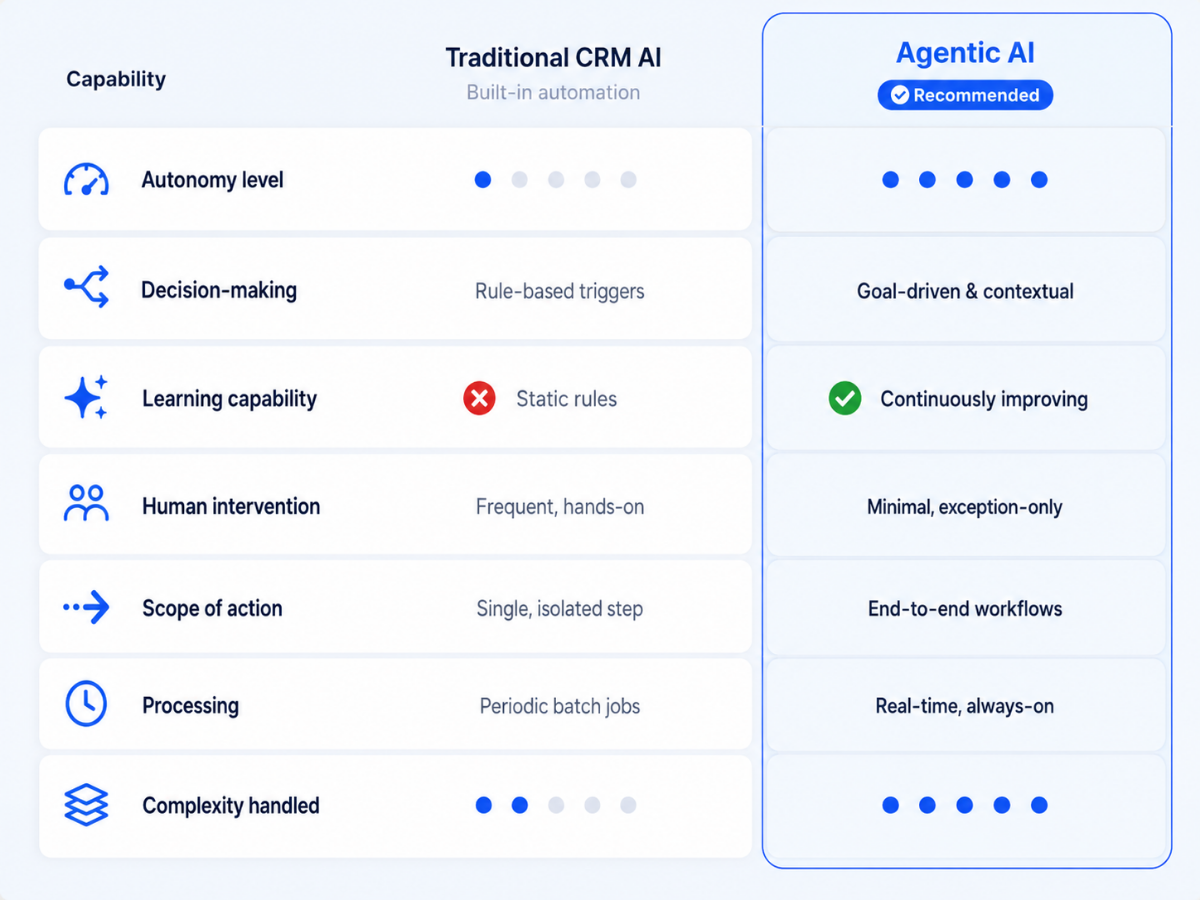
Here’s where the distinction becomes practical:
| Capability | Traditional CRM AI | Agentic AI for CRM Hygiene |
|---|---|---|
| Autonomy Level | Requires human initiation | Operates independently within guardrails |
| Task Complexity | Single-step tasks (score this lead, suggest this email) | Multi-step workflows (detect decay → source enrichment → validate → update → log) |
| Human Involvement | Required for every action | Required only for exceptions and governance |
| Learning/Adaptation | Limited to model updates | Continuous learning from outcomes |
| Continuous Operation | Runs when triggered | Always-on monitoring and remediation |
The adoption curve is steep. According to Gartner (2025), 40% of enterprise applications will include task-specific AI agents by the end of 2026, up from less than 5% in 2025. McKinsey’s State of AI 2025 report found that 62% of organizations are experimenting with AI agents, while 23% are already scaling agents in at least one function.
But here’s where Gartner’s “agentwashing” warning becomes relevant. Many vendors are rebranding basic automation as “agentic” to capitalize on the hype. If a tool requires you to manually trigger every action, it’s not agentic. It’s automation with better marketing.
True agentic AI for CRM hygiene means the system continuously monitors your database, identifies records that need attention, determines the appropriate remediation, and executes or escalates actions based on your governance rules. That’s the standard to hold vendors against.
Why Agentic AI for CRM Hygiene Changes Everything
The shift from batch cleanup to continuous hygiene isn’t incremental. It’s architectural. And it’s why agentic AI for CRM hygiene represents a genuine transformation in how organizations manage data quality.
From Batch Cleanup to Continuous Hygiene
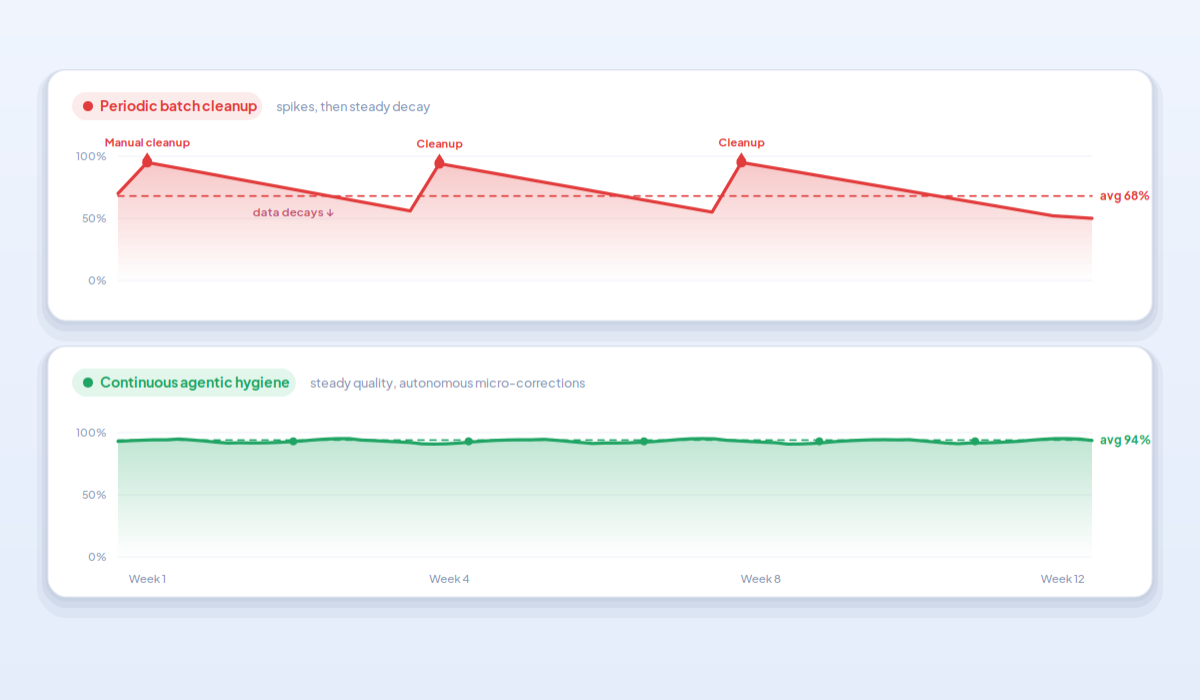
The old model looked like this: every quarter, someone runs a data quality report, discovers thousands of issues, assigns a team to clean them up over several weeks, and declares victory. Three months later, the cycle repeats.
The new model: an agentic system monitors every record, every field, and every update in real time. New records are validated on entry. Existing records are checked on a rolling basis. Issues are remediated before they compound.
This isn’t about replacing humans. It’s about eliminating the tedious, repetitive work that burns out operations teams and never actually finishes. Your data governance specialists should be designing policies and handling edge cases, not manually merging duplicates.
The Four Pillars of Agentic CRM Hygiene
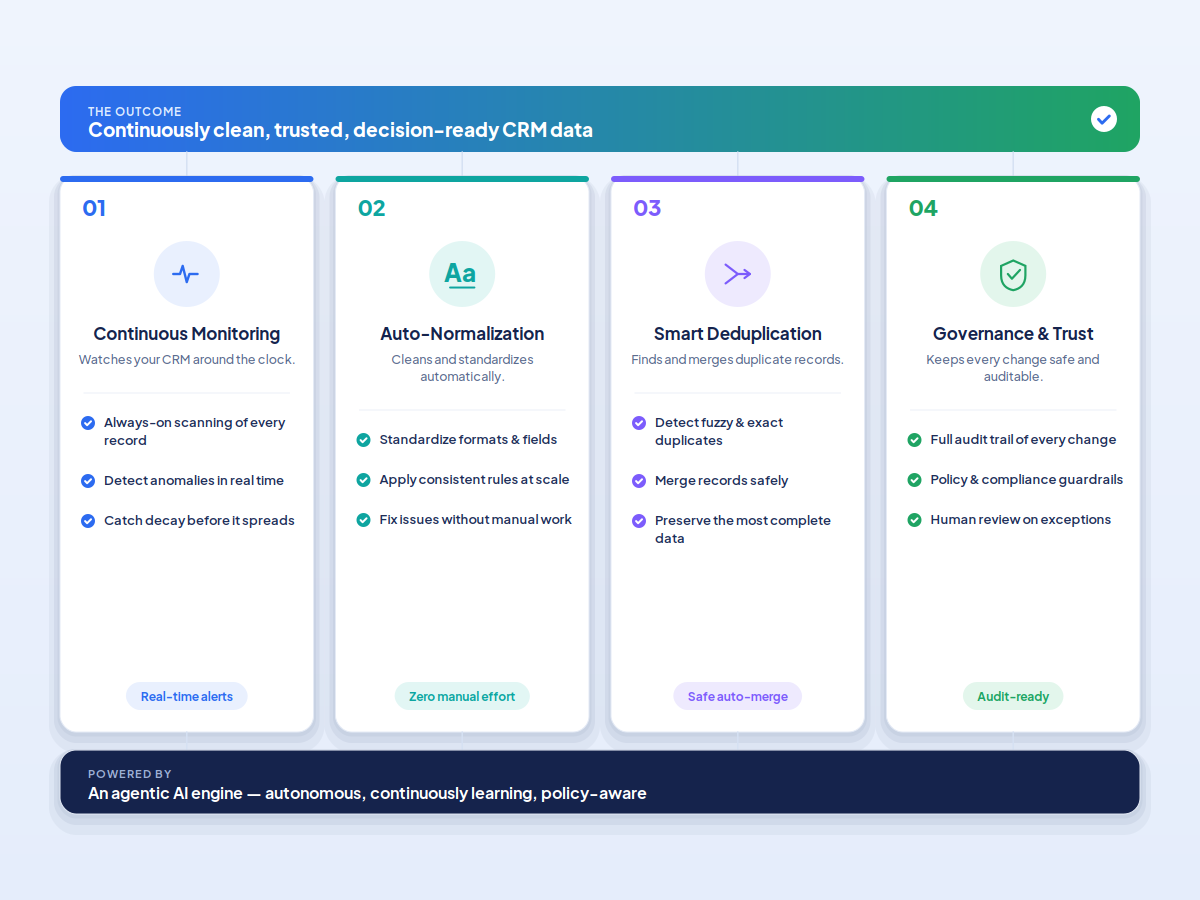
Based on our implementation experience, we’ve identified four core capabilities that define effective agentic CRM hygiene. We call this The NAV43 CRM Hygiene Agent Framework:
1. Detection
Identifying duplicate, incomplete, outdated, or malformed records. This isn’t just pattern matching. Sophisticated detection involves fuzzy matching across fields, identifying near-duplicates that share phone numbers but have different email domains, flagging records with stale data based on firmographic signals.
2. Enrichment
Automatically sourcing missing firmographic, contact, and behavioral data. When an agent detects that a lead record is missing company size or industry, it doesn’t just flag it. It queries enrichment sources, validates the data, and applies the update.
3. Normalization
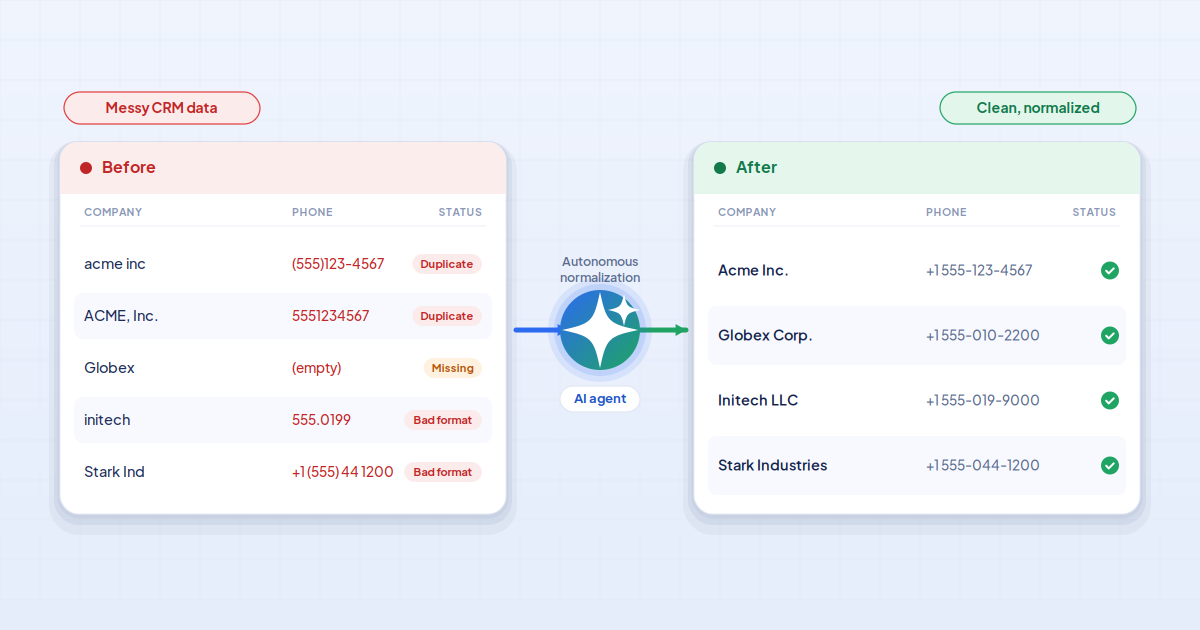
Standardizing formats, picklist values, and naming conventions across the database. One of our clients discovered their CRM had 14 different variations of “Vice President” in job title fields – from “VP” to “V.P.” to “Vice Pres” to “Vice-President” to “vice president.” An agentic normalization agent consolidated these in hours, not months.
4. Validation
Confirming data accuracy through third-party verification, email validation, and company registry checks. Enrichment is only useful if the enriched data is accurate. Validation agents continuously verify that email addresses are deliverable, phone numbers are in service, and company information matches authoritative sources.
The results speak for themselves. AI-driven data quality initiatives improve accuracy by 30% in the first year (Digital DI Consultants, 2026). But that improvement only happens when all four pillars work together in a continuous, autonomous system.
Is AI Replacing CRM? The Real Relationship Between AI Agents and Your CRM Platform
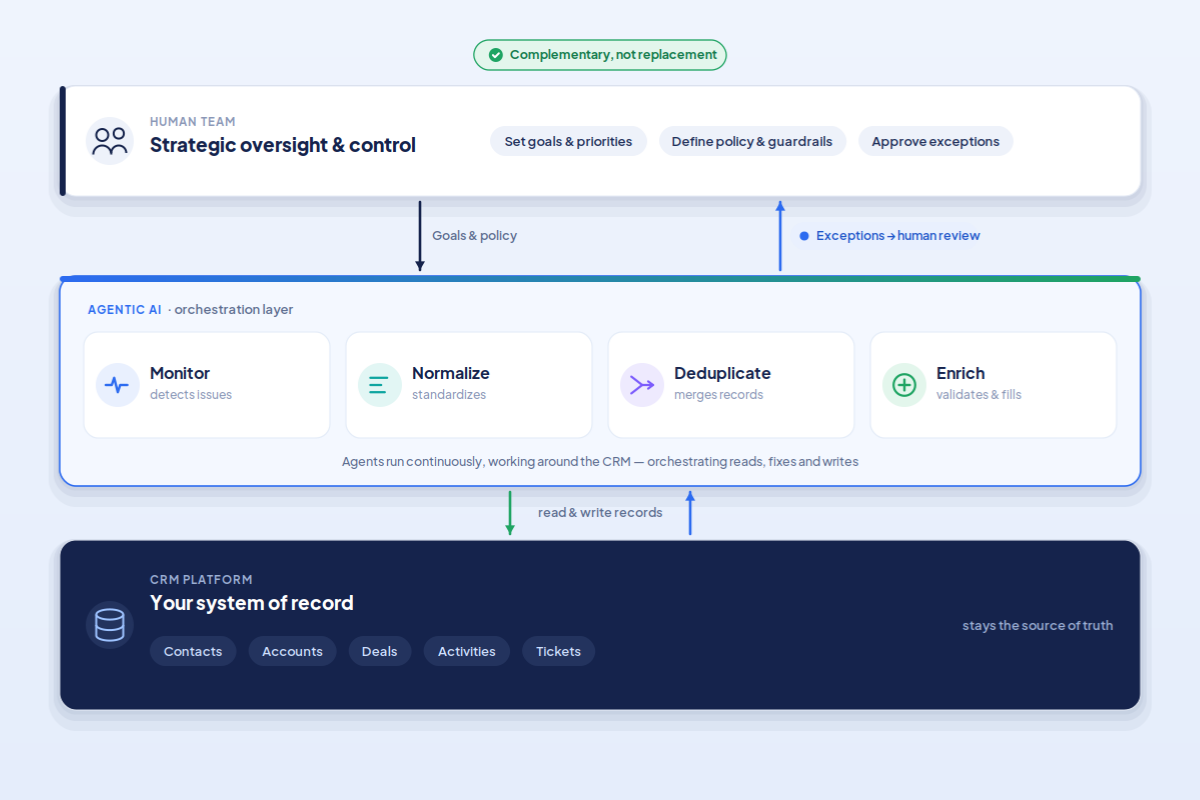
This is one of the most common questions we hear, and the answer is unequivocal: no, AI is not replacing CRM. It’s making CRM more valuable.
Your CRM remains the system of record, the source of truth for customer and prospect data. AI agents are the intelligent automation layer that operates within it, improving data quality and extending functionality without replacing the foundation.
Think of it this way: your CRM is the foundation, and AI agents are the maintenance crew. You still need the building. But now you have workers who never sleep, never miss a detail, and cost a fraction of manual labor.
The relationship is symbiotic. Clean CRM data makes AI more effective by giving it accurate information to work with. AI makes CRM data cleaner by continuously monitoring and remediating issues. The better your data, the smarter your AI. The smarter your AI, the better your data.
This is why data hygiene is a prerequisite for AI success, not something AI automatically fixes. If you deploy AI features on top of a dirty database, you’re accelerating the propagation of errors.
Major CRM platforms understand this relationship. HubSpot’s Data Hub and Operations Hub features are designed to work alongside AI capabilities, not replace core CRM functionality. Salesforce’s Agentforce and Data Cloud integration follows the same principle: AI augments the CRM, not supplants it.
The vendors building AI into CRM aren’t trying to obsolete their own platforms. They’re trying to make those platforms more intelligent, more automated, and more valuable. That only works if the underlying data is trustworthy.
How to Maintain CRM Hygiene with Agentic AI: A Phased Implementation Framework
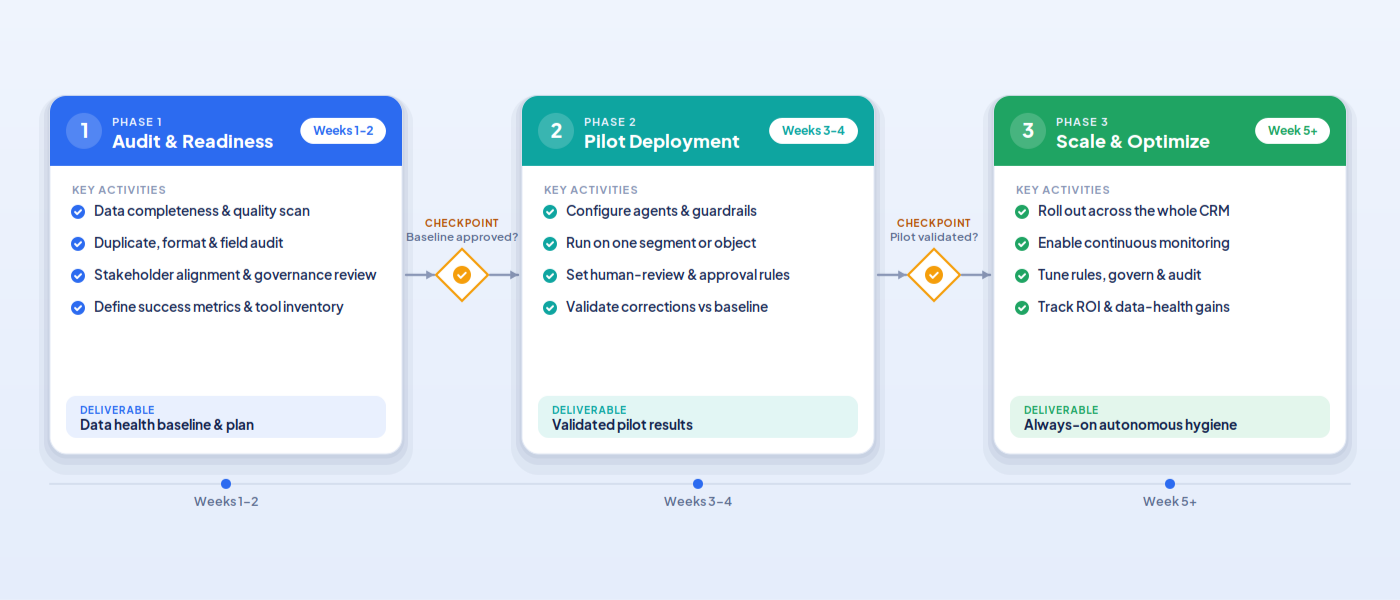
Here’s where most content on this topic fails: it discusses the benefits of agentic AI without explaining how to actually implement it. We’ve seen too many organizations jump straight to tool selection without building the foundation for success.
Data hygiene is a prerequisite for AI success, not an outcome of it. You can’t deploy an AI agent to “fix” your CRM if you haven’t defined what “fixed” looks like.
The following framework has been refined through real implementations. It’s designed to build foundations before automation and scale deliberately to avoid the 40% failure rate Gartner predicts.
Phase 1: Data Audit and Readiness Assessment (Weeks 1-2)

Before you evaluate any AI tool, you need to understand your current state. This isn’t optional. According to the Process Excellence Network (2026), 52% of businesses cite data quality and availability as the biggest barriers to AI adoption. You can’t skip the assessment.
CRM Data Readiness Assessment Checklist:
- [ ] Calculate completeness rates for critical fields (email, phone, job title, company, industry)
- [ ] Measure duplicate percentage across contact and company records
- [ ] Document format inconsistencies in phone numbers, addresses, and picklist values
- [ ] Identify which fields matter most for your business processes (not all data is equally important)
- [ ] Audit current data entry processes and identify where errors originate
- [ ] Map existing integrations that create or modify CRM data
- [ ] Review data governance documentation (or note its absence)
- [ ] Establish baseline metrics: accuracy rate, completeness rate, duplicate rate, decay rate
- [ ] Identify stakeholders who need to approve data quality changes
- [ ] Calculate current cost of data quality issues (time spent, revenue lost)
The goal of Phase 1 is to know exactly where you stand before you start automating. You cannot measure AI impact later if you don’t have baseline metrics now.
Phase 2: Define Normalization Standards (Weeks 2-3)
This is where we’ve seen clients skip ahead and pay for it later. If you deploy an AI agent before defining your normalization standards, you’ll end up with an agent that standardizes everything to the wrong formats because no one defined the rules first.
What to define:
- Naming conventions: How should company names be formatted? “IBM” or “International Business Machines Corporation”?
- Picklist values: What are the acceptable values for Industry, Job Title, Lead Source?
- Format standards: Phone numbers with country codes? Addresses with postal code formatting?
- Data dictionary: A single source of truth documenting every field, its purpose, acceptable values, and validation rules
- Approval workflows: Which normalizations can be automated entirely? Which require human review?
- Acceptance criteria: What accuracy rate constitutes success?
This documentation becomes the instruction set for your AI agent. Garbage in, garbage out still applies, even with sophisticated AI. If your rules are ambiguous, your agent’s actions will be inconsistent.
Phase 3: Select and Configure AI Agent Tools (Weeks 3-5)
Only after completing Phases 1 and 2 should you evaluate tools. By this point, you know your current state, your target state, and the rules you want the agent to enforce.
Configuration priorities:
- Integration with your existing CRM platform (native vs. API vs. middleware)
- Agent permissions and access controls
- Approval workflows for different action types
- Audit trails and logging requirements
- Rollback capabilities for reversing erroneous changes
- Start with a limited scope: one object type (contacts), one business unit, one set of rules
The limited scope is intentional. You’re not trying to boil the ocean in Week 4. You’re trying to prove the model works before scaling.
Phase 4: Pilot, Monitor, and Scale (Weeks 5-8+)
Run a controlled pilot with human-in-the-loop oversight. This means every action the agent takes is logged, and a human reviews a sample of decisions to validate accuracy.
Pilot metrics to track:
- Accuracy rate: What percentage of agent actions were correct?
- False positive rate: How often did the agent flag a non-issue?
- False negative rate: What issues did the agent miss?
- Time savings: How many hours of manual work did the agent eliminate?
- Escalation rate: What percentage of actions required human intervention?
Adjust agent rules based on pilot learnings. If the false positive rate is too high, tighten the detection criteria. If the agent is missing obvious issues, expand the monitoring scope.
Scale gradually. Once you’ve validated the model on contacts, expand to companies. Then deals. Then, custom objects. Each expansion follows the same pilot-monitor-adjust cycle.
The 8-Week Agentic CRM Hygiene Rollout Plan:
| Week | Phase | Key Activities |
|---|---|---|
| 1-2 | Data Audit | Baseline metrics, completeness audit, stakeholder alignment |
| 2-3 | Standards Definition | Data dictionary, normalization rules, approval workflows |
| 3-5 | Tool Selection & Config | Vendor evaluation, integration, and limited-scope configuration |
| 5-6 | Pilot Launch | Controlled deployment, human-in-the-loop oversight |
| 6-7 | Pilot Analysis | Accuracy review, rule adjustments, ROI validation |
| 8+ | Controlled Scale | Expand scope, additional objects, additional business units |
The data quality obstacle jumped from 19% to 44% between 2024 and 2025 as the #1 barrier to AI adoption (BARC Survey, 2025). This phased approach directly addresses that obstacle by building the foundation before deploying the automation.
What Is the Best AI for CRM? A Vendor-Neutral Tool Comparison
This is one of the most-asked questions, and it’s also the most poorly answered in existing content. Most articles are either vendor-sponsored promotional material or so generic they’re useless.
Let me be direct: the “best” AI for CRM hygiene depends entirely on your existing stack, your specific data quality challenges, and your governance requirements. There is no universal winner.
Evaluation Criteria for Agentic CRM Hygiene Tools
Before comparing tools, establish your evaluation criteria:
Autonomy level: Can the tool act independently, or does it just surface suggestions for humans to execute? True agentic capability means the system can complete multi-step workflows without human initiation.
Integration depth: Native integrations with your CRM are typically more reliable than API-based connections, which are more reliable than middleware solutions. But native options may be limited depending on your platform.
Governance controls: Can you define approval workflows? Are there audit trails? Can you roll back changes if something goes wrong? These features are non-negotiable for enterprise deployment.
Enrichment sources: What third-party data does the tool access? The value of enrichment depends on the quality and coverage of the underlying data sources.
Cost model: Per-record pricing, per-action pricing, or platform licensing? The right model depends on your database size and expected action volume.
Time to value: How long does implementation take? What’s the learning curve?
The Agentic AI for CRM Hygiene Tool Landscape (2026)
The market breaks down into four categories:
Native CRM Capabilities
HubSpot’s Operations Hub and Data Hub include data quality tools like deduplication, data sync, and programmable automation. For HubSpot users, this is the natural starting point. The integration is seamless, governance inherits from your existing HubSpot setup, and there’s no middleware to manage.
Salesforce’s Data Cloud paired with Agentforce represents the enterprise-grade option. Deeper automation capabilities, more sophisticated matching algorithms, but significantly more complex implementation and higher total cost.
Third-Party Enrichment Platforms with AI
ZoomInfo, Clearbit (now Breeze AI under HubSpot), and Apollo have evolved beyond simple data append services. They now offer continuous enrichment, decay detection, and automated updates. The strength is enrichment depth; the weakness is that they’re optimized for adding data rather than normalizing or deduplicating existing data.
Dedicated Data Quality Platforms
Validity DemandTools, Insycle, and Tray.ai specialize in CRM data quality workflows. These tools are purpose-built for deduplication, normalization, and data management. Integration quality varies by CRM platform. They’re often the right choice when your data quality challenges are severe enough to warrant a dedicated solution.
Emerging Agentic Platforms
Clay, Bardeen, and Relevance AI represent the newer generation of agentic automation tools. They offer more flexible workflow design and can orchestrate actions across multiple systems. The trade-off is maturity: these platforms are evolving rapidly, which means more capability but also more implementation risk.
| Tool | Category | Best For | Autonomy Level | CRM Integration | Governance | Price Range |
|---|---|---|---|---|---|---|
| HubSpot Operations Hub | Native | HubSpot users with moderate data quality issues | Medium | Native | Strong | $$ |
| Salesforce Data Cloud + Agentforce | Native | Enterprise Salesforce users | High | Native | Enterprise-grade | $$$$ |
| ZoomInfo | Enrichment | Enrichment-first use cases | Medium | API | Moderate | $$$ |
| Insycle | Data Quality | Severe deduplication and normalization needs | Medium | API | Strong | $$ |
| Clay | Agentic Platform | Complex multi-system workflows | High | API/Middleware | Developing | $$ |
| Validity DemandTools | Data Quality | Salesforce-specific data management | Medium | Native (SFDC) | Strong | $$ |
Most agencies won’t tell you this, but in our testing, we found that no single tool excels at all four pillars of CRM hygiene. ZoomInfo excels at enrichment but requires significant configuration for normalization rules. Insycle handles normalization beautifully, but pulls from limited enrichment sources. The native CRM options are convenient but may lack the sophistication of purpose-built tools.
The right answer is often a combination: native CRM features for basic hygiene, a specialized tool for your most acute pain point, and clear process documentation to prevent overlap and gaps.
The ROI of Agentic CRM Hygiene: Building Your Business Case
AI projects fail without clear business value. The 40% cancellation rate Gartner predicts (Gartner, 2025) isn’t random. It’s driven by projects that couldn’t demonstrate ROI. This section arms you to make the internal case before you start spending.
Calculating Your CRM Data Hygiene Costs
The formula is straightforward:
Current Cost = (Hours spent on manual data work × hourly cost) + (Revenue lost to bad data) + (Tool/vendor costs for current solutions)
Let’s break down each component:
Manual data work: If 32% of sales reps spend more than one hour per day on data entry (CRM.org, 2026), and your average fully-loaded sales rep costs $75/hour, a 20-person team loses $480,000+ annually to data administration. That’s not even counting ops team time.
Revenue lost to bad data: Validity’s research shows 37% of CRM users lost revenue due to poor data quality. If your data quality is below average (and if only half your data is accurate, it is), you’re likely in that group. Quantify it: How many deals failed because of wrong contact information? How many campaigns underperformed due to bad segmentation?
Hidden costs: Sales reps avoiding the CRM entirely, marketing campaigns sent to bad email addresses (wasting budget and hurting deliverability), customer service issues from outdated information, and executive decisions made on unreliable reports.
The Productivity and Efficiency Gains
According to Deloitte’s State of AI in the Enterprise 2026 report, 66% of organizations report productivity and efficiency gains from enterprise AI adoption.
For CRM hygiene specifically, the gains compound:
- Direct time savings: Agents handle the repetitive detection, enrichment, normalization, and validation work that previously required human hours
- Reduced rework: Clean data means fewer campaigns that need to be re-sent, fewer sales calls that reach wrong numbers, fewer deals that stall due to incorrect information
- Faster sales cycles: Reps spend time selling instead of data entry; accurate contact data means more conversations happen
- Improved AI performance: Every other AI feature in your CRM works better when the underlying data is accurate
The 30% accuracy improvement in year one (Digital DI Consultants, 2026) translates directly to these operational benefits.
Build your business case by comparing (Current annual cost of data quality issues) vs. (Cost of agentic AI implementation + ongoing operational costs) to determine the ROI timeline.
For most mid-market organizations, the math works in the first year. For those with particularly severe data quality issues, it can work in the first quarter.
Common Pitfalls: Why Agentic CRM Hygiene Projects Fail
Given that Gartner predicts 40%+ of agentic AI projects will be canceled by 2027 (Gartner, 2025), let’s be explicit about the failure modes and how to avoid them.
Pitfall 1: Skipping the Standards Definition Phase
We’ve seen this repeatedly. Teams get excited about the technology, rush to implement, and end up with an agent that makes their data worse, not better. The agent normalizes job titles to the wrong format. It merges records that shouldn’t be merged. It is enriched with data from low-quality sources.
Avoidance: Phase 2 is mandatory. Document your standards before you automate them.
Pitfall 2: Insufficient Governance Controls
Agentic systems that can act autonomously can also make mistakes autonomously. Without proper approval workflows, audit trails, and rollback capabilities, a single misconfiguration can propagate across thousands of records before anyone notices.
Avoidance: Start with tighter human-in-the-loop controls than you think you need. Loosen them as you validate accuracy.
Pitfall 3: Overscoping the Initial Deployment
Trying to solve every data quality problem simultaneously is a recipe for failure. The complexity explodes, the timeline extends, stakeholder patience erodes, and the project gets canceled before it delivers value.
Avoidance: Start with one object type, one business unit, one clear success metric. Prove the model, then scale.
Pitfall 4: Ignoring Change Management
Your sales team has workarounds for the CRM’s current limitations. Your ops team has manual processes they’ve perfected. Deploying AI agents without preparing these stakeholders leads to resistance, bypass, and ultimately abandonment.
Avoidance: Involve end users in the pilot phase. Communicate the benefits clearly. Make the transition gradual.
Pitfall 5: Unclear ROI Metrics
Projects that can’t demonstrate value get cut. If you haven’t defined what success looks like and how you’ll measure it, you’re vulnerable to budget reviews.
Avoidance: Establish baseline metrics in Phase 1. Track improvements continuously. Report ROI regularly.
Conclusion: Key Takeaways
The convergence of CRM data decay and AI acceleration creates both a crisis and an opportunity. Organizations that deploy agentic AI for CRM hygiene correctly will pull ahead. Those who skip the foundation work will join the 40% cancellation rate.
Here’s what matters most:
- CRM data quality is a prerequisite for AI success, not an outcome of it. You cannot deploy AI to fix a database that hasn’t been audited, standardized, and governed.
- True agentic AI operates continuously and autonomously, not just when you click a button. Be wary of “agentwashing” – vendors rebranding basic automation as agentic.
- The four pillars of CRM hygiene – detection, enrichment, normalization, and validation – must work together. Partial solutions create partial results.
- Phased implementation dramatically reduces failure risk. Audit first, define standards second, select tools third, pilot before scaling.
- The ROI is measurable and often compelling. Companies lose $12.9 million annually to poor data quality. Agentic AI that improves accuracy by 30% pays for itself.
Next Steps
If you’re evaluating agentic AI for CRM hygiene, start with the Data Readiness Assessment Checklist from Phase 1. You cannot make a good tool decision without knowing your current state.
For organizations already using HubSpot’s CRM and automation capabilities, the path forward involves understanding how HubSpot lifecycle stages interact with data quality, and potentially leveraging the HubSpot CRM cleanup checklist as a starting point.
If you’re building a broader marketing technology stack, consider how CRM hygiene fits into your overall MarTech architecture. The decisions you make about AI agents should align with your MarTech stack audit findings and consolidation strategy.
For teams navigating the broader question of what agentic AI means for marketing and how it differs from traditional marketing automation, those resources provide essential context.
Ready to assess your CRM data quality and build a roadmap for agentic automation? Get a Free Growth Plan that includes a data readiness assessment and implementation recommendations tailored to your stack.
The organizations winning in 2026 aren’t the ones with the most AI features. They’re the ones with the cleanest data to power those features. Start building your foundation now.
