What Is Agentic AI in Marketing? The Practitioner’s Guide to Autonomous Marketing Agents
Here’s a stat that should make you sit up: 87% of marketers now use generative AI in at least one recurring workflow (Salesforce State of Marketing, 2026). That’s not the surprising part. The surprising part? Only 11% of agentic AI pilots ever make it to full production.
The gap between AI hype and operational reality has never been wider.
I’ve watched this disconnect play out with our clients at NAV43 over the past eighteen months. Marketing teams invest heavily in what vendors call “agentic AI,” only to discover they’ve purchased a rebranded chatbot with a shinier interface. The disappointment is palpable. The wasted budget is painful.
This phenomenon has a name now: agentwashing. It’s the practice of slapping “agent” or “autonomous” onto any AI tool that can string together a few sentences. The result? Confused buyers, failed implementations, and a growing skepticism about whether agentic AI in marketing is actually worth the investment.
It is worth the investment. But only if you understand what you’re actually buying and how to deploy it.
This article is your practitioner’s guide to cutting through that noise. You’ll learn the precise distinction between generative and agentic AI, see real implementation frameworks we use with clients, get a tool evaluation matrix to spot agentwashed products, and walk away with an 8-week roadmap for deploying your first marketing agent. No theory without application. No hype without reality checks.
Let’s get into it.
Agentic AI vs Generative AI: The Critical Distinction Most Marketers Miss
This is where most content on agentic AI fails. They give you a definition, maybe a diagram, and move on. But understanding this distinction at a practical level is the difference between a successful pilot and a six-figure write-off.
What Generative AI Actually Does
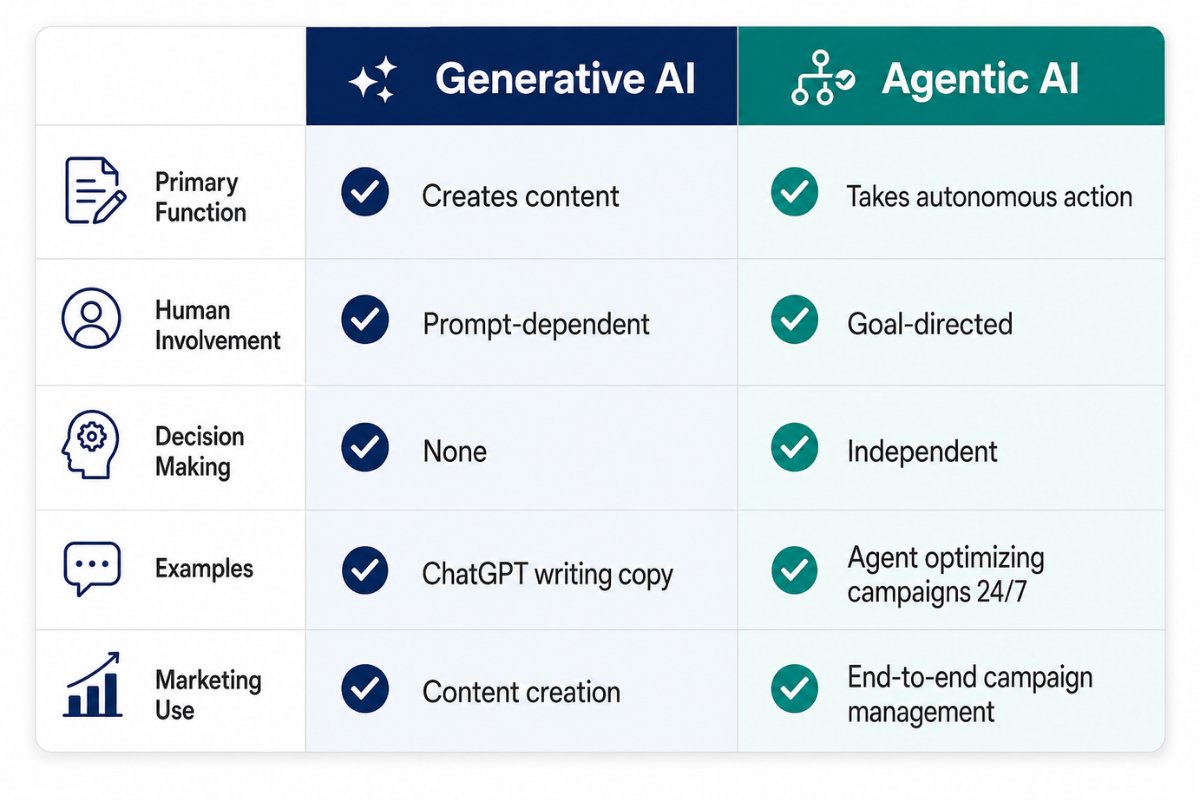
Generative AI creates content based on prompts. You ask it for email copy, and it writes email copy. You request ad variations, and it produces ad variations. You prompt it to draft a blog outline, and it delivers one.
The operative word here is reactive. Generative AI responds to your inputs. It doesn’t initiate action on its own.
Think of it this way: generative AI is an incredibly capable assistant sitting next to you. It can write, analyze, summarize, and ideate at superhuman speed. But it waits for you to tell it what to do. Every single time.
ChatGPT generating an email sequence? Generative AI. Claude drafting a content brief? Generative AI. Midjourney creating ad visuals from your prompt? Generative AI.
The limitation isn’t capability. These tools are remarkably powerful. The limitation is that they require constant human prompting and cannot act independently. You remain at the wheel for every turn, every decision, every execution step.
I frame this to clients as “AI as an assistant.” Powerful, yes. But still fundamentally dependent on you to drive the process forward.
What Makes AI “Agentic”
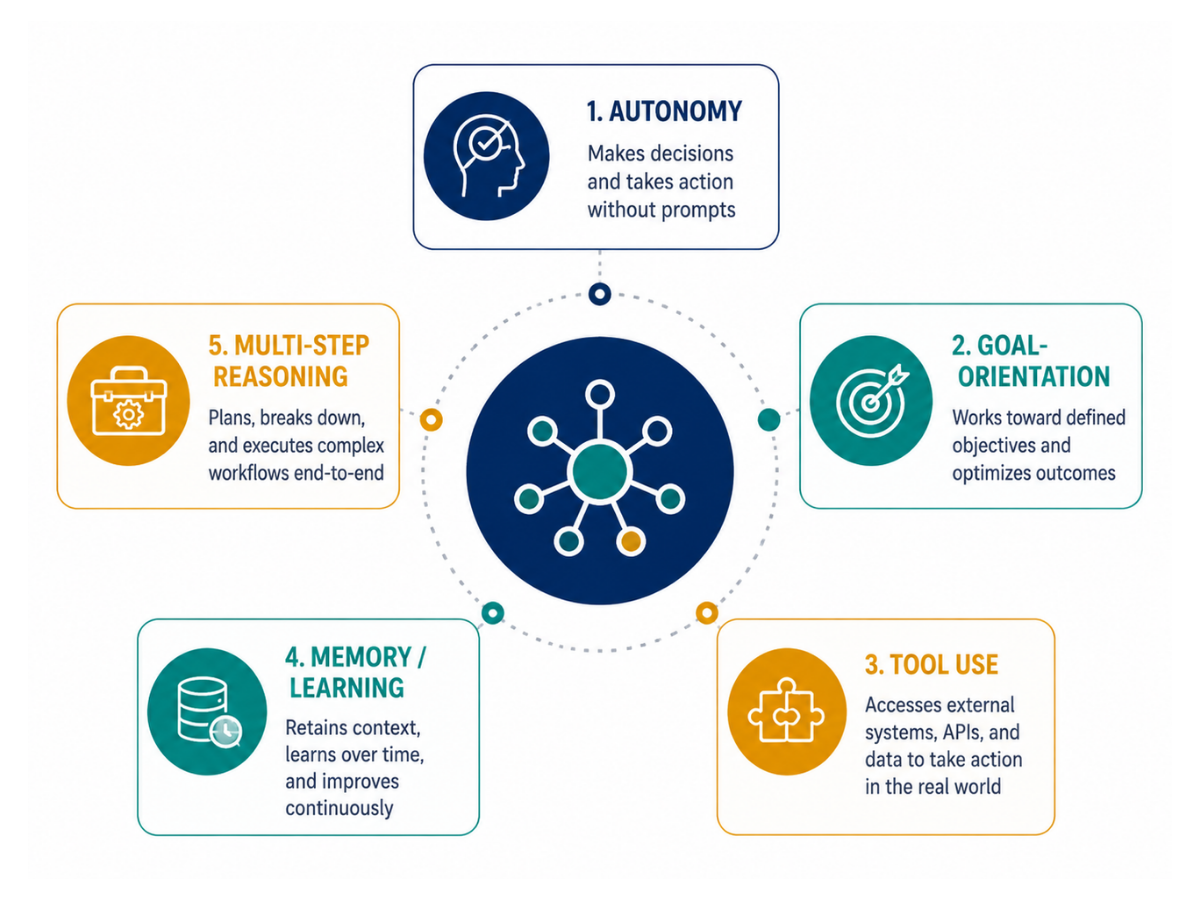
Agentic AI operates on a fundamentally different paradigm. Instead of waiting for prompts, it plans multi-step workflows, uses external tools, maintains memory across sessions, and returns finished results.
The four pillars that define truly agentic AI are:
- Autonomous planning – the system creates its own action plan to achieve a goal
- Tool use – it can access external systems, databases, and applications
- Memory and context persistence – it remembers previous interactions and learns from outcomes
- Goal-directed execution – it works toward objectives without step-by-step human instruction
The shift is profound. Instead of “help me write this email,” you say “optimize this nurture sequence and report back on results.” The agent determines what data it needs, which tools to use, which experiments to run, and which changes to implement. Then it does all of that and tells you what happened.
Frame this as “AI as autonomous operator.” You set the objective. It figures out the path.
Here’s a concrete example. Generative AI: “Write me a follow-up email for cold leads who haven’t responded.” You get one email. You send it manually. You wait. You ask for another variant.
Agentic AI: “Monitor my CRM, identify leads that haven’t engaged in 14 days, draft personalized re-engagement sequences based on their behavior history, send them at optimal times, track responses, and adjust the approach based on what works.” The agent executes this workflow continuously, learning and improving without your intervention.
One critical clarification: LLMs like ChatGPT and Claude are the “brains” that can power agentic systems when wrapped in the right orchestration frameworks. The model provides the intelligence. The agentic framework provides autonomy, memory, and tool integration.
Is ChatGPT Agentic AI? Is Claude Agentic AI?
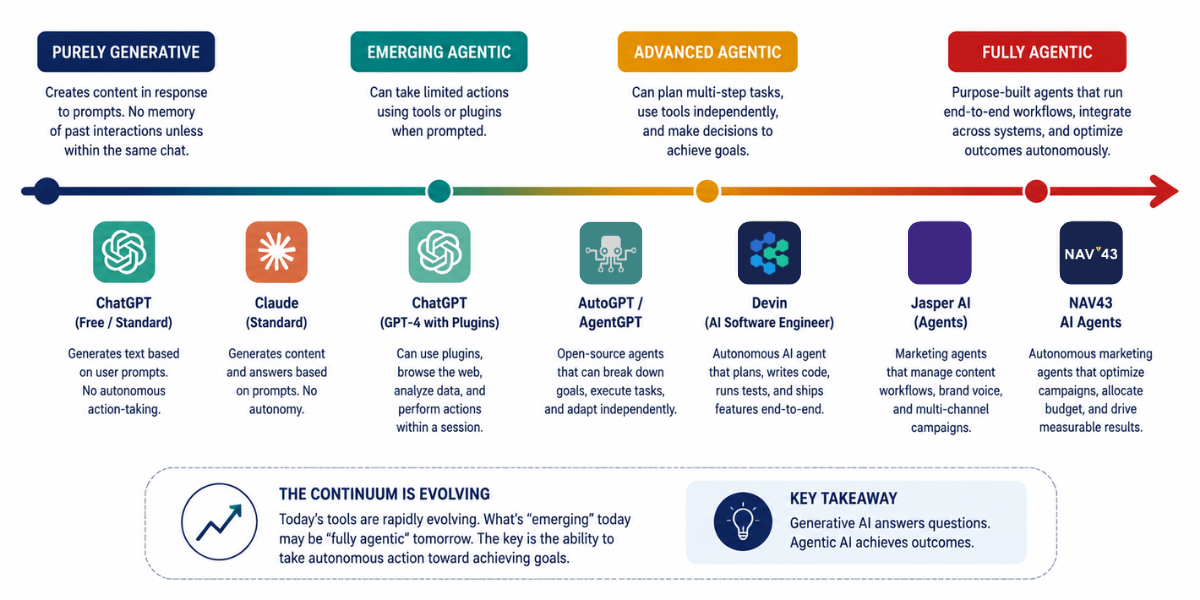
These questions flood my inbox, so let me address them directly.
Base ChatGPT and Claude are generative AI models, not inherently agentic. When you open ChatGPT and type a prompt, you’re using generative AI. The model responds to your input and waits for the next one.
However, both platforms are rapidly adding capabilities that enable agentic behavior. ChatGPT’s emerging “Agent Mode” and Claude’s “Computer Use” features represent steps toward autonomous operation. These features allow the models to take actions, use tools, and execute multi-step workflows with less human intervention.
The distinction that matters: the model provides intelligence, the agentic framework provides autonomy. You can build an agentic system using Claude as the underlying model, but Claude by itself isn’t agentic just because you’re using it.
This matters enormously for tool evaluation. A vendor telling you their product “uses ChatGPT” doesn’t make it agentic. You need to understand what orchestration layer sits on top of that model and whether it truly enables autonomous planning, tool use, and goal-directed execution.
Agentic AI Litmus Test: 4 Questions to Cut Through the Marketing Hype
Before purchasing any tool marketed as “agentic,” ask these questions:
- Can it take autonomous action without a prompt for each step? If you need to prompt it through every phase, it’s generative AI with extra steps.
- Does it integrate with and use external tools? True agents access your CRM, analytics, email platform, and other systems to gather data and take action.
- Does it maintain memory across sessions? Can it remember what happened yesterday and apply those learnings today? Or does it start fresh each time?
- Does it work toward defined goals? Can you give it an objective like “increase MQL volume by 20%” and let it figure out the path? Or do you need to specify every action?
If the answer is “no” to most of these questions, you’re looking at an agentwashed chatbot, not a true marketing agent.
Why Agentic AI Matters for Marketing Now
The theoretical case for agentic AI is compelling. The market data makes it urgent.
The Market Shift in Numbers
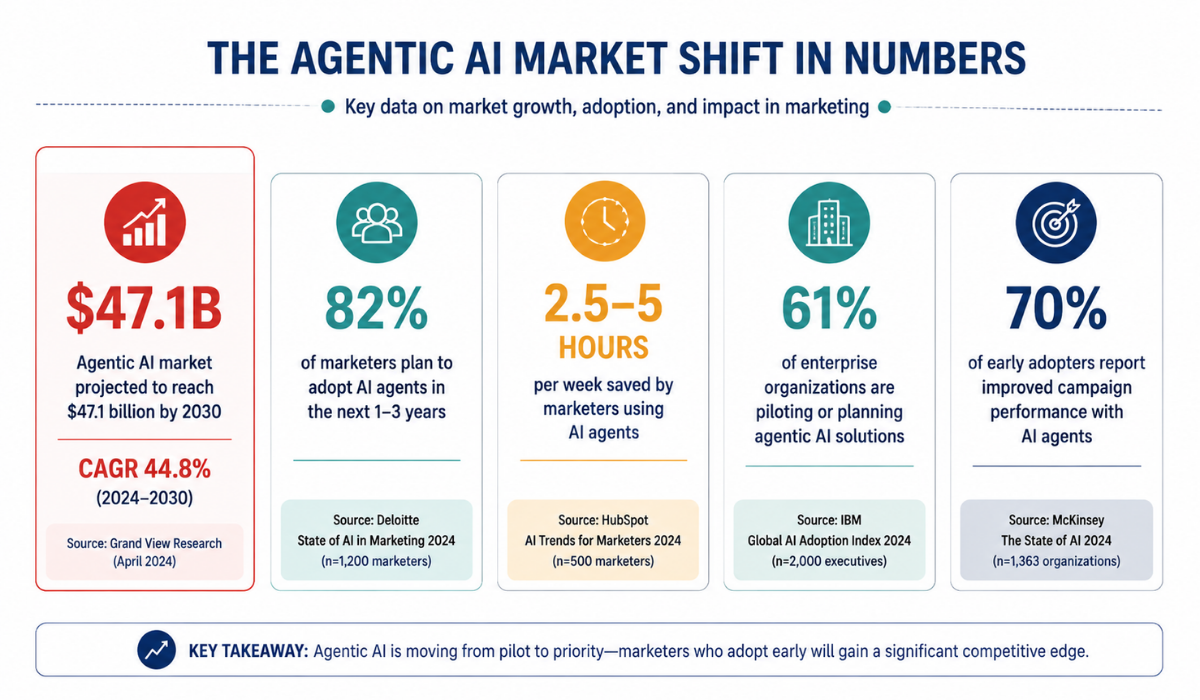
The global agentic AI market is projected to grow from $7.29 billion in 2025 to $139.19 billion by 2034, representing a 40.5% compound annual growth rate (Fortune Business Insights, 2025). That’s not incremental growth. That’s a fundamental reshaping of how marketing operations will function.
The adoption curve is already steeper than most realize. According to Globe Newswire and Landbase research (2025), 79% of organizations report some level of agentic AI adoption, with 96% planning to expand their usage. This isn’t future-state planning. It’s the current-state reality.
Within marketing specifically, 34% of enterprise marketing teams now run at least one autonomous agent in production, up from just 14% in Q4 2025 (Digital Applied, 2026). That’s a 143% increase in active deployments in a single year.
The budget allocation follows the adoption: 63% of enterprise CMOs now report a dedicated budget line for agent infrastructure (Digital Applied, 2026). This isn’t being funded from innovation slush funds. It’s getting its own line item.
Perhaps most compelling: companies report an average ROI of 171% from agentic AI investments, with U.S. enterprises achieving 192% ROI (Landbase, 2025-2026). When executed properly, the returns are substantial and measurable.
Gartner predicts that by 2028, 60% of brands will use agentic AI to facilitate streamlined one-to-one interactions (Gartner, 2026). The window for early-mover advantage is closing.
The Problem Agentic AI Solves for Marketers
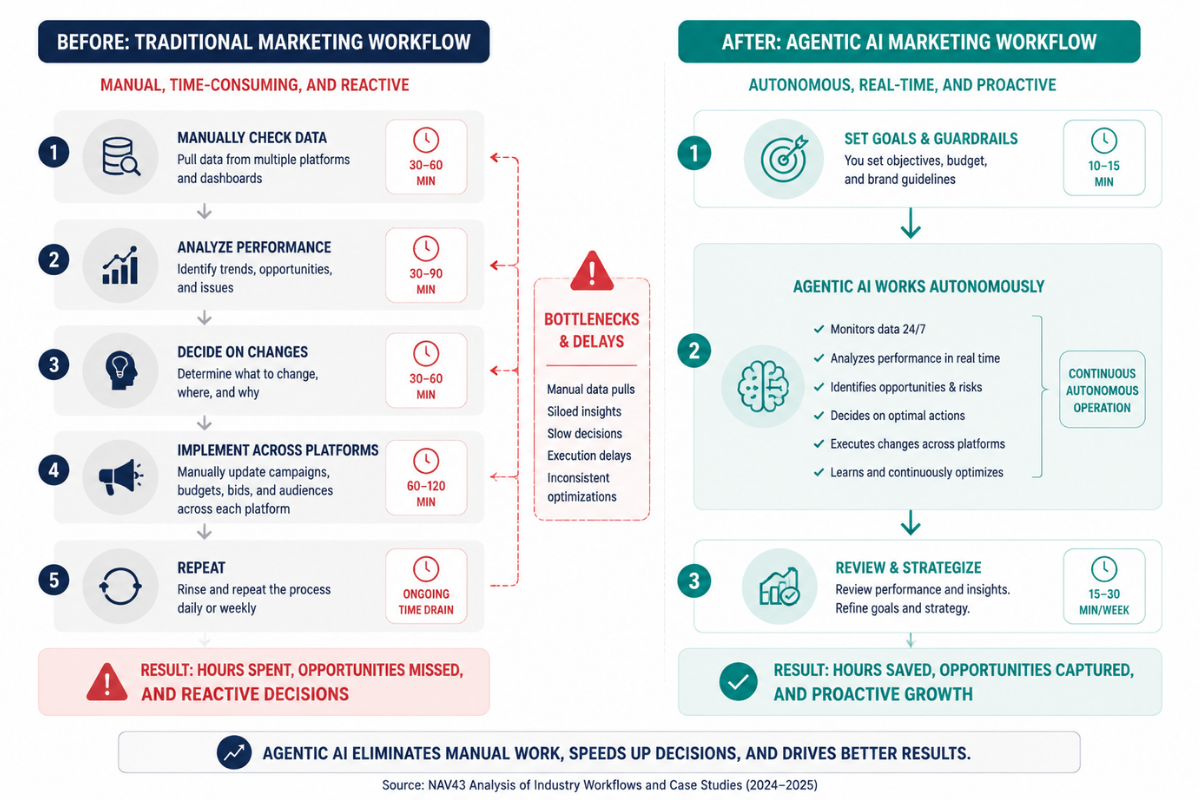
Numbers are compelling, but let me tell you what I actually see in client marketing operations.
Marketing teams are drowning in repetitive, multi-step tasks that generative AI can’t fully automate. I reviewed a lead generation operation last month in which the team spent 12+ hours weekly on tasks that could be automated by agents: lead scoring updates, segment adjustments, campaign budget reallocation, and performance reporting. Each task required human judgment, yes, but that judgment was applied to routine decisions that followed predictable patterns.
This is the gap generative AI can’t bridge. It can write your campaign reports, but it can’t decide what to do based on those reports and then execute the changes. That middle layer, the decision-and-execution layer, is exactly what agentic AI addresses.
There’s also a widening personalization gap. According to Braze’s 2026 Global Customer Engagement Review, 93% of marketing leaders say AI helps them understand their customers more accurately, yet only 53% of consumers say brands are accurately predicting their wants (Braze 2026 Global Customer Engagement Review, 2026). They understand their customers more accurately. But only 53% of consumers say brands are accurately predicting their wants. That’s a 40-point gap between capability and delivery.
Why the gap? Because understanding what personalization should happen and actually executing it at scale are two different problems. Agentic AI bridges this by handling the execution layer, taking the insights and acting on them across thousands of customer interactions simultaneously.
The specific pain points I see agentic AI addressing for our clients include lead routing delays, where qualified leads sit in queues while humans manually assign them; campaign optimization lag, where performance signals take days to translate into budget adjustments; and content repurposing bottlenecks, where a single pillar piece takes weeks to fragment across channels.
Practical Agentic AI Examples in Marketing

Let’s move from concept to application. Here’s how agentic AI actually works across core marketing functions.
Lead Scoring and Routing Agents
Traditional lead scoring relies on static rules. Lead fills out a form with certain fields, gets a certain score, and is routed to a certain rep. The problem is that buyer behavior evolves faster than your scoring models can adapt.
An agentic lead scoring system operates differently. The agent continuously monitors CRM data, tracking not just form submissions but engagement patterns, content consumption, return visits, and firmographic signals. It scores leads based on behavioral patterns that correlate with conversion, learning from every won and lost deal.
When a lead hits a threshold, the agent doesn’t just update a field. It routes to the appropriate sales rep based on territory, capacity, and historical win rates with similar leads. It triggers a personalized nurture sequence tailored to what the lead has already engaged with. And it adjusts its own scoring model based on whether that lead ultimately converts.
A typical workflow looks like this: Agent monitors website behavior, cross-references with firmographic data from enrichment tools, scores leads against conversion probability, routes to the rep with the highest historical success rate for that lead profile, triggers a nurture sequence that acknowledges what the lead has already viewed, and refines the scoring model when the outcome is known.
The tools enabling this kind of agent include Salesforce Agentforce for enterprise-scale implementations, HubSpot Breeze AI for mid-market teams, and Clay for B2B teams needing flexible data enrichment and sequencing.
Campaign Orchestration Agents
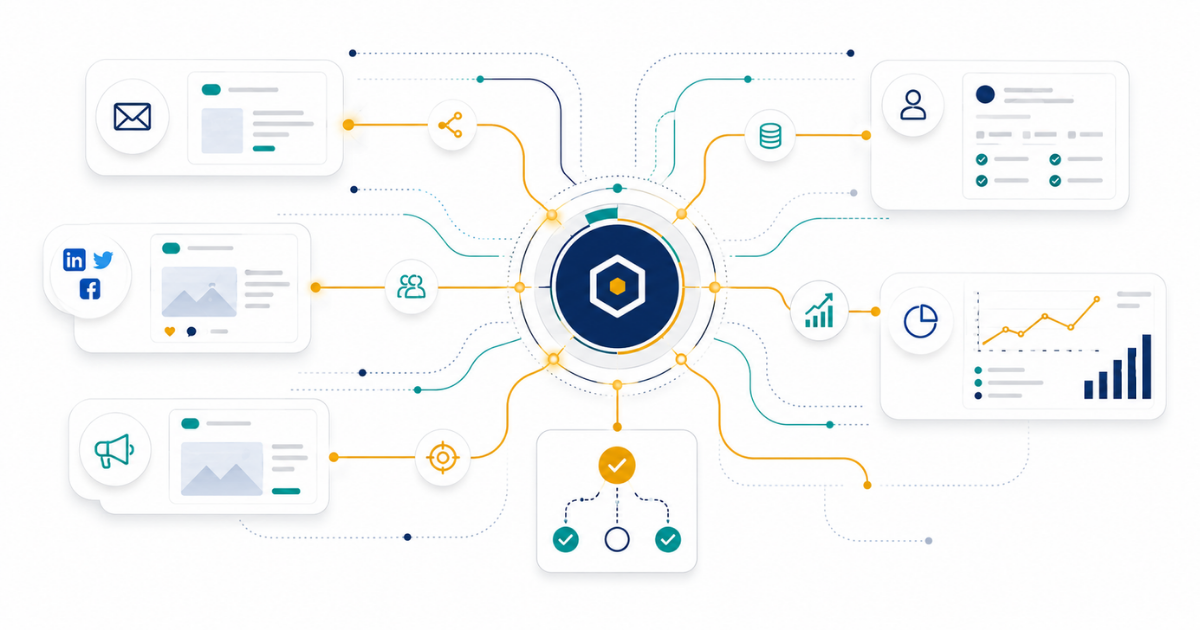
This is where the ROI becomes obvious. Campaign orchestration agents manage end-to-end multi-channel campaigns, handling budget allocation, audience targeting, creative rotation, and performance optimization.
Imagine running LinkedIn, Google, and display campaigns simultaneously. Traditional approach: you review performance weekly, make adjustments, wait for results, iterate. By the time you respond to underperformance, you’ve already wasted budget.
An orchestration agent continuously monitors performance signals. It detects that your LinkedIn campaign’s cost per lead is trending 30% above target. It doesn’t wait for your weekly review. It reallocates budget to the Google channel that’s outperforming benchmarks. It adjusts audience-targeting parameters for the underperforming channel. It reports what it did and why.
The human role shifts from execution to governance. You set the guardrails: minimum spend per channel, maximum single-day reallocation, and approval thresholds for major shifts. The agent operates within those boundaries, optimizing faster than any human team could.
One of our e-commerce clients implemented a campaign orchestration agent and saw a 23% reduction in wasted ad spend within the first 60 days. The agent wasn’t doing anything the marketing team couldn’t do. It was just doing it continuously, without the latency of human review cycles.
Content Repurposing and Distribution Agents
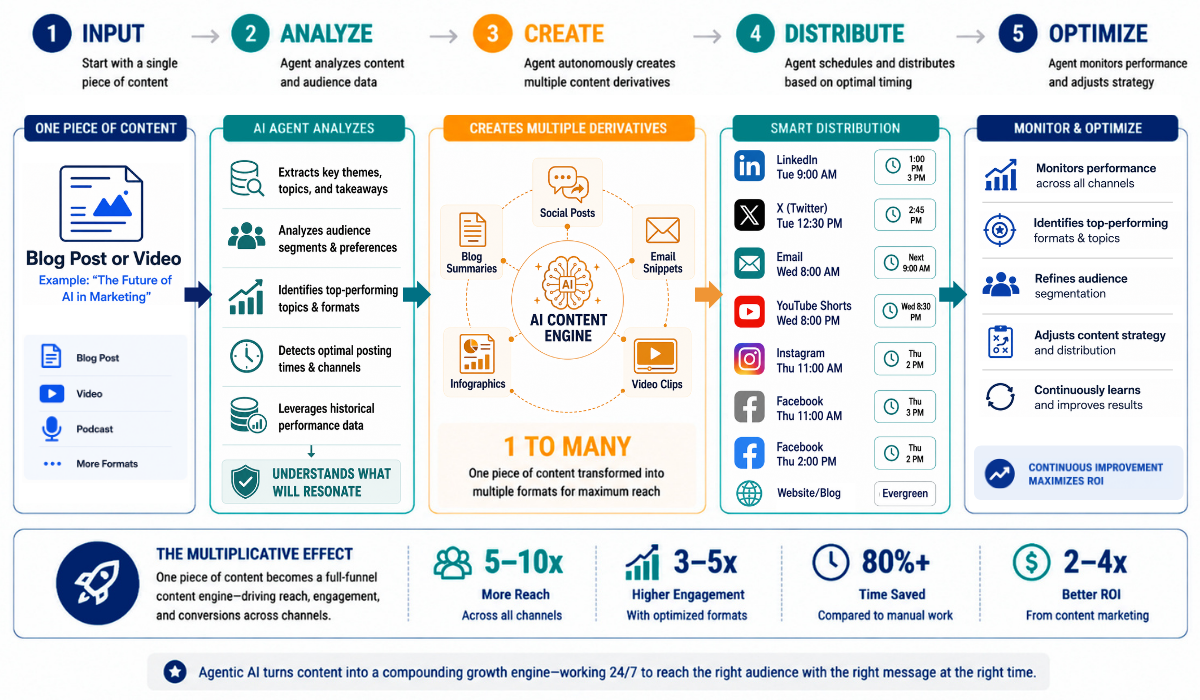
Content teams face a perpetual bottleneck: creating derivative assets from pillar content. You publish a comprehensive guide, and it should become LinkedIn posts, email snippets, ad copy variations, social threads, and newsletter content. In practice, that repurposing queue backs up for weeks.
A content repurposing agent takes your pillar content and autonomously creates derivative assets. Not just one variation, but multiple formats optimized for different channels and audiences. Then it schedules distribution based on historical performance data, learning which content types perform best on which channels at which times.
The workflow: New blog post published on your site. The agent analyzes the content structure and key points. It creates 10 LinkedIn posts with different hooks. It drafts 5 email subject line variations. It generates 3 ad copy sets. It schedules across channels based on engagement patterns. It monitors performance and adjusts future content mix based on what resonates.
According to HubSpot’s 2026 State of Marketing Report, 19.2% of marketers already leverage AI agents to automate end-to-end marketing initiatives. The early adopters are building significant efficiency advantages.
Audience Segmentation and Personalization Agents
Static segments are dying. The idea that you define “Enterprise Decision Makers” once and that definition holds for a year is increasingly disconnected from how buyers actually behave.
Personalization agents continuously analyze customer behavior and dynamically adjust segments. They move beyond demographic and firmographic boxes to behavior-driven micro-segments that evolve in real-time.
Here’s a real example from a B2B client implementation. The agent identified that visitors who viewed the pricing page three or more times but didn’t convert responded significantly better to case study content than to feature-focused messaging. Traditional segmentation wouldn’t catch this. The agent not only identified the pattern but also automatically adjusted nurture sequences for this micro-segment, routing them toward social proof content rather than product features.
The compounding effect matters here. As the agent learns and improves segmentation, the improvements build on each other. After six months, the micro-segments it creates bear little resemblance to what a human team would have defined, but they consistently outperform.
The NAV43 Agentic AI Readiness Framework
We developed this framework after watching too many client pilots fail for preventable reasons. Implementation success is less about the technology and more about the organizational preparation.
Phase 1: Foundation Assessment (Weeks 1-2)
Before you evaluate a single tool, you need to understand your starting position.
Audit your current marketing tech stack for agent compatibility. Not every system exposes the APIs agents need. Not every data source is accessible. Identify the gaps now, not after you’ve signed contracts.
Map your high-volume, repetitive workflows. These are your agent candidates. Look for tasks that follow predictable patterns, require multi-step execution, and consume significant team hours. Lead routing, campaign optimization, content distribution, and report generation are common starting points.
Evaluate data quality and accessibility critically. Agents are only as good as the data they can access. If your CRM is cluttered with duplicate records and outdated contact information, an agent will amplify those problems at scale. We recommend clients spend 40% of pilot prep time on data quality. That number sounds high until you see an agent making decisions based on garbage data.
Assess team readiness and governance requirements. Who will monitor agent behavior? Who approves guardrail changes? Who intervenes when an agent makes an unexpected decision? Define these roles before deployment.
Deliverable: Prioritized list of agent opportunities ranked by impact and feasibility, with data readiness scores for each.
Phase 2: Pilot Selection and Design (Weeks 3-4)
Resist the temptation to solve your biggest problem first. Select one high-impact but lower-risk workflow for your initial pilot. You want to learn about something that matters but won’t crater your quarter if the implementation struggles.
Define success metrics before deployment, not after. What does success look like for this pilot? Be specific. “Improve efficiency” isn’t measurable. “Reduce lead routing time from 4 hours to 30 minutes with 95% accuracy” is measurable.
Establish guardrails that constrain agent behavior within acceptable bounds. Spending limits. Approval thresholds. Escalation triggers. Actions the agent is never allowed to take without human confirmation.
Design human-in-the-loop checkpoints explicitly. Where must a human approve before the agent proceeds? High-stakes actions such as large budget reallocations, customer-facing communications, and data exports typically require human gatekeeping. Low-stakes actions like internal reporting and segment adjustments might not.
Deliverable: Pilot specification document with clear scope, metrics, guardrails, and governance structure.
Phase 3: Controlled Deployment (Weeks 5-8)
Deploy your agent in a limited scope with heavy monitoring. If you’re building a lead scoring agent, start with one segment, not your entire database. If you’re deploying a campaign agent, start with one channel.
Track not just outcomes but agent decision patterns. Are the decisions sensible? Do they align with what your team would do? When they diverge, is the agent wrong, or is it finding patterns you missed?
Conduct weekly reviews of agent actions against expected behavior. Document unexpected behaviors and edge cases. These aren’t failures. They’re learning opportunities that inform your guardrail refinements.
Iterate on guardrails and prompts based on observed behavior. No implementation gets this right on the first try. The goal is rapid learning and adjustment, not a perfect launch.
Deliverable: Performance report with documented behaviors, outcomes against success metrics, and recommendations for expansion or adjustment.
Phase 4: Scale and Governance (Weeks 9-12)
With a successful pilot validated, expand to full scope or additional workflows.
Establish ongoing governance: who reviews agent performance, how often, and what triggers intervention? This isn’t set-and-forget technology. Agents require ongoing oversight, just as manual processes do.
Document agent behaviors and decision logic for compliance and brand safety. If someone asks why a particular customer received a particular message, you need to be able to answer.
Plan for multi-agent coordination if you’re deploying multiple agents. How do they interact? How do you prevent conflicts? How do you maintain visibility across the agent fleet?
Deliverable: Agent governance playbook and expansion roadmap.
NAV43 Agentic AI Readiness Checklist
Before launching any agent pilot, verify these 12 requirements:
Data Readiness
– [ ] CRM data is deduplicated and current (less than 10% stale records)
– [ ] Key data sources have API access enabled
– [ ] Data dictionary exists documenting field definitions
– [ ] Data refresh frequency supports agent decision timeline
Governance Structure
– [ ] Agent oversight owner is assigned
– [ ] Guardrail thresholds are defined and documented
– [ ] Escalation triggers and paths are established
– [ ] Approval workflows for high-stakes actions are configured
Team Readiness
– [ ] Team understands generative vs agentic distinction
– [ ] Pilot workflow is documented with clear handoff points
– [ ] Success metrics are defined, and measurement is configured
– [ ] Feedback loops for agent improvement are established
Agentic AI Tools for Marketing: Cutting Through the Noise
The tool landscape is chaotic. Here’s how to navigate it.
Truly Agentic Platforms vs “Agentwashed” Chatbots
The agentwashing problem is real and expensive. Many tools claiming to be “agentic” are chatbots with better UX and fancier marketing.
How to distinguish the real from the fake: Does the tool take autonomous action, or does it wait for your next prompt? Does it integrate with and use external systems, or is it isolated? Does it maintain memory across sessions, or does it start fresh each time? Does it work toward goals you set, or does it need you to specify every step?
Warning signs of agentwashing include marketing that emphasizes “AI-powered” without explaining what the AI actually does autonomously, demos that show impressive output but require prompting at every stage, no clear documentation of tool integrations and API connections, and pricing models that suggest chatbot usage patterns rather than agent operations.
Agentic AI Tool Comparison Matrix
| Platform | Truly Agentic? | Marketing Use Cases | Integration Depth | Price Range | Best For |
|---|---|---|---|---|---|
| Salesforce Agentforce | Yes | Lead routing, service, campaign orchestration | Deep (Salesforce ecosystem) | Enterprise | Salesforce-native orgs with complex workflows |
| HubSpot Breeze AI | Partial (evolving) | Content creation, lead scoring, workflow automation | Deep (HubSpot ecosystem) | Mid-market | HubSpot users wanting AI-assisted automation |
| Clay | Yes | Data enrichment, outbound sequencing, lead research | API-first, flexible | Mid-market | B2B teams needing data-driven prospecting agents |
| Writer | Partial | Content governance, brand voice agents | Content stack focused | Enterprise | Large content teams needing brand consistency |
| Asana AI Teammates | Yes | Project management, task orchestration | Work management focused | Mid-market | Marketing ops teams managing complex projects |
| Relevance AI | Yes | Custom agent building, workflow automation | Flexible, API-driven | SMB to Enterprise | Teams wanting to build custom marketing agents |
| Lindy AI | Yes | Multi-agent orchestration, meeting automation | Broad integrations | Mid-market | Teams needing multiple coordinated agents |
A note on HubSpot Breeze: I’m marking it “partial” because it’s evolving rapidly. The content agent’s capabilities are genuinely useful, but full agentic behavior with multi-system orchestration is still in development. Worth watching closely, especially for existing HubSpot users.
Tool Selection Criteria for Marketing Teams
Beyond the comparison matrix, evaluate tools against these criteria:
Integration depth with your existing stack. Agents are only as good as the data they can access and the systems they can control. If an agent can’t connect to your CRM, your marketing automation platform, and your analytics, it’s operating blind.
Governance and audit capabilities. Can you see what the agent did and why? When something goes wrong, can you trace the decision chain? For regulated industries, this isn’t optional.
Guardrail configurability. Can you set spending limits? Approval thresholds? Brand safety rules? The best agentic platforms give you granular control over the boundaries of agent behavior.
Learning and adaptation. Does the agent improve over time based on outcomes? A static agent delivers diminishing value. An adaptive agent delivers compounding value.
Human-in-the-loop flexibility. Can you adjust the amount of autonomy the agent has? Early deployments need tighter human oversight. Mature deployments can loosen the reins. The platform should support both.
The 8-Week Agentic AI Implementation Roadmap
Let me give you the exact roadmap we use with clients. Adapt the timelines based on your team’s capacity and data readiness, but don’t skip steps.
Weeks 1-2: Discovery and Foundation
Activities:
– Complete the NAV43 Agentic AI Readiness Assessment
– Audit data quality across CRM, marketing automation, and analytics platforms
– Identify 3-5 candidate workflows for agent automation
– Interview stakeholders to understand pain points and governance concerns
– Document current state workflow maps for top candidates
Deliverables:
– Readiness score (we use a 100-point scale)
– Workflow candidates ranked by impact and feasibility
– Stakeholder alignment document with governance requirements
Common Pitfall: Rushing this phase. Teams eager to deploy skip proper discovery and pay for it later with failed pilots and scope creep.
Weeks 3-4: Pilot Design and Tool Selection
Activities:
– Select single pilot workflow based on Week 1-2 assessment
– Evaluate 2-3 tools against your selection criteria
– Define success metrics with specific targets and measurement methods
– Design guardrails and human-in-the-loop checkpoints
– Create a pilot specification document with clear scope boundaries
Deliverables:
– Tool selection recommendation with evaluation rationale
– Pilot specification document
– Success metrics dashboard template (configure before deployment, not after)
Common Pitfall: Selecting pilots who are too ambitious. Your first agent deployment isn’t the time to solve your most complex problem. Choose something meaningful but bounded.
Weeks 5-6: Controlled Deployment
Activities:
– Deploy agent in a limited scope (single campaign, subset of leads, one channel)
– Implement monitoring: log all agent actions and decisions
– Conduct daily check-ins during week 5, then twice-weekly in week 6
– Document unexpected behaviors and edge cases
– Begin gathering baseline performance data against success metrics
Deliverables:
– Deployment checklist completed
– Monitoring dashboard is live and accessible
– Initial behavior audit with categorized observations
Common Pitfall: Treating unexpected behavior as failure. Some divergence from expected behavior is normal and often reveals valuable insights. Document it; don’t panic about it.
Weeks 7-8: Optimization and Expansion Planning
Activities:
– Analyze pilot results against success metrics
– Identify optimization opportunities: guardrail adjustments, prompt refinements, workflow modifications
– Develop a business case for expansion based on pilot data
– Create governance playbook for scaled deployment
– Plan Phase 2: additional workflows or expanded scope
Deliverables:
– Pilot results report with quantified outcomes
– Optimization recommendations prioritized by impact
– Expansion roadmap with timeline and resource requirements
– Governance playbook draft for review
Common Pitfall: Declaring victory or failure too early. Eight weeks give you enough data to understand performance trends, but not enough to capture all seasonal variations or edge cases. Plan for continued monitoring even after the pilot “ends.”
8-Week Agentic AI Implementation Tracker
| Week | Milestone | Key Deliverable | Owner |
|---|---|---|---|
| 1 | Readiness Assessment Complete | Readiness Score Document | ___ |
| 2 | Workflow Candidates Identified | Ranked Candidate List | ___ |
| 3 | Pilot Workflow Selected | Selection Rationale Document | ___ |
| 4 | Tool Selected, Pilot Designed | Pilot Spec with Guardrails | ___ |
| 5 | Controlled Deployment Live | Monitoring Dashboard Active | ___ |
| 6 | Initial Behavior Audit | Observation Log with Categories | ___ |
| 7 | Performance Analysis Complete | Results Report Draft | ___ |
| 8 | Expansion Plan Approved | Roadmap and Governance Playbook | ___ |
Common Pitfalls: Why 89% of Agentic AI Pilots Fail
Only 11% of agentic AI pilots reach production. That means 89% fail somewhere along the way. Here’s why, and how to avoid joining that majority.
Pitfall 1: Deploying Agents on Dirty Data
Agents amplify data quality issues. This is not a minor concern. It’s the single most common reason pilots fail.
Common scenario: A lead scoring agent is trained on CRM data with duplicate records, outdated contact information, and inconsistent field values. The agent learns from this data and produces scores that seem plausible but are fundamentally unreliable. The sales team no longer trusts the scores. The pilot gets labeled a failure.
The agent wasn’t broken. The data was.
Prevention: Conduct a thorough data audit and cleanup before agent deployment, not after. We recommend clients spend 40% of pilot preparation time on data quality. That allocation consistently separates successful pilots from failed ones.
Pitfall 2: Insufficient Guardrails
Agents will optimize for their stated objective. Sometimes that optimization takes paths you didn’t anticipate and wouldn’t approve.
Example: A budget optimization agent is tasked with maximizing lead volume while minimizing cost per lead. It reallocates 90% of the spend to a single channel because that channel technically has the best CPA. Brand awareness goals? Ignored, because they weren’t part of the objective. Channel diversification strategy? Abandoned, because concentration delivered better numbers on the specified metric.
The agent did exactly what it was told. That’s the problem.
Prevention: Define guardrails that constrain agent behavior within acceptable bounds. Minimum and maximum spend per channel. Required approval above certain thresholds. Actions that always require human confirmation. The balance is delicate: too many guardrails eliminate the benefit of automation; too few create unacceptable risk.
Pitfall 3: No Human-in-the-Loop Design
Gartner warns that 40% of agentic AI projects will fail by 2027 due to poor risk management (Gartner, 2026). Fully autonomous deployment without human checkpoints is a primary driver of that risk.
The failure mode: An agent takes an action that damages customer relationships, violates brand guidelines, or creates compliance exposure. By the time humans notice, the damage is done and compounded.
Prevention: Design explicit approval points for high-stakes actions. Large budget changes, customer-facing communications, and data exports typically require human gates. The goal is appropriate autonomy, not maximum autonomy. Your AI content workflows need human oversight, and so do your AI agents.
Pitfall 4: Measuring the Wrong Things
Teams measure agent activity rather than agent impact.
Example: A content repurposing agent creates 500 derivative assets per month. The team celebrates the productivity gain. But they never measure whether those assets drive engagement, generate leads, or move the pipeline. Lots of activity. Unknown impact.
Prevention: Define outcome metrics before deployment. Lead quality and conversion rates, not just lead volume. Revenue influenced, not just content produced. Customer satisfaction, not just interaction volume. Activity metrics help you understand what the agent is doing. Outcome metrics tell you whether it’s working.
Pitfall 5: Underestimating Change Management
Agentic AI changes how teams work. Job responsibilities shift. Decision-making processes evolve. Skills requirements change. Teams that treat this as purely a technology project fail to achieve sustainable adoption.
Prevention: Invest in change management alongside technology implementation. Communicate why the change is happening and what it means for team roles. Provide training on working alongside agents. Celebrate early wins to build momentum. Address concerns directly rather than dismissing them.
Agentic AI and the Future of Marketing Operations
Let me share what I genuinely find exciting about this technology.
For two decades, marketing technology has promised to free teams from repetitive tasks so they can focus on strategy and creativity. It’s largely failed to deliver on that promise. Instead, it’s created new categories of repetitive tasks: managing platforms, building workflows, generating reports, and reconciling data across systems.
Agentic AI represents the first technology wave that might actually deliver on the original promise. Not because agents are smarter than previous automation, but because they can handle the judgment layer that previous automation couldn’t. They can decide what to do, not just execute what you tell them.
The marketing teams that will thrive in this environment aren’t the ones who automate everything. They’re the ones who figure out the right balance between agent autonomy and human oversight. They’re the ones who use freed-up time for genuinely strategic work, not just finding new tasks to automate. They’re the ones who treat agents as team members requiring governance, not magic boxes that run unsupervised.
By 2028, 60% of brands will use agentic AI for one-to-one interactions (Gartner, 2026). The question isn’t whether this technology will reshape marketing operations. It’s whether your team will be ahead of that curve or scrambling to catch up.
Key Takeaways
- Agentic AI is fundamentally different from generative AI: Generative AI responds to prompts; agentic AI pursues goals autonomously with planning, tool use, and memory.
- ChatGPT and Claude are not inherently agentic: They’re powerful models that can power agentic systems when wrapped in proper orchestration frameworks.
- The market is moving fast: 34% of enterprise marketing teams already run at least one agent in production, with an average ROI of 171%.
- Agentwashing is rampant: Use the four-question litmus test to distinguish genuine agents from rebranded chatbots.
- 89% of pilots fail for preventable reasons: Dirty data, insufficient guardrails, no human oversight, wrong metrics, and ignored change management.
- Implementation requires disciplined phasing: Foundation assessment, pilot design, controlled deployment, then scaled governance.
Next Steps
If you’re evaluating agentic AI for your marketing operation, start with the NAV43 Readiness Checklist above. Be honest about your data quality, governance readiness, and team capacity.
For most mid-market teams, the right entry point is a single, well-scoped pilot, not a platform-wide transformation. Pick one workflow that’s high-volume, pattern-driven, and currently consuming hours your team shouldn’t be spending on it. Define your success metrics before you deploy. Build your guardrails before you need them.
The goal isn’t to automate marketing. It’s to automate the operational layer so your team can focus on the work that actually requires human judgment: strategy, creative direction, relationship building, and the kind of nuanced decision-making no agent will replicate anytime soon.
Agentic AI won’t replace great marketing teams. But it will increasingly separate marketing teams that are operating at full strategic capacity from those still buried in execution tasks that shouldn’t require human time.
The technology is ready. The question is whether your organization is.
If you want help assessing your readiness or designing your first pilot, reach out to the NAV43 team. We’ve walked this implementation path with enough clients to know where the landmines are and how to avoid them.
