Agentic AI vs Marketing Automation vs AI Copilots: The B2B Marketer’s Decision Framework for 2026
Here’s a stat that should grab your attention: 40% of enterprise applications will include task-specific AI agents by the end of 2026, up from less than 5% in 2025 (Gartner, 2025). That’s not incremental change. That’s a tectonic shift in how marketing technology operates.
But here’s the tension nobody’s talking about: Gartner also predicts that over 40% of those agentic AI projects will be canceled by the end of 2027 due to escalating costs, unclear business value, or inadequate risk controls (Gartner, 2025) due to escalating costs, unclear business value, or inadequate risk controls. The opportunity is massive. The failure rate is equally sobering.
I’ve had three client conversations this month alone where teams were ready to rip out their automation stack and “go agentic” without understanding what that actually means, or what it costs. The confusion is understandable. Vendors use these terms interchangeably. Industry publications blur the lines. And marketing leaders are left trying to make million-dollar technology decisions based on hype instead of clarity.
This article provides a clear decision framework for choosing the right technology for the right use case. We’ll define the three technologies precisely, map them to specific marketing workflows, and give you the exact criteria we use at NAV43 to help clients avoid the 40% failure rate. No vendor hype. Just implementation data from the field.
The Three Technologies Defined: What They Actually Are (And Aren’t)
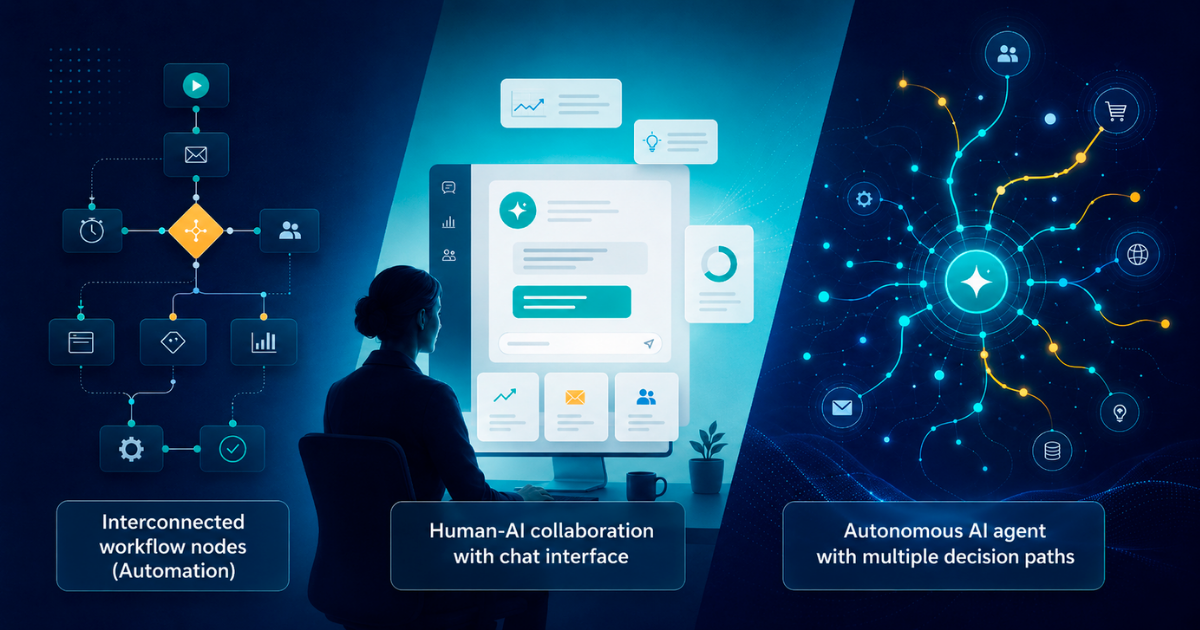
These terms are thrown around interchangeably, but they represent fundamentally different approaches to how AI and automation support marketing. Understanding the distinctions isn’t academic; they directly impact your budget, team structure, and results.
Let me break down each technology with the precision this decision deserves.
Marketing Automation: Rules-Based Execution at Scale
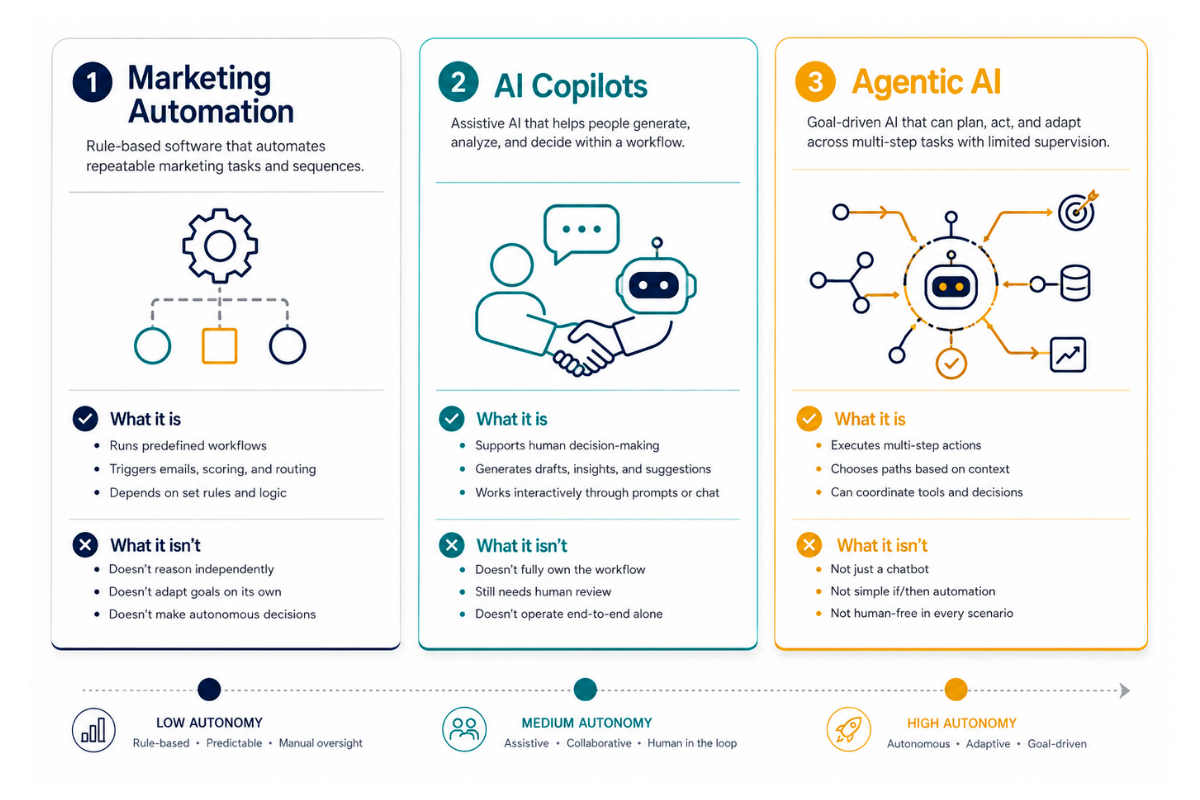
Marketing automation consists of predefined workflows that execute deterministic actions based on triggers and conditions. The keyword is deterministic: given the same input, you get the same output, every time.
Here’s what defines marketing automation:
- Human-designed logic: Someone on your team builds the workflow, defines the triggers, and specifies the actions
- Predictable outcomes: If a lead fills out a form, the same sequence fires. No variation, no surprises.
- No learning or adaptation: The system doesn’t improve unless a human updates the rules
Common examples include email sequences triggered by form submissions, lead scoring based on explicit behavioral and firmographic rules, scheduled social posts, and automated CRM data syncing.
The strengths are significant: reliability, auditability, low risk, and a mature ecosystem of proven platforms. Marketing automation programs return $5.44 per dollar spent on average, with top-quartile programs achieving $8.71 per dollar (Forrester Wave benchmarking, 2026). That’s not hype. That’s a decade of proven ROI.
One of our e-commerce clients runs a HubSpot workflow that routes leads to sales based on company size plus behavior score. It’s nothing fancy. It’s completely predictable. And it saves their sales team 15 hours of manual triage each week. Sometimes boring technology is exactly what you need.
AI Copilots: Human-Initiated Assistance
AI copilots are AI systems that augment human work by suggesting, drafting, or analyzing, but require human initiation and approval for every action. The human remains the orchestrator.
The defining characteristics:
- Reactive: The copilot responds to prompts; it doesn’t initiate work independently
- Single-task focused: You ask for a headline, you get headline suggestions. You ask for an email draft, you get an email draft.
- Human stays in the loop: Every output requires human review and approval before it goes anywhere
Examples include ChatGPT drafting email copy, Jasper suggesting headlines, HubSpot Breeze recommending subject lines, and Claude summarizing campaign performance data.
The adoption numbers are striking: 86.4% of marketers now use AI tools, especially for content and media creation (HubSpot State of Marketing 2026). Copilots have gone from experimental to essential in under two years.
But there’s a ceiling. Copilots deliver 5-10% efficiency gains at the organizational level (Gartner, McKinsey, Forrester, PwC analysis, 2025-2026) because humans remain the bottleneck. You still have to prompt, review, edit, and execute. The AI accelerates individual tasks; it doesn’t transform workflows.
Think of it this way: you prompt, it suggests, you approve, you execute. The human is the orchestrator. The AI is a very capable assistant.
Agentic AI: Goal-Directed Autonomous Execution
Agentic AI systems plan, execute multi-step workflows, use tools, and return finished results with minimal human oversight. This is the category driving all the excitement and all the concern.
Gartner defines AI agents as systems that can:
- Act proactively rather than waiting for prompts
- Reason through multi-step processes
- Use external tools (APIs, databases, email systems)
- Maintain memory across sessions
- Pursue goals rather than complete isolated tasks
A practical example: an agent that monitors intent signals, researches target accounts, drafts personalized outreach sequences, sends the messages, and schedules follow-ups, all autonomously. You set the goal (“book 20 qualified demos this month”), and the agent figures out how to achieve it.
The efficiency potential is substantial. Agentic AI delivers 20-50% efficiency gains at the organizational level, compared with copilots’ 5-10% (Gartner, McKinsey, Forrester analysis, 2025-2026). It also enables true 1:1 personalization at scale, which has been theoretically possible but practically impossible with human-dependent workflows.
Current adoption: 19.2% of marketers already leverage AI agents to automate end-to-end marketing initiatives (HubSpot State of Marketing 2026). Among enterprise marketing teams, 34% run at least one autonomous agent in production.
But here’s the critical caveat: only approximately 11% of AI pilots make it to full production. The gap between “running a pilot” and “deploying at scale” is where most organizations stumble.
Side-by-Side Comparison: Marketing Automation vs AI Copilots vs Agentic AI
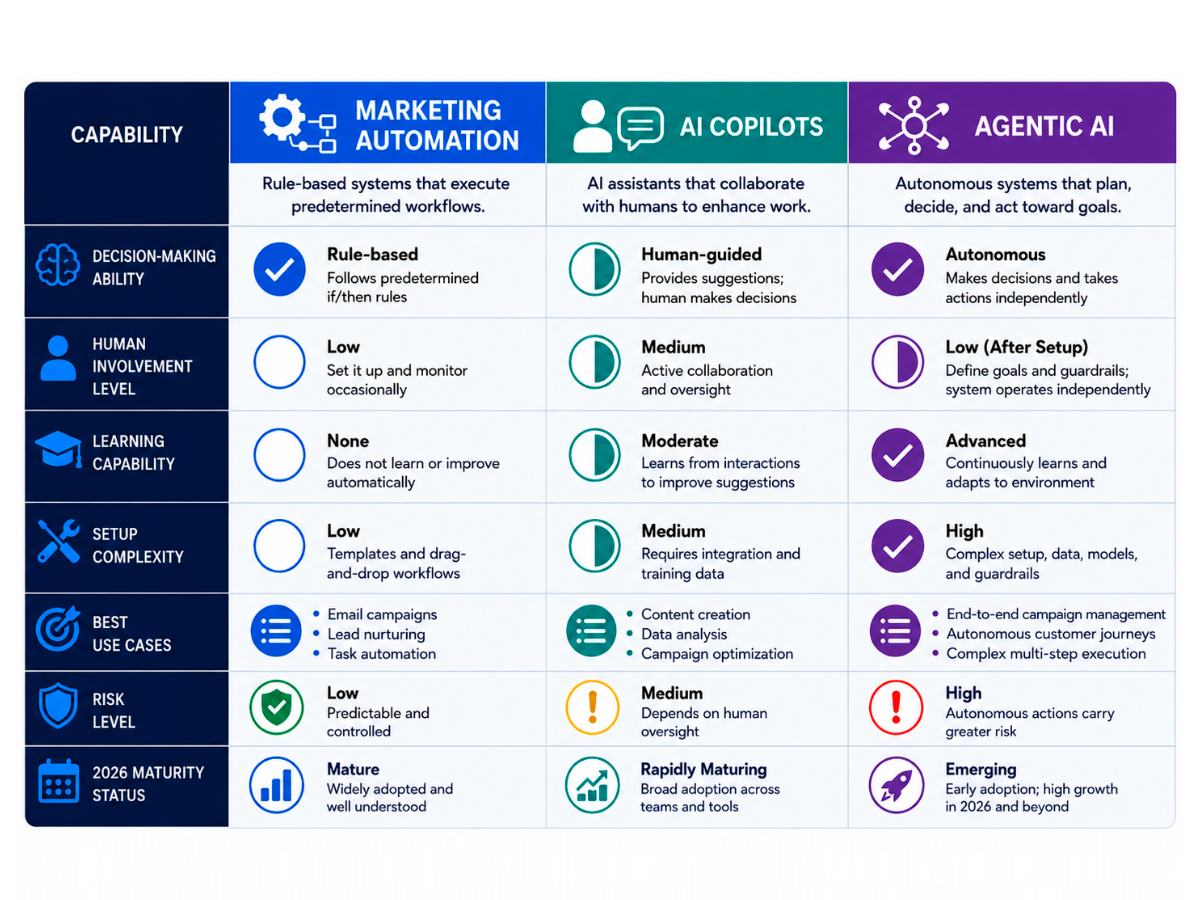
| Dimension | Marketing Automation | AI Copilots | Agentic AI |
|---|---|---|---|
| Human involvement | Designs rules; monitors execution | Initiates and approves every action | Sets goals; reviews outcomes |
| Learning capability | None without manual updates | Contextual within session | Learns from outcomes over time |
| Risk level | Low – predictable outputs | Low to Medium – human review required | Medium to High – autonomous decisions |
| Typical ROI timeline | 3-6 months | Immediate (productivity gains) | 6-12 months (requires integration) |
| Best for | High-volume, predictable workflows | Creative and analytical tasks | Complex, high-value processes |
| Platform examples | HubSpot Workflows, Marketo, Pardot | ChatGPT, Claude, Jasper, Breeze | Salesforce Agentforce, HubSpot Agents, LangChain |
The Maturity Spectrum: Where Each Technology Fits
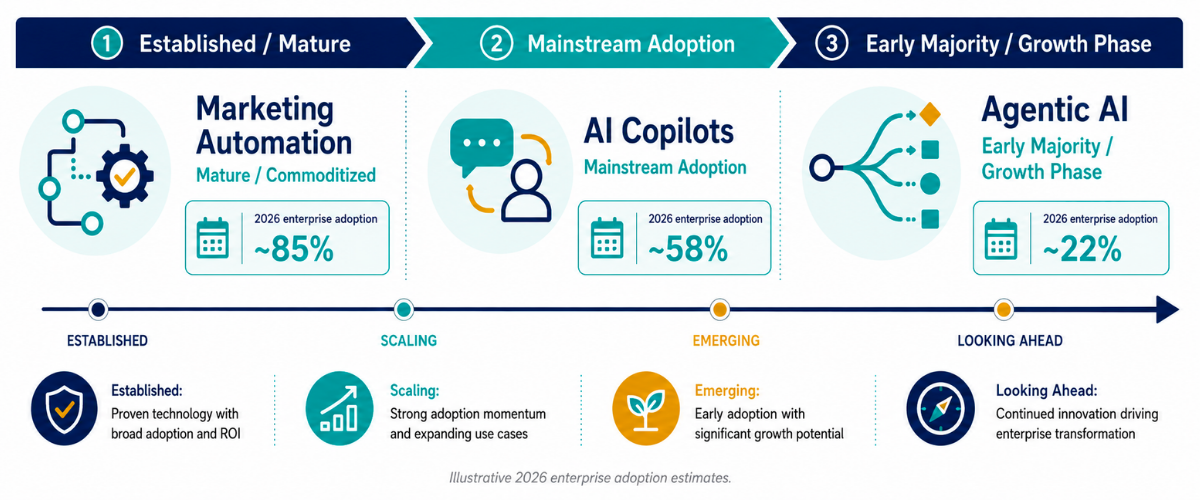
Here’s what I tell clients: this isn’t an either/or decision. It’s a spectrum. And sophisticated marketing organizations run all three technologies simultaneously, with each applied to the workflows where it delivers the most value.
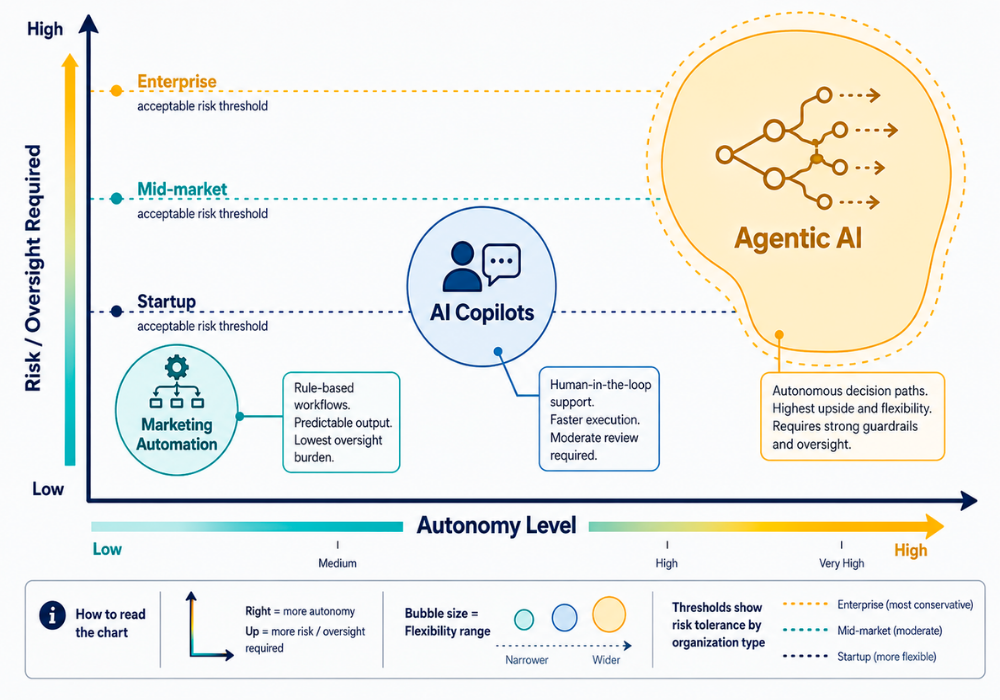
Think of it as a progression: Automation → Copilots → Agentic AI represents increasing autonomy AND increasing risk. The question isn’t “which one should we use?” It’s “which one should we use for which workflow?”
The Autonomy-Risk Tradeoff
More autonomy means more efficiency potential. It also means more governance requirements, greater integration complexity, and a higher risk of things going wrong.
I call this the “trust gradient.” How much do you trust AI to act without human review? The answer should vary by use case:
- Zero trust required: Lead routing based on company size (use automation)
- Partial trust required: Email subject line selection (copilot suggests, human approves)
- High trust required: Autonomous outreach to enterprise accounts (agentic, with monitoring)
The investment patterns reflect this reality. 63% of enterprise CMOs now report a dedicated budget line for agent infrastructure (Digital Applied, 2026). This isn’t discretionary spending, but it’s recognition that agentic systems require their own operational overhead.
Mapping Your Marketing Stack to the Spectrum
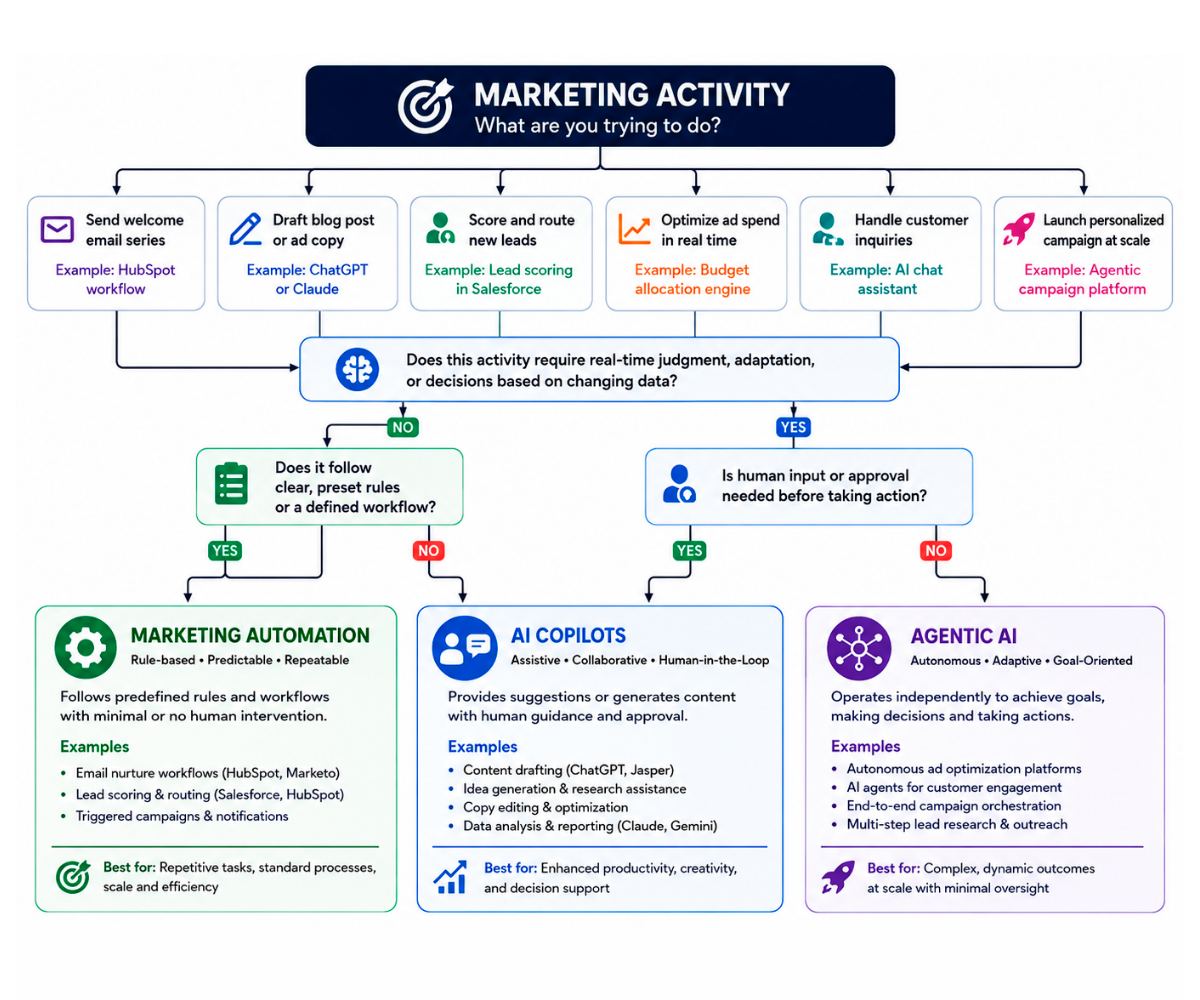
Here’s how we think about technology selection at NAV43:
Low-risk, high-volume tasks → Automation
– Email sequences triggered by behavior
– Lead routing and assignment
– CRM data syncing
– Scheduled reporting
– Compliance notifications
Creative and strategic work → Copilots
– Content creation and ideation
– Campaign messaging development
– Performance analysis and insights
– Ad copy variations
– Competitive research
High-value, complex workflows with clear success metrics → Agentic AI
– ABM account orchestration
– Intent-based outreach sequencing
– Personalized content recommendations
– Multi-touch attribution modeling
The rule we follow: use automation for the 80% of workflows that are predictable, copilots for content production and analysis, and agents only for specific high-value use cases with robust monitoring. Most organizations should start with that ratio and adjust based on results.
The NAV43 AI Marketing Technology Decision Matrix
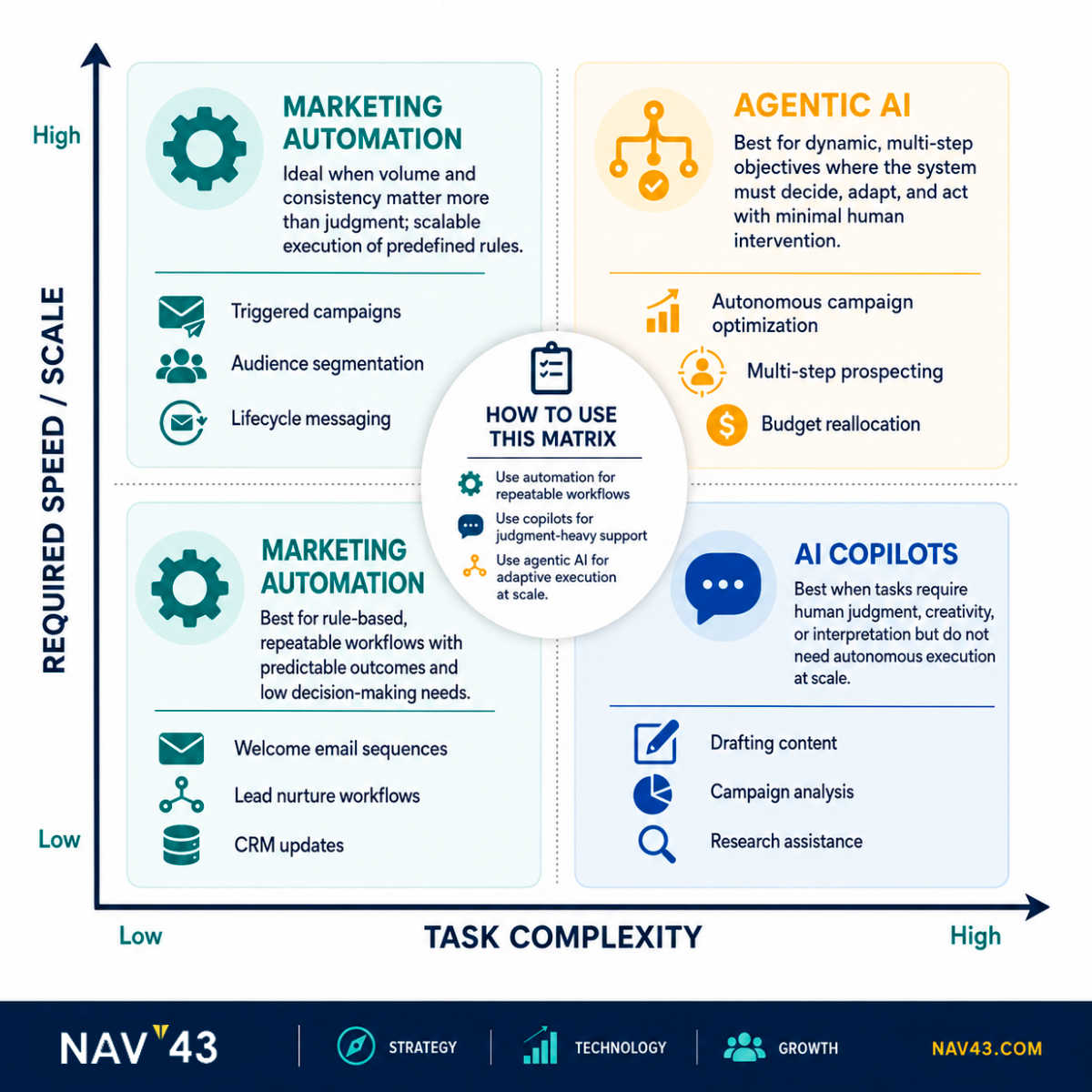
This is the framework we use with clients to move from confusion to clarity. It addresses the gap most vendors won’t acknowledge: not every workflow should be agentic, and not every AI investment is the right one.
The Four Decision Criteria
When a client asks, “Should we deploy an AI agent for this workflow?” we evaluate four criteria:
1. Workflow Complexity
– Is it a single task, a linear sequence, or a multi-step workflow with branching logic?
– Single tasks → Copilot
– Linear sequences → Automation
– Complex, branching workflows → Agentic AI (if other criteria are met)
2. Acceptable Error Rate
– What’s the cost of a mistake?
– Sending a promotional email to the wrong segment? Annoying but recoverable.
– Misquoting enterprise pricing? Potentially catastrophic.
– Higher stakes → More human oversight → Less autonomy
3. Feedback Loop Speed
– How quickly can you detect and correct errors?
– If an agent sends 1,000 emails before you catch a problem, that’s 1,000 problems.
– If you can monitor in real-time and intervene within minutes, you have more room for autonomy.
4. Team AI Maturity
– Does your team have the skills to monitor, debug, and govern AI systems?
– Can they interpret agent decision logs?
– Do they understand prompt engineering and output validation?
– Low maturity → Start with copilots; build skills before graduating to agents
NAV43 AI Technology Decision Matrix Checklist
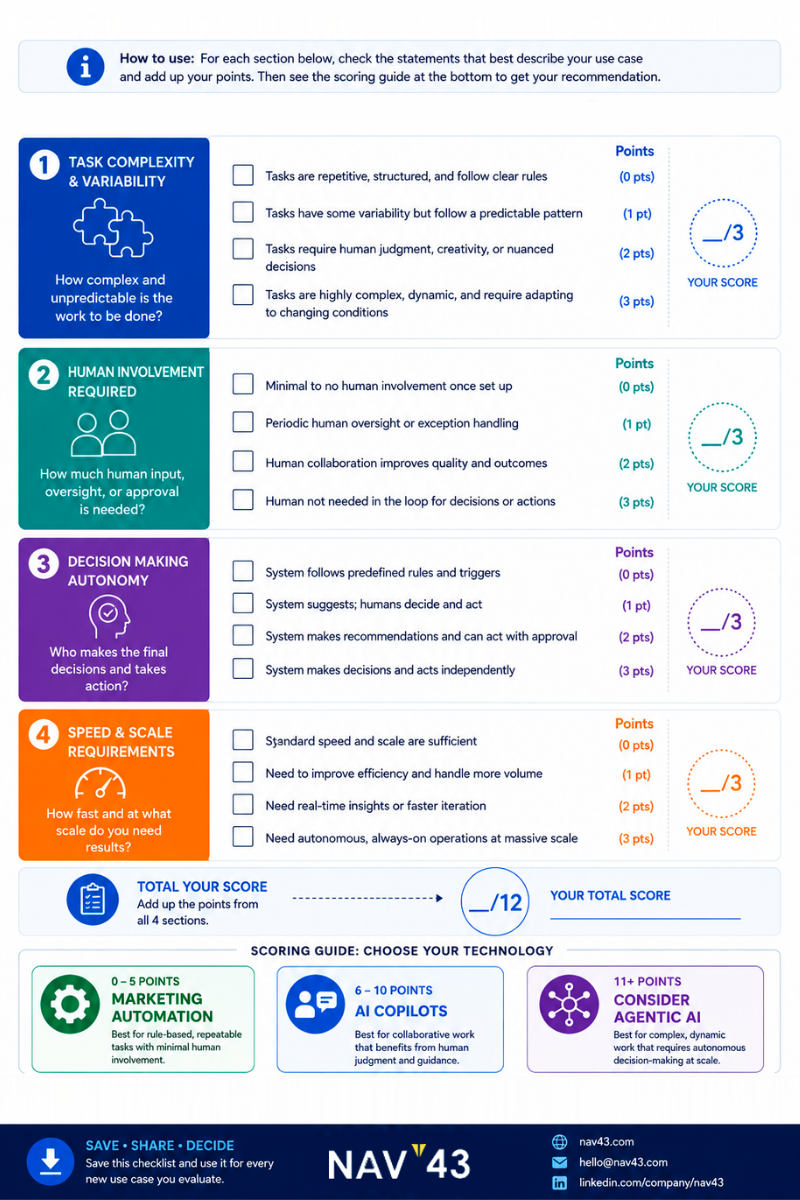
Use this checklist to evaluate any workflow before investing in technology:
Choose Copilot if:
– [ ] Workflow is single-step or task-based
– [ ] Error tolerance is low (mistakes are costly)
– [ ] Team is building AI skills but not yet mature
– [ ] Human judgment is essential to output quality
Choose Automation if:
– [ ] Workflow is linear with predictable steps
– [ ] Outcomes need to be consistent and auditable
– [ ] Error tolerance is medium (recoverable mistakes)
– [ ] Process is already documented and working manually
Consider Agentic AI if:
– [ ] Workflow is multi-step with branching logic
– [ ] Error tolerance is high (mistakes are recoverable)
– [ ] Feedback loops are fast (real-time or near-real-time)
– [ ] Team is AI-mature with monitoring capabilities
– [ ] ROI justifies governance investment
– [ ] Success metrics are clearly defined
Default to Automation + Copilot if:
– [ ] Regulatory or compliance stakes are high
– [ ] Customer-facing mistakes create legal exposure
– [ ] You’re in a YMYL (Your Money or Your Life) category
– [ ] Governance infrastructure isn’t yet built
Decision Matrix by Marketing Function
| Marketing Function | Recommended Primary | Why |
|---|---|---|
| Email nurture sequences | Automation | Predictable, auditable, proven ROI |
| Blog content creation | Copilot | Creative work benefits from human judgment |
| Lead scoring | Automation (with AI enrichment) | Needs consistency and auditability |
| ABM account research | Agentic AI | Multi-step, high-value, clear success metrics |
| Social media scheduling | Automation | Deterministic, low-risk |
| Ad copy testing | Copilot | Creative iteration with human approval |
| Intent-based outreach | Agentic AI (with human review) | Complex workflow, high value per conversion |
| Compliance review | Automation + Human | Risk too high for autonomous AI |
| Campaign performance analysis | Copilot | Requires interpretation and strategic judgment |
| Customer segmentation | Automation (rule-based) or Agentic (dynamic) | Depends on complexity and data volume |
For deeper dives into AI-driven content strategy, see our guide on AI SEO Content Strategy: Full-Funnel Approach in the AI Search Era.
The Hybrid Stack in Practice: How Leading B2B Teams Run All Three
The most sophisticated B2B marketing teams don’t choose between automation, copilots, and agents. They layer them. Each technology handles the workflows where it delivers the most value, and they integrate to create something more powerful than any single approach.
Layer 1: Automation as the Foundation
Marketing automation remains the backbone for reliable, auditable execution. This isn’t old technology being replaced – it’s mature technology serving its purpose.
The numbers tell the story: marketing automation programs return $5.44 per dollar spent on average, with top-quartile programs reaching $8.71 per dollar (Forrester Wave benchmarking, 2026). That ROI comes from predictability, not intelligence.
Use cases that should never graduate to agentic:
– Compliance notifications and legal disclaimers
– Data sync operations between systems
– Audit trail logging
– SLA-driven response triggers
– Regulatory reporting workflows
Platform examples: HubSpot workflows, Marketo programs, Pardot automation rules, Salesforce Process Builder.
We cover automation architecture in depth in our HubSpot Automations for B2B guide.
Layer 2: Copilots for Creative Acceleration
Copilots sit on top of automation, helping humans work faster within the system. The automation handles execution; the copilot accelerates creation.
The adoption is near-universal: 86.4% of marketers now use AI tools for content and media creation (HubSpot State of Marketing 2026). This is no longer a competitive advantage, but rather, it’s table stakes.
Key use cases:
– Drafting email copy and variations
– Generating ad copy for testing
– Summarizing campaign performance
– Ideating content angles and headlines
– Analyzing competitor positioning
The workflow we recommend: AI drafts → Human edits → Automation distributes. The copilot accelerates the creative bottleneck; automation handles the reliable distribution.
For teams scaling content production, our AI Content Creation Workflows guide breaks down the process step by step.
Layer 3: Agents for High-Value Autonomous Workflows
Agents operate in specific, bounded domains where ROI justifies governance investment. This is the newest layer, and it requires the most careful implementation.
The efficiency differential is real: agents deliver 20-50% efficiency gains versus copilots’ 5-10% at the organizational level (Gartner, McKinsey, Forrester analysis, 2025-2026). But that gain comes with requirements most organizations underestimate.
Requirements before deploying agents:
– Clear success metrics (not “improve efficiency” but “reduce time-to-first-touch by 40%”)
– Fast feedback loops (real-time or same-day monitoring)
– Human escalation paths (when should the agent hand off?)
– Audit logging (can you reconstruct every decision?)
– Kill switches (can you shut it down instantly if needed?)
Here’s a B2B agent workflow we’ve helped clients implement:
- Intent signal detected (third-party data or site behavior)
- Agent researches the account (firmographics, tech stack, recent news)
- Agent drafts personalized sequence
- Human approves sequence (critical checkpoint)
- Automation executes the sends
- Agent monitors engagement signals
- Agent escalates to sales when threshold is hit
Notice the hybrid architecture: the agent handles the complex reasoning, the human provides quality control, and automation handles reliable execution.
Platform examples: HubSpot Breeze Agents, Salesforce Agentforce, Microsoft Copilot Studio, custom LangChain/LangGraph builds.
The NAV43 Hybrid Stack Architecture
Here’s the framework we recommend for B2B marketing teams:
Foundation Layer: HubSpot or Salesforce automation for all deterministic workflows. This handles lead routing, email sequences, data sync, and scheduled operations. Reliability and auditability are paramount.
Acceleration Layer: AI copilots integrated into content and creative workflows. ChatGPT, Claude, or platform-native tools (HubSpot Breeze) accelerate human work without removing human judgment.
Autonomy Layer: Bounded agents for specific high-value use cases with human checkpoints. ABM orchestration, intent-based outreach, and dynamic segmentation are good candidates if governance is in place.
Governance Layer: Centralized logging, approval workflows, and kill switches for all AI systems. This is what separates the 60% that succeed from the 40% that get canceled.
The Governance Imperative: Why 40% of Agentic Projects Will Fail
Let me be direct: the failure rate for agentic AI is uncomfortably high, and most vendors won’t tell you that. If you’re considering agents, you need to understand why projects fail and how to avoid joining that statistic.
The Failure Rate Nobody’s Talking About
Over 40% of agentic AI projects will be canceled by the end of 2027 due to escalating costs, unclear business value, or inadequate risk controls (Gartner, 2025). That’s not a fringe prediction. It’s Gartner’s central forecast.
Beyond the headline number, only approximately 11% of AI pilots make it to full production. The gap between “running a proof of concept” and “operating at scale” is where most organizations stumble.
Root causes we’ve seen across client engagements:
– Underestimated integration complexity: Agents need real-time access to multiple systems. Each integration is a potential failure point.
– Missing governance infrastructure: Organizations build the agent before building the monitoring systems to watch it.
– Unclear success metrics: “We wanted to try AI agents” isn’t a success criterion.
– Change management failures: Teams don’t know how to work with agents, debug their decisions, or intervene appropriately.
I’ve seen clients budget for the AI license and completely forget to budget for the six months of workflow redesign. The technology cost is often the smallest part of the investment.
The Hidden Costs of Agentic AI
Token consumption: Agents that reason through multi-step workflows consume 10-50x more tokens than copilot interactions. An agent evaluating 100 accounts and drafting personalized sequences can burn through thousands of dollars in API costs per month.
Integration complexity: Agents need access to multiple systems, including CRM, email, intent data, a content library, and scheduling tools. Each integration requires development, testing, and ongoing maintenance. The data quality of every connected system affects agent performance.
Change management: Teams need to learn to manage AI, not just use it. This includes prompt engineering, output validation, interpretation of the decision log, and appropriate intervention. It’s a new skill set most marketing teams don’t have.
Monitoring overhead: Someone has to watch the agents, review their decisions, and intervene when they drift. This isn’t optional. It’s the cost of autonomous systems.
The budget reality: 63% of enterprise CMOs now report a dedicated budget line for agent infrastructure, including token consumption and workflow platforms (Digital Applied, 2026). If your budget doesn’t include these line items, your project probably isn’t adequately funded.
Building Governance Before Building Agents
The EU AI Act high-risk requirements take effect in August 2026. Marketing AI that influences consumer decisions may fall within scope. Even if you’re not in the EU, these regulations signal the direction of global AI governance.
Minimum governance requirements before deploying agents:
– Audit logging: Every decision the agent makes must be reconstructible
– Human escalation triggers: Clear criteria for when agents hand off to humans
– Output quality monitoring: Automated checks plus human sampling
– Kill switches: Ability to shut down any agent instantly
– Regular accuracy reviews: Scheduled assessments of agent performance
The principle is simple: if you can’t explain why the agent made a decision, you’re not ready for agents.
Agentic AI Governance Readiness Checklist
Before deploying any agent, ensure you can answer “yes” to all of these:
- [ ] Clear ownership: Who is accountable when the agent makes a mistake?
- [ ] Audit trail: Can you reconstruct every decision the agent made in the last 30 days?
- [ ] Escalation paths: Are there documented criteria for when the agent hands off to a human?
- [ ] Quality metrics: Do you have specific KPIs for measuring agent performance?
- [ ] Kill switch: Can you shut down the agent within 5 minutes if needed?
- [ ] Compliance review: Has legal/compliance approved the specific use case?
- [ ] Monitoring plan: Who reviews agent outputs daily? Weekly?
- [ ] Rollback capability: Can you revert to manual or automated workflows if the agent fails?
If you can’t answer “yes” to all of these, you’re not ready for agentic deployment. Start with copilots and build the governance infrastructure first.
The Seven Mistakes B2B Marketers Make When Choosing Between These Technologies
After helping dozens of clients navigate this landscape, patterns emerge. Here are the mistakes we see most often, and how to avoid them.
Mistake #1: Ripping Out Automation to “Go Agentic”
The error: Treating agentic AI as a replacement for automation rather than a complement.
Why it fails: Automation handles predictable, high-volume tasks reliably and cheaply. Agents are overkill for deterministic workflows. You don’t need AI reasoning to send a confirmation email.
The fix: Keep automation as your foundation. Add agents only for workflows that genuinely benefit from reasoning and adaptation.
A client wanted to replace their entire HubSpot workflow engine with agents. We showed them that the token costs alone would 4x their monthly spend for workflows that were already working fine. They kept the automation and added an agent for ABM research only.
Mistake #2: Deploying Agents Without Clear Success Metrics
The error: Launching agentic AI because it’s innovative, without defining what success looks like.
Why it fails: Without metrics, you can’t tell if the agent is helping or hurting, and you’ll join the 40% cancellation rate (Gartner, 2025).
The fix: Define specific, measurable outcomes before deployment. Not “improve efficiency” but “reduce time-to-first-touch by 40%” or “increase meeting book rate by 25%.”
Over 40% of agentic AI projects fail due to “unclear business value” (Gartner, 2025). Don’t start without knowing how you’ll measure success.
Mistake #3: Underestimating Integration Complexity
The error: Assuming agents will “just work” with your existing tech stack.
Why it fails: Agents need real-time access to CRM data, email systems, content libraries, and intent signals. Each integration requires development, testing, and maintenance. Each is a potential failure point.
The fix: Map every system the agent needs to access before committing. Budget 2-3x the time you think integrations will take. Test data quality in every connected system.
The agent is only as good as the data it can access. If your CRM is a mess, your agent will be a mess.
Mistake #4: Skipping the Copilot Phase
The error: Jumping straight from basic automation to fully autonomous agents.
Why it fails: Teams that haven’t learned to work with AI copilots lack the skills to govern and monitor autonomous systems. They don’t know how AI reasons, where it fails, or how to prompt effectively.
The fix: Spend 6-12 months with copilots first. Build AI literacy across your team before removing the human from the loop.
The statistics tell the story: 86.4% of marketers use AI tools, but only 19.2% are leveraging agents end-to-end (HubSpot State of Marketing 2026). The gap exists for a reason. It’s so teams need to build capabilities progressively.
For teams building these skills, our AI-Ready Content guide covers the fundamentals.
Mistake #5: Ignoring the Token Economics
The error: Budgeting for AI licenses without accounting for usage-based costs.
Why it fails: Agentic AI that reasons through multi-step workflows can consume 10-50x more tokens than copilot interactions. What looks affordable in a pilot becomes expensive at scale.
The fix: Model token consumption based on realistic usage before committing. Include usage costs in ROI calculations, not just license fees.
Mistake #6: Treating All Workflows as Agent Candidates
The error: Applying agentic AI to every possible workflow because it’s the newest technology.
Why it fails: Some workflows are better served by automation (predictable, high-volume) or copilots (creative, judgment-intensive). Using agents everywhere wastes resources and increases risk.
The fix: Use the decision matrix. Match technology to workflow characteristics, not ambition.
Mistake #7: Deploying Without Human Checkpoints
The error: Running agents in fully autonomous mode from day one.
Why it fails: Without human checkpoints, small errors compound before anyone notices. Customer-facing mistakes damage relationships. Compliance issues create legal exposure.
The fix: Start with human-in-the-loop deployment: agents recommend, humans approve. Graduate to autonomy only after demonstrating consistent quality over 60-90 days.
Measuring Success Across the Technology Stack
Different technologies require different metrics. Here’s how to evaluate performance across your hybrid stack.
Automation Metrics
- Workflow completion rate: What percentage of triggered workflows execute fully?
- Time savings: Hours saved versus manual execution
- Error rate: Percentage of workflows requiring human intervention
- Lead routing accuracy: Leads going to the correct owners on the first assignment
- ROI: Revenue influenced divided by platform and setup costs
Target benchmark: Marketing automation programs should return $5-8 per dollar spent (Forrester, 2026).
Copilot Metrics
- Production velocity: Content pieces produced per creator per week
- Revision rate: Edits required on AI-generated drafts
- Time-to-publish: Duration from brief to published content
- Quality consistency: Editorial quality scores across outputs
- Adoption rate: Percentage of team actively using copilot tools
Agent Metrics
- Goal completion rate: Percentage of assigned goals achieved
- Escalation rate: How often agents hand off to humans
- Error detection latency: Time between agent error and human intervention
- Token efficiency: Output value per dollar of token consumption
- Human approval rate: Percentage of agent outputs approved without modification
For agents, the escalation rate is particularly telling. Too low suggests insufficient monitoring. Too high suggests the agent isn’t adding value. Target 10-20% escalation rate for mature deployments.
For teams building measurement frameworks, our AI SEO KPIs guide covers the metrics that matter in the current landscape.
The 12-Month Roadmap: From Current State to Hybrid Stack
For teams ready to build a sophisticated, hybrid approach, here’s the phased roadmap we recommend.
Months 1-3: Foundation Assessment
- Audit current automation workflows for reliability and ROI
- Document all marketing processes and their complexity levels
- Assess team AI maturity through skills inventory
- Identify high-value workflow candidates for copilot acceleration
- Establish baseline metrics for all priority workflows
Months 4-6: Copilot Integration
- Deploy copilots for content creation workflows
- Train the team on prompt engineering and output validation
- Integrate copilots with existing content management systems
- Measure productivity gains and quality maintenance
- Build AI literacy across marketing team
Months 7-9: Agent Pilot
- Select one bounded, high-value use case for the agent pilot
- Build governance infrastructure (logging, escalation, kill switches)
- Deploy agent with human-in-the-loop approval
- Monitor closely and iterate on prompts and workflows
- Document decision patterns and failure modes
Months 10-12: Scale and Optimize
- Evaluate pilot results against defined success metrics
- Expand agent deployment if pilot succeeds (or pivot if not)
- Automate monitoring and alerting
- Develop runbooks for common agent interventions
- Plan next phase of agent deployment based on learnings
This timeline assumes adequate resources and clear executive sponsorship. Rushing the timeline increases the risk of joining the 40% failure rate.
Conclusion: The Strategic Framework for AI Technology Decisions
The conversation around agentic AI, marketing automation, and AI copilots has been clouded by hype. Vendors promise transformation; implementation reality delivers complexity. The 40% failure rate for agentic projects isn’t pessimism; it’s data that should inform your decisions.
Here are the key takeaways:
- Marketing automation remains foundational. It delivers proven ROI ($5.44-$8.71 per dollar spent), handles predictable workflows reliably, and doesn’t require the governance overhead of autonomous systems. Don’t rip it out to chase the newest technology.
- Copilots are table stakes. With 86.4% of marketers using AI tools, the question isn’t whether to adopt copilots but how to integrate them into existing workflows. They accelerate human work without removing human judgment.
- Agentic AI is powerful but risky. The 20-50% efficiency gains are real, but so is the 40%+ project failure rate. Deploy agents only for high-value workflows where governance infrastructure is in place, and success metrics are defined.
- The hybrid stack wins. Sophisticated teams layer all three technologies: automation for reliability, copilots for acceleration, agents for high-value autonomous workflows. Match technology to workflow characteristics, not ambition.
- Governance is the differentiator. The organizations that succeed with agentic AI are the ones that build monitoring, escalation paths, and kill switches before they build agents. If you can’t explain why the agent made a decision, you’re not ready for agents.
Next Steps: Building Your Technology Strategy
The framework in this article gives you the structure for making better technology decisions. Here’s how to put it into practice:
- Audit your current state. Document every marketing workflow and its technology. Identify what’s working and what’s struggling.
- Apply the decision matrix. For each workflow, evaluate complexity, error tolerance, feedback loop speed, and team maturity. Match technology to the criteria.
- Start with copilots if you haven’t already. Build AI literacy on your team before introducing autonomous systems.
- Build governance before building agents. Audit logging, escalation paths, and kill switches aren’t optional.
- Define success metrics before deploying. If you can’t measure it, you can’t manage it, and you’ll join the 40% failure rate.
If you want a structured assessment of your current technology stack and a roadmap tailored to your organization’s maturity, get your free NAV43 growth plan. We’ll evaluate your automation, copilot, and agent opportunities – and help you avoid the expensive mistakes we see organizations make every day.
The AI marketing landscape is evolving faster than any of us predicted. The organizations that win won’t be the ones that chase every new technology. They’ll be the ones that match the right technology to the right workflow – and have the governance discipline to scale what works.
