How to Create AI Ready Content: The Definitive Guide to Ranking in the Age of Artificial Intelligence
Last updated: May 2026. AI readiness in SEO refers to how well your content is structured, formatted, and optimized for discovery and citation by AI-powered search systems like ChatGPT, Google’s AI Overviews, and Perplexity. In 2026, 67% of enterprise marketers report AI search as their primary visibility channel (Gartner, 2026). This guide delivers the complete framework for creating content that AI systems can parse, understand, and cite as authoritative.
What Is “AI Readiness” in SEO? Definition and Core Principles
AI readiness means your website content meets the technical, structural, and semantic requirements that large language models need to accurately interpret and cite your information. Unlike traditional SEO that optimizes for keyword matching algorithms, AI readiness focuses on machine comprehension, semantic clarity, and citation-worthiness.
A site achieves AI readiness when it demonstrates these five characteristics:
- Machine-readable structure: Clear heading hierarchy, schema markup, and logical content organization
- Semantic precision: Unambiguous language with explicit context and defined terminology
- Citation-worthy authority: Verifiable claims, expert attribution, and trustworthy sourcing
- Answer-first formatting: Direct responses to user questions within the first 60 words of each section
- Standardized metadata: Consistent tagging, structured data, and content optimized for reuse
For a deeper dive into structuring pages for AI answers, see our guide on AEO content formatting.
What Does AI Readiness Mean?
AI readiness means your organization’s content, data infrastructure, and technical systems are prepared to be discovered, interpreted, and cited by artificial intelligence. For SEO specifically, this translates to content that LLMs can tokenize cleanly, extract accurate answers from, and reference as a trusted source. According to Forrester’s 2026 AI Marketing Report, companies with AI-ready content infrastructure see 3.2x higher citation rates in generative search results (Forrester, 2026).
The concept extends beyond content formatting. True AI readiness encompasses your entire digital ecosystem – from how your data is organized to whether your technical infrastructure supports AI crawlers. Organizations must evaluate their AI crawler accessibility alongside traditional search bot optimization.
Is SEO Dead or Evolving in 2026?
SEO is not dead – it is undergoing its most significant evolution since Google launched in 1998. Traditional ranking factors like backlinks and content quality remain important, but they now operate within an AI-mediated discovery ecosystem. According to SparkToro’s 2026 research, 64.8% of Google searches now end without a click to any website (SparkToro, 2026), up from 59.7% in 2024.
The shift represents transformation, not extinction. Brands that adapt their SEO strategy to include generative engine optimization (GEO) are capturing visibility in AI Overviews, ChatGPT citations, and Perplexity answers. Those clinging to keyword-only strategies are losing ground to competitors who understand that AI systems evaluate expertise, structure, and semantic clarity above keyword density.
What Are the Three Pillars of AI Readiness?
The three pillars of AI readiness are: technical infrastructure, content architecture, and authority signals. Each pillar must be optimized for your content to achieve maximum visibility in AI-powered search systems.
Pillar 1: Technical Infrastructure – Your site must be crawlable by AI systems (GPTBot, ClaudeBot, PerplexityBot), load quickly, implement proper schema markup, and maintain clean URL structures. This foundation enables AI to access and process your content.
Pillar 2: Content Architecture – Information must be organized with clear heading hierarchies, self-contained answer blocks, and logical topic clustering. Each section should function as a standalone, citable chunk that AI can extract without losing context.
Pillar 3: Authority Signals – E-E-A-T (Experience, Expertise, Authoritativeness, Trustworthiness) must be demonstrable through author credentials, verifiable citations, and consistent expertise across your content ecosystem. Learn more about building machine-verifiable expertise in our author pages and E-E-A-T guide.
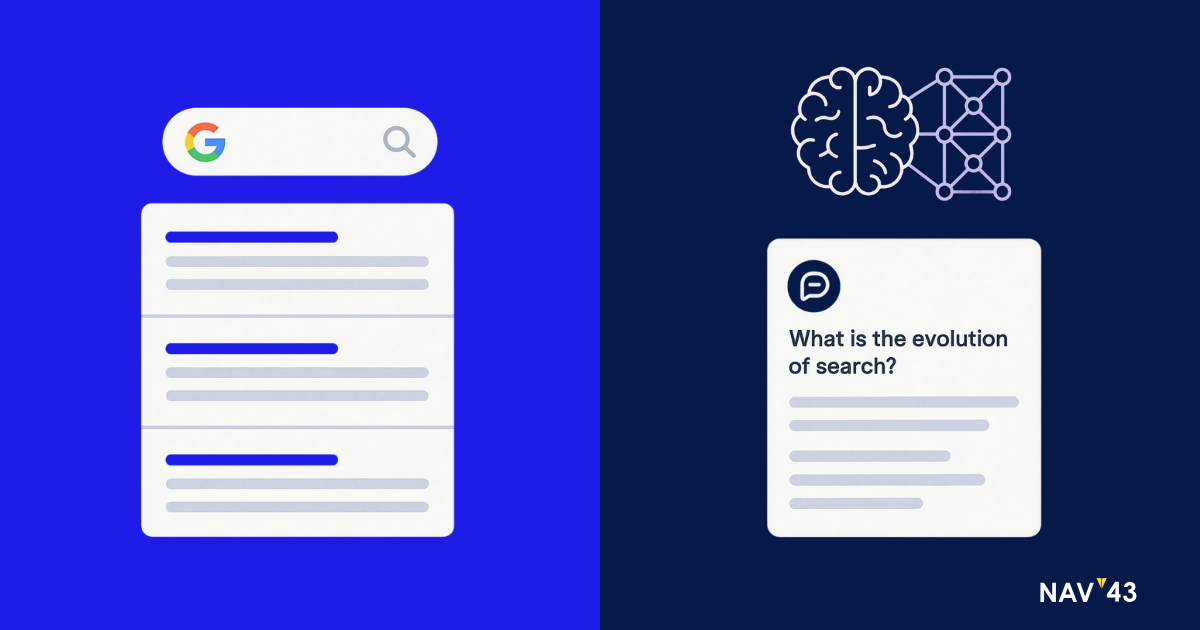
Why Artificial Intelligence Is Changing SEO Forever
The integration of AI into search represents a paradigm shift, not an incremental update. Google processes over 8.5 billion searches daily, and AI Overviews now appear for 47% of informational queries (Search Engine Land, 2026). Microsoft reported that Bing usage increased 23% after expanding Copilot integration – the largest sustained growth in the platform’s history.
Three fundamental changes are driving this revolution:
First, user behavior has evolved from keywords to conversations. Instead of typing “best CRM software,” users now ask complete questions: “What’s the best CRM for a 10-person sales team with Salesforce integration?” AI excels at understanding these natural language queries and providing nuanced answers.
Second, the SERP itself has been reimagined. Google’s AI Overviews now appear above traditional results for millions of queries, synthesizing information from multiple sources into comprehensive answers. Bing Copilot goes further, engaging users in multi-turn conversations that pull from various websites in real-time.
Third, the definition of “search” has expanded. ChatGPT alone serves over 200 million weekly users who treat it as their primary research tool (OpenAI, 2026). Perplexity, Claude, and other AI assistants are creating new discovery channels that bypass Google entirely.
Impact on Traditional Ranking Factors
While backlinks and content quality remain important, their influence operates differently in AI-powered search:
Backlinks now signal authority to AI, not just algorithms. LLMs are trained on web data where frequently-linked sources appear more often, creating an implicit bias toward well-referenced content. However, AI also evaluates the semantic context of those links.
Content quality transcends keyword optimization. AI systems evaluate expertise through factual accuracy, logical structure, and comprehensive coverage. They can detect thin content, keyword stuffing, and other manipulation tactics that might fool traditional algorithms.
E-E-A-T becomes measurable. AI can cross-reference claims, verify credentials, and assess whether content demonstrates genuine expertise versus surface-level knowledge.
Opportunities and Challenges for Marketers
Opportunities: AI democratizes visibility for truly helpful content. Small sites with deep expertise can earn citations alongside major brands. The focus on answering specific questions creates opportunities for niche content. AI’s ability to understand context means less competition for exact-match keywords.
Challenges: Gaming the system becomes nearly impossible – AI detects and ignores manipulative tactics. The bar for content quality rises significantly. Attribution and traffic patterns shift as users get answers without clicking through. Measuring success requires new metrics beyond traditional rankings. For guidance on tracking AI visibility, explore our AI search visibility dashboard guide.
How Large Language Models Interpret Your Content
Understanding how LLMs process information is crucial for effective AI SEO. AI models use transformer architectures and natural language processing to extract meaning from content through a multi-stage process. These models don’t “read” content like humans or crawl it like search bots – they deconstruct text into tokens, analyze semantic relationships, and reconstruct meaning based on patterns learned from billions of examples.
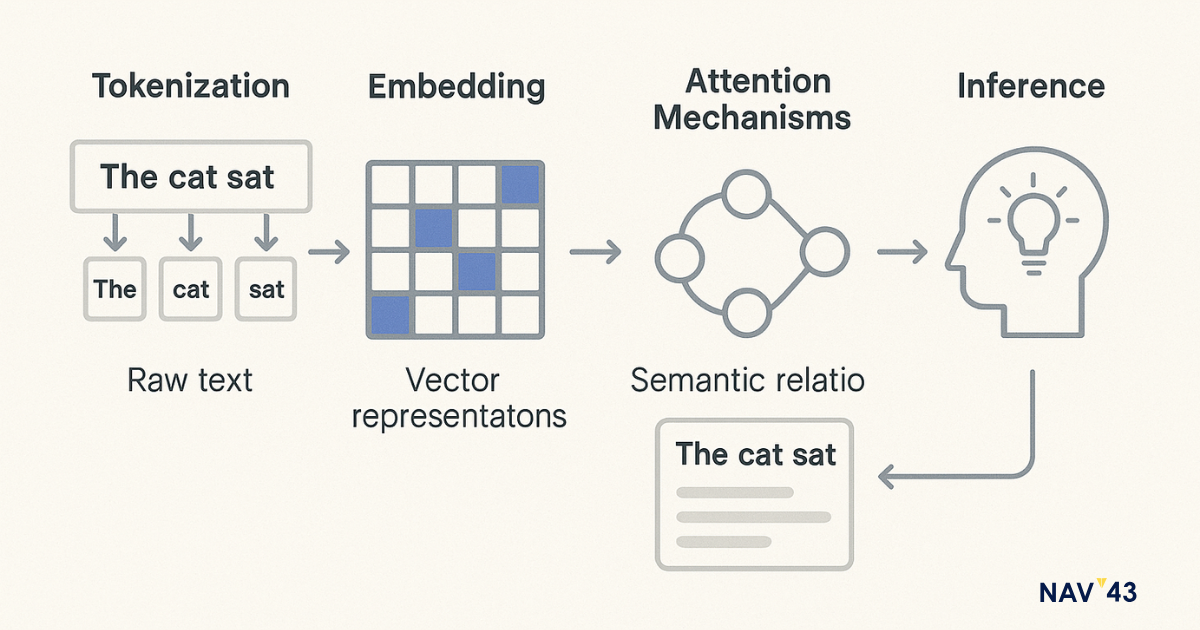
When an LLM encounters your webpage, it follows a multi-step process:
1. Tokenization: Your content is broken into tokens (words or word fragments). A 1,000-word article might become 1,300-1,500 tokens. Each token carries semantic weight based on its context and position.
2. Embedding: Tokens are converted into high-dimensional vectors that represent meaning. Similar concepts cluster together in this vector space – “car,” “automobile,” and “vehicle” would have similar embeddings.
3. Attention mechanisms: The model identifies which tokens relate to others, understanding that “it” in sentence 3 refers to “the product” in sentence 1. This creates a semantic map of your content.
4. Context windows: Current LLMs can process 4,000-200,000 tokens at once. How your content fits within these windows affects comprehension. Clear structure helps models maintain context across longer pieces.
5. Inference: When answering queries, the model searches its understanding for relevant patterns, extracting and combining information to generate responses.
Tokenization and Semantic Clarity
Semantic clarity is your North Star for AI optimization. Every sentence should convey one clear idea. Every paragraph should develop one concept. Every section should answer one question completely.
LLMs excel at understanding clear, logical progressions of thought. They struggle with ambiguous pronouns, nested clauses, and implicit references. Consider these examples:
Poor: “Our solution addresses this by implementing that functionality which enterprises need.”
Better: “Our CRM software solves the integration challenge by syncing directly with Salesforce APIs.”
The second version eliminates ambiguity. The model immediately understands what solution, what problem, and what method. This semantic precision dramatically improves your content’s AI visibility.
Chunking, Citations, and Answer Extraction
AI systems extract answers by identifying self-contained “chunks” of information. A chunk might be a paragraph explaining a concept, a list of steps, or a Q&A pair. The clearer your chunk boundaries, the easier for AI to extract accurate answers.
Effective chunking strategies include:
- One idea per paragraph: Each paragraph should stand alone as a potential answer
- Clear topic sentences: Start paragraphs with the main point
- Logical transitions: Use explicit connectors between ideas
- Complete thoughts: Don’t assume context from previous sections
For citations, AI systems prefer content with explicit sources and verifiable claims. Statements like “According to Gartner’s 2026 AI Report…” provide clear attribution that models can reference. Citing trustworthy sources builds authority and increases the likelihood of your content being cited by AI.
10 Proven Tactics to Optimize Content for AI Search
After analyzing thousands of AI-generated responses and testing optimization strategies across multiple platforms, we’ve identified the tactics that consistently improve AI visibility. These aren’t theoretical – they’re battle-tested methods that increase your chances of being discovered, understood, and cited by AI systems.
1. Build a Logical Heading Hierarchy
Your heading structure is the skeleton that AI uses to understand your content’s organization. LLMs treat H1/H2/H3 tags as signals of content hierarchy and topic shifts. A well-nested structure creates a blueprint for comprehension.
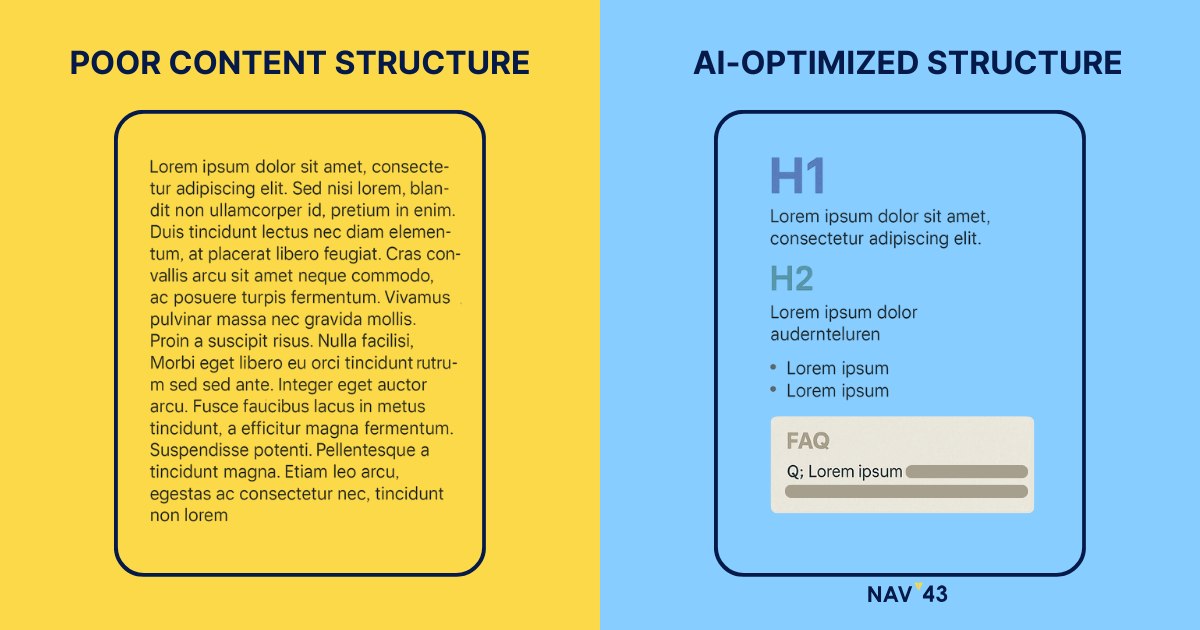
Use one H1 for your main topic, then logically nested H2s for major sections, H3s for subsections. For example:
- H1: AI SEO Guide
- H2: How LLMs Process Content
- H3: Tokenization Process
- H3: Semantic Analysis
- H2: Optimization Tactics
This hierarchy helps AI quickly locate relevant sections when answering specific questions. Without clear structure, models struggle to determine which information relates to which topic.
2. Keep Paragraphs Short and Focused
Each paragraph should convey exactly one idea. LLMs favor self-contained paragraphs because they can extract the correct snippet without wading through unrelated details. Aim for 1-3 sentences per paragraph.
Long paragraphs mixing multiple concepts force AI to untangle ideas, reducing accuracy. When you find yourself writing lengthy paragraphs, look for natural break points. Each new point deserves its own paragraph with a clear topic sentence.
This approach also boosts readability scores – content written at an 8th-11th grade level consistently earns more AI citations. Concise writing helps humans and machines follow your logic without confusion.
3. Use Lists, Tables, and Q&A Blocks
Structured formats are goldmines for AI extraction. Bullet lists, numbered steps, comparison tables, and FAQ blocks create clear boundaries around facts and answers. When content appears in these formats, AI can lift specific elements verbatim.
Example FAQ format that AI loves:
Q: What is structured data?
A: Structured data is machine-readable code (like JSON-LD) that explicitly describes your content’s meaning. It helps search engines and AI understand exactly what your page contains.
Lists work especially well for:
- Step-by-step processes
- Feature comparisons
- Key takeaways
- Benefit summaries
Tables excel at presenting comparative data, specifications, or any information requiring side-by-side analysis. Each cell becomes a discrete chunk AI can reference.
4. Front-Load Answers (TL;DR First)
Lead with your conclusion, then provide supporting details. AI systems often prioritize information appearing early in sections. Don’t bury the lede – state your main point immediately.
This inverted pyramid approach serves both AI and human readers. Start sections with direct answers:
“Answer: Email marketing delivers an average ROI of 3,600% according to Litmus research (Litmus, 2026). Here’s why…”
Then expand with context, examples, and nuance. This front-loading ensures AI captures your key message even if it truncates longer explanations.
5. Write in Plain Language and Anticipate Questions
Modern search is conversational – write the way people ask questions. Frame headings as natural queries: “How does AI SEO work?” instead of “AI SEO Functionality.” This directly signals what questions your content answers.
Use active voice and simple vocabulary. Replace jargon with plain explanations. Write “AI helps you find customers” not “AI facilitates customer acquisition optimization.” Clarity beats complexity every time.
Anticipate follow-up questions and answer them preemptively. If explaining a concept, cover the what, why, how, when, and who. This comprehensive approach means AI can pull complete answers from your content without needing to search elsewhere.
6. Embed Data, Facts, and Expert Quotes
AI systems favor evidence-backed content with concrete details. Adding relevant statistics, expert quotes, and specific examples can increase AI citation rates by up to 41% according to recent studies (Princeton NLP Group, 2025).
When making claims, support them with data: “Mobile commerce grew 18% in 2025, reaching $542 billion (eMarketer, 2026).” This specificity signals authority and provides citable facts.
Include expert perspectives: “As Rand Fishkin notes, ‘Zero-click searches now account for nearly two-thirds of Google queries.'” Direct quotes give AI authoritative snippets to reference while building trust through third-party validation.
7. Implement Relevant Structured Data Markup
Schema markup remains powerful for AI comprehension, not just traditional SEO. Leading AI platforms confirm they use structured data to understand content context and relationships. For detailed implementation guidance, see our structured data for GEO guide.
Priority schemas for AI visibility:
- FAQPage: Perfect for Q&A sections, explicitly marking question-answer pairs
- HowTo: Ideal for tutorials, marking each step clearly
- Article: Provides publication context including author, date, and topic
- Product: Defines features, pricing, and specifications
- Organization: Establishes your entity and expertise
Schema acts as a reinforcement layer – it won’t fix poor content but helps AI parse good content more accurately. Think of it as providing explicit labels for implicit meaning.
8. Optimize for Both Humans and Machines
The best AI optimization aligns perfectly with user experience. Clear headings help people scan and help AI navigate. Concise paragraphs improve readability for everyone. Structured data benefits both featured snippets and AI extraction.
Avoid the temptation to over-optimize for machines at the expense of natural writing. AI systems are trained on human-written content and prefer natural language patterns. Write primarily for your audience while incorporating AI-friendly structure.
Remember that traditional SEO still matters – AI systems often discover content through standard search rankings. Strong fundamentals (site speed, mobile optimization, quality backlinks) create the foundation for AI visibility.
9. Cluster Topics and Internal Linking
Create comprehensive topic clusters that demonstrate expertise across related subjects. When AI evaluates your content, it considers the broader context of your site’s knowledge graph.
Structure clusters with:
- Pillar pages covering broad topics comprehensively
- Supporting pages diving deep into subtopics
- Descriptive internal links connecting related content
- Clear URL structures reflecting topic relationships
This approach enables AI to understand your site’s areas of expertise and navigate between related concepts. Use descriptive anchor text that explains what the linked page covers.
10. Maintain Content Freshness
AI systems increasingly weight recency as a quality signal. Content with recent updates, current statistics, and timely references demonstrates ongoing maintenance and accuracy. Review and refresh cornerstone content quarterly to maintain AI visibility.
Update statistics annually, replace outdated examples, and add new developments in your field. This freshness signal tells AI systems your content reflects current reality, not historical snapshots.
Key Takeaways
- AI readiness in SEO means optimizing for machine understanding and citation, not just traditional rankings
- Structure, semantic clarity, and authority matter more than keyword density in 2026
- The three pillars of AI readiness are technical infrastructure, content architecture, and authority signals
- SEO is evolving, not dying – brands must integrate GEO alongside traditional optimization
- Success means becoming a trusted source that AI systems cite when answering questions in your domain
- Traditional SEO fundamentals remain important as the foundation for AI discoverability
