AI SEO KPIs in a Zero-Click Search Environment: B2B Measurement Framework for 2026
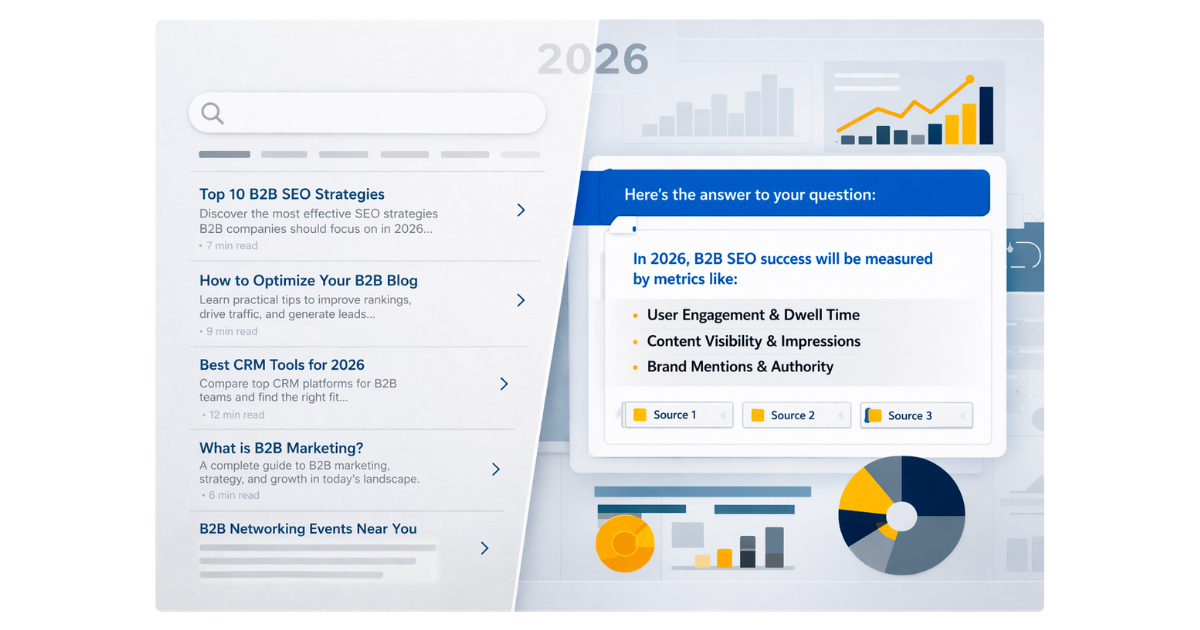
Your rankings are stable. Your content is indexed. Your SEO team is hitting its targets. And your organic traffic just dropped 40%.
I call this “The Great Decoupling” – the phenomenon where search volume increases while clicks decrease. It’s happening to nearly every B2B brand I work with, and if you’re reading this, it’s probably happening to you too.
Here’s the stat that should stop you in your tracks: 73% of B2B websites experienced significant traffic loss between 2024 and 2025 (Onely, 2025). Not because they’re doing SEO wrong. Because the rules changed underneath them.
The numbers paint a stark picture. 58.5% of US searches and 59.7% of EU searches now end without a click (Semrush, 2025). When AI Overviews appear – which now happens in over 30% of queries – organic CTR drops 61% (Seer Interactive, 2025). The old playbook of “rank higher, get more traffic” has fundamentally broken.
But here’s what most marketing leaders miss: this isn’t a crisis. It’s a filter. Brands measuring the right metrics are discovering that AI-referred traffic converts 23x better than traditional organic visitors (Ahrefs/Passionfruit, 2025). The opportunity is massive – if you know where to look.
In this article, I’m giving you the complete framework we use at NAV43 to measure AI SEO success in this new reality. You’ll get the specific KPIs that matter, the tool stack to measure them, and the attribution model that connects AI visibility to pipeline and revenue. No theory. Just the exact system we’ve built from working with 50+ B2B and e-commerce brands navigating this transition.
The marketing dashboards you’re presenting to leadership right now? They’re lying to you. Let me show you what to measure instead.
The Zero-Click Reality: What Changed and Why Traditional KPIs Are Failing
The Numbers Behind the Shift
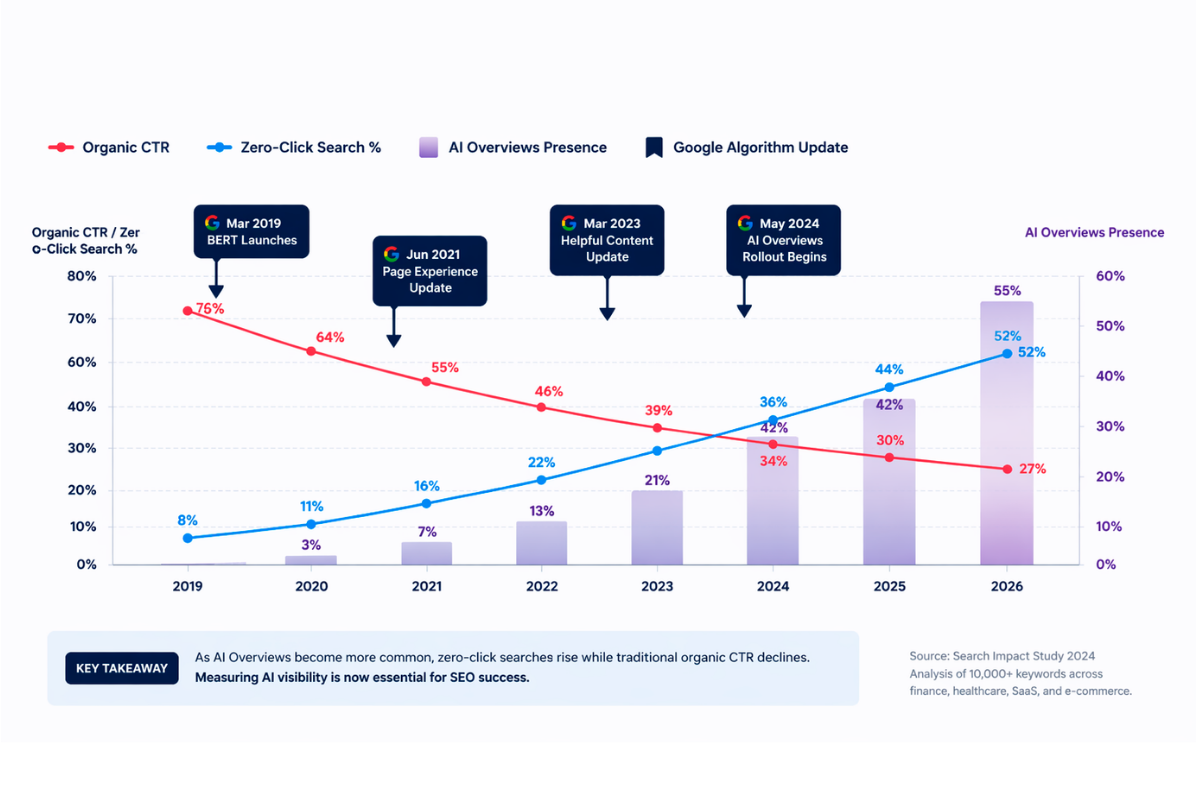
Let me paint you a picture of just how dramatically the landscape has changed.
When AI Overviews appear on a search results page, organic click-through rate drops from 1.76% to 0.61% – a 61% decline. Paid CTR fares even worse, dropping 68% from 19.7% to 6.34% (Seer Interactive, 2025). And that’s just for standard AI Overviews.
Google’s new AI Mode is even more aggressive. Around 93% of AI Mode searches end without a click to any external website (Ahrefs, 2025). Compare that to 43% for standard AI Overviews, and you see the trajectory clearly.
Gartner predicted that traditional search engine volume would drop 25% by 2026 due to AI chatbots and virtual agents (Gartner, 2024). We’re watching that prediction unfold in real-time. But here’s what the raw traffic numbers don’t tell you: the decline isn’t uniform. Informational queries have been hit hardest – the “what is” and “how to” searches that historically drove top-of-funnel awareness. Commercial and transactional queries remain stronger, at least for now.
This matters because most B2B content strategies are built around informational queries. If your primary KPI is organic sessions, you’re watching a number that no longer correlates with your actual market influence.
Why Your Current Dashboard Is Lying to You
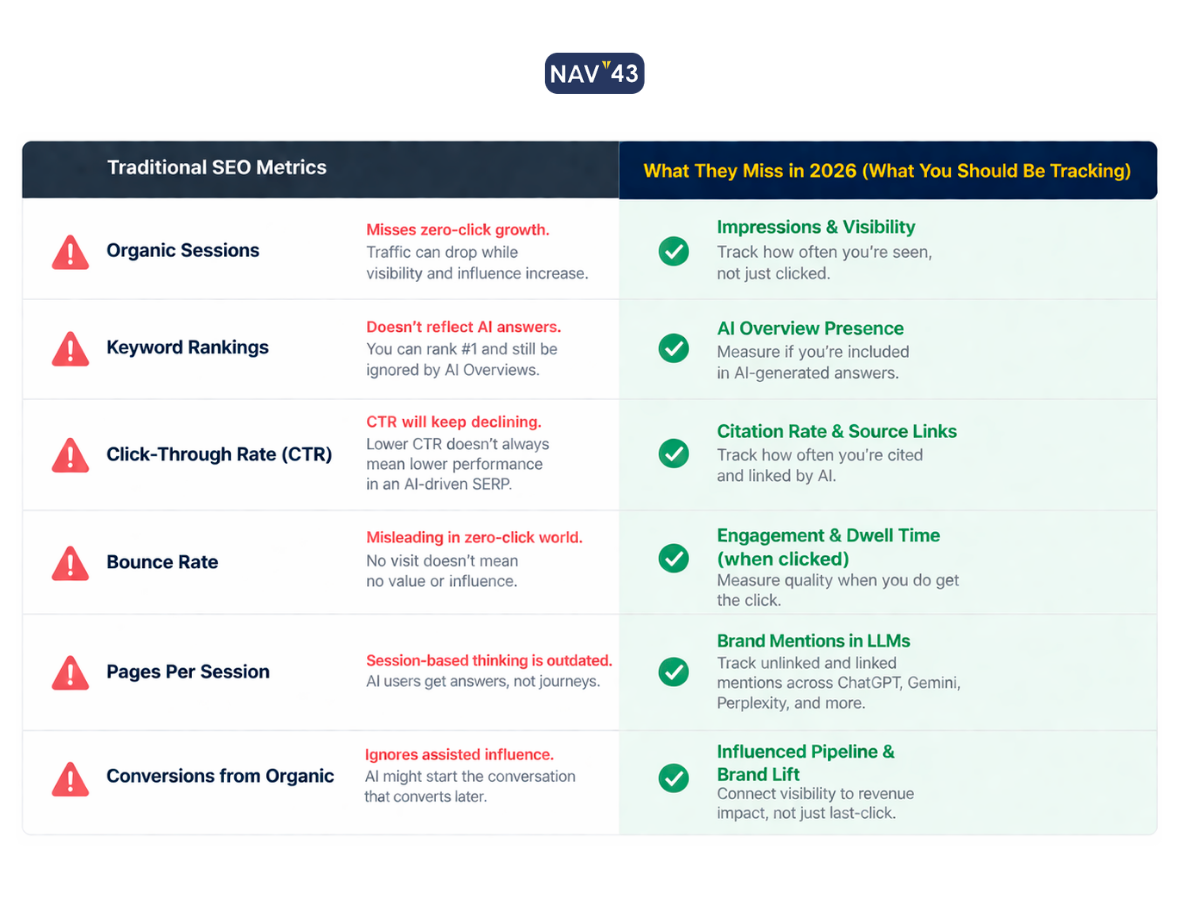
I was reviewing a B2B SaaS client’s Q4 numbers last month. Their rankings improved across 200+ target keywords while organic sessions dropped 28%. The old me would have panicked. The new me knew exactly where to look.
The problem isn’t the data – it’s the attribution gap. Value is being created before and without clicks. A prospect queries ChatGPT about “best enterprise CRM for manufacturing” and sees your brand mentioned as a leader. They don’t click anything. Two weeks later, they search your brand name directly and convert. That conversion gets attributed to “branded organic” or “direct,” completely masking the AI touchpoint that created the opportunity.
Only 1% of searches lead to users clicking a link within an AI Overview (Pew Research Center, 2025). Yet brands cited in AI Overviews earn 35% more organic clicks and 91% more paid clicks compared to non-cited brands on other queries (Seer Interactive, 2025). The visibility creates downstream value that your current analytics can’t see.
This is the visibility paradox: you can rank #1 and still be invisible if the AI Overview answers the query completely. Your traditional dashboard shows success while your actual market influence erodes.
The Citation Gap: A Hidden Competitive Advantage
Here’s where things get interesting for forward-thinking marketers.
Only 12% of URLs cited by ChatGPT, Perplexity, and Copilot rank in Google’s top 10 search results. Even more striking: 80% of LLM citations don’t rank in the top 100 Google results at all (Ahrefs, 2025).
This means AI visibility has become a parallel track to traditional rankings. Companies can gain significant AI citation presence without traditional ranking success, and vice versa. A brand crushing it in traditional SEO might be completely absent from AI responses, while a smaller competitor with better-structured, more authoritative content dominates the AI conversation.
Citation tracking is now a separate, parallel KPI track to traditional rankings. And most B2B marketing teams aren’t measuring it at all.
The Great Decoupling: Before vs. After AI Search
| Metric | Traditional SEO Assumption | 2026 Reality |
|---|---|---|
| Rankings | Higher rankings = more traffic | Higher rankings + AI Overview = fewer clicks |
| Traffic | Sessions are the primary success indicator | Sessions hide AI-influenced conversions |
| Attribution | Last-click captures value | AI touchpoints invisible in standard attribution |
| Success indicators | Rankings, sessions, bounce rate | Citations, share of voice, branded search lift |
| Competitive analysis | Track competitor rankings | Track competitor AI citations across platforms |
The NAV43 AI Visibility Scorecard: A New KPI Framework for B2B
Introducing the Framework
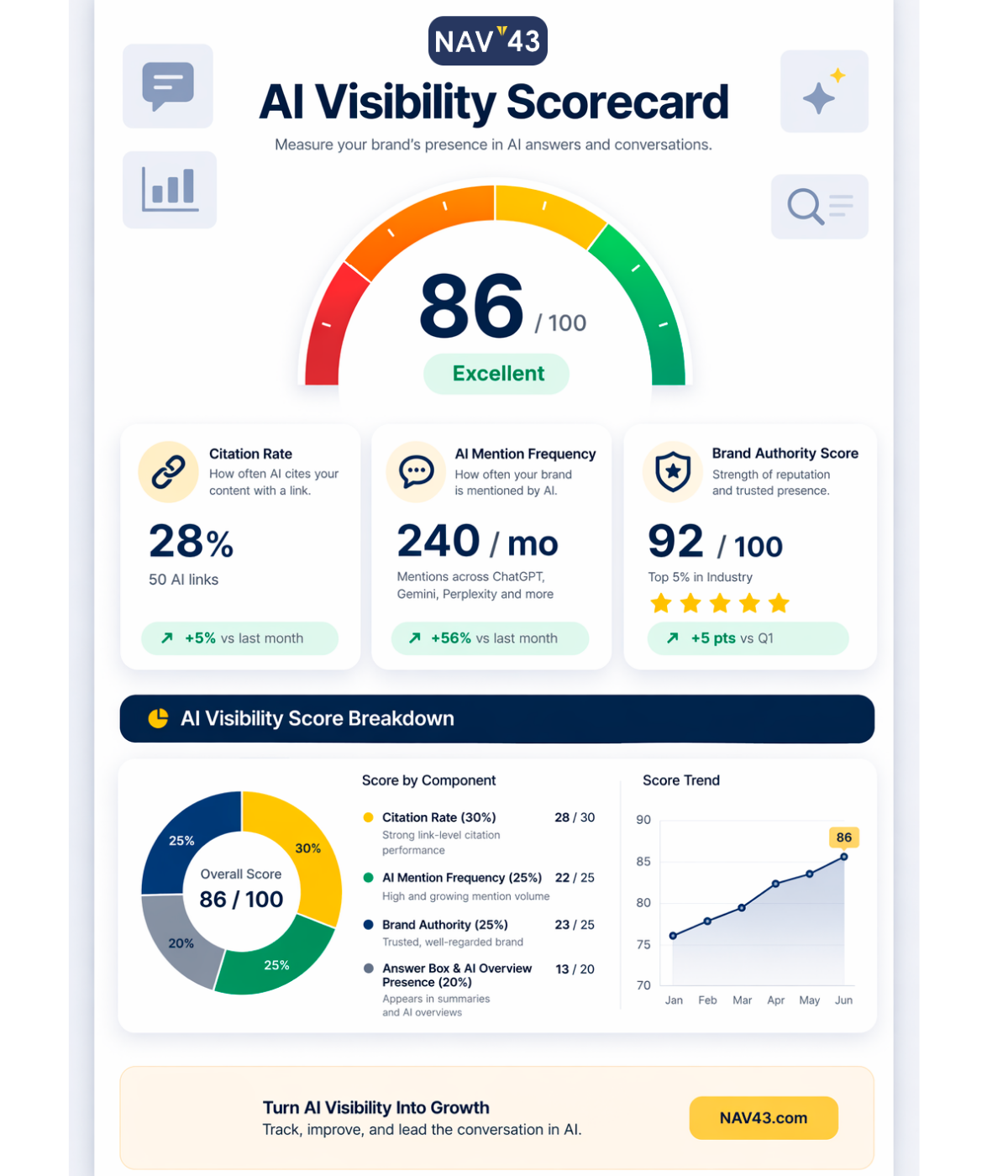
Over the past 18 months, we’ve developed this framework from direct client work across 50+ B2B and e-commerce brands. It’s what we use every day to measure and optimize AI SEO performance.
The core principle: Measure the influence funnel, not just the click funnel.
The traditional funnel looks like this: Impression → Click → Session → Conversion. The AI-era influence funnel looks like this: Brand Mention → Citation → Consideration → Direct/Branded Search → Conversion.
The first model captures value at the click. The second captures value creation that happens before or without clicks. Both matter. But if you’re only measuring the first, you’re flying blind.
This framework complements traditional SEO metrics, not replaces them. You still need technical health, content quality, and traditional ranking signals. But you also need to track what happens in the AI layer that now sits between your content and your buyers.
The Four Pillars of AI SEO Measurement
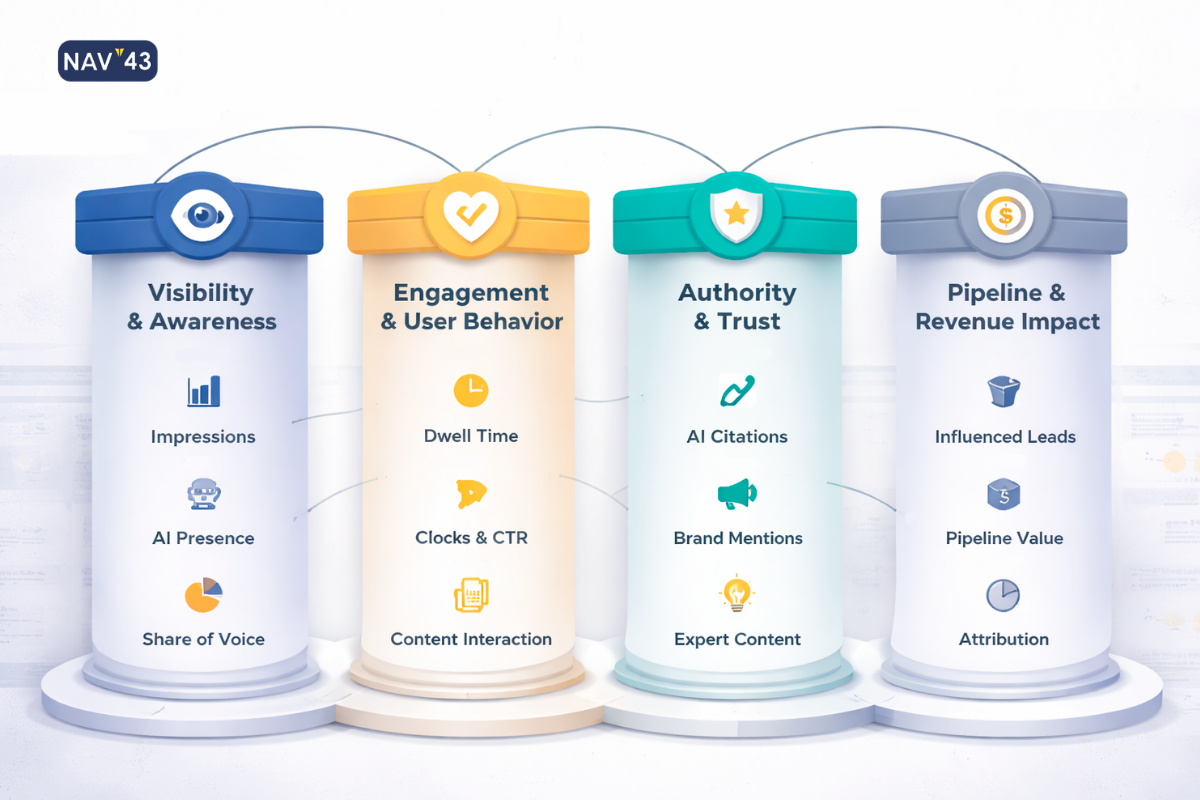
FRAMEWORK: The NAV43 AI Visibility Scorecard
Pillar 1: AI Citation Metrics
– Citation frequency: How often your brand/content is cited across AI platforms (ChatGPT, Perplexity, Google AI Overviews, Claude, Copilot)
– Citation share of voice: Your citations vs. competitor citations for target query clusters
– Citation sentiment: Is the AI presenting your brand positively, neutrally, or negatively?
– Citation positioning: Are you cited as the primary authority or a supporting reference?
Pillar 2: Visibility & Reach Metrics
– AI Overview inclusion rate: % of target keywords where your content appears in AI Overviews
– Multi-platform presence: Tracking visibility across Google, ChatGPT, and Perplexity simultaneously
– Featured snippet retention: Traditional SERP features still feed AI responses
– Knowledge panel accuracy: Ensuring your brand entity information is correct across AI systems
Pillar 3: Engagement Quality Metrics
– AI-referred traffic conversion rate: Segment and measure AI-sourced visitors separately
– Conversion rate differential: Compare AI-referred vs. traditional organic (expect 10-20x higher for AI) (Ahrefs/Passionfruit 2025)
– Branded search lift: Increase in brand name searches following AI citation campaigns
– Direct traffic correlation: AI visibility often manifests as direct traffic, not organic
Pillar 4: Business Impact Metrics
– Influenced pipeline: Deals where AI search touchpoints were part of the journey
– Citation-to-MQL correlation: Track citation increases against lead quality changes
– Competitive displacement: Tracking when you replace competitors in AI citations
– Revenue attribution (blended): Combining traditional and AI-influenced attribution models
Setting Benchmarks by Vertical
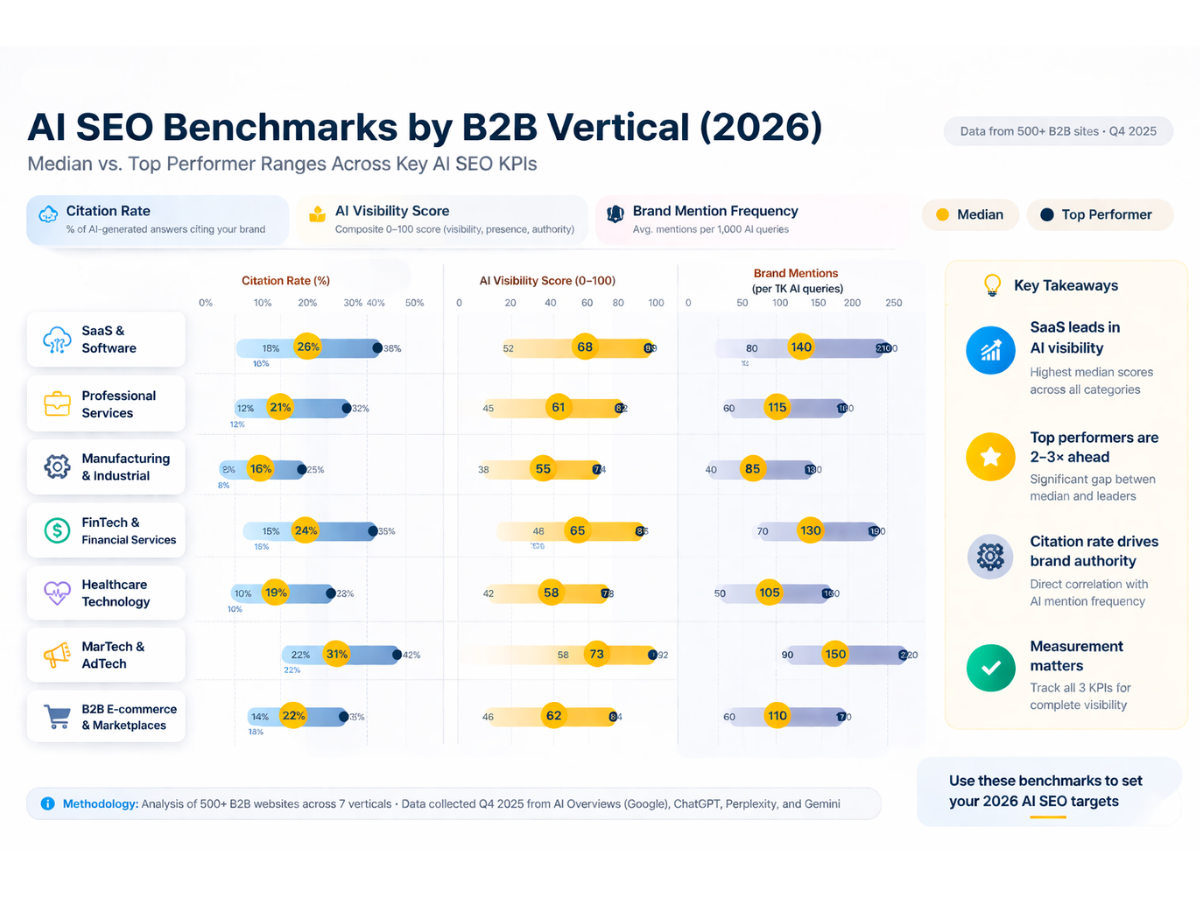
One question I get constantly: “What should our numbers be?”
The honest answer is that industry benchmarks are still emerging. AI search is evolving too rapidly for any single study to capture definitive benchmarks across verticals. But based on our client data and available research, here are the targets we recommend as starting points:
AI SEO KPI Benchmarks by Vertical
| Metric | B2B SaaS | E-commerce | Professional Services | Enterprise |
|---|---|---|---|---|
| Citation share of voice target | 15-25% of competitor set | 10-20% of competitor set | 20-30% of competitor set | 25-35% of competitor set |
| AI Overview inclusion rate | 30-40% of target queries | 25-35% of target queries | 35-45% of target queries | 40-50% of target queries |
| AI-referred conversion rate | 15-25% | 8-15% | 20-30% | 15-25% |
| Branded search lift (monthly) | 5-10% | 3-7% | 5-12% | 8-15% |
These are calibration points, not hard targets. Your first priority is to establish your own baseline, then measure improvement against yourself.
For deeper guidance on creating content that earns these citations, see our complete guide on How to Create AI Ready Content.
Measuring What Matters: The Complete AI SEO Metrics Breakdown
Tier 1: Leading Indicators (Weekly Tracking)
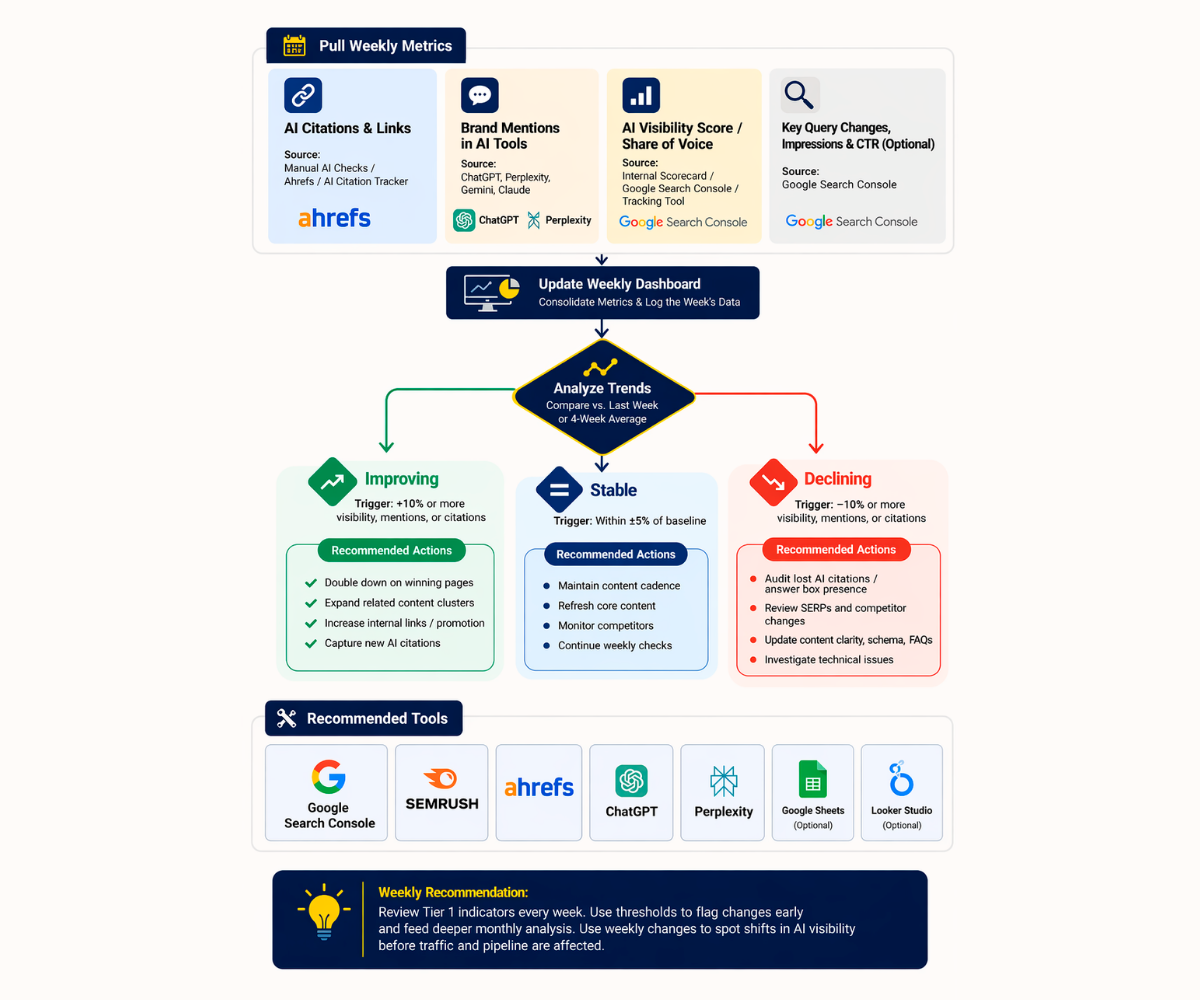
Leading indicators predict future performance changes before they show up in your revenue reports. Track these weekly:
AI citation frequency changes – Is your brand being mentioned more or less often in AI responses? A sudden drop here signals content freshness problems or competitor gains. A steady increase indicates your content strategy is working.
AI Overview appearance rate for target queries – What percentage of your priority keywords trigger AI Overviews, and how often does your content appear in them? This tells you both the threat level (how much traffic is at risk) and the opportunity level (where you can capture AI visibility).
Share of voice shifts vs. top 3 competitors – This is the metric that keeps our clients’ CMOs engaged. When you show them that you’ve moved from a 15% citation share of voice to 22%, while Competitor A dropped from 28% to 19%, they immediately understand the competitive dynamics.
New citation sources discovered – AI systems pull from diverse sources. Tracking where new citations come from helps you understand which content types and platforms are gaining influence.
Content freshness scores across indexed pages – AI systems favor current information. If your key pages haven’t been updated in 6+ months, they’re losing AI visibility, even if traditional rankings hold.
Tier 2: Performance Indicators (Monthly Tracking)
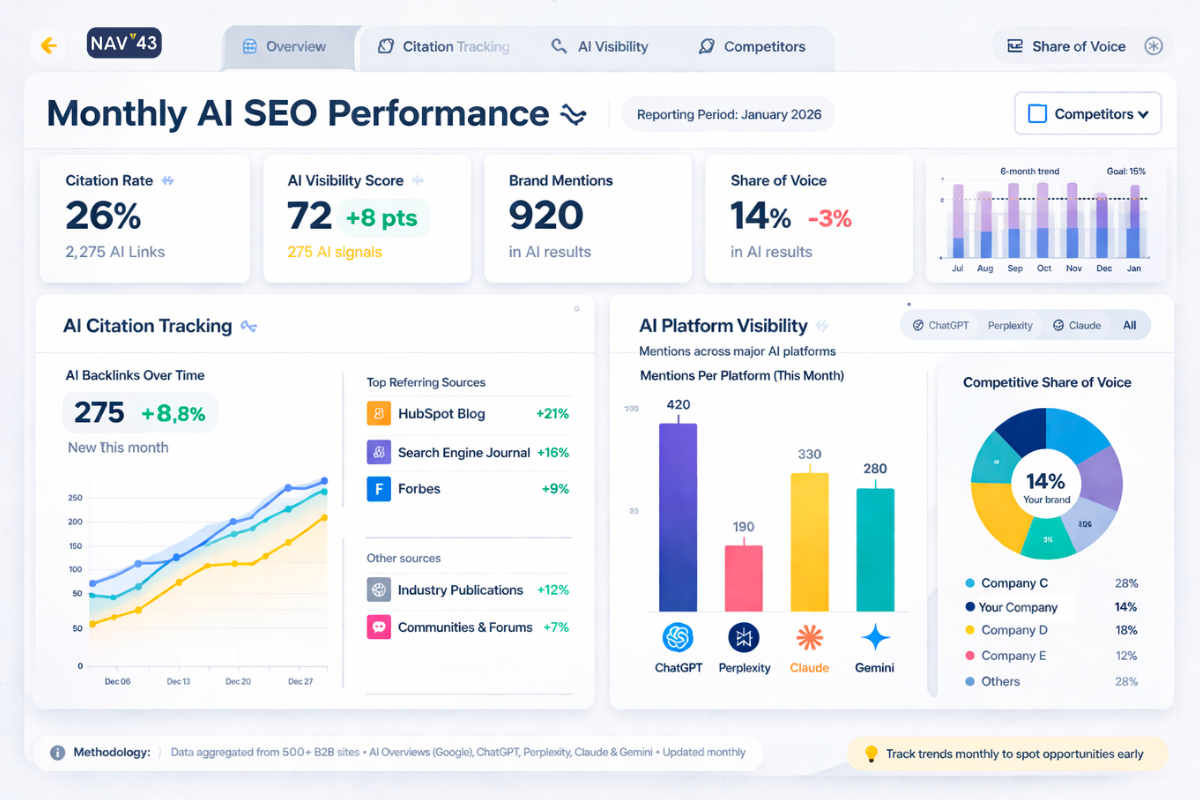
Performance indicators show whether leading indicators are translating into business outcomes. Track these monthly:
Organic traffic from AI-referring sources (segment in GA4) – Create custom segments to isolate traffic that shows AI referral patterns. This isn’t perfect, as many AI users then type your URL directly,- but it provides directional data.
Branded search volume trends (Google Search Console + third-party) – This is your proxy for AI influence. If people see your brand cited in AI responses and then search for you by name, branded search volume increases. Track month-over-month and year-over-year.
Conversion rate by traffic source (AI-referred vs. traditional organic) – Industry data suggests AI-referred traffic converts 23x better (Ahrefs/Passionfruit, 2025). Validate this for your own business. If it holds, this dramatically changes how you value AI visibility.
MQL/SQL quality scores by channel – Are leads that come in around the same time as citation increases higher quality? Do they close faster? This helps build the business case for AI SEO investment.
For B2B businesses, organic search drives 44.6% of all revenue – more than twice as much as all other digital channels combined (Digital Bloom IQ, 2025). But that metric needs source segmentation now. “Organic” that comes via AI exposure behaves differently from organic in traditional rankings.
Tier 3: Lagging Indicators (Quarterly Tracking)
Lagging indicators confirm that your strategy is working at the business level. Track these quarterly:
Overall organic revenue attribution (blended model) – Combine traditional last-touch attribution with influence modeling to capture both direct and AI-influenced conversions.
Customer acquisition cost by channel – Is CAC decreasing as AI visibility increases? For most of our clients, the answer is yes – AI visibility drives higher-intent traffic that requires less nurturing.
Pipeline influenced by AI visibility touchpoints – Work with your sales team to understand which deals involved AI-driven research. Many buyers will tell you, “I asked ChatGPT for recommendations,” if you simply ask.
Market share of voice (aggregated across platforms) – Zoom out and look at your total visibility across Google, ChatGPT, Perplexity, Claude, and industry platforms. Are you gaining or losing ground?
The Metrics That No Longer Matter (Or Matter Less)
This is as important as knowing what to measure. Stop reporting these metrics in isolation:
- Raw session counts without source segmentation – Meaningless when AI is intercepting clicks
- Keyword rankings without AI Overview context – Rank #1 with an AI Overview above you? You’re not really #1
- Bounce rate – AI-primed visitors often convert faster; high bounce might mean efficient answers
- Time on page – Shorter can mean more efficient, not less engaged
- Pages per session – Single-page conversions are increasing as AI pre-qualifies traffic
Stop Reporting These Metrics in Isolation
❌ “We drove 50,000 organic sessions this month”
✅ “We drove 50,000 organic sessions, with 12% showing AI referral patterns and converting at 23x higher rates than traditional organic” (Ahrefs/Passionfruit 2025)❌ “We rank #1 for our primary keyword”
✅ “We rank #1 and appear in the AI Overview for our primary keyword, capturing 28% of available visibility”❌ “Bounce rate is down 5%”
✅ “Conversion rate for AI-referred traffic is 6x higher than traditional, even with shorter sessions”
Building Your AI SEO Measurement Stack: Tools and Implementation
The Tool Stack for 2026 AI SEO Measurement
AI SEO Measurement Tool Stack
| Category | Recommended Tools | What It Measures | Price Range |
|---|---|---|---|
| Citation & AI Visibility Tracking | |||
| Primary | Ahrefs Brand Radar | Brand mentions and citations across AI platforms | $99-999/mo (part of Ahrefs) |
| Specialized | Profound | AI-generated response monitoring across ChatGPT, Perplexity, Claude | $500-2,000/mo |
| Specialized | Waikay | GEO citation tracking and share of voice | $300-1,500/mo |
| Specialized | LLM Refs | Tracks which URLs are being cited by major LLMs | $200-800/mo |
| Traditional SEO (Still Necessary) | |||
| Rankings & Links | Semrush or Ahrefs | Rankings, backlinks, technical health | $119-499/mo |
| Google Data | Google Search Console | Impression and click data, branded search trends | Free |
| Technical | Screaming Frog | Technical audits and structured data validation | Free-$259/yr |
| Analytics & Attribution | |||
| Core Analytics | GA4 with custom AI segments | Traffic source and conversion tracking | Free |
| B2B Attribution | HubSpot | Pipeline attribution and lead source tracking | $890-3,600/mo |
| Multi-touch | Ruler Analytics or Dreamdata | Multi-touch attribution for B2B | $200-1,000/mo |
| Competitive Intelligence | |||
| Audience Intel | SparkToro | Audience intelligence and share of voice | $50-300/mo |
| Traffic Analysis | Semrush Market Explorer | Competitive traffic analysis | Part of Semrush |
| Manual | Regular AI querying | Competitive audits across ChatGPT, Perplexity, Google | Time investment |
You don’t need everything on this list. Start with one AI citation tracking tool, GA4 segments, and manual competitive queries. Build from there based on what you learn.
Implementation Roadmap: Weeks 1-4
Week 1: Baseline Audit
Query your top 50 target keywords in ChatGPT, Perplexity, and Google AI Overviews. For each query, document:
– Are you cited? (Yes/No)
– Citation sentiment (Positive/Neutral/Negative)
– Competitors cited
– Primary source linked (if any)
This takes 4-6 hours for a proper audit. Don’t shortcut it – this baseline is critical.
Export current organic traffic segmented by source from GA4. Create a snapshot of branded search volume from Google Search Console.
Week 2: Tool Setup
Implement at a minimum one AI citation tracking tool. Profound and Waikay are our current recommendations for B2B brands. They’re purpose-built for GEO measurement.
Create GA4 segments for AI-referred traffic. The exact parameters depend on your tech stack, but look for referrals from chat.openai.com, perplexity.ai, and similar domains, plus direct traffic patterns that spike after AI citation gains.
Set up branded search tracking in Google Search Console with weekly exports.
Week 3: Dashboard Build
Create a unified dashboard with Tier 1, 2, and 3 metrics clearly separated. We use Looker Studio for most clients, pulling data from multiple sources.
Establish your review cadence:
– Weekly: Tier 1 metrics review (30 minutes)
– Monthly: Tier 2 metrics review + team discussion (1 hour)
– Quarterly: Tier 3 metrics review + strategy adjustment (2-3 hours)
Set up automated alerts for significant changes: citation share of voice drops >10%, branded search changes >15%, conversion rate anomalies.
Week 4: Competitive Baseline
Audit your top 5 competitors using the same AI querying methodology from Week 1. Document their citation frequency, sentiment, and positioning.
Calculate initial share of voice benchmarks. If you’re cited 8 times across 50 queries and your top competitor is cited 15 times, you know your starting gap.
Identify citation gaps and opportunities. Where are competitors being cited, but you’re absent? Those are your priority content targets.
For a comprehensive technical foundation that supports AI visibility, see our Technical SEO Audit Checklist.
AI SEO Measurement Stack Implementation Checklist
- [ ] Conduct baseline AI citation audit across 50 target queries
- [ ] Document current citation status for brand and top 5 competitors
- [ ] Export current GA4 traffic data segmented by source
- [ ] Record baseline branded search volume from GSC
- [ ] Select and implement AI citation tracking tool
- [ ] Create GA4 segments for AI-referred traffic patterns
- [ ] Configure automated branded search tracking
- [ ] Build unified dashboard with Tier 1/2/3 metrics
- [ ] Set up weekly/monthly/quarterly review calendar
- [ ] Configure automated alerts for significant metric changes
- [ ] Complete competitive citation audit for top 5 competitors
- [ ] Calculate initial share of voice benchmarks
- [ ] Identify citation gap opportunities
- [ ] Document tool access credentials and admin contacts
- [ ] Train team on new KPI definitions and reporting cadence
Connecting AI SEO to Revenue: Attribution in a Zero-Click World
The Attribution Challenge
Let me describe a scenario that’s probably happening in your funnel right now.
A VP of Operations at a manufacturing company asks ChatGPT: “What are the best ERP systems for mid-size manufacturers?” ChatGPT mentions your brand as a leader in the space, alongside two competitors. The VP doesn’t click anything; they’re just doing initial research.
Two weeks later, the same VP searches “YourBrand ERP pricing” on Google and fills out a demo request form. That conversion gets attributed to “branded organic” in your analytics. Your marketing report shows organic branded search performing well.
But the AI touchpoint, which is the moment your brand became a consideration, is completely invisible. You can’t optimize for what you can’t see.
This is why traditional last-click and even multi-touch attribution models fail in the AI era. They’re designed to track actions (clicks, page views, form fills), not influence (citations, mentions, presence in AI responses).
The Influence Attribution Model
At NAV43, we’ve developed a blended attribution approach that appropriately weights AI visibility touchpoints.
The core insight: AI-referred traffic is valued at 4.4x the economic value of traditional organic traffic (Ahrefs/Passionfruit, 2025). This multiplier should be built into your attribution model.
Practically, this means:
1. Track “citation-influenced conversions” as a separate metric from standard conversions
2. Use branded search lift as a proxy for AI visibility impact
3. Apply a multiplier to conversions that occur during periods of citation gains
4. Survey new leads about their research journey – many will mention AI assistants
We’ve found that simply asking “How did you first hear about us?” with AI assistant options (ChatGPT, Perplexity, Google AI, etc.) surfaces valuable data. About 20-30% of B2B leads will indicate AI as a discovery channel when given the option.
Practical Revenue Connection for B2B
For B2B organizations, the connection to the pipeline is everything. Here’s how to make AI SEO metrics meaningful to your revenue team.
Integrate AI SEO metrics with HubSpot or your CRM pipeline data. Create custom properties for “AI discovery indicated” and track how these leads move through your funnel compared to other sources.
Build correlation analyses:
– Did AI citation increases correlate with MQL volume increases?
– Did competitors’ losing AI citations correlate with your pipeline gains?
– What’s the average deal size for AI-influenced leads vs. other sources?
Create “influenced pipeline” reports that account for AI touchpoints. This isn’t about claiming credit for every deal – it’s about understanding how AI visibility contributes to overall revenue generation.
For more on connecting marketing automation to the pipeline, see our guide on HubSpot Automations for B2B.
Presenting AI SEO ROI to Leadership
Here’s what I’ve learned from presenting AI SEO results to dozens of C-suite executives: frame AI SEO investment as brand protection, not just acquisition.
Gartner predicts 90% of B2B buying will be AI agent intermediated by 2028 (Gartner, 2025). This isn’t a maybe – it’s the direction buyers are clearly moving. Executives understand “future-proofing the brand for how customers will buy” better than they understand “optimizing for AI citations.”
Use competitive displacement stories. When you can show that your citation share of voice increased from 18% to 27% while Competitor A dropped from 31% to 22%, executives immediately grasp the strategic implications.
Build correlation charts that tell the story visually: AI citation increases → branded search increases → conversion increases. Even if the causal chain isn’t perfectly attributable, the correlation makes the case.
The CFO Slide: Presenting AI SEO ROI
The Setup:
– “73% of B2B websites lost significant traffic in 2024-2025. We were at risk of being in that group.”The Investment:
– “We invested [X] in AI SEO optimization: content restructuring, citation tracking tools, and ongoing monitoring.”The Results:
– Citation share of voice: 12% → 24% (100% increase)
– Branded search volume: +34% YoY
– AI-referred conversion rate: 18% (vs. 4% traditional organic)
– Influenced pipeline: $X.XMThe Future:
– “Gartner predicts 90% of B2B buying will be AI-mediated by 2028. We’re building the visibility now that will drive revenue then.”
Optimizing for AI Citations: The GEO Content Blueprint
What Makes Content Citable by AI
The research is clear: content depth, factual density, readability, and freshness drive AI citations more than traditional link authority. This represents a fundamental shift from the backlink-dominated SEO of the previous decade.
What AI systems are looking for:
– Clear, quotable summary statements in the first 100 words that directly answer common queries
– Structured data markup (FAQ, HowTo, Article schema) that helps AI parse content
– Expert attribution and clear E-E-A-T signals that establish authority
– Data tables and statistics with clear sourcing that AI can cite with confidence
– Current, fresh content that reflects the latest industry developments
For a deeper dive into structuring content for AI systems, see our comprehensive guide on Structured Data for GEO: How Schema Markup Boosts AI Search Visibility.
The NAV43 Answerable Content Framework
Here’s the exact framework we use when creating content designed for AI citation:
Step 1: State the question explicitly in the H2
Don’t make the AI infer what question you’re answering. Use the actual question or a clear statement of the topic.
Step 2: Provide a 2-3 sentence quotable answer immediately
AI systems need a clean excerpt to cite. Your first sentences after the heading should be citation-ready – clear, accurate, and comprehensive enough to stand alone.
Step 3: Expand with evidence and examples
After the quotable answer, go deep. Data, case studies, expert quotes, and practical examples. This builds the authority that makes AI systems confident, citing you.
Step 4: Include structured data markup
FAQ schema for Q&A content. HowTo schema for process content. Article schema with proper author attribution for everything.
Step 5: End the section with a clear takeaway
Give AI systems a natural closing point for excerpts. Summarize the key insight in one actionable sentence.
Content Refresh Protocol for AI Visibility
Content with 20%+ new material sees ranking improvements within weeks of refresh (HubSpot data). For AI visibility, freshness matters even more. AI systems explicitly prefer current information.
Our refresh protocol:
– Pages appearing in AI Overviews: Update monthly with new data points and examples
– Pillar content: Update quarterly with comprehensive refreshes
– Evergreen guides: Update semi-annually with current statistics and screenshots
When refreshing, prioritize:
– Adding current-year statistics and data points (AI loves citing specific numbers)
– Updating expert quotes and industry references
– Ensuring schema markup is current and complete
– Adding recent case studies or examples
– Improving quotable summary statements at the top of each section
For more on AI-ready content strategy across the funnel, see our AI SEO Content Strategy guide.
Common Pitfalls: What Gets AI SEO Measurement Wrong
Pitfall 1: Treating Zero-Click as Zero Value
I see this constantly: marketing teams panicking about zero-click queries and abandoning keywords that trigger AI Overviews. This is exactly backward.
Citation visibility has brand value even without clicks. Brands cited in AI Overviews earn 35% more organic clicks on other queries (Seer Interactive, 2025). Being present in AI responses builds brand recognition that drives downstream conversions.
Don’t abandon keywords just because they trigger AI Overviews. Instead, optimize for citation presence and track the downstream impact on branded search and direct conversions.
Pitfall 2: Over-Rotating Away from Traditional SEO
Some marketers hear “AI SEO” and think traditional SEO is dead. It’s not.
Technical SEO still matters. AI systems crawl and index content using fundamentally similar mechanisms to traditional search. Content quality signals still matter, and thin content doesn’t get cited. Backlinks still correlate with authority signals that AI systems recognize.
Our recommended balance: 70% traditional SEO excellence, 30% GEO-specific optimization. Get the fundamentals right first, then layer AI optimization on top.
Pitfall 3: Measuring AI Visibility Without Competitive Context
Citation frequency means nothing without a share-of-voice comparison. If you’re cited 20 times per week, that sounds good – until you learn your top competitor is cited 80 times.
Track relative position, not just absolute presence. Your goal isn’t just “get cited,” but it’s “get cited more than competitors” and “be cited in the primary position rather than as a secondary reference.”
Pitfall 4: Ignoring Platform Differences
Google AI Overviews, ChatGPT, Perplexity, and Claude each cite different sources. They have different training data, different weighting of authority signals, and different content preferences.
LinkedIn is the most-cited domain for professional queries across all major AI platforms – not because of traditional SEO signals, but because of the authority and recency of professional content there.
Optimize for the platform. Track performance across each AI system separately. What works for Google AI Overviews might not work for ChatGPT, and vice versa.
Pitfall 5: Expecting Immediate Results
Traditional SEO takes months to show results. AI SEO can take even longer because you’re building visibility across multiple platforms with different update cycles.
Set expectations appropriately with leadership. This is a 6-12 month investment horizon, not a 6-week sprint. The brands that start now will have compounding advantages over those who wait.
For a broader understanding of how AI is reshaping the entire SEO landscape, see our comprehensive guide on AI SEO 2025.
Conclusion: Key Takeaways and Next Steps
The shift to AI-mediated search isn’t a temporary disruption, but it’s the new architecture of how B2B buyers discover and evaluate solutions. The brands that adapt their measurement frameworks now will own the visibility that drives revenue for the next decade.
Key Takeaways:
- The Great Decoupling is real: Rankings, traffic, and business impact have disconnected. Traditional KPIs are actively misleading you about your market visibility.
- Citation is the new currency: Only 12% of AI-cited URLs rank in Google’s top 10. AI visibility has become a parallel track that requires separate measurement.
- Quality over quantity: AI-referred traffic converts 23x better than traditional organic. The opportunity isn’t about volume – it’s about capturing higher-intent visibility.
- The NAV43 AI Visibility Scorecard provides a complete framework: Four pillars covering Citation Metrics, Visibility & Reach, Engagement Quality, and Business Impact give you full-funnel measurement.
- Attribution requires new models: Connect AI visibility to the pipeline through influence attribution, branded search proxies, and direct buyer surveys.
Your Next Steps:
- This week: Conduct your baseline AI citation audit across your top 50 target queries. Document where you stand vs. competitors.
- This month: Implement at least one AI citation tracking tool and create GA4 segments for AI-referred traffic patterns.
- This quarter: Build your unified dashboard, establish benchmarks, and present the new framework to leadership.
- Ongoing: Embed AI SEO KPIs into your regular reporting cadence. Make them as visible as traditional rankings and traffic.
The window for establishing AI visibility is narrowing. The brands that build citation authority now will compound that advantage as AI search grows from 30% of queries to the dominant mode of discovery. The brands that wait will find themselves invisible in the channel where their buyers increasingly make decisions.
Ready to build your AI SEO measurement framework? Get a free growth audit, and we’ll analyze your current AI visibility, identify your biggest citation gaps, and show you exactly where to focus first.
The rules have changed. Your measurement has to change with them.
