
AI Agent Briefing Templates for SEO, Paid Media, and Content QA: The Practitioner’s System
29% of AI agent deployments are abandoned within 90 days. The top reason? Unclear success criteria (Gartner via Digital Applied, 2026).
I’ve watched marketing teams burn weeks building sophisticated agent workflows that collapse the moment someone asks, “How do we know this is working?” The fix isn’t better AI. It’s better briefing.
Last month, I was reviewing a client’s content workflow. They had three different AI tools, no shared briefing system, and every piece required 4+ revision cycles. The marketing director was frustrated. The content team was burned out. And the AI they’d invested in was getting blamed for problems it didn’t create.
The AI wasn’t the problem. The briefing was.
Here’s the reality: 86.4% of marketing teams now use AI in some part of their workflow (HubSpot State of Marketing, 2026), but only 19.2% are using AI agents to automate marketing initiatives end-to-end. That gap isn’t a technology problem. It’s an infrastructure problem. The missing layer between “we adopted AI” and “we’re seeing ROI on AI” is the briefing template.
This article gives you ready-to-use AI agent briefing templates for SEO, paid media, and content QA that you can implement this week. Not theory. Not “10 tips for prompting.” Actual templates with specific prompt structures, success criteria, and governance frameworks that work across all three disciplines.
By the time you finish reading, you’ll have the exact system we use at NAV43 to significantly cut revision cycles and improve first-pass approval rates.

What You Need Before You Build Agent Briefings
Before you write a single agent briefing template, you need four things in place. Skip this section at your peril. The 29% failure rate (Gartner, 2026) exists because teams skip straight to the exciting part without laying the foundation.
Prerequisite 1: Documented workflows, even rough ones. If your content process lives in someone’s head, an agent can’t follow it. You don’t need perfection. You need a written sequence of steps: who does what, in what order, with what handoffs.
Prerequisite 2: Defined success metrics per channel. What does “good” look like for your SEO content? For your paid media campaigns? For your content QA process? If you can’t quantify it, you can’t brief an agent on it.
Prerequisite 3: Approval authority clarity. Who can approve agent output for each workflow? Who escalates when the agent flags uncertainty? This isn’t bureaucracy. It’s the difference between an agent that accelerates work and one that creates chaos.
Prerequisite 4: Brand voice guidelines. Agents execute literally. If your brand voice exists only as “you know it when you see it,” the agent will produce generic output that requires endless revision.
Here’s a quick diagnostic. Answer these five questions:
Agent Briefing Readiness Checklist:
– Can your team describe the steps in your content workflow in under 2 minutes?
– Do you have written success criteria for your top 3 content types?
– Is there a documented approval chain for marketing output?
– Do you have a brand voice guide that specifies tone, vocabulary, and examples?
– Can a new hire understand your QA process from documentation alone?
If you answered “no” to more than two of these, you’re not ready for agent briefing. You need process documentation first. That’s not a failure. That’s knowing where to start.
Tool requirements: Any capable LLM (Claude, GPT-4, Gemini), a documentation system (Notion, Confluence, Google Docs), and access to your existing SOPs. That’s it. The template matters more than the tool.
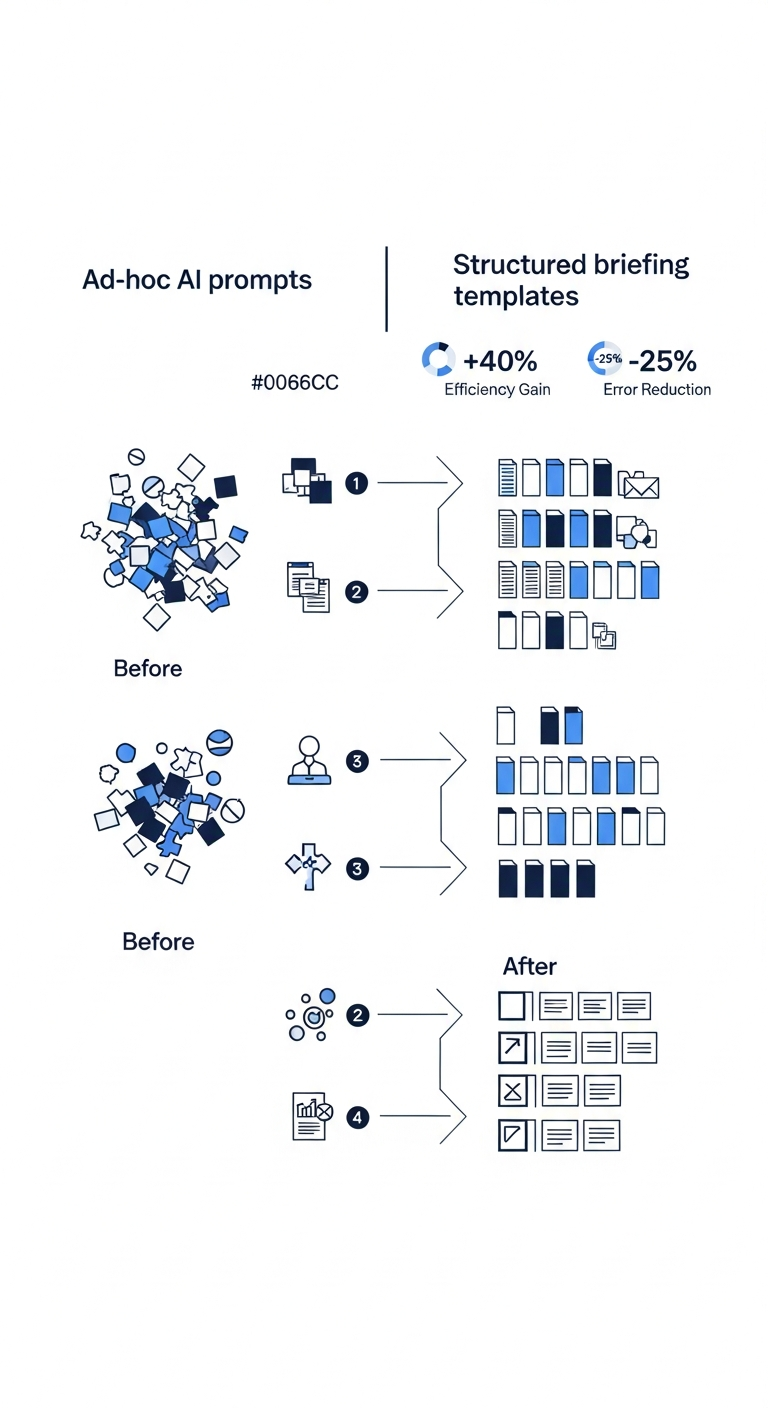
The Anatomy of an Agent Briefing Template
A traditional marketing brief assumes human judgment fills the gaps. “Write compelling copy” works when you’re briefing a copywriter because they’ll infer your brand voice, audience context, and unstated requirements.
Agents don’t infer. They execute literally.
I’ve seen teams copy-paste their human SOPs into agent prompts and wonder why output quality tanked. The agent didn’t fail. The brief failed to specify what every human reviewer unconsciously applied.
Every agent briefing template must include five core components:
1. Role & Context Definition
Who is the agent? What does it know? What constraints apply? This isn’t roleplay. It’s giving the agent a knowledge boundary and a decision-making framework.
2. Task Specification
The exact deliverable with format requirements. Not “write a blog post” but “write a 2,800-word blog post structured with H2s every 300-400 words, targeting the primary keyword in the H1 and first 100 words, with at least 3 internal links.”
3. Success Criteria
Quantified standards, not “make it good.” What specific, measurable requirements must the output meet to pass? If a human reviewer can’t evaluate the output against explicit criteria, neither can the next step in your workflow.
4. Guardrails & Governance
What must the agent NOT do? What compliance requirements apply? What claims are prohibited? What requires escalation?
5. Output QA Protocol
How does the output get evaluated before it moves downstream? What does a human reviewer check? What triggers a revision request versus an approval?
The CRISPE framework (Capacity, Role, Insight, Statement, Personality, Experiment) provides one structural option for prompt construction. But the framework matters less than the completeness. An agent brief missing any of these five components will produce inconsistent output.
| Traditional Brief | Agent Brief |
|---|---|
| “Write engaging content” | “Content must achieve Flesch reading score of 60-70” |
| “Match our brand voice” | “Use these 5 brand voice markers in every piece” |
| “Include relevant keywords” | “Primary keyword in H1, first 100 words, one H2, 3-5 semantic variations throughout” |
| “Make it SEO-friendly” | “Minimum 3 internal links to cluster content, schema markup for FAQPage if applicable” |
| “Get approval before publishing” | “Flag for human review if confidence score below 85%” |
The difference is precision. The traditional brief trusts human judgment. The agent brief makes every expectation explicit.
SEO Agent Briefing Template: The Complete Framework
SEO workflows are among the highest-value targets for agent automation. Keyword clustering, content brief generation, on-page optimization audits, and internal linking recommendations are all tasks where agents excel when properly briefed.
Role & Context Block for SEO Agents
The role definition tells the agent what expertise to apply and what boundaries constrain it.
Here’s the structure we use at NAV43:
ROLE: You are an SEO content strategist with expertise in B2B SaaS content marketing, topic clustering, and E-E-A-T optimization.

CONTEXT: You are creating content briefs for a mid-market B2B company targeting marketing directors and VPs. All content must support Experience, Expertise, Authoritativeness, and Trustworthiness signals.

KNOWLEDGE ACCESS: You have access to:
- Provided keyword research data (search volume, difficulty, intent classification)
- Provided competitor analysis
- Existing content inventory for internal linking
- Brand voice guidelines (see attached)

CONSTRAINTS:
- Do not fabricate statistics. If data is needed, specify "[STAT NEEDED: topic]"
- All claims must be supportable with cited sources
- Do not recommend content strategies that conflict with provided brand guidelines
This block establishes what the agent knows, what it doesn’t know, and what it should never do. The E-E-A-T mandate is non-negotiable for SEO content. If your agent produces content that lacks expertise signals, you’ll spend more time fixing it than you saved.
Task Specification for SEO Workflows
Different SEO tasks require different specifications. Here’s a ready-to-use template for a content brief generator agent:
SEO Content Brief Generator Prompt Template:
TASK: Generate a comprehensive content brief for the following target keyword.

TARGET KEYWORD: [PRIMARY KEYWORD]
SECONDARY KEYWORDS: [LIST]
SEARCH INTENT: [Informational/Commercial/Transactional/Navigational]
TARGET WORD COUNT: [RANGE]
CONTENT TYPE: [How-To/Pillar Guide/Comparison/etc.]

REQUIRED BRIEF ELEMENTS:
1. Working title (include primary keyword, no year)
2. Target audience description (job title, pain points, what they're trying to accomplish)
3. Search intent analysis (what does the searcher want to achieve?)
4. Recommended structure (H2s and H3s with word count targets per section)
5. Entity mapping:
 - Primary entity: [What is this content fundamentally about?]
 - Supporting entities: [What related concepts must be covered?]
 - Entity relationships: [How do these connect for Knowledge Graph optimization?]
6. People Also Ask questions to address (minimum 4)
7. Internal linking opportunities (minimum 3 from provided inventory)
8. External citation requirements (what claims need sourcing?)
9. E-E-A-T requirements:
 - Experience signals to include
 - Expertise demonstrations needed
 - Authority citations required
 - Trust elements (disclosures, sourcing, author attribution)
10. Competitive differentiation (what angle makes this better than top 3 competitors?)

OUTPUT FORMAT: Structured markdown with clear section breaks
This template produces briefs that writers can execute without guessing. The entity mapping section is critical for Knowledge Graph strategy and AI search visibility.
Success Criteria & QA Protocol for SEO Output
Quantified standards prevent subjective debates about whether output is “good enough.”
SEO Agent Output QA Checklist:
- Keyword targeting: Primary keyword appears in H1, first 100 words, and at least one H2
- Semantic coverage: Brief addresses 80%+ of People Also Ask questions from provided research
- Internal linking: Minimum 3 internal links to existing cluster content specified
- Entity mapping: Primary entity, 3+ supporting entities, and relationships documented
- E-E-A-T completeness: All four E-E-A-T elements have specific requirements listed
- Word count guidance: Section-by-section word count targets provided
- Competitive angle: Clear differentiation statement included
- Format compliance: Output is properly structured markdown
A human reviewer should be able to run through this checklist in under 90 seconds. If the brief passes all 8 points, it moves forward. If it fails any point, the agent revises.
This connects directly to the AI SEO content strategy we’ve built at NAV43 for clients navigating the new search landscape.
Paid Media Agent Briefing Template: From Trafficking to Reporting

Paid media agents work best for specific, rules-based tasks: campaign trafficking QA, ad copy variation generation, performance anomaly detection, and reporting narrative generation. Human strategy remains essential. But the execution layer is highly automatable.
60% of US ad buyers have used or plan to use AI-powered buying products (eMarketer, 2024). And teams using AI tools for media plan execution report 40% cost reductions (Digiday via eMarketer, 2026).
Role & Context Block for Paid Media Agents
ROLE: You are a paid media operations specialist with expertise in Google Ads, LinkedIn Ads, and campaign trafficking.

CONTEXT: You are performing QA validation on campaign setups before launch. Your job is to verify configuration against documented standards, not to create strategy.

KNOWLEDGE ACCESS:
- Campaign naming conventions document
- Targeting parameter requirements by campaign type
- Budget allocation rules
- UTM parameter standards
- Platform advertising policies (Google, LinkedIn)

CONSTRAINTS:
- Do not recommend budget changes. Flag for human review.
- Do not approve campaigns. Validate and report.
- All ad copy must be checked against prohibited claims list
- Brand voice violations must be flagged, not auto-corrected
The constraint block is critical for paid media. Agents should validate, not execute. Budget decisions and strategic pivots require human judgment.
Task Specification for Paid Media Workflows
The four highest-value paid media agent use cases:
- Campaign trafficking QA – Verify setup against your trafficking checklist
- Ad copy variation generation – Create variations within character limits and brand guidelines
- Performance anomaly detection – Flag metrics outside normal variance
- Reporting narrative generation – Translate data into executive summary language
Here’s the template for campaign trafficking QA:
Campaign Trafficking QA Prompt Template:
TASK: Validate the following campaign configuration against trafficking standards.

CAMPAIGN DETAILS:
- Campaign name: [NAME]
- Platform: [Google Ads/LinkedIn/Meta]
- Campaign type: [Search/Display/Video/Lead Gen]
- Budget: [DAILY BUDGET]
- Targeting parameters: [PROVIDED]
- Ad creative: [PROVIDED]
- Landing page URL: [URL]
- UTM parameters: [PROVIDED]

VALIDATION CHECKLIST:
1. Naming convention compliance
 - Does campaign name match format: [CLIENT]_[PLATFORM]_[CAMPAIGN TYPE]_[AUDIENCE]_[DATE]?
 - Flag any deviations

2. Targeting parameter validation
 - Geography matches brief requirements?
 - Audience targeting matches documented parameters?
 - Exclusions applied per standard exclusion list?

3. Budget allocation verification
 - Daily budget within approved range for campaign type?
 - Bid strategy matches campaign objective?

4. Tracking requirements
 - UTM parameters present and correctly formatted?
 - Conversion tracking pixels verified?
 - Offline conversion integration confirmed?

5. Ad copy compliance
 - Character limits met for all headlines/descriptions?
 - Required CTAs present?
 - Prohibited language check (see prohibited list)?
 - Brand voice markers present?

6. Landing page alignment
 - Landing page matches ad messaging?
 - Form fields present and functional?
 - Mobile responsiveness confirmed?

OUTPUT FORMAT:
Pass/Fail for each item with specific notes on failures.
Overall recommendation: APPROVE / REQUIRES REVISION / ESCALATE

ESCALATION TRIGGERS:
- Budget exceeds 120% of standard
- New targeting parameter not in approved list
- Compliance uncertainty on ad claims
The agent validates setup against your trafficking checklist. It doesn’t replace the checklist. This connects to the offline conversion tracking setup that makes paid media optimization actually work for lead generation.
Success Criteria & QA Protocol for Paid Media Output
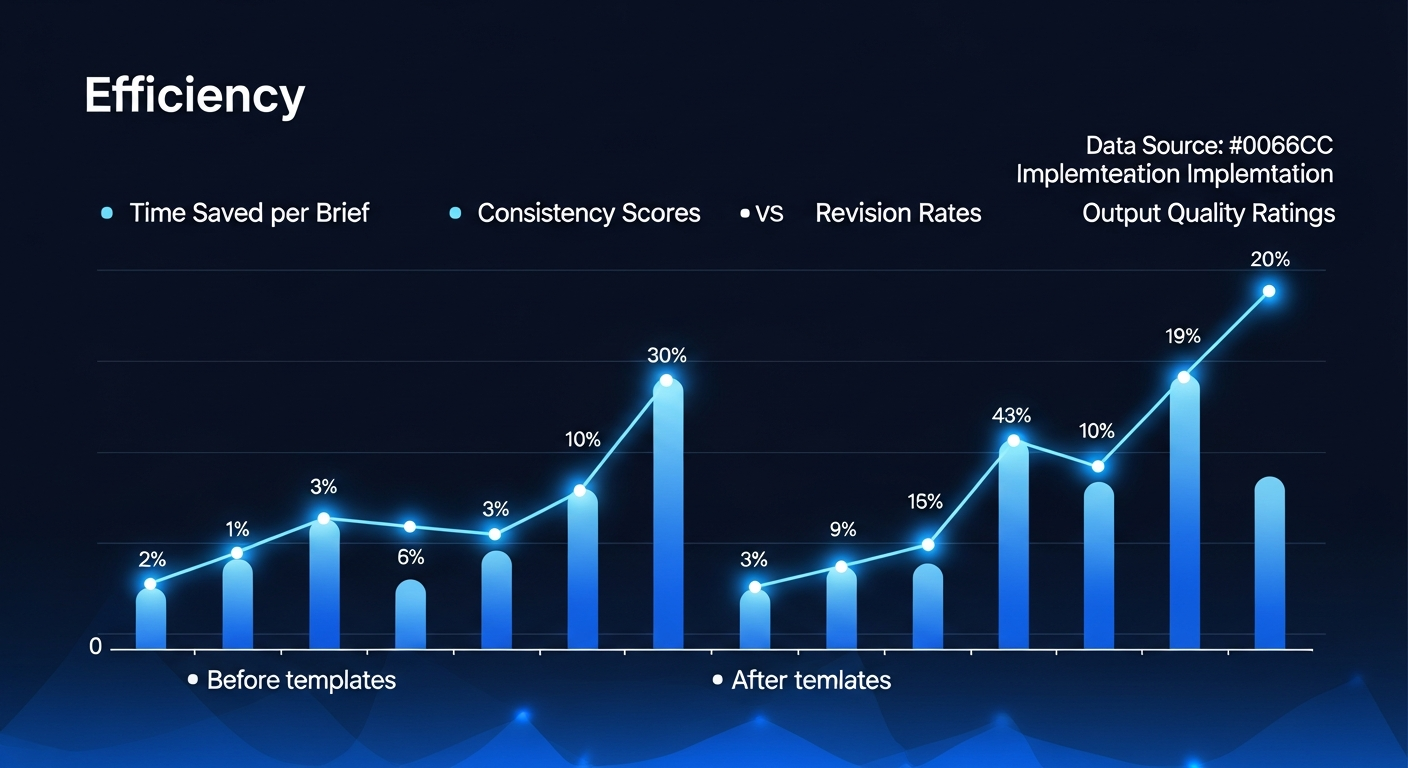
Trafficking verification standards:
– Naming convention 100% compliant
– UTM parameters validated against documented format
– Audience targeting matches brief exactly
Ad copy standards:
– All headlines under character limit
– All descriptions under character limit
– Required CTA present in at least one variation
– Zero prohibited language detected
Reporting output standards:
– Variance thresholds that trigger human review: >15% deviation from benchmark
– Executive summaries include: period-over-period comparison, top performer, bottom performer, recommended action
Governance mandate: All budget recommendations require human approval before execution. No exceptions.
Content QA Agent Briefing Template: The Approval Bottleneck Fix
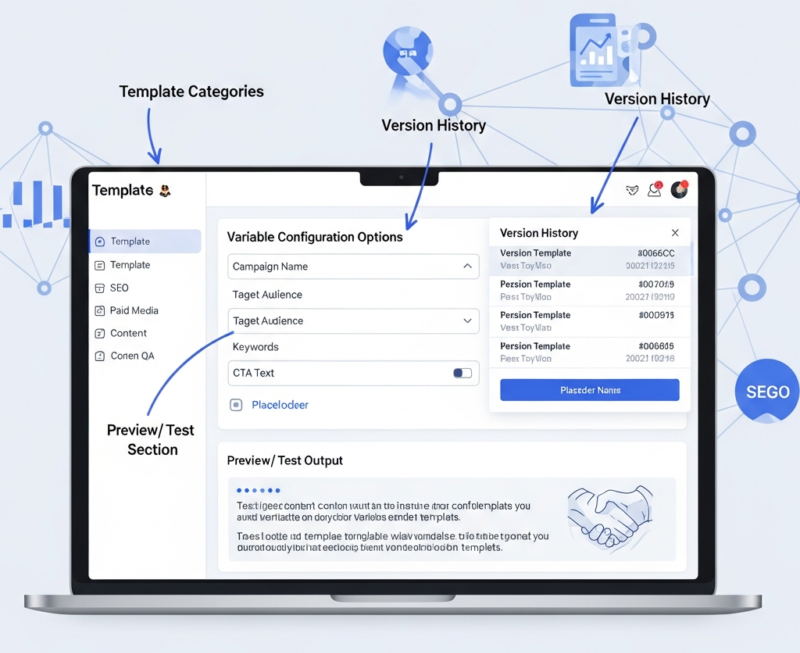
Content QA is where most workflows break. Pieces sit in approval limbo. Reviewers apply inconsistent standards. Revision cycles multiply.
This is also where agent briefing templates deliver the highest leverage.
Why Content QA Is the Highest-Leverage Agent Use Case
Teams with structured QA briefing report 40% fewer revision cycles and 75%+ first-pass approval rates compared to the 40-50% baseline for manual review (Digital Applied, 2026).
The math is simple: if you publish 20 pieces of content per month and cut revision cycles from 4 to 2.4, you’ve recovered the equivalent of 32 revision cycles annually. That’s capacity for 8 additional pieces of content with the same team.
Every content team I’ve audited in the past year has the same problem: QA criteria live in someone’s head, not in a document. That works until that person goes on vacation. Or until you try to brief an agent.
The Five-Stage Content QA Framework
Map your workflow through these five stages to understand what the agent handles versus what requires human judgment:
Stage 1: Intake
Agent validates submission completeness against required elements. Does the piece have all the components specified in the brief? Is the metadata complete? Are required assets attached?
Stage 2: Automated First-Pass Scoring
Agent checks against quantified criteria: readability scores, keyword presence, brand voice markers, structural requirements, internal linking minimums. This is where the agent excels. Binary pass/fail against explicit standards.
Stage 3: Human Review
Reviewer focuses on judgment calls the agent flagged. Tone appropriateness. Strategic alignment. Claims that need subject matter expertise to verify. The agent narrows what humans review.
Stage 4: Approval Gate
Clear pass/fail criteria. If automated score exceeds threshold AND human review approves, content moves to publish. If not, escalation paths are documented.
Stage 5: Post-Publish Monitoring
Agent flags performance anomalies. Traffic below baseline. Engagement metrics outside normal range. Pages that may need refresh based on performance signals.
This framework aligns with the agentic AI for content operations approach we’ve documented for scaling content teams.
Task Specification for Content QA Agents
Content QA Scoring Agent Prompt Template:
TASK: Score the following content piece against QA criteria and provide a pass/flag/fail recommendation.

INPUTS PROVIDED:
- Content piece: [ATTACHED]
- Brand voice guide excerpt: [ATTACHED]
- QA checklist: [ATTACHED]
- Target keyword data: [PROVIDED]
- Content brief: [ATTACHED]

SCORING CRITERIA:

1. STRUCTURAL REQUIREMENTS (20 points)
 - H1 present and includes primary keyword (5 pts)
 - H2s every 300-400 words (5 pts)
 - Paragraph length under 5 sentences (5 pts)
 - Word count within target range (5 pts)

2. KEYWORD OPTIMIZATION (20 points)
 - Primary keyword in first 100 words (5 pts)
 - Primary keyword in at least one H2 (5 pts)
 - 3-5 semantic variations present (5 pts)
 - Keyword density between 1-2% (5 pts)

3. E-E-A-T SIGNALS (20 points)
 - Cited statistics with sources (5 pts)
 - Author attribution present (5 pts)
 - Experience signals (first-person, case references) (5 pts)
 - External authority citations (5 pts)

4. BRAND VOICE COMPLIANCE (20 points)
 - Tone matches brand voice guide (10 pts)
 - Prohibited phrases absent (5 pts)
 - Required brand voice markers present (5 pts)

5. INTERNAL LINKING (10 points)
 - Minimum 3 internal links (5 pts)
 - Links contextually relevant (5 pts)

6. TECHNICAL REQUIREMENTS (10 points)
 - Meta description present and within character limit (3 pts)
 - Alt text for images (3 pts)
 - No broken links (4 pts)

TOTAL: /100 points

OUTPUT FORMAT:
1. Score by category
2. Overall score
3. Items flagged for human review (with severity tier)
4. Specific revision callouts with line references
5. Recommendation: PASS (85+) / FLAG FOR REVIEW (70-84) / FAIL (<70)

SEVERITY TIERS FOR FLAGGED ISSUES:
- BLOCKING: Must fix before publish (factual errors, brand voice violations, missing required elements)
- RECOMMENDED: Should fix but not publish-blocking (style improvements, optimization opportunities)
- ADVISORY: Style preference, reviewer discretion
This template produces actionable QA output. The reviewer knows exactly what to check and what severity level applies to each issue.
Success Criteria & Calibration Protocol
Passing threshold: Minimum score of 85/100 on automated criteria to proceed to human review without blocking flags.
Brand voice compliance requirement: Content must score 7+/10 on brand voice rubric based on provided guidelines.
E-E-A-T validation: Agent must verify presence of cited statistics, author attribution, and experience signals. Any E-E-A-T category scoring 0 is an automatic flag.
Calibration protocol: Before deploying a QA agent at scale, run 10 historical pieces through the QA agent and compare to human reviewer decisions. Adjust thresholds until agreement rate exceeds 90%. This calibration step is what separates teams that succeed from teams that abandon their agents in 90 days.
This QA framework connects directly to how to create AI-ready content that passes both human review and AI citation requirements.
The Cross-Functional Briefing System: Connecting SEO, Paid, and Content QA
Siloed briefing templates fail at the handoffs.
SEO content goes to the paid team without keyword context. QA reviewers don’t know campaign goals. The content team creates pieces that don’t align with the landing pages being promoted.
The teams reporting 4.1x-5.3x ROI on agent workflows aren’t running better prompts. They’re running connected systems. Every agent knows what happened upstream and what’s expected downstream (McKinsey/Digital Applied, 2026).
The Briefing Handoff Protocol
Map this workflow: Keyword research (SEO agent) → Content brief (SEO agent) → Draft creation (content agent) → QA validation (QA agent) → Paid promotion brief (paid agent)
At each stage, specific information must transfer.
Cross-Functional Handoff Matrix:
| Stage | Output | Information Passed Forward |
|---|---|---|
| Keyword Research | Keyword clusters, intent mapping | Primary keyword, secondary keywords, search volume, intent classification, competitive difficulty |
| Content Brief | Structured brief | Target audience, angle, E-E-A-T requirements, internal linking targets, success metrics |
| Draft Creation | Content piece | Actual content, metadata, asset list |
| QA Validation | Scored assessment | Pass/fail status, revision requirements, approved version |
| Paid Promotion | Campaign brief | Target keyword, landing page URL, key messaging points, audience match |
Universal Header Block
This block appears on ALL agent briefs regardless of function:
BRIEF HEADER:
- Campaign/Project ID: [ID]
- Primary Goal: [What outcome does this work toward?]
- Target Audience: [Who is this for?]
- Success Metrics: [How will we measure if this worked?]
- Approval Authority: [Who approves this stage?]
- Upstream Dependencies: [What briefing does this depend on?]
- Downstream Handoff: [Who receives this output?]
When every agent brief includes this header, you eliminate the “wait, what was this for again?” question that derails workflows.
Governance & Failure Prevention: What the 29% Got Wrong
Let’s return to that stat: 29% of agent deployments abandoned within 90 days, with 41% citing unclear success criteria as the primary failure (Gartner via Digital Applied, 2026).
But unclear success criteria isn’t the only failure mode.
Failure Mode 1: Scope Creep
The agent gets asked to do too much. What started as “QA the content” becomes “QA the content, suggest improvements, rewrite weak sections, optimize for keywords, and generate social media posts.” Each addition dilutes performance.
Fix: One briefing template, one task. If you need multiple outputs, use multiple agents with handoffs.
Failure Mode 2: No Calibration Period
Teams deploy an agent briefing template and immediately trust the output at scale.
Fix: Every new agent briefing needs a 2-week calibration phase where output is reviewed at 100% before moving to sampling. Use this period to tune thresholds and catch edge cases.
Failure Mode 3: Missing Escalation Paths
The agent flags uncertainty, but there’s no documented process for what happens next.
Fix: Every briefing template must specify: what triggers escalation, who receives the escalation, expected response time, and what happens if the escalation isn’t resolved.
Failure Mode 4: Over-Automation of Judgment-Heavy Tasks
Some decisions shouldn’t be automated. Brand positioning. Strategic pivots. Crisis communications. Budget reallocation.
Fix: Document agent authority levels. What can the agent execute directly? What requires human approval? Make this explicit in every template.
Agent Governance Readiness Checklist:
- Is there an audit trail for agent outputs? (Version history, input/output logging)
- Are briefing templates under version control?
- Is there a human-in-the-loop mandate for specified decision types?
- Are escalation paths documented and tested?
- Is there a scheduled review cycle for briefing template updates?
- Are agent authority levels documented and enforced?
The teams that fail treat briefing templates as “set and forget.” The teams that succeed treat them as living documents with monthly review cycles.
For enterprise teams, this connects to the human-in-the-loop AI governance framework that separates sustainable AI programs from expensive experiments.
Implementing Your First Agent Briefing: The 80/20 Start
Don’t try to automate everything at once. That’s how you join the 29% (Gartner, 2026).
Pick one workflow with clear success criteria and high revision burden. Start there.
Recommended starting points by team type:
- Content teams: Start with Content QA scoring agent. It has the clearest success criteria and the most immediate ROI (reduced revision cycles).
- SEO teams: Start with content brief generator. It standardizes output and ensures no critical elements get missed.
- Paid teams: Start with campaign trafficking QA. It’s rules-based, high-frequency, and catches errors before they cost money.
The 48-Hour Proof of Concept:
Day 1:
– Select one workflow
– Document current success criteria (or create them if they don’t exist)
– Build the briefing template using the structures in this article
– Run 5 pieces through the agent
Day 2:
– Review agent output against human reviewer decisions
– Calculate agreement rate
– Adjust thresholds where needed
– Document calibration notes
What to track:
– First-pass approval rate before vs. after
– Average revision cycles before vs. after
– Time from draft to publish before vs. after
Scaling sequence:
1. One workflow → calibration → expand scope
2. Add second workflow
3. Build cross-functional handoffs
4. Implement governance and review cycles
What Comes Next: Agent Briefing as Competitive Advantage
By end of 2026, Gartner predicts 40% of enterprise applications will integrate task-specific AI agents, up from less than 5% in 2025 (Gartner, 2025).
The teams investing in briefing infrastructure now will have a 12-18 month head start on competitors still debating “which AI tool to buy.”
Here’s what’s shifting: as AI agents become the audience (Forrester calls this B2A, Business-to-Agent marketing), your briefing templates become your interface with both human and machine audiences. The same structure that helps an AI agent execute your content brief helps AI search engines understand and cite your content.
This connects directly to how to get ChatGPT to cite your brand and the broader GEO strategy that’s reshaping visibility.
The briefing template is the product. Not the AI. Not the workflow. The documentation that makes every execution predictable and improvable.
Key Takeaways
- 29% of agent deployments fail within 90 days, primarily due to unclear success criteria (Gartner, 2026). The fix is better briefing, not better AI.
- Every agent briefing template needs five components: Role & Context, Task Specification, Success Criteria, Guardrails & Governance, and Output QA Protocol.
- Agent briefs must be explicit where human briefs assume inference. “Write compelling copy” becomes “achieve Flesch score 60-70 with brand voice markers X, Y, Z.”
- Content QA delivers the highest leverage because revision cycles compound. A 40% reduction in revisions recovers capacity for additional content.
- Cross-functional briefing systems outperform siloed templates because every agent knows what happened upstream and what’s expected downstream.
- Governance isn’t bureaucracy. Calibration periods, escalation paths, and human-in-the-loop mandates are what separate the 71% that succeed from the 29% that abandon.
Next Steps
- This week: Run the Agent Briefing Readiness Diagnostic. If you pass, build your first template. If not, document your workflows first.
- This month: Complete a 48-hour proof of concept with one workflow. Measure first-pass approval rates before and after.
- This quarter: Expand to cross-functional briefing handoffs. Connect your SEO, content, and paid media workflows.
If you want help building the briefing infrastructure that turns AI adoption into measurable ROI, get a free growth plan from NAV43. We’ll audit your current workflows and show you exactly where agent briefing templates will deliver the highest leverage.
The 40% of enterprise apps integrating AI agents by the end of 2026 will be the ones with the briefing systems to make them work. The question is whether you’re building that infrastructure now or scrambling to catch up later.
