GEO for SaaS: Win AI Mentions in Competitive Categories
Nearly half of your competitors are invisible to AI-assisted buyers, and they don’t even know it.
According to the DerivateX 2026 AI Visibility Benchmark Report, 44% of B2B SaaS companies score below 50 on AI Presence Score, essentially meaning they don’t exist when prospects ask ChatGPT, Perplexity, or Google AI Overviews for software recommendations. This isn’t a vanity metric problem. It’s a pipeline crisis hiding in plain sight.
Here’s why this matters right now: 73% of B2B buyers now use AI tools like ChatGPT and Perplexity in their research process (Averi, 2026). Even more striking, 47% of enterprise buyers start their vendor search with AI instead of Google. The consideration set is being formed inside AI assistants before your sales team ever gets a call.
The upside for those who crack this? AI search traffic converts at a staggering 5.1x the rate of traditional Google organic traffic (Exposure Ninja, 2026). When someone arrives at your site from an AI recommendation, they’re not browsing. They’re ready to buy.
This article delivers what most GEO content doesn’t: a SaaS-specific playbook for winning AI mentions in competitive categories. I’ll break down platform-specific strategies for ChatGPT, Perplexity, and Google AI Overviews, walk through the technical implementation details that actually move the needle, and give you realistic timelines so you can plan resources accordingly.
At NAV43, we’ve been deep in the trenches with SaaS clients as they navigate this shift. What follows is the exact framework we use.
Why GEO Is Now a Pipeline Priority for SaaS
The way B2B buyers discover software has fundamentally changed, and most SaaS marketing teams haven’t caught up.
Gartner predicted that traditional search engine volume would drop 25% by 2026 due to AI chatbots and virtual agents (Gartner, 2024). We’re watching that prediction play out in real time. AI-referred sessions jumped 527% year-over-year in the first five months of 2025 (Previsible, 2025). This isn’t a gradual shift. It’s a cliff.
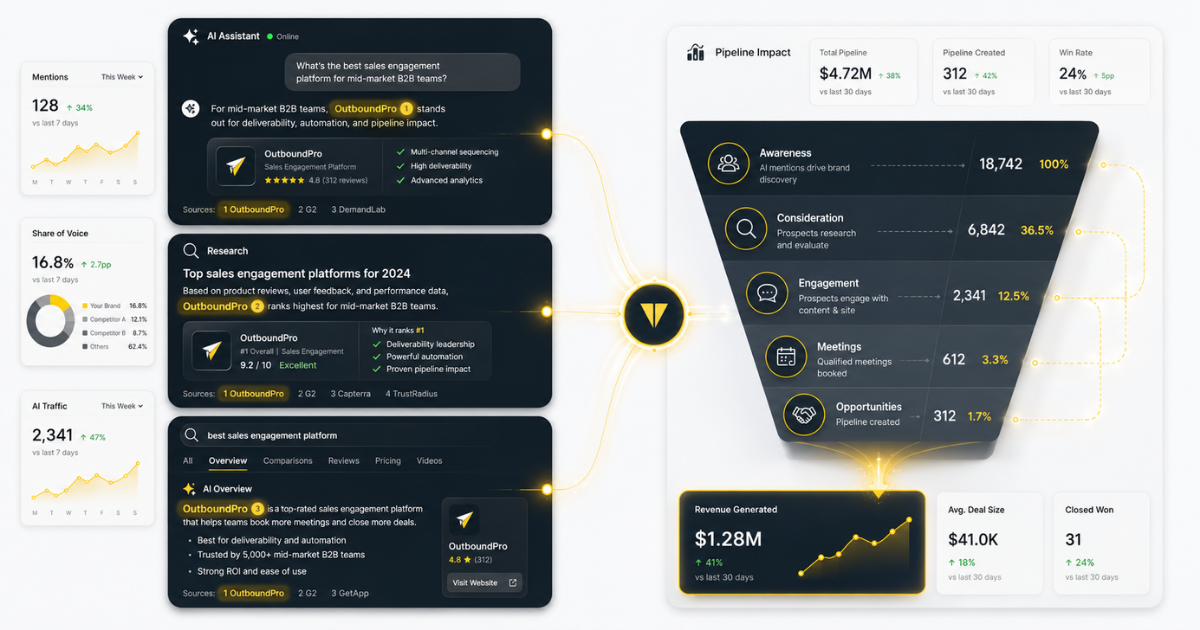
GEO for SaaS isn’t SEO 2.0. It’s a pipeline-and-demand-generation priority that belongs in the same conversation as paid media and ABM. Here’s the reframe that matters: traditional SEO optimizes for traffic volume. GEO optimizes for citation share and conversion quality.
The urgency is real. According to eMarketer (2026), 54% of US marketers plan to implement GEO within three to six months. The window for early-mover advantage is closing fast. If you wait until your competitors figure this out, you’ll be playing catch-up in a game where AI systems tend to reinforce existing authority.
I was reviewing a SaaS client’s AI visibility last quarter. They ranked #3 organically for their primary category term. When I queried that same term in ChatGPT, Perplexity, and Google AI Overviews, they appeared in exactly zero responses. Their competitors owned the AI conversation entirely.
The AI Shortlist Problem
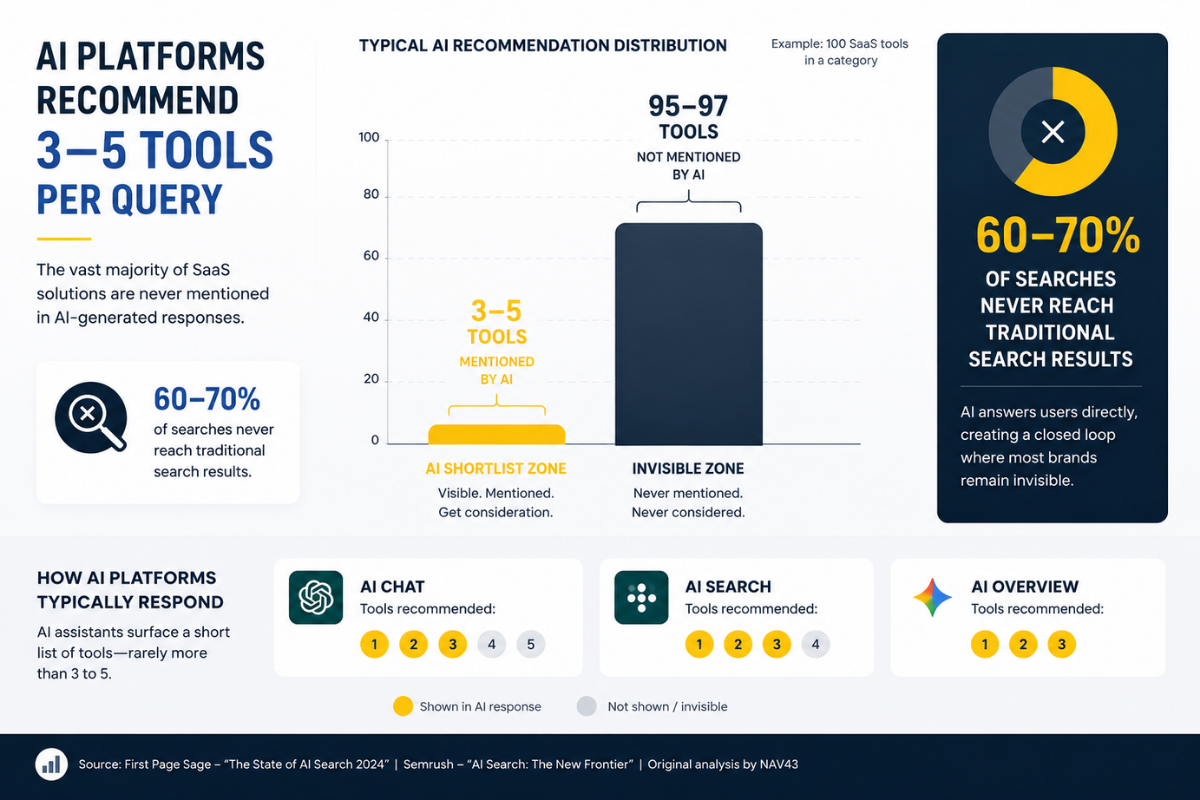
When a VP of Operations asks ChatGPT, “What are the best project management tools for remote teams?” Is your brand in the response?
This is the new consideration set problem. AI recommendations are forming vendor shortlists before prospects ever visit your website, read your case studies, or talk to your sales team. If you’re not mentioned, you’re not considered.
Forrester’s 2025 research found that 89% of B2B buyers consult generative AI during their purchasing journey. Not occasionally. Consistently. The AI assistant has become the first filter in the buying process.
Here’s what makes this different from traditional SEO: ranking well in Google doesn’t guarantee AI citation. I’ve seen SaaS companies dominate the first page of Google results while being completely absent from AI recommendations for the same queries. The signals AI systems use to determine what to cite are distinct from the signals Google uses for organic ranking.
The companies winning AI mentions are the ones who understand this distinction and optimize for it specifically.
The Platform Divergence Problem: One Strategy Won’t Work
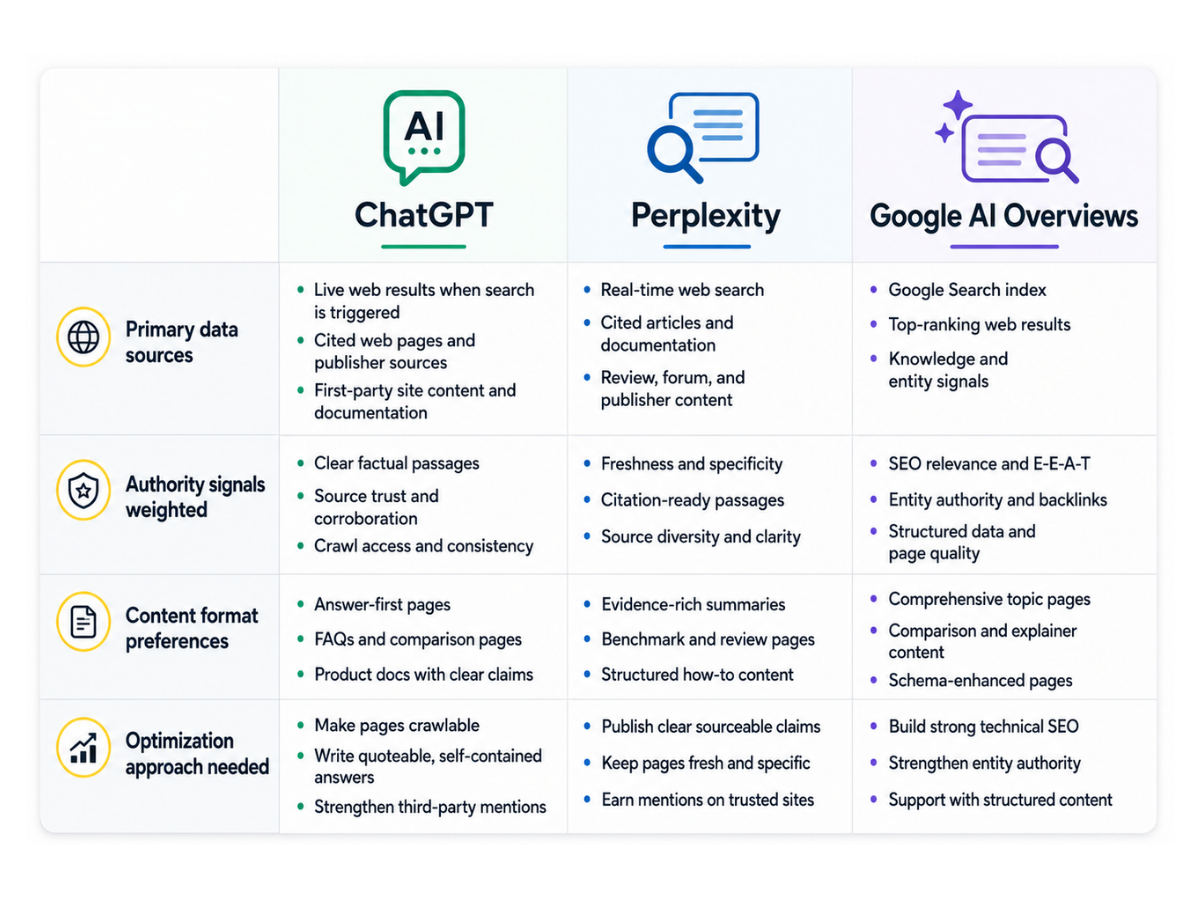
Here’s a data point that should reshape how you think about GEO: only 11% of domains are cited by both ChatGPT and Perplexity (Averi, 2026).
Read that again. The overlap is tiny. This means a single GEO strategy will leave you invisible on at least one major platform. For competitive SaaS categories where multiple platforms influence the buyer journey, this is a critical insight.
We’ve seen this play out with SaaS clients repeatedly. One client dominated Perplexity citations for their category, but got zero mentions in ChatGPT. Another had a strong ChatGPT presence but was invisible in Google AI Overviews. The platform-specific strategies that follow are non-negotiable if you want comprehensive coverage.
ChatGPT: The Wikipedia Model
ChatGPT’s citation preferences lean heavily toward what I call the “Wikipedia model.” Research shows that 47.9% of ChatGPT’s top citations come from Wikipedia-style encyclopedic content.
This has major tactical implications for SaaS brands:
What ChatGPT rewards:
– Comprehensive, definitive guides that cover topics exhaustively
– “What is [category]?” and glossary-style content
– Educational content that explains concepts clearly without heavy sales language
– Established authority signals built over time
The training data lag: ChatGPT’s training data runs 60 to 180 days behind current content. This means your content needs to be established and stable before it gets picked up. Quick tactical plays won’t work here. You’re playing a longer game.
For SaaS companies, this means investing in definitive category content. If you sell sales engagement software, you need the best “What is sales engagement?” page on the internet. Not promotional. Educational. Comprehensive.
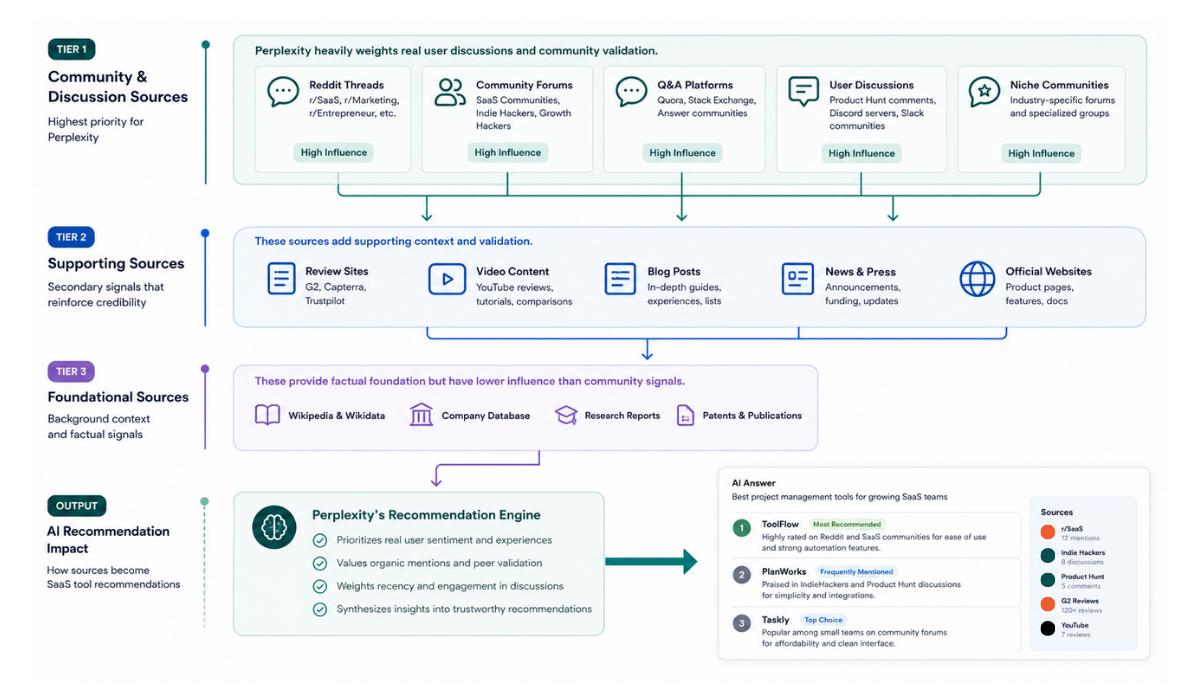
Perplexity: The Reddit & Community Model
Perplexity operates on an entirely different model. A striking 46.7% of Perplexity’s citations come from Reddit.
This should change everything about how you think about community presence. Most SaaS brands ignore Reddit entirely, viewing it as a cesspool of complainers or a place for consumer discussions. That’s a massive citation gap you can exploit.
What Perplexity rewards:
– Real-time, fresh content and discussions
– Community validation and authentic user mentions
– Third-party reviews and user-generated content
– Active participation in relevant subreddits
The real-time advantage: Unlike ChatGPT, Perplexity searches the live web. Fresh content and active community discussions matter more. New content can get cited within two to four weeks.
For SaaS companies, this means building a genuine Reddit presence. Not astroturfing. Not a promotional posting that gets banned. Authentic participation in communities where your buyers gather. r/SaaS, r/startups, r/marketing, and industry-specific subreddits are citation goldmines.
Google AI Overviews: The Multi-Modal Model
Google AI Overviews have become more prevalent, appearing in 25.11% of Google searches, up from 13.14% in March 2025 (Conductor, 2026). This growth trajectory shows no signs of slowing.
Google’s AI Overviews favor multi-modal content:
What Google AI Overviews reward:
– Video content, particularly YouTube (cited in 23% of responses)
– Visual explainers, infographics, and diagrams
– Structured data markup that helps AI understand content
– Clear hierarchical content structure
The indexing advantage: Google AI Overviews pull from more recently indexed content, typically four to eight weeks, versus ChatGPT’s 60 to 180 day lag. This creates opportunities for timely, well-structured content to gain visibility faster.
For SaaS companies, this means your video content strategy directly impacts AI visibility. Product explainers, feature walkthroughs, and category education videos on YouTube are no longer just top-of-funnel awareness plays. They’re GEO assets.
| Platform | Primary Citation Source | Indexing Speed | Content Priority |
|---|---|---|---|
| ChatGPT | Wikipedia-style encyclopedic (47.9%) | 60-180 days | Definitive guides, glossary content, educational pages |
| Perplexity | Reddit & communities (46.7%) | 2-4 weeks | Community discussions, reviews, real-time content |
| Google AI Overviews | Multi-modal including YouTube (23%) | 4-8 weeks | Video content, structured data, visual explainers |
Brand Mentions Beat Backlinks: The New Authority Signal
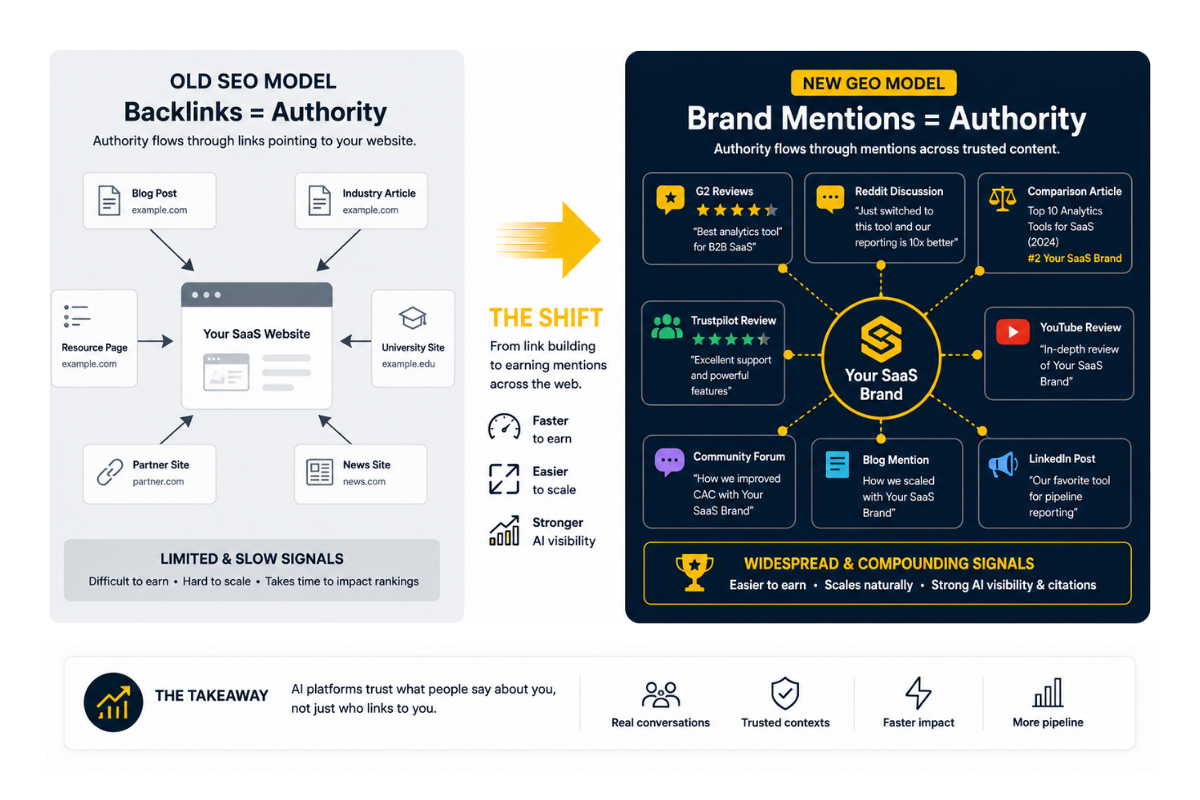
Here’s the paradigm shift that should reframe your entire GEO strategy: brand web mentions correlate at 0.664 with AI citation rates, roughly 3x stronger than backlinks at 0.218 (Loganix, 2026).
This is a fundamental change from traditional SEO, where backlinks have been the dominant authority signal for two decades. For AI systems, being talked about matters more than being linked to.
Even more telling: 85% of AI brand mentions come from third-party pages, not owned domains (AirOps, 2025-2026). Your own website is important, but the conversation happening about your brand elsewhere is what AI systems actually cite.
For competitive SaaS categories, this means the companies getting mentioned most in third-party contexts win the AI recommendation game. Your investment in PR, analyst relations, review site presence, and community engagement now has direct pipeline implications.
This isn’t abstract. I’ve seen SaaS companies with weaker SEO profiles outperform category leaders in AI citations because they invested heavily in earned media and community presence while competitors focused exclusively on their own domains.
Building Mention Velocity in Competitive Categories
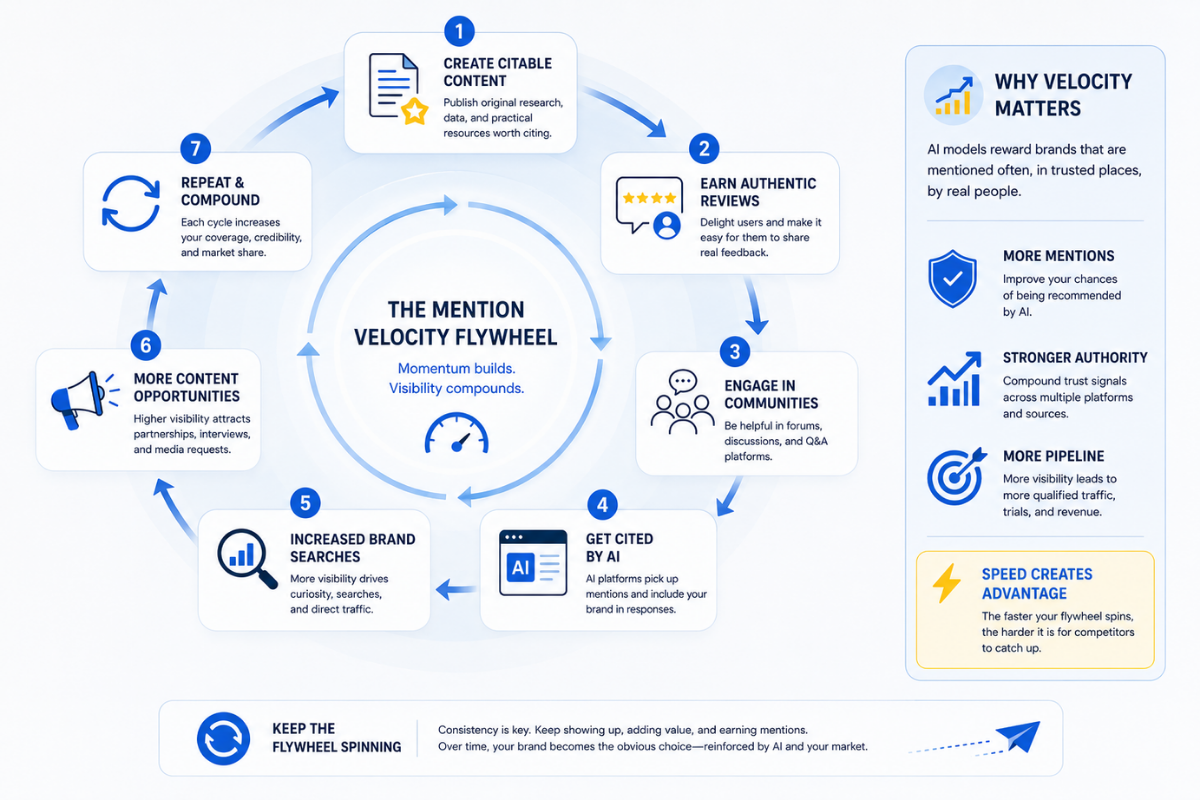
Mention velocity is the rate at which your brand gets referenced across the web in relevant contexts. This is the metric that predicts AI citation success.
The tactical playbook for building mention velocity:
- Industry publications: Guest posts, contributed articles, and expert quotes in publications your buyers read
- Podcast appearances: B2B podcasts in your vertical create transcripts that get indexed and cited
- Review site optimization: G2, Capterra, TrustRadius reviews structured for AI extraction
- Analyst briefings: Gartner, Forrester, and vertical analysts who publish market guides
- Community presence: Reddit, industry Slack communities, LinkedIn discussions
The case study that crystallizes this: Hamming.ai achieved 40% of its demos through AI and Reddit channels, driven by strategic presence-building. They didn’t outspend competitors on paid media. They out-mentioned them.
Your Reddit strategy deserves special attention. This isn’t about promotional posting that violates subreddit rules. It’s about genuine participation: answering questions where your expertise is relevant, engaging authentically in discussions, building a reputation as a helpful community member. The mentions that follow are organic and carry real weight with AI systems.
The NAV43 SaaS GEO Implementation Framework
Most GEO content stops at “optimize for AI.” That’s not actionable. What follows is the practical implementation framework we use with SaaS clients, with realistic timelines and specific tactics.
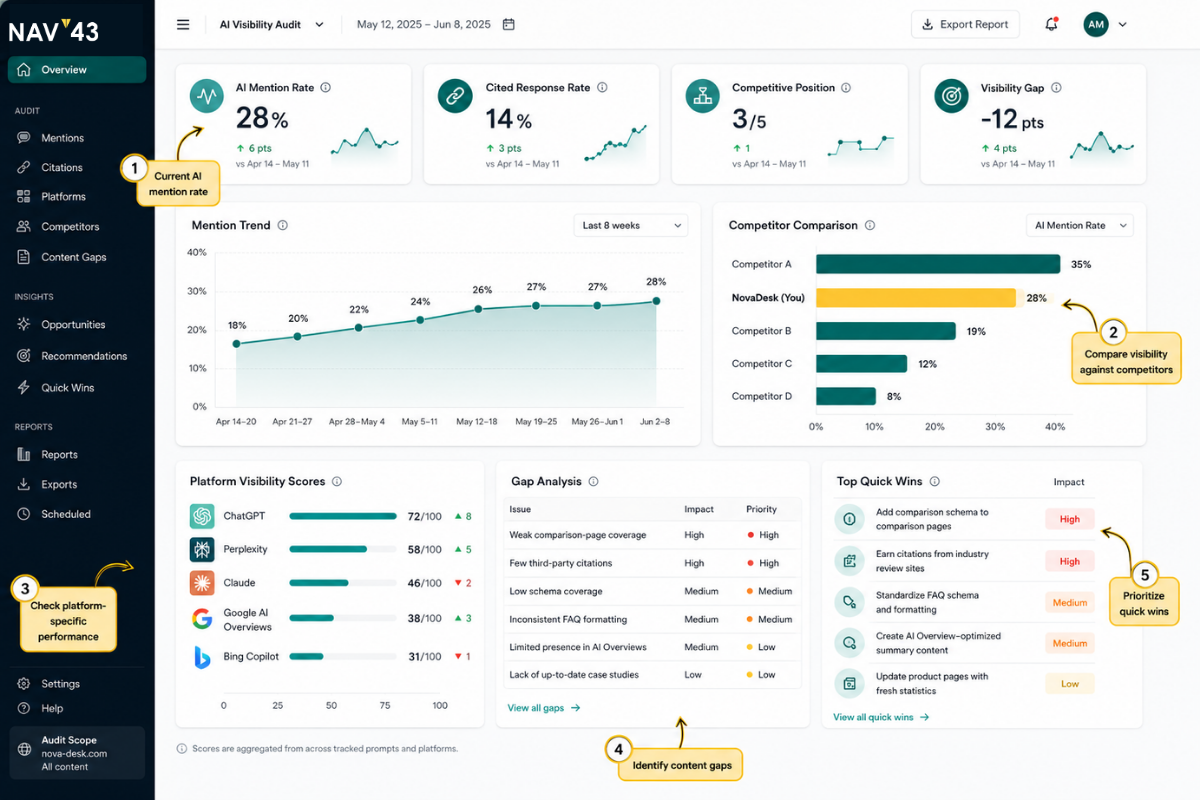
Phase 1: AI Visibility Audit (Weeks 1-2)
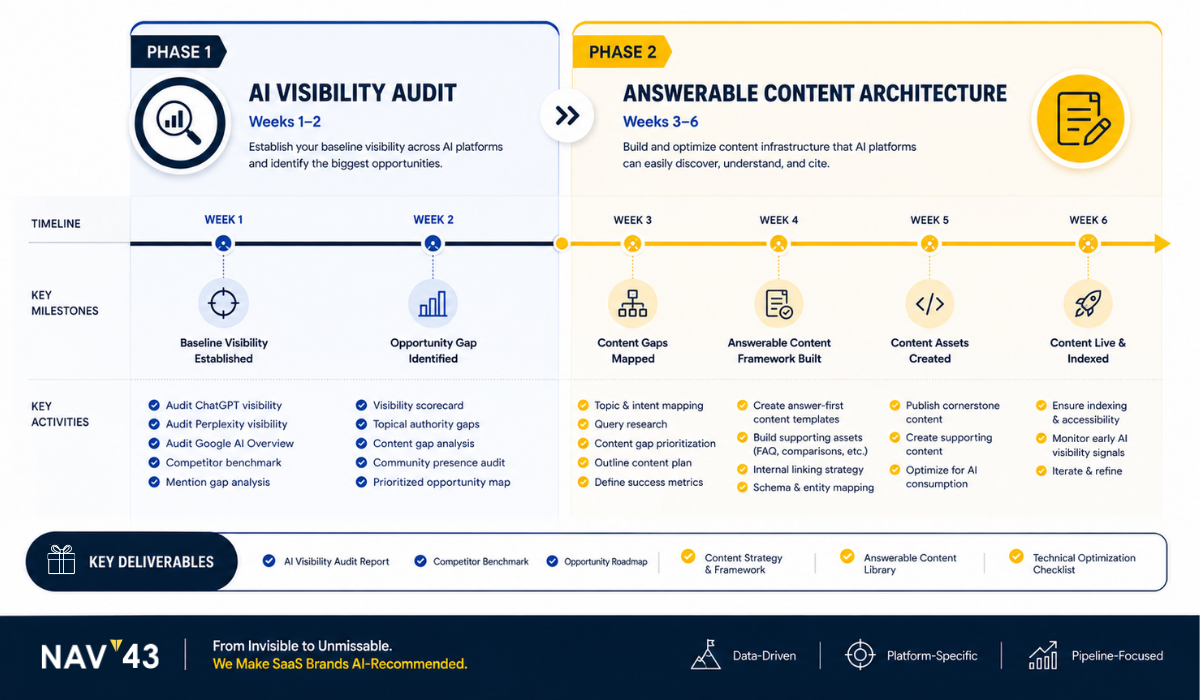
Before you optimize anything, you need to know where you stand and where the gaps are.
The audit methodology:
- Identify your top 50 target phrases: category terms, comparison queries, problem-solution searches, buying intent queries
- Query each phrase across all three platforms: ChatGPT, Perplexity, and Google AI Overviews
- Document every citation: who gets mentioned, what content gets cited, what sources AI pulls from
- Map citation gaps: where do competitors appear and you don’t?
- Prioritize by commercial value: which gaps represent the highest-intent buyer queries?
This audit reveals patterns. Maybe you’re invisible for comparison queries. Maybe competitors own the category definition content. Maybe third-party review sites dominate your category while your G2 presence is weak.
The output should be a prioritized gap list with specific content and presence-building recommendations for each gap.
Phase 2: Answerable Content Architecture (Weeks 3-6)
Once you know the gaps, you rebuild content architecture for AI extraction.
The Answerable Content Framework:
- State the question explicitly: Use the exact query language in your H2 headers
- Provide a quotable answer: 40-60 words that directly answer the question in the first paragraph after each header
- Expand with evidence: Supporting data, examples, and proof points
- Add structured data markup: Schema that helps AI understand content structure
Answer capsules are the tactical unit here. These are the 40-60-word direct answers designed for AI extraction. They should appear immediately after H2 and H3 headings, before you expand into a detailed explanation.
Your FAQ pages for AEO need restructuring, too. Standard FAQ formatting often fails to extract AI. Structure questions and answers with explicit question headers and direct first-sentence answers.
Phase 3: Technical GEO Implementation (Weeks 4-8)
The technical foundation that most SaaS companies miss.
llms.txt implementation: This emerging standard helps AI systems understand your site structure. Place it at your domain root (/llms.txt) with:
– Company description and core offerings
– Primary product/service URLs
– Key content sections AI should prioritize
– Contact and attribution information
Structured data markup checklist:
– FAQPage schema for all FAQ content
– HowTo schema for process and tutorial content
– Product schema for pricing and feature pages
– Organization schema for brand authority signals
– Article schema for blog content with author attribution
Content formatting for AI extraction:
– Subheadings every 150-200 words
– Summary boxes at the top of long-form content
– Clear hierarchy: H1 → H2 → H3, never skipping levels
– Bulleted lists for features, steps, and comparisons
– Tables for data comparisons and benchmarks
For deeper technical implementation, our structured data for GEO guide covers schema markup in detail.
Phase 4: Third-Party Presence Building (Ongoing)
This is the long game that compounds over time.
Earned media strategy:
– PR outreach to industry publications with data-driven pitches
– Analyst briefings for category inclusion in market guides
– Speaking opportunities at industry events (recorded sessions get indexed)
– Contributed expert quotes for journalist roundups
Review site optimization:
– Active G2, Capterra, TrustRadius profiles with complete information
– Review solicitation campaigns to build review velocity
– Response to all reviews (engagement signals matter)
– Feature and category claims updated for accuracy
Community presence:
– Reddit participation strategy: identify top five subreddits, set engagement cadence
– LinkedIn thought leadership from company leaders
– Industry Slack community participation
– Podcast guesting with transcripts that get indexed
Phase 5: Measurement & Iteration (Monthly)
The measurement gap is enormous. Only 14% of marketers are measuring AI citation performance (GoodFirms, 2026). This is both a crisis and an opportunity.
Key metrics to track:
– Citation share by platform: What percentage of top queries cite your brand versus competitors?
– AI-referred traffic: Segment analytics to track visitors arriving from AI platforms
– Conversion rate from AI traffic: Compare to other channels to validate quality
– Brand mention velocity: Track third-party mentions over time
Monthly audit process:
1. Re-query your top 20 target phrases across all platforms
2. Document changes in citation patterns
3. Identify content or presence gaps that emerged
4. Adjust content and outreach priorities based on findings
Research from Princeton University, Georgia Tech, and IIT Delhi found that GEO techniques can boost visibility in generative engine responses by up to 40% (KDD 2024). Measurement tells you whether your specific tactics are working.
The NAV43 SaaS GEO Implementation Checklist
Phase 1: AI Visibility Audit (Weeks 1-2)
– [ ] Compile list of 50 target phrases (category, comparison, problem-solution)
– [ ] Query all phrases in ChatGPT, Perplexity, and Google AI Overviews
– [ ] Document competitor citations and source content
– [ ] Map citation gaps by phrase and platform
– [ ] Prioritize gaps by commercial value
– [ ] Create baseline AI Presence Score or proxy metrics
Phase 2: Answerable Content Architecture (Weeks 3-6)
– [ ] Audit existing content for answerable structure
– [ ] Add answer capsules (40-60 words) after all H2/H3 headers
– [ ] Restructure FAQ pages for AI extraction
– [ ] Create/update category definition content (“What is [category]?”)
– [ ] Build comparison content for top competitor matchups
Phase 3: Technical GEO Implementation (Weeks 4-8)
– [ ] Create and publish llms.txt file
– [ ] Implement FAQPage schema on all FAQ content
– [ ] Add Product schema to pricing/feature pages
– [ ] Implement Organization schema site-wide
– [ ] Add Article schema with author attribution to blog posts
– [ ] Audit and fix heading hierarchy across key pages
– [ ] Add summary boxes to long-form content
Phase 4: Third-Party Presence Building (Ongoing)
– [ ] Identify top 5 relevant subreddits and set engagement schedule
– [ ] Complete and optimize G2/Capterra/TrustRadius profiles
– [ ] Launch review solicitation campaign
– [ ] Build PR outreach list for industry publications
– [ ] Schedule analyst briefings for relevant market guides
– [ ] Identify podcast guesting opportunities
Phase 5: Measurement & Iteration (Monthly)
– [ ] Re-audit top 20 queries across all platforms
– [ ] Track AI-referred traffic in analytics
– [ ] Calculate citation share versus competitors
– [ ] Measure conversion rate from AI traffic
– [ ] Document brand mention velocity
– [ ] Adjust priorities based on findings
SaaS GEO Content Blueprint: What to Optimize First
Not all content is equally valuable for GEO. Here’s the prioritization framework for SaaS companies with limited resources.
High-Priority Content Types for SaaS GEO
1. Category definition pages: “What is [category]?” content that AI uses for foundational answers. If you sell CRM software, your “What is CRM?” page should be the most comprehensive resource on the internet. These pages get cited across multiple query types.
2. Comparison pages: “[Your product] vs [Competitor]” structured for AI extraction. When buyers ask AI to compare options, these pages are citation gold. Structure them with clear, balanced comparison tables and direct answer capsules for each comparison dimension.
3. Use case pages: Specific problem-solution content that matches buyer prompts. “Best [category] for [use case]” queries are high-intent and highly citable. Build dedicated pages for your top five to ten use cases.
4. Integration pages: Often overlooked, but highly cited for “tools that integrate with X” queries. If you integrate with Salesforce, HubSpot, or Slack, those integration pages should be optimized for AI extraction.
5. Pricing and feature pages: Structured data optimization makes these pages citable for product-specific queries. Clear tables, comparison matrices, and schema markup matter here.
The Answer Capsule Formula
An answer capsule is a 40-60-word direct answer designed for AI extraction. This is the tactical unit that makes your content quotable.
Structure:
1. Lead with the direct answer (1-2 sentences)
2. Follow with one supporting data point or proof
3. End with a specific detail or next step
Example – Before optimization:
“Project management software helps teams coordinate work. There are many different types of project management tools available today, ranging from simple task trackers to complex enterprise solutions. The key is finding the right fit for your organization’s specific needs and workflows.”
Example – After optimization:
“Project management software is a digital platform that helps teams plan, track, and complete work through centralized task management, timeline visualization, and collaboration features. Enterprise teams typically reduce project delivery time by 20-30% after implementation. The most effective solutions integrate with existing tools like Slack, email, and document storage.”
The second version is citable. AI can extract it as a complete answer. The first is filler.
Place answer capsules immediately after H2 and H3 headers. Expanded explanation follows, but the quotable answer comes first. For more on this approach, see our GEO content strategy guide.
Answer Capsule Template for SaaS
[Question as H2 or H3 header]
[Direct answer – 1-2 sentences that completely answer the question] + [One supporting data point, statistic, or proof point] + [Specific detail, example, or actionable next step]
Example filled in:
What is sales engagement software?
Sales engagement software is a platform that automates and optimizes sales outreach through multi-channel sequences, email tracking, call logging, and analytics. Top-performing sales teams using engagement platforms achieve 25-40% higher response rates than those using manual outreach. Key features to evaluate include depth of CRM integration, flexibility in sequence automation, and real-time activity analytics.
Competitive Analysis: Finding Your AI Citation Gaps
Understanding where competitors are winning is half the battle. Here’s the methodology for systematic competitive intelligence.
The AI Citation Gap Audit Process
Step 1: Build your query list
Compile 20-30 high-value prompts that represent how buyers actually search. Categories to include:
- Category definition: “What is [your category]?”
- Best-in-class: “What are the best [category] tools?”
- Comparison: “Compare [competitor A] vs [competitor B]”
- Use case: “Best [category] for [specific use case]”
- Problem-solution: “How do I solve [problem your product addresses]?”
- Buying: “What should I look for when buying [category]?”
Step 2: Query systematically
Run each query across all three platforms. Document:
– Which brands get mentioned
– What content source gets cited
– How brands are positioned (positive, neutral, critical)
– What format does the cited content take
Step 3: Categorize the gaps
Are competitors winning on:
– Owned content: Their website pages are getting cited directly
– Third-party mentions: Reviews, press, Reddit discussions mention them
– Both: Comprehensive presence across owned and earned
This categorization tells you where to focus. If competitors win on third-party mentions but your owned content is comparable, your priority is presence-building, not content optimization.
Step 4: Prioritize by commercial value
Not all gaps matter equally. High-intent buying queries matter more than informational queries. Gaps in your core category matter more than adjacent spaces. Create a prioritized action list.
Competitive Intelligence Questions to Ask AI
Use these prompt templates for competitive research:
- “What are the best [category] tools for [specific use case]?”
- “Compare [competitor A] vs [competitor B] for [use case]”
- “What are the pros and cons of [competitor]?”
- “What do users say about [competitor]?”
- “Is [competitor] good for [company size/industry]?”
- “What are alternatives to [competitor]?”
Document citation frequency, sentiment, and positioning for each competitor. This reveals not just who appears, but how AI systems characterize them.
The 44% “invisible half” stat from DerivateX (DerivateX 2026 AI Visibility Benchmark Report, 2026) means your competitors may not even realize they have this problem. Systematic competitive intelligence lets you identify and exploit their blind spots before they wake up.
Common Pitfalls: What We See SaaS Teams Get Wrong
After working with dozens of SaaS companies on GEO implementation, certain patterns emerge. Here’s what to avoid.
1. Treating GEO as an SEO add-on rather than a distinct discipline
GEO and SEO share some tactics, but the signals that drive success are different. Backlinks dominated SEO. Brand mentions dominate GEO. Companies that treat GEO as “SEO plus schema markup” miss the fundamental shift toward third-party presence.
2. Optimizing for one platform only
With only 11% domain overlap between ChatGPT and Perplexity (Averi, 2026), single-platform optimization leaves massive gaps. Budget and prioritize for platform coverage, not just depth on one engine.
3. Ignoring Reddit and community presence
The Perplexity data, showing a 46.7% Reddit citation share, makes this a critical channel. Yet most B2B SaaS brands have no strategic presence on Reddit. This is low-hanging fruit.
4. Expecting ChatGPT results in weeks
The 60-180 day training data lag means ChatGPT optimization is a long game. Teams that expect quick wins get frustrated and abandon the strategy before it compounds. Set realistic timelines and track leading indicators.
5. Failing to measure AI-specific metrics
You can’t improve what you don’t measure. The 14% measurement rate is shocking. Build AI citation tracking into your regular reporting cadence.
6. Creating promotional content disguised as educational content
AI systems are trained to recognize and avoid promotional content. The comprehensive guides that get cited are genuinely educational, not sales pitches with a veneer of education. Lead with value.
For a deeper dive into measurement approaches, our AI SEO measurement guide covers the metrics and methodologies in detail.
Conclusion: The Window Is Open, But Closing
GEO for SaaS isn’t a future consideration. It’s a current pipeline priority. With 73% of B2B buyers using AI tools in their research process and AI traffic converting at 5.1x traditional organic rates, the companies that crack this problem now will compound their advantage while competitors play catch-up.
Key takeaways:
- 44% of B2B SaaS companies are invisible to AI-assisted buyers. If you haven’t audited your AI visibility, assume you have significant gaps.
- Platform-specific strategies are mandatory. Only 11% of domains are cited by both ChatGPT and Perplexity. One GEO approach won’t cut it.
- Brand mentions beat backlinks 3x for AI citation. Your third-party presence strategy is now a pipeline lever, not a PR vanity project.
- Implementation takes 8-12 weeks for initial results. Perplexity responds fastest (2-4 weeks), Google AI Overviews next (4-8 weeks), ChatGPT slowest (60-180 days). Plan accordingly.
- Measure or you’re guessing. Only 14% of marketers track AI citation performance. This is your competitive intelligence edge.
Next Steps
Start with the AI visibility audit. Query your top 20 target phrases across ChatGPT, Perplexity, and Google AI Overviews today. Document where you appear and where competitors dominate. That gap analysis is your roadmap.
Then prioritize ruthlessly. You can’t optimize everything at once. Focus on high-intent buying queries in your core category first. Category definition pages, comparison content, and top use case pages should be your initial targets.
Build third-party presence in parallel. Your Reddit strategy, review site optimization, and earned media outreach compound over time. Start now, even if the full content optimization takes months.
Ready to audit your AI visibility and build a GEO strategy for your SaaS category? Get your free growth plan from NAV43, and we’ll show you exactly where you stand and how to close the gaps.
54% of marketers planning to implement GEO in the next three to six months are your competition. The question is whether you’ll be ahead of them or behind.
