Author Pages, E-E-A-T, and AI Search Visibility: The Complete Guide to Building Machine-Verifiable Expertise
I was reviewing a client’s analytics last month when something stopped me cold. This B2B SaaS company was ranking #1 for their primary keyword, pulling in solid organic traffic, and their content quality was genuinely excellent. Yet when I queried their core topics in ChatGPT, Google AI Overviews, and Perplexity, they were completely invisible. Not mentioned once.
The culprit? Anonymous content. Every blog post, every guide, every thought leadership piece was published without a clear author attribution. No author pages. No Person schema. No way for AI systems to verify who created the content or why their expertise should be trusted.
Here’s a stat that should grab your attention: AI Overviews now appear in 25.11% of Google searches, up from just 13.14% in March 2025 (Conductor 2026 Benchmarks, 2026). And here’s the kicker – only 17% of AI Overview citations come from content ranking in the traditional top 10 organic results (BrightEdge, 2026). That means the old playbook of “rank high, get traffic” is fundamentally broken.
Nearly 60% of Google searches now end without a click (Semrush 2025 Zero-Click Study, 2025). If AI systems can’t verify who wrote your content, you’re not just missing clicks – you’re invisible to the majority of searchers who never leave the AI-generated answer.
Author pages are no longer a “nice to have” bio section at the bottom of your about page. They’re the technical infrastructure that enables AI systems to verify expertise and decide whether to cite your content.
This article covers why author entities matter for AI search visibility, how to build machine-verifiable author pages that AI systems trust, the NAV43 Author Entity Framework we use with enterprise clients, and how to measure the impact of your investment. If you’re serious about AI SEO and content strategy, this is where you start.
Why Author Pages Are Now Critical Infrastructure for AI Search
The Shift from Keywords to Entity Verification
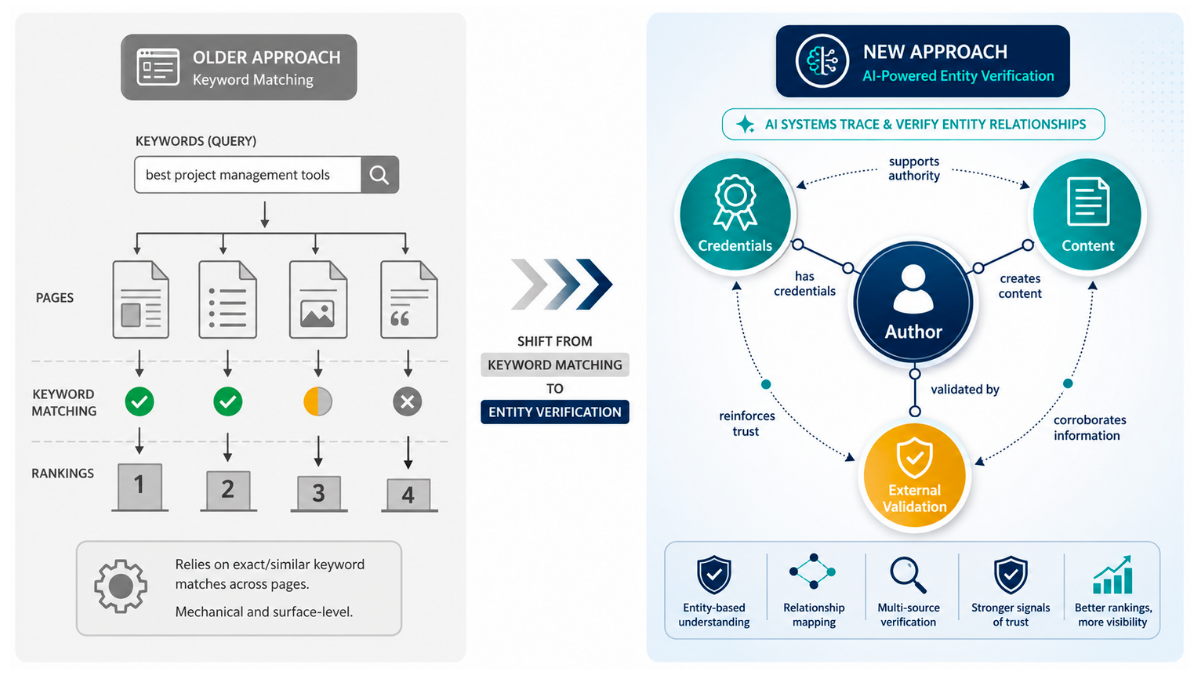
Traditional SEO was built on a simple premise: optimize for keywords, build links, rank higher, and get clicks. AI-powered search has fundamentally rewritten that equation.
When Google AI Overviews, ChatGPT, Perplexity, or Bing Copilot generate an answer, they’re not just matching keywords to content. They’re evaluating whether the source is trustworthy enough to cite. And that evaluation increasingly depends on whether they can verify who created the content and what makes them qualified to speak on the topic.
Only 17% of AI Overview citations come from content ranking in the traditional top 10 organic results (BrightEdge, 2026). Read that again. Your position one ranking means far less than it used to, as AI systems select sources based on authority signals rather than keyword optimization.
This is where entity reconciliation comes into play. Google’s Knowledge Graph doesn’t just see your author page in isolation. It connects scattered mentions of that person across LinkedIn, industry publications, association directories, and company pages into a single, verified entity record. When your author has a robust entity presence, AI systems can confirm their credentials before deciding to cite their work.
Brands with strong reputational signals are 3-5x more likely to be cited in AI Overviews (JS Interactive, 2025-2026). That’s not a marginal improvement. It’s the difference between being part of the conversation and being completely absent from it.
Think of your author pages as “entity homes.” They’re the canonical source that all other mentions link back to, the central hub that enables machine verification of expertise. Without this hub, your authors exist as disconnected fragments across the web, and AI systems have no reliable way to aggregate their authority.
The Zero-Click Reality and What It Means for Visibility
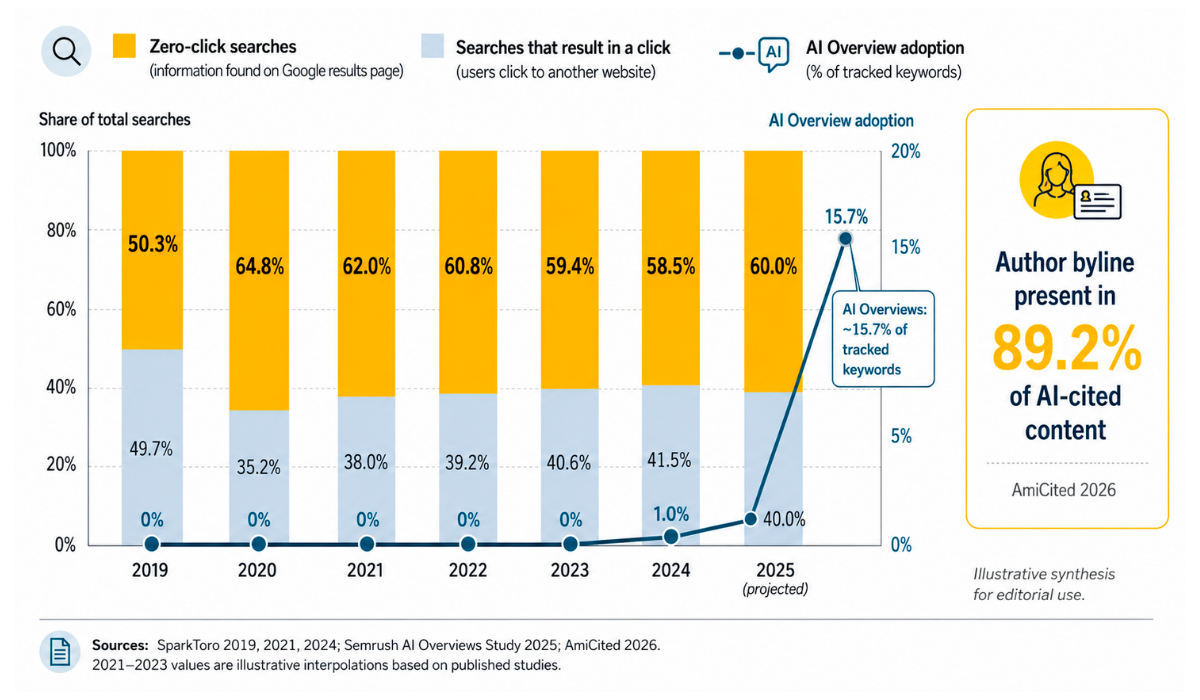
The numbers are stark, and they’re getting starker.
Around 93% of AI Mode searches end without a click, compared to 43% for AI Overviews (Position Digital/Ahrefs, 2026). AI Overviews reduce clicks to the top-ranking page by 58% (Ahrefs, 2026). The traditional metric of “organic traffic” is becoming less relevant by the quarter.
But here’s what many marketers miss: visibility still matters, even without the click.
When ChatGPT recommends a software solution, that brand enters the consideration set. When Google AI Overviews cite a study or framework, that organization gains credibility. When Perplexity cites an expert’s analysis, that person’s authority is amplified.
The new visibility equation isn’t “rank and get clicks.” It’s “get cited and build brand authority.”
And there’s a quality dimension too. AI-referred visitors browse 12% more pages per visit and show a 23% lower bounce rate than non-AI referrals (Adobe, 2026). When you do get clicks from AI citations, they’re from users who’ve already been primed to trust your expertise.
In this zero-click world, author credibility becomes the differentiator between being cited and being invisible. If AI systems can’t verify your expertise, they’ll cite someone else’s.
The New Visibility Equation
Traditional SEO: Keyword optimization → High rankings → Organic clicks → Conversions
AI Search: Entity authority → Machine verification → AI citations → Brand visibility → Assisted conversions
The click may not happen, but the brand impression does. Your author pages are the foundation of machine verification.
How AI Systems Evaluate Author Credibility
Understanding E-E-A-T as an AI Filtering Mechanism
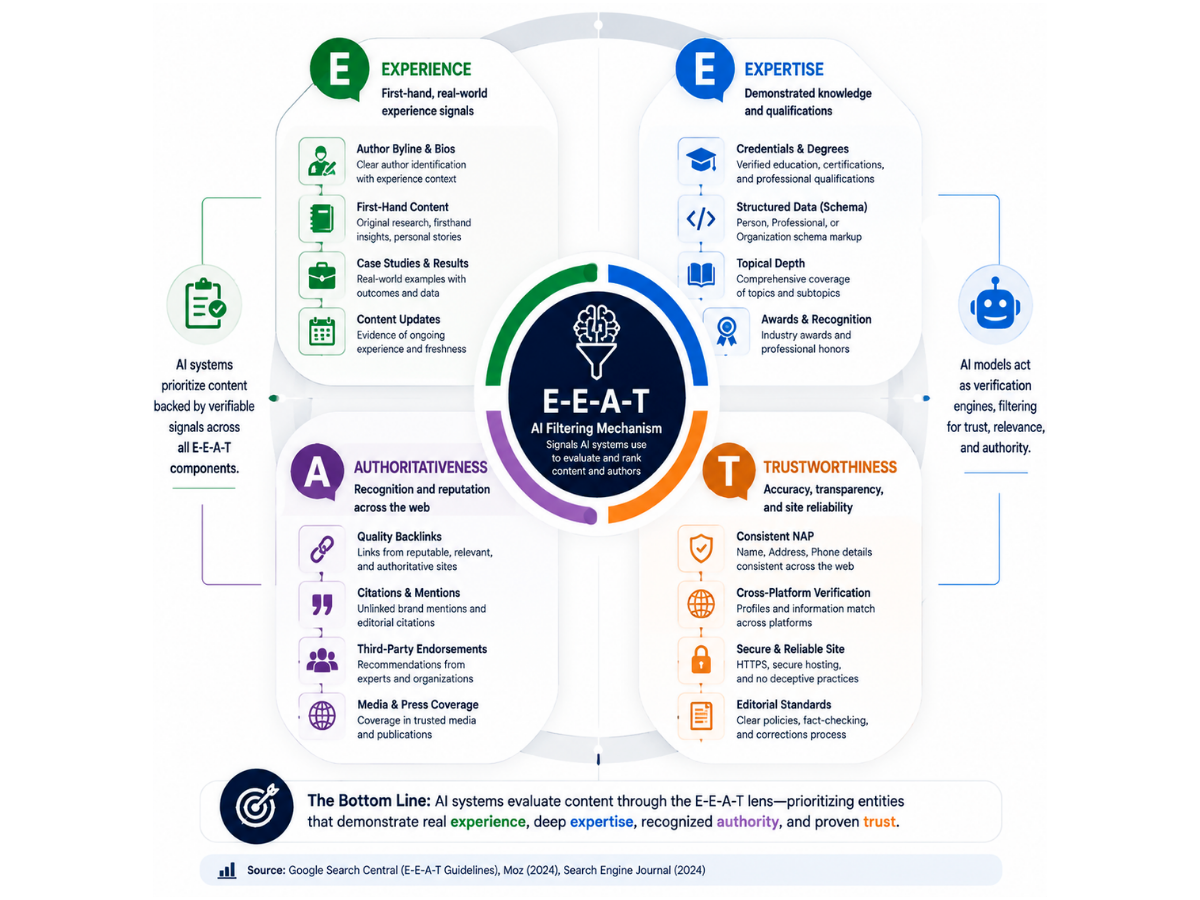
Let me clear up a persistent misconception: E-E-A-T – Experience, Expertise, Authoritativeness, Trustworthiness is not a direct ranking factor. You won’t find an “E-E-A-T score” in any Google algorithm update.
What E-E-A-T represents is something more consequential for AI search. It’s a filtering mechanism that determines whether your content is trustworthy enough to appear in AI-generated answers.
Google’s Quality Rater Guidelines, updated in September 2025 and January 2025, expanded YMYL (Your Money or Your Life) categories and placed even greater emphasis on demonstrable expertise. The March 2024 update introduced the “Who, How, and Why” framework: who created the content, how it was created, and why it was created.
Here’s the brutal reality for AI-generated content: only 3% of AI-generated content pages remained in top 100 rankings after 3 months without authority and E-E-A-T signals (Search Engine Land, 2026).y and E-E-A-T signals (Search Engine Land, 16-month experiment). AI can help you create content faster, but without human expertise backing it up, that content has a very short shelf life.
Trustworthiness is the primary AI filtering mechanism. Pages with low trust signals may never appear in AI-generated answers, regardless of how perfectly they’re optimized for keywords. If an AI system can’t verify the credibility of your source, it won’t risk citing it and potentially spreading misinformation.
This is why author pages have become critical infrastructure. They’re not just about biography and credentials for human readers – they’re about providing the verification signals that AI systems need to trust your content.
The Machine-Verification Requirements
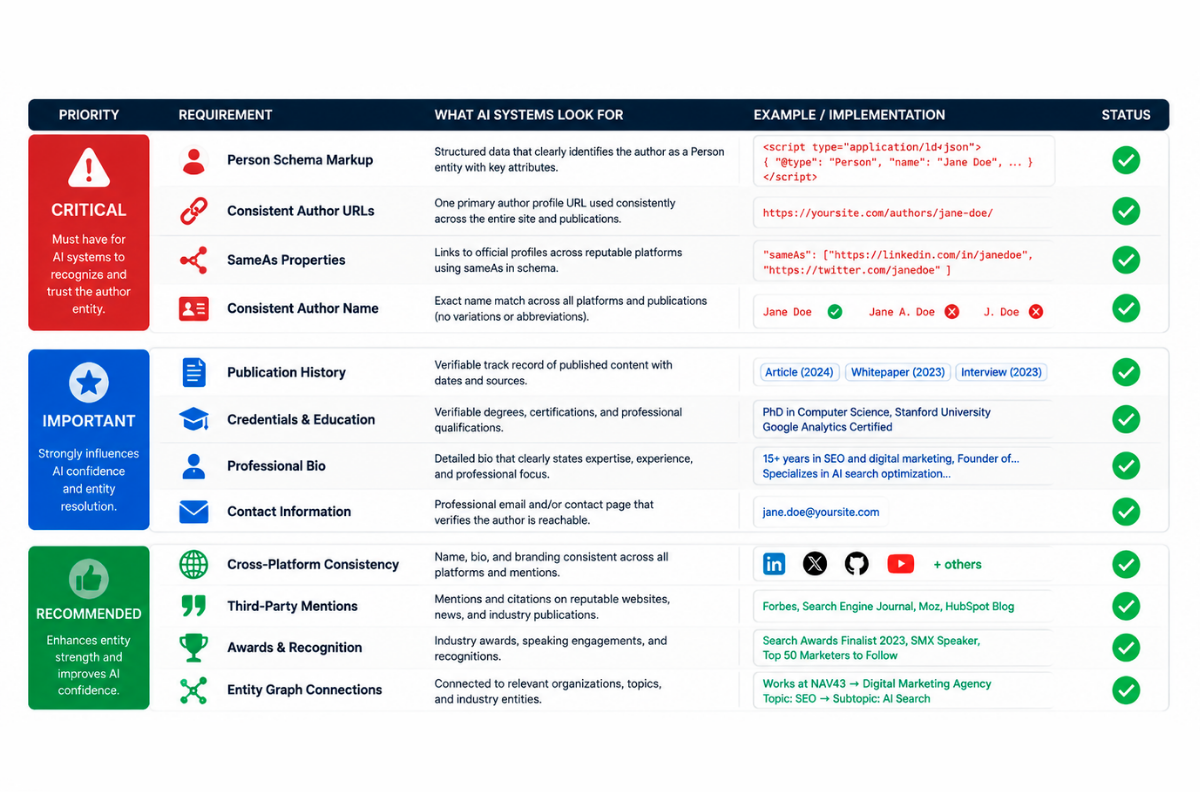
When I talk about “machine-verifiable” author credibility, I mean specific technical implementations that AI systems can parse and evaluate. Let me break down exactly what that looks like.
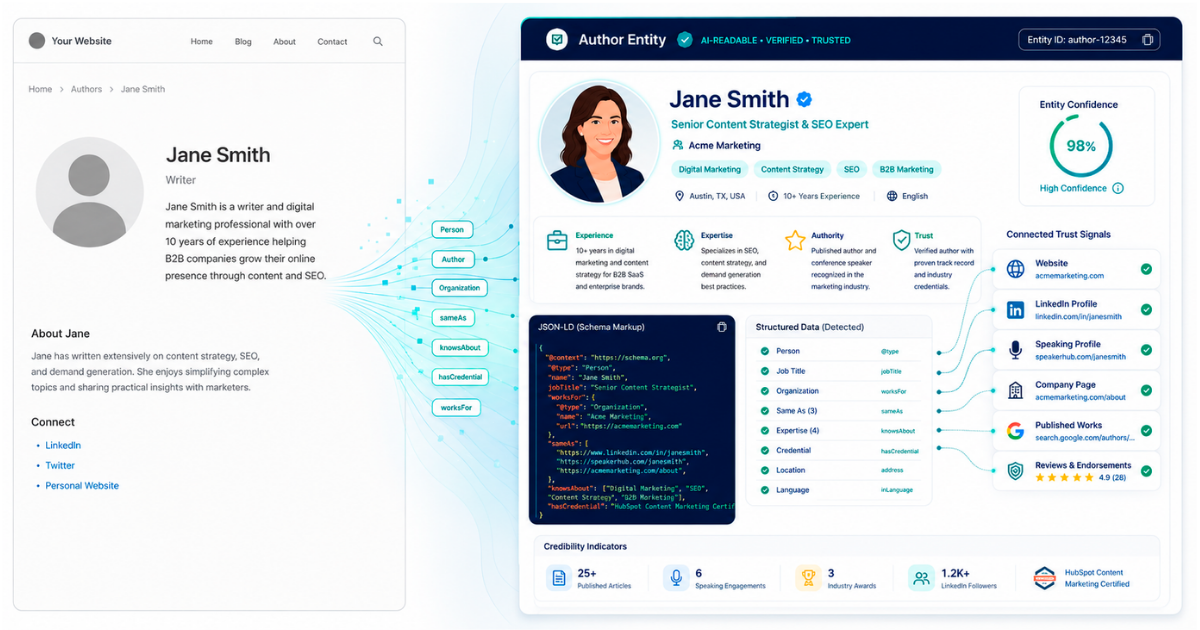
Person Schema is the foundational markup that tells search engines and AI systems who your author is. It’s structured data that explicitly declares: this is a person, this is their name, this is their job title, these are their credentials, and here’s where you can verify their identity elsewhere on the web.
The Article Schema connects the Person entity to the content they create. Every piece of content should include authorship attribution in a format machines can read, not just humans.
The sameAs property is where entity reconciliation happens. This property lists URLs where the same person is mentioned – their LinkedIn profile, Twitter/X account, industry association membership page, and guest author profiles on other publications. When AI systems see the same person consistently referenced across multiple authoritative sources, entity authority compounds.
Sites implementing structured data and FAQ blocks saw a 44% increase in AI search citations (BrightEdge, 2025). That’s not a coincidence. Structured data is the language AI systems speak.
Beyond schema, AI systems look for:
- Consistent NAP signals (Name, Association, Profile) across the web
- Cross-platform presence on authoritative professional platforms
- Credential documentation that can be independently verified
- Publication history demonstrating sustained expertise in a topic area
- External citations and mentions from other authoritative sources
The goal is to create an author entity that AI systems can verify independently, not just trust your word for it.
| E-E-A-T Signal Type | Human Indicator | Machine-Verifiable Equivalent | Schema Property |
|---|---|---|---|
| Experience | “15 years in the industry” | Employment history, bylines over time | workHistory, hasOccupation |
| Expertise | Credentials listed in bio | Linked certifications, degrees | hasCredential, alumniOf |
| Authoritativeness | Industry reputation | Citations from other sources, sameAs links | sameAs, award |
| Trustworthiness | Professional presentation | HTTPS, consistent NAP, verification badges | identifier, url |
The NAV43 Author Entity Framework: Building Author Pages That AI Systems Trust
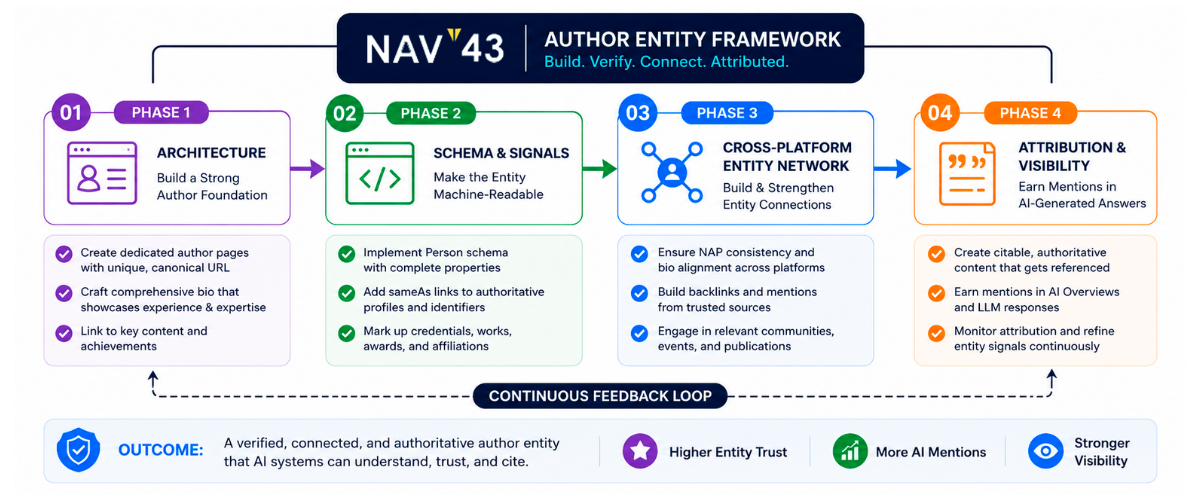
This is the exact framework we use with enterprise clients to build author pages that pass machine verification. It’s organized into four phases, each building on the previous.
Phase 1: Author Entity Architecture
Before you write a single line of code, you need to define the architecture of your author entity system.
Core Components of an Effective Author Page:
Every author page needs these elements to function as an “entity home”:
- Professional bio with verifiable credentials – Not “marketing professional with 10 years experience” but “Senior Marketing Director at [Company], previously Digital Strategy Lead at [Previous Company], certified HubSpot Solutions Partner”
- Defined expertise areas – Specific topics the author is qualified to cover, aligned with your content clusters
- Publication history – Links to content they’ve authored, organized by topic or recency
- External validation signals – Links to profiles on LinkedIn, industry associations, speaking engagements, media appearances
- Professional headshot – Real photo, not AI-generated, consistent across platforms
- First-person voice elements – Direct quotes or statements that humanize the entity
URL Structure Matters:
Use consistent, crawlable URL patterns:
– /author/peter-palarchio/ or /team/peter-palarchio/
– Never use parameter-based URLs like /author?id=123
– Keep it lowercase, hyphenated, and permanent
Content Requirements:
Write author pages in the first person where appropriate. Include specific, verifiable claims about expertise. Reference concrete accomplishments rather than vague descriptors. Link to the content they’ve authored using proper Article schema attribution.
The author page should serve both human readers evaluating credibility and machine systems parsing entity data.
Phase 2: Person Schema Implementation
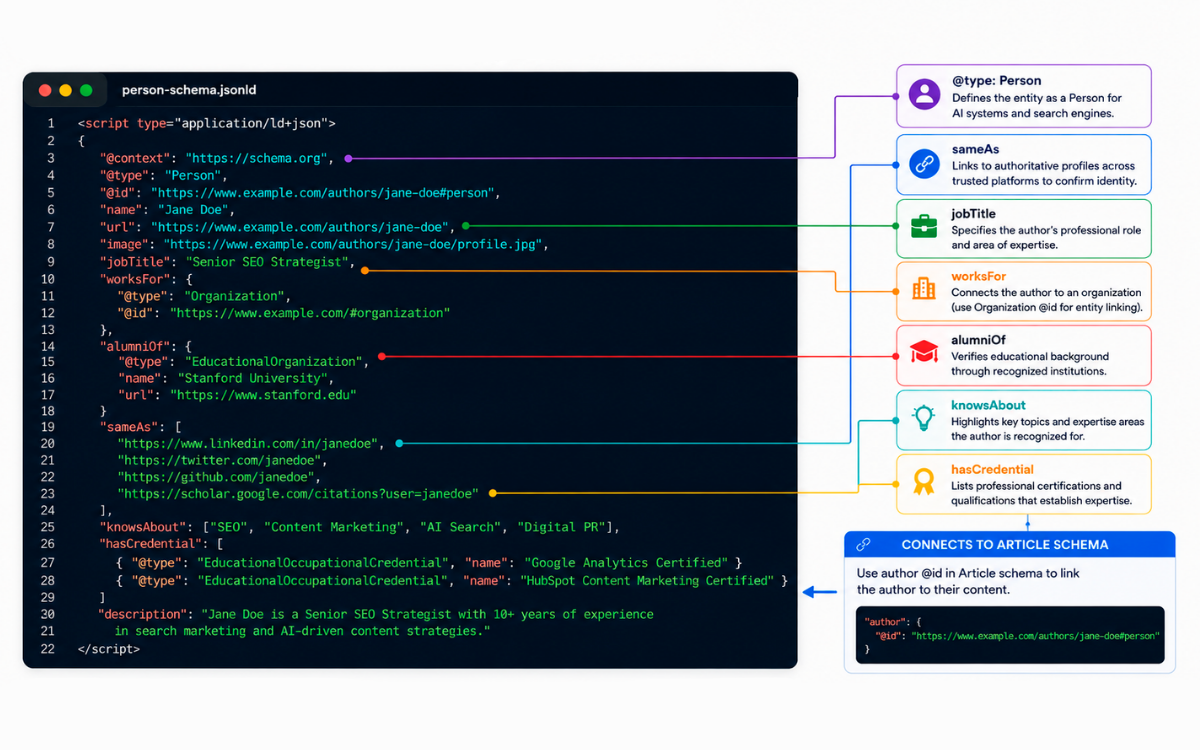
This is where many organizations fall short. They have author pages, but those pages lack the structured data that makes them machine-readable.
Here’s a complete Person schema implementation:
{
 "@context": "https://schema.org",
 "@type": "Person",
 "name": "Peter Palarchio",
 "jobTitle": "Founder & Digital Marketing Strategist",
 "worksFor": {
 "@type": "Organization",
 "name": "NAV43",
 "url": "https://nav43.com"
 },
 "url": "https://nav43.com/team/peter-palarchio/",
 "image": "https://nav43.com/images/peter-palarchio-headshot.jpg",
 "description": "Digital marketing strategist specializing in SEO, GEO, and MarTech for enterprise and e-commerce brands.",
 "sameAs": [
 "https://www.linkedin.com/in/peterpalarchio/",
 "https://twitter.com/nav43media",
 "https://nav43.com/blog/"
 ],
 "knowsAbout": [
 "Search Engine Optimization",
 "Generative Engine Optimization",
 "AI Content Strategy",
 "Marketing Technology",
 "HubSpot Implementation"
 ],
 "alumniOf": {
 "@type": "Organization",
 "name": "University Name"
 },
 "hasCredential": [
 {
 "@type": "EducationalOccupationalCredential",
 "credentialCategory": "certification",
 "name": "HubSpot Solutions Partner Certification"
 }
 ]
}
Required Properties:
– name – The author’s full name, exactly as it appears elsewhere
– jobTitle – Current professional title
– worksFor – Organization they’re associated with
– url – The canonical author page URL
Recommended Properties:
– sameAs – Array of profile URLs on other platforms (critical for entity reconciliation)
– knowsAbout – Array of expertise areas (helps AI systems understand topical authority)
– alumniOf – Educational background
– hasCredential – Professional certifications
– award – Recognitions that establish authority
Critical Implementation Notes:
The schema data must match what’s visible on the page. If your schema says “Marketing Director” but the visible bio says “Marketing Manager,” you’ve created conflicting signals that undermine trust.
Validate your schema using Google’s Rich Results Test before deployment. Errors in structured data can prevent AI systems from parsing your author entities entirely.
Phase 3: Cross-Platform Entity Connection
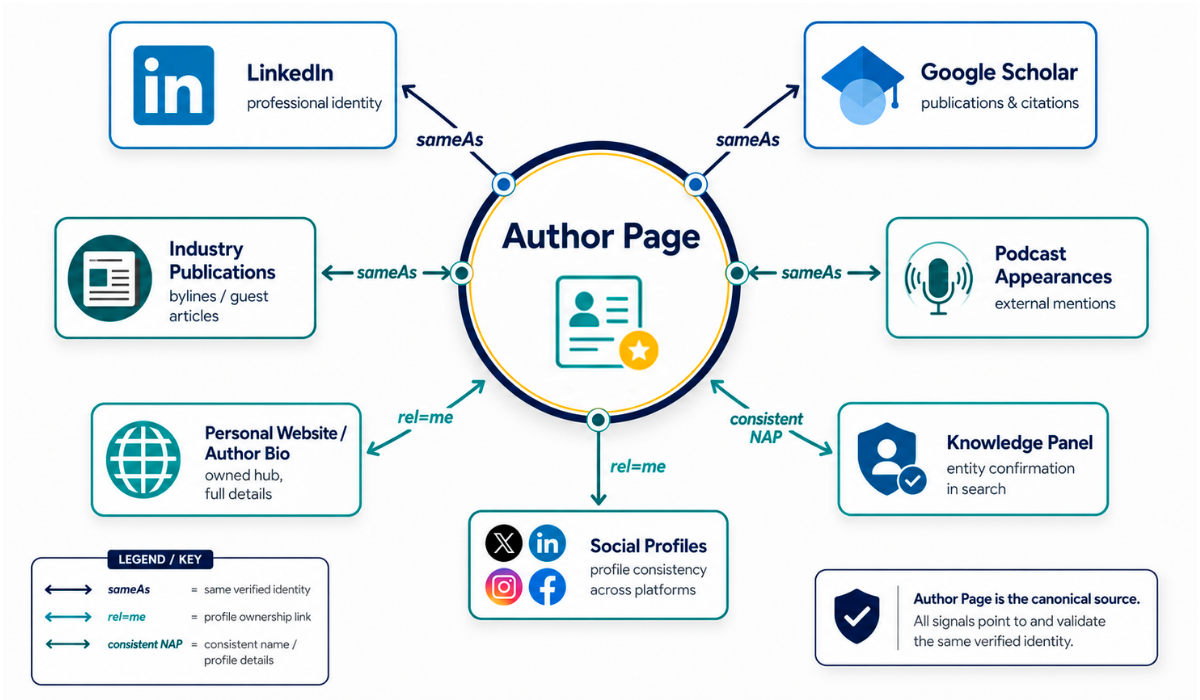
The sameAs property is where entity reconciliation magic happens, but it only works if your cross-platform presence is consistent and authoritative.
Which Platforms to Include:
- LinkedIn – Essential for B2B. Ensure the profile URL is customized, job title matches the schema, and expertise areas align.
- Twitter/X – If the author is active on the platform. Dormant accounts can be excluded.
- Industry association profiles – American Marketing Association, professional certification bodies, trade organizations
- Publication author pages – If they’ve written for Forbes, Harvard Business Review, or industry publications
- Company team/about page – The organizational connection
LinkedIn Profile Optimization for Entity Verification:
Your LinkedIn profile is often the first external source AI systems check for entity verification. Optimize it accordingly:
- Custom URL (
linkedin.com/in/firstname-lastname) - Headline matching job title used in the Person schema
- About section echoing expertise areas from the author page
- Work history that supports claims of experience
- Skills section aligned with
knowsAboutproperties
Guest Post and Publication Strategy:
Every guest post, podcast appearance, or external publication creates another node in your author’s entity network. Ensure:
- Bylines use the same name format consistently
- Author bios link back to your canonical author page
- Credentials mentioned match those on your primary author page
This is where many organizations drop the ball. Their CEO uses “Robert” on their company site but “Bob” on guest posts. Their marketing director has different job titles across three publications. These inconsistencies fracture entity authority.
Phase 4: Content Attribution Architecture
Building author pages is only half the equation. You also need to connect those entities to the content they create.
Article Schema with Author Attribution:
Every blog post, guide, or content piece should include an Article schema that points to the Person entity:
{
 "@context": "https://schema.org",
 "@type": "Article",
 "headline": "Article Title Here",
 "author": {
 "@type": "Person",
 "@id": "https://nav43.com/team/peter-palarchio/",
 "name": "Peter Palarchio"
 },
 "publisher": {
 "@type": "Organization",
 "name": "NAV43",
 "logo": {
 "@type": "ImageObject",
 "url": "https://nav43.com/logo.png"
 }
 },
 "datePublished": "2026-04-20",
 "dateModified": "2026-04-20"
}
The @id property creates a direct connection between the article and the canonical author entity. This is how AI systems trace content back to verified expertise.
Byline Placement and Formatting:
For both humans and machines:
– Author name should appear prominently at the top of the article
– Link the author name to their author page
– Include a brief author bio at the bottom with credentials
– Use consistent author photos across all content
Multi-Author Content:
For content with multiple authors, list each in the Article schema author array. Designate primary and contributing authors clearly. Ensure each author has their own Person entity page.
Connecting to Content Clusters:
Your author pages should align with your content clusters. If Peter Palarchio is the authority on technical SEO audits, all content in that cluster should attribute to him. This reinforces topical authority at both the content and entity levels.
The NAV43 Author Entity Framework Checklist
Phase 1: Architecture
– [ ] Author page URL follows a consistent pattern (/author/name/ or /team/name/)
– [ ] Bio includes specific, verifiable credentials
– [ ] Expertise areas explicitly defined
– [ ] Publication history linked
– [ ] Professional headshot (real, not AI-generated)
– [ ] First-person voice elements included
Phase 2: Person Schema
– [ ] JSON-LD implemented in page head
– [ ] Required properties complete (name, jobTitle, worksFor, url)
– [ ] sameAs array includes 3+ authoritative profiles
– [ ] knowsAbout reflects actual expertise areas
– [ ] Schema validated with Rich Results Test
– [ ] Schema data matches visible page content
Phase 3: Cross-Platform Connection
– [ ] LinkedIn profile optimized and linked
– [ ] All profiles use a consistent name format
– [ ] Job titles match across platforms
– [ ] External author bios link to canonical author page
– [ ] Industry associations and certifications linked
Phase 4: Content Attribution
– [ ] Article schema includes author property
– [ ] Author @id points to canonical entity page
– [ ] Byline appears prominently on all content
– [ ] Author bio included at article’s bottom
– [ ] Multi-author content properly attributed
Author Page Optimization for YMYL Industries
If your organization operates in finance, healthcare, legal, or other YMYL (Your Money or Your Life) categories, the author verification bar is significantly higher. AI systems apply stricter filtering for queries where incorrect information could harm users.
Finance and FinTech Authors:
Required credential documentation:
– CFA, CFP, CPA, or equivalent certifications
– FINRA licenses (Series 7, 66, etc.)
– Educational background (MBA, finance degrees)
– Regulatory disclosures where required
Schema implementation should include hasCredential with specific credential types and issuing organizations. Link to public credential verification databases where available.
Healthcare and Medical Authors:
Required credential documentation:
– Medical degrees (MD, DO, PharmD, etc.)
– Board certifications and specialty designations
– Institutional affiliations (hospital, research institution)
– State licensure verification
For medical content, consider adding the MedicalWebPage type with reviewedBy property pointing to credentialed medical reviewers, even if the author is also credentialed.
Legal Authors:
Required credential documentation:
– JD and bar admissions (specific states)
– Practice areas and specializations
– Court admissions (federal, state, appellate)
– Professional association memberships (ABA sections, specialty bars)
Link to state bar directory listings as external validation.
The Pattern Across YMYL:
AI systems are looking for third-party verification of claimed credentials. It’s not enough to say “certified financial planner.” You should link to the CFP Board directory. Don’t just claim bar admission, but link to your state bar’s public attorney search.
This external verification is what separates trustworthy YMYL content from potentially harmful misinformation.
| Industry | Required Credentials | Key Schema Properties | Verification Sources |
|---|---|---|---|
| Finance | CFA, CFP, CPA, Series licenses | hasCredential, memberOf | FINRA BrokerCheck, CFP Board |
| Healthcare | MD/DO, board certifications | hasCredential, affiliation | State medical boards, specialty boards |
| Legal | JD, bar admissions | hasCredential, memberOf | State bar directories |
| Real Estate | Broker licenses, certifications | hasCredential, areaServed | State real estate commissions |
Cross-Platform AI Citation Strategy
Building Presence Across AI Search Engines
The AI search landscape isn’t a single battlefield – it’s multiple fronts with different rules of engagement.
Google AI Overviews favor established domain authority and E-E-A-T signals. They tend to cite content that already has strong traditional SEO signals, though the 17% overlap with top-10 rankings (BrightEdge, 2026) shows it’s not the only factor.
ChatGPT (and the models behind it) have been trained on web content with a specific cutoff date, but they’re increasingly integrated with real-time search via plugins and browsing. Brand consistency across the web influences how ChatGPT represents your organization.
Perplexity actively searches and cites sources in real-time, with heavy emphasis on content that directly answers questions. Author credibility matters, but so does content structure that enables direct quotation.
Bing Copilot leverages Microsoft’s search infrastructure and OpenAI’s models, creating a hybrid that weighs both traditional search signals and AI content evaluation.
52% of AI Overview sources come from the top 10 search results, making E-E-A-T the foundation for visibility (ClickPoint Software, 2025). This tells us that while AI citation isn’t purely about rankings, traditional SEO and E-E-A-T signals create the foundation.
The Rising Tide Effect:
Here’s what we’ve observed with clients: strong author entity signals tend to improve citation across all AI platforms, not just one. When you build a robust, verifiable author entity, you’re speaking the language that all AI systems understand.
This is why the framework approach matters. Rather than optimizing for each AI system individually, build the foundational infrastructure of author entities, and you create compounding authority across all of them.
The Answerable Content Connection
Author credibility and content structure work together. AI systems prefer citing content from verified experts, but they also need content formatted for direct quotation.
This is where the NAV43 Answerable Content Framework connects:
- State the question explicitly – Match the query structure
- Provide a 2-3 sentence quotable answer – Give AI something to cite directly
- Expand with evidence – Support the answer with data and examples
- Include structured data – Help AI systems parse and attribute
When your author page establishes expertise, and your content structure enables citation, you’ve created the optimal conditions for AI visibility. The author entity asks, “Why should I trust this?”, while the content structure asks, “What should I quote?”
Measuring Author Page Impact on AI Search Visibility
Metrics That Matter
Traditional SEO metrics, such as rankings, organic traffic, and click-through rates, tell only part of the story in the AI search era. Here’s what to measure instead:
AI Citations: How often is your brand, your authors, or your content cited in AI-generated answers? This requires manual monitoring or specialized tools.
Brand Mentions in AI Answers: Even when you’re not directly cited, are you mentioned? Query your primary topics in ChatGPT, Perplexity, and Google AI Overviews. Document where you appear and where you’re absent.
Assisted Conversions: Users who first encountered your brand through an AI citation, then converted through another channel. This requires proper attribution modeling.
Referral Quality: As noted earlier, AI-referred visitors browse 12% more pages per visit and show a 23% lower bounce rate than non-AI referrals (Adobe, 2026). Track these quality metrics for AI-sourced traffic.
Competitive Share of Voice: How often are you cited versus competitors for key topics? This competitive benchmarking reveals gaps in your author entity strategy.
The Author Entity Audit Process
Before you can improve, you need to understand your current state.
Step 1: Query-Based Visibility Audit
For each author, query their name + primary expertise areas in:
– Google (standard search and AI Overviews)
– ChatGPT
– Perplexity
– Bing Copilot
Document: Does the AI know who they are? Does it cite their work? Does it misattribute or confuse their identity with someone else?
Step 2: Schema Validation
Use Google’s Rich Results Test to validate the Person schema on each author page. Check for errors, warnings, and missing recommended properties. Validate Article schema on content pages to ensure author attribution is properly structured.
Step 3: Knowledge Graph Verification
Search for the author’s name in quotes on Google. Does a Knowledge Panel appear? If so, what information does it show? Is it accurate and complete? If no Knowledge Panel exists, the author likely hasn’t yet achieved entity status in Google’s Knowledge Graph.
Step 4: Cross-Platform Consistency Audit
Visit every profile linked in the sameAs property. Verify that name format, job title, expertise claims, and professional presentation are consistent. Document any discrepancies.
Step 5: Prioritization Framework
Not all authors need equal optimization. Prioritize based on:
– Content volume attributed to the author
– Strategic importance of their expertise areas
– Current visibility gaps (authors invisible to AI despite high content output)
– YMYL category involvement
Author Entity Audit Scorecard
| Dimension | Criteria | Score (1-5) | Notes |
|---|---|---|---|
| Technical | Person schema implemented | ||
| sameAs includes 3+ profiles | |||
| Article schema links to author | |||
| Schema validates without errors | |||
| Content | Bio includes verifiable credentials | ||
| Expertise areas explicitly defined | |||
| Publication history linked | |||
| First-person voice present | |||
| Cross-Platform | LinkedIn optimized and linked | ||
| Name consistency across platforms | |||
| External author bios link back | |||
| Knowledge Panel exists | |||
| AI Visibility | Appears in Google AI Overviews | ||
| Cited by ChatGPT for expertise areas | |||
| Mentioned in Perplexity answers |
Scoring Guide: 1 = Not implemented, 2 = Partially implemented, 3 = Implemented but needs improvement, 4 = Well implemented, 5 = Optimized
Common Pitfalls: What Most Organizations Get Wrong
After auditing author entity implementations across dozens of organizations, these are the patterns that consistently undermine AI search visibility.
Pitfall 1: Generic Bios Without Verifiable Credentials
“Marketing professional with 10 years of experience” tells AI systems nothing. There’s no organization to verify, no credential to check, no specific claim to validate.
Fix: Replace vague experience claims with specific roles, companies, and verifiable credentials. “Former Marketing Director at [Named Company], HubSpot certified, former Gartner speaker.”
Pitfall 2: Schema Implementation Without Visible Content Alignment
Your Person schema claims expertise in “data science” and “machine learning,” but the visible bio focuses on “content marketing” and “SEO.” AI systems see conflicting signals.
Fix: Ensure perfect alignment between schema properties and visible page content. What you claim in code must match what humans read.
Pitfall 3: Orphaned Author Pages
Organizations create beautiful author pages, then never link content to them via Article schema. The author entity exists, but nothing connects it to the content it should validate.
Fix: Implement Article schema with proper author attribution on every piece of content. Create explicit connections between entities and their work.
Pitfall 4: Inconsistent Cross-Platform Presence
The CEO is “Robert Chen” on the company website, “Bob Chen” on LinkedIn, and “R. Chen” on guest posts. Each mention fragments the entity rather than reinforcing it.
Fix: Choose one canonical name format and use it everywhere. Update existing profiles for consistency. Brief external publishers on the correct byline format.
Pitfall 5: Neglecting External Validation
The author’s page claims impressive credentials, but none of them link to external verification. AI systems can’t independently confirm any claims.
Fix: For each claimed credential, provide an external verification link where possible. Industry associations, certification bodies, publication archives, and university alumni directories.
Pitfall 6: One-Time Setup Without Maintenance
Author entities are treated as “set and forget.” Job titles change, new credentials are earned, new publications happen, but the author page stays static.
Fix: Build author page reviews into your content calendar. Quarterly updates at a minimum, with immediate updates for significant changes.
Pitfall 7: Focusing on Volume Over Authority
Organizations push content volume by having everyone publish, regardless of expertise. The intern writes about enterprise security strategy. The sales rep authors technical implementation guides.
Fix: Match authors to their actual areas of expertise. It’s better to have fewer authors with genuine authority than many authors with questionable credentials. Consider content marketing SEO services to build strategic depth.
Conclusion & Next Steps
The shift to AI-powered search has fundamentally changed what it takes to be visible. Rankings still matter, but they’re no longer sufficient. In a world where 60% of searches end without a click and AI systems curate the answers users see, author pages have evolved from bio sections to critical technical infrastructure.
Here are the key takeaways:
- AI systems select sources based on entity verification, not just keyword optimization. Only 17% of AI Overview citations come from traditional top 10 organic results (BrightEdge, 2026).op-10 content.
- E-E-A-T serves as a filter for AI inclusion. Pages without verifiable trust signals may never appear in AI-generated answers.
- Person schema and cross-platform entity connection are now mandatory. Sites implementing structured data and FAQ blocks saw a 44% increase in AI search citations (BrightEdge, 2025).ns.
- Author entities require ongoing maintenance. Static author pages lose authority as the digital landscape evolves.
- The quality of AI-referred traffic is significantly higher. When you do earn citations, those visitors are more engaged and more likely to convert.
Immediate Action Items:
- Audit your current author pages using the scorecard above. Identify gaps in technical implementation, content depth, and cross-platform consistency.
- Implement the Person schema on every author page, including all required and recommended properties.
- Verify cross-platform consistency – check every sameAs URL for alignment in name, title, and expertise claims.
- Connect content to authors via Article schema on every blog post, guide, and content piece.
- Establish a maintenance cadence – quarterly author page reviews at a minimum.
Brands that invest in author entity infrastructure now will compound authority while competitors remain invisible to AI systems. The window for establishing entity authority is open, but as more organizations catch on, the competitive barrier will rise.
Your 30-Day Author Entity Action Plan
Week 1: Audit & Strategy
– Complete Author Entity Audit Scorecard for all authors
– Prioritize authors by content volume and strategic importance
– Document cross-platform inconsistencies
Week 2: Schema Implementation
– Implement Person schema on all priority author pages
– Validate with Google Rich Results Test
– Fix any errors before proceeding
Week 3: Cross-Platform Alignment
– Update LinkedIn profiles for consistency
– Correct external author bios with canonical links
– Add sameAs properties for all verified profiles
Week 4: Content Attribution & Monitoring
– Implement Article schema with author attribution
– Set up AI citation monitoring process
– Schedule quarterly maintenance reviews
The AI search era demands a new kind of infrastructure investment. Author pages are where that investment starts.
Ready to assess your author entity infrastructure and AI search visibility? Get a free NAV43 growth plan – we’ll audit your current author pages, identify E-E-A-T gaps, and show you exactly where the citation opportunities are hiding.
The brands building this infrastructure today will own the AI-powered search results of tomorrow. Make sure you’re one of them.
