Google Demand Gen vs Performance Max: A Funnel Strategy for B2B Brands
Here’s a stat that should change how you think about your Google Ads strategy: 80% of the B2B buying journey takes place without direct vendor contact (Gartner, 2025). Your buyers are researching, evaluating, and shortlisting solutions before they ever speak to sales.
Now layer in another reality: 92% of B2B buyers start with at least one vendor already in mind, and 41% have a single preferred vendor before formal evaluation begins (Forrester, 2024). If you’re not in their consideration set early, you’re fighting from behind with conversion-focused campaigns that target people who’ve already made up their minds.
This is the core tension at the heart of the demand gen vs performance max debate. Performance Max is built for conversions, but B2B buyers don’t convert on first touch. Demand Gen is built for awareness, but most B2B marketers don’t know how to measure its impact on the pipeline.
The stakes couldn’t be higher. B2B buyers go through an average of 27 touchpoints before making a purchase decision (Gartner, 2025). Your campaigns need to be present at every stage, not just the final click.
This is the playbook for combining Demand Gen and Performance Max into a full-funnel B2B strategy. You’ll get budget allocation frameworks, audience segmentation tactics, and measurement approaches that actually work for long sales cycles. We’ll also show you how Google’s 2025 “Power Pack” strategy – AI Max + Demand Gen + PMax – fits together as a unified system for B2B lead generation.
What You’ll Learn in This Guide
TL;DR: The NAV43 B2B Funnel Framework
- The fundamental difference between Demand Gen and Performance Max, and why the naming creates confusion
- When to use each campaign type for B2B, with specific criteria checklists
- How to prevent cannibalization between campaign types and protect your branded search traffic
- Budget allocation framework with starting percentages and adjustment triggers
- Measurement approach for long B2B sales cycles, including offline conversion imports
- How AI Max for Search bridges awareness and conversion as the “intent capture” layer
- The exact framework NAV43 uses with clients to structure full-funnel Google Ads for B2B
This is a practitioner’s guide. Not theory, but the exact approach we implement with mid-market and enterprise B2B clients.
Demand Gen vs Performance Max: What’s Actually Different?
Let’s cut through the confusion. Both campaign types live inside Google Ads, both use AI, and both can show ads on YouTube. But they serve fundamentally different purposes.
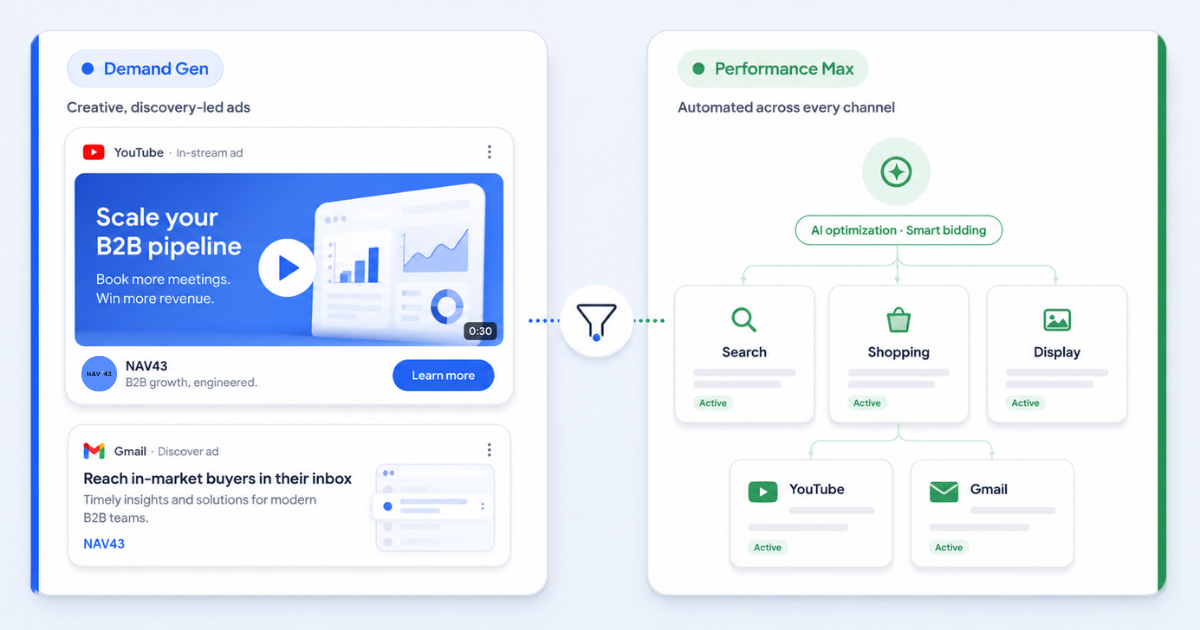
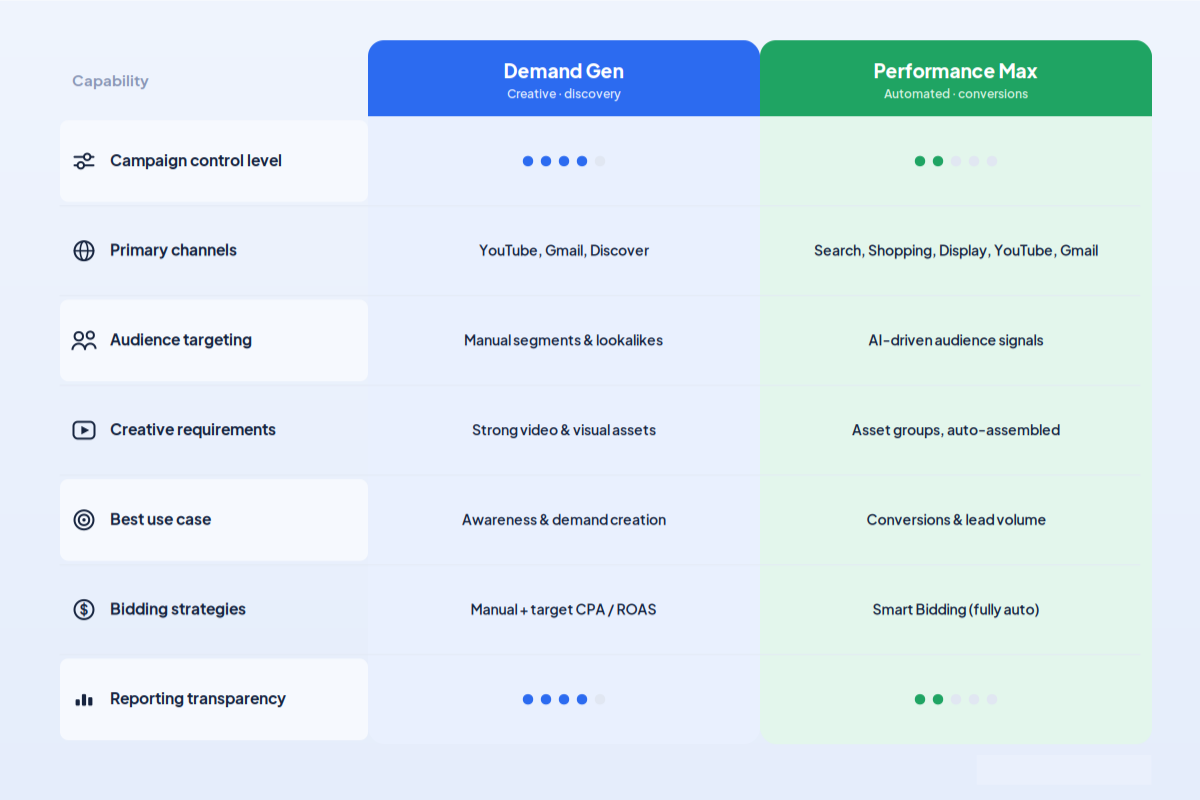
Demand Gen campaigns are designed for awareness and consideration. They run across YouTube, YouTube Shorts, Discover, and Gmail. The key advantage? Granular audience targeting and creative control. You decide who sees your ads and where they appear. As of June 2025, advertisers can opt out of specific channels – meaning you can run YouTube-only campaigns if that’s where your buyers spend time.
Performance Max campaigns are designed for conversions across all Google inventory – Search, Shopping, Display, YouTube, Discover, Maps, and Gmail. The AI decides everything based on your conversion signals. You provide creative assets and a conversion goal; Google figures out the rest.
Here’s the critical distinction: Demand Gen gives you control over where and to whom your ads appear. PMax gives Google’s AI control based on conversion signals.
This matters enormously for B2B. With Demand Gen, you can target CFOs at companies with 500+ employees in the manufacturing sector. With PMax, you tell Google “find me more leads like these” and trust the algorithm to deliver.
Over 1 million advertisers now use Performance Max globally (Google, 2025), and 73% of advertisers run at least one PMax campaign (ALM Corp, 2025). But that ubiquity doesn’t mean it’s the right tool for every job.
The “black box” criticism of PMax has softened somewhat. The 2025 updates include channel-level reporting, campaign-level negative keywords, and search term insights. You can finally see where your budget is going and exclude irrelevant queries.
Meanwhile, Video Action Campaigns were replaced by Demand Gen in July 2025, consolidating all YouTube conversion-focused campaigns into a single system (Google/Search Engine Land, 2025). If you were running YouTube campaigns before, you’re now running Demand Gen whether you chose to or not.
| Feature | Demand Gen | Performance Max |
|---|---|---|
| Primary Goal | Awareness & Consideration | Conversions |
| Inventory | YouTube, Shorts, Discover, Gmail | All Google inventory |
| Audience Control | High – custom segments, lookalikes, in-market | Low – AI-driven targeting |
| Creative Control | High – video, image, carousel formats | Medium – asset groups |
| Conversion Focus | Secondary (view-through, assisted) | Primary optimization target |
| Ideal Funnel Stage | Top & Mid-Funnel | Bottom Funnel |
The Short Answer: Control vs. Automation
What is the difference between PMax and Demand Gen?
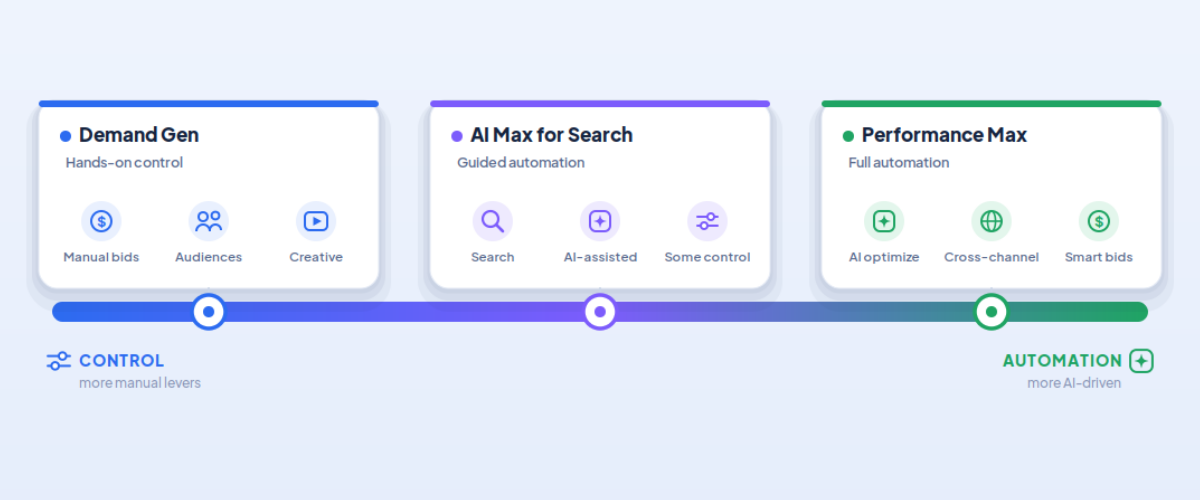
Demand Gen gives you control over audiences and placements while optimizing for engagement and consideration. Performance Max gives Google control over everything except your creative assets and conversion goal, optimizing purely for conversions.
They serve different funnel stages. Demand Gen builds awareness with cold audiences who don’t know you yet. PMax converts warm audiences who are ready to act. Running only one without the other is like having a sales team without marketing, or marketing without sales.
Demand Gen (the Campaign Type) vs. Demand Generation (the Strategy)
The naming creates real confusion. Let’s clear it up.
Demand generation (the marketing strategy) is the practice of creating awareness and interest in a product or service before buyers are ready to purchase. It focuses on brand building, education, and trust. The goal is to be remembered when the buyer finally enters an active buying cycle.
Performance marketing (the opposing strategy) drives measurable actions – clicks, leads, purchases – with direct attribution. It focuses on ROI and cost efficiency. The goal is to convert existing demand, not create new demand.
Demand Gen (the Google campaign type) is Google’s attempt to bring demand generation strategy into a performance marketing platform. It lets awareness campaigns be measured and optimized like conversion campaigns. You can run top-funnel creative and still see view-through conversions, assisted conversions, and engagement metrics.
This is a meaningful evolution. Historically, B2B marketers ran brand campaigns on one platform (Display, YouTube) and conversion campaigns on another (Search). Demand Gen lets you connect the dots within a single system, passing audience signals between campaign types.
Why B2B Needs Both: The Case for a Full-Funnel Approach
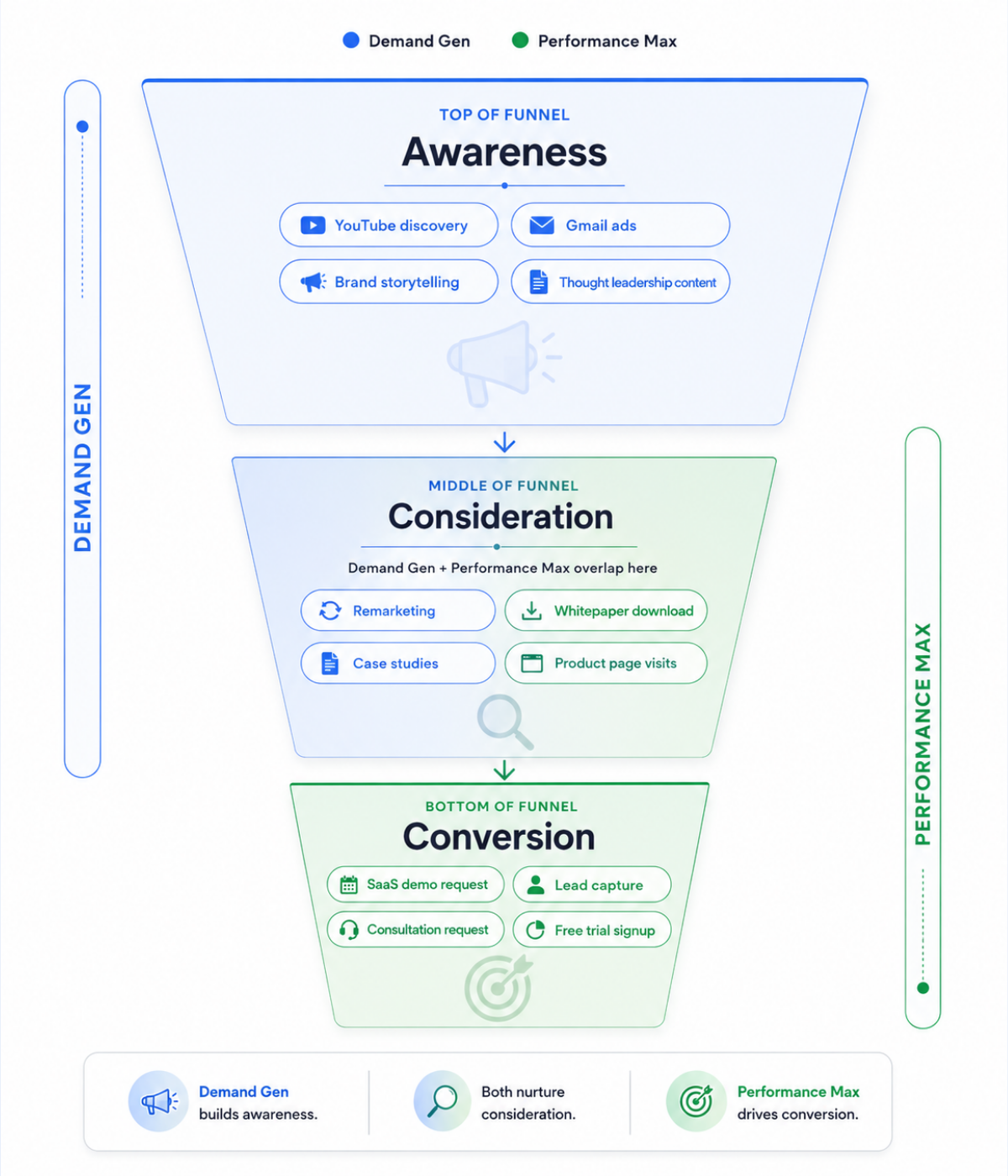
The “Demand Gen OR PMax” framing is wrong for B2B. Long sales cycles require both awareness and conversion infrastructure working together.
Consider the data: 61% of B2B buyers prefer a rep-free buying experience, and 73% actively avoid suppliers who send irrelevant outreach (Gartner, 2025). Your buyers are self-educating. They’re reading content, watching videos, and comparing solutions before they ever want to talk to you.
If 92% of buyers start with a vendor in mind (Forrester, 2024), you need Demand Gen to get on that shortlist before the buyer searches for your solution category. By the time someone types “enterprise CRM software” into Google, they’ve already decided who they’re evaluating. PMax can capture that search, but it can’t create the preference.
Here’s what happens when you run only PMax for B2B:
- You cannibalize branded search. PMax loves to claim credit for branded queries because they convert well. You end up paying for clicks you would have gotten organically.
- You retarget the same warm audiences. PMax optimizes toward conversions, so it keeps showing ads to people who’ve already engaged. That’s efficient but not scalable.
- You don’t build new demand. PMax captures existing intent. If there’s no intent to capture, it has nothing to optimize toward.
And when you run only Demand Gen?
- You struggle to convert. Awareness without follow-through means wasted brand impressions.
- You can’t measure impact. Without a conversion layer, Demand Gen appears to be generating only YouTube views.
- You lose buyers at the critical moment. Someone remembers you, searches for you, and finds a competitor who’s bidding on Search.
The solution is obvious: run both, strategically layered.
When Demand Gen Is the Right Play
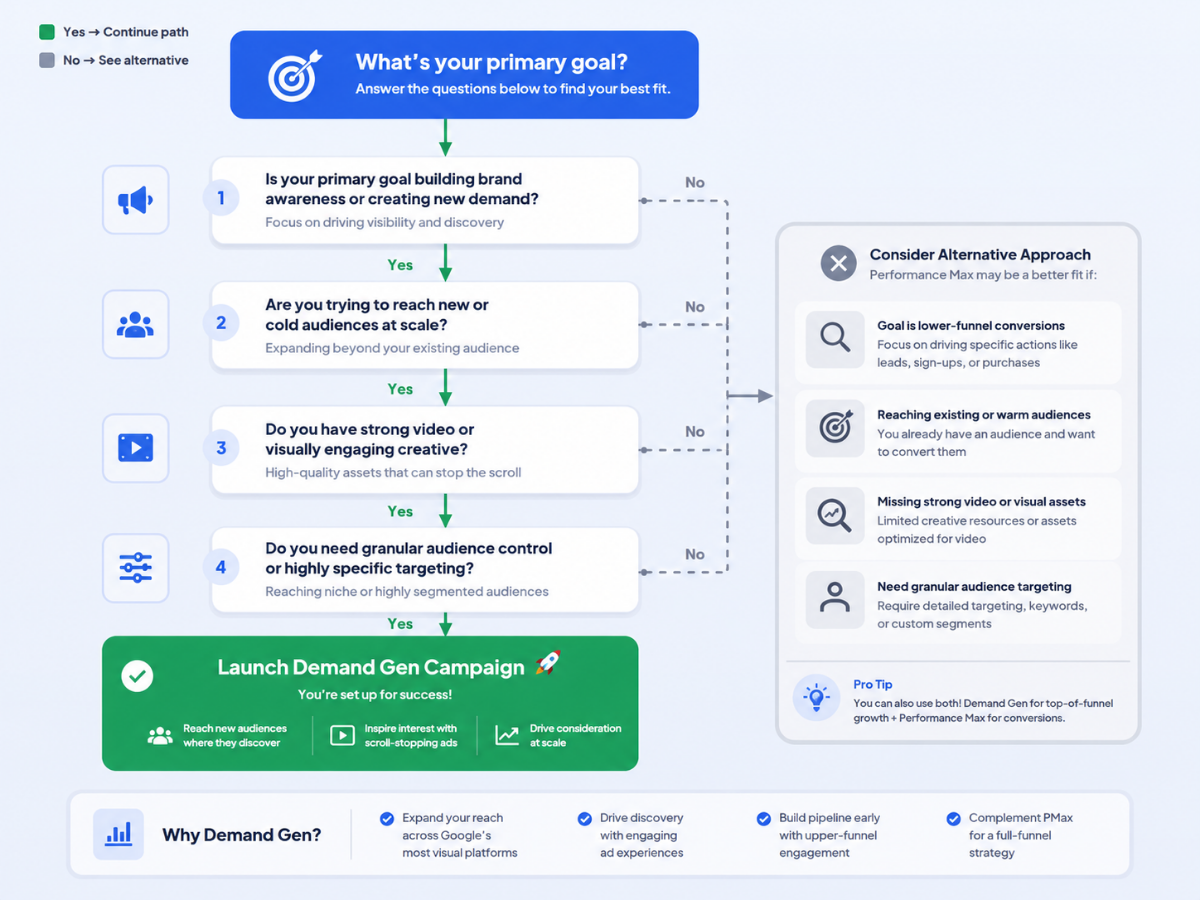
Demand Gen excels when you need to reach people who don’t know you exist. Here are the specific triggers:
Choose Demand Gen when:
– Launching a new product or service line
– Entering a new market or vertical
– Building brand awareness in a crowded category
– Targeting specific decision-maker personas (CFOs, IT directors, procurement)
– Promoting high-value content (webinars, research reports, guides)
– Introducing your brand to a competitor’s audience
The targeting capabilities make this possible. You can build custom segments based on job titles, company size, and industry signals. Layer in-market audiences for relevant categories. Create lookalike audiences from your CRM lists of closed-won customers.
But understand the creative requirements. Demand Gen is visual-first. You need high-quality video (15-30 seconds for YouTube, 6-15 seconds for Shorts) and compelling static images. This isn’t a text ad campaign.
Demand Gen Checklist:
– [ ] You have video or strong visual creative assets
– [ ] You’re targeting audiences who don’t know your brand
– [ ] You have a clear awareness or consideration goal
– [ ] You can measure view-through and assisted conversions
– [ ] You’re willing to invest in brand building with delayed ROI
– [ ] You have defined buyer personas to target
When Performance Max Is the Right Play
Performance Max excels when you have demand to capture. Here are the specific triggers:
Choose Performance Max when:
– Scaling conversions from a proven offer
– Remarketing to warm audiences across all channels
– Maximizing lead volume when conversion signals are strong
– Capturing demand that already exists for your category
– You have consistent conversion data to train the algorithm
– Your conversion tracking is airtight, and lead quality is validated
The trade-off is clear: you sacrifice control for scale. PMax decides where your ads run and who sees them. That works when your conversion tracking accurately reflects lead quality.
For B2B, this is non-negotiable: you must import offline conversions. A form fill is not a conversion. An MQL is not a conversion. You need to pass pipeline stages (SQL, Opportunity, Closed-Won) back to Google so PMax optimizes toward revenue, not vanity metrics.
The 2025 updates help. Channel-level reporting shows whether PMax is spending on Search, Display, or YouTube. Negative keywords let you exclude irrelevant queries. Search term visibility reveals what queries are triggering your ads.
Performance Max Checklist:
– [ ] You have proven conversion signals (not just form fills)
– [ ] You can import offline conversion data from your CRM
– [ ] You have at least 50 conversions per month for the algorithm to optimize
– [ ] Your lead quality is consistent and validated
– [ ] You’ve set up brand exclusions to protect branded search
– [ ] You’re willing to let Google control placement decisions
Here’s something the industry data reveals: Performance Max cost share peaked at 82% in May 2024, losing approximately 6% by early 2025 as advertisers (Smarter Ecommerce, 2025) returned to Standard Shopping and Search (smec, 2025). The “all PMax all the time” approach isn’t working. Advertisers are rediscovering the value of control.
Are PMax Ads Worth It for B2B?
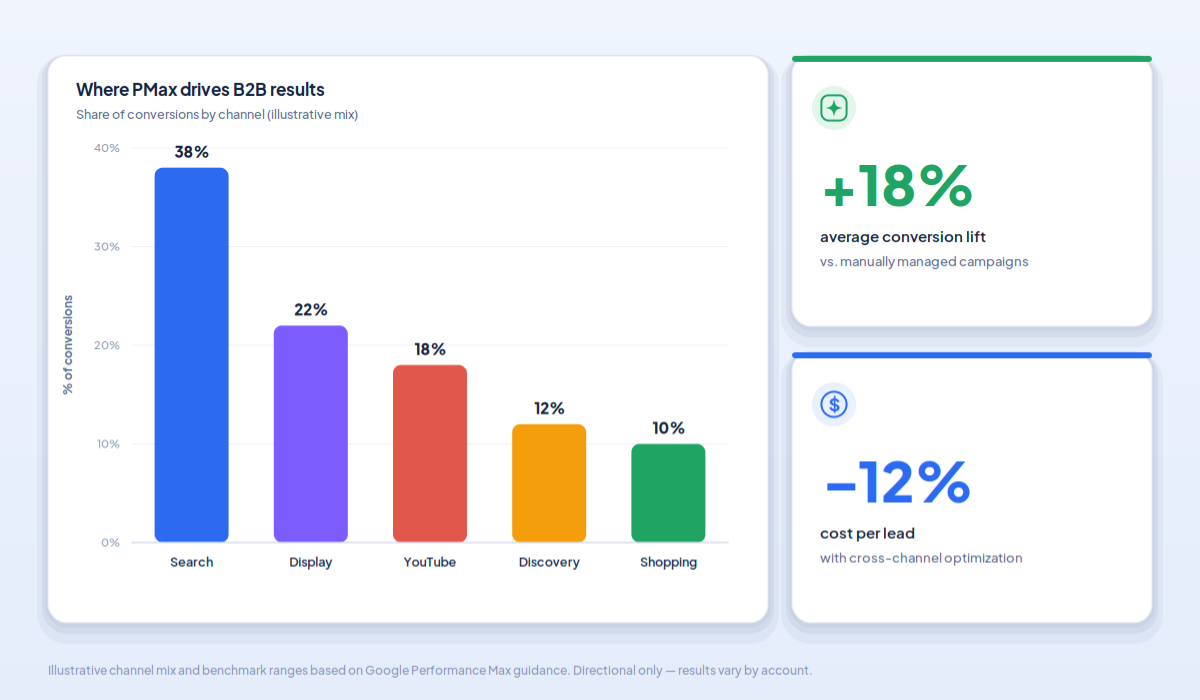
Yes, but only under specific conditions.
PMax is worth it when your conversion tracking is dialed in, your lead quality is consistent, and you’re using it alongside other campaign types – not instead of them.
The criticism is valid: PMax has historically been a black box that cannibalizes branded search traffic. We’ve seen accounts where 40% of PMax “conversions” came from branded queries that would have converted anyway.
Here’s the NAV43 position: Performance Max is a conversion amplifier, not a demand creator. It’s worth the investment when you have demand to capture. It’s not worth it when you need to build demand from scratch.
Advertisers optimizing PMax properly see 20-35% ROAS improvements (ALM Corp, 2025). But “optimizing properly” means brand exclusions, offline conversion imports, negative keywords, and strategic asset group structuring. It doesn’t mean setting it up and walking away.
When Should B2B Brands Launch Demand Gen Campaigns?
Launch Demand Gen when you need to build awareness before buyers enter the consideration phase.
Key triggers:
– New market entry where your brand has low recognition
– New product launch requiring education
– Category creation where buyers don’t know the solution exists
– Targeting specific personas for high-value, long-cycle deals
– Promoting research, webinars, or thought leadership content
The investment is paying off for early adopters. ROI Revolution clients’ investment in Demand Gen campaigns more than doubled in Q2 2025 compared to the prior year, with conversion value growing at a similar rate (ROI Revolution, 2025).
The signal is clear: brands that commit to Demand Gen as part of a full-funnel strategy are seeing compounding returns.
The Full-Funnel Framework: How to Layer Demand Gen, PMax, and AI Max for Search
Google’s 2025 “Power Pack” strategy positions AI Max, Demand Gen, and PMax as a unified system. Here’s how each piece maps to the B2B funnel.
Top of Funnel: Demand Gen
Reaches cold audiences with video and visual creative on YouTube, Discover, and Gmail. Introduces your brand, establishes credibility, and builds consideration.
Mid-Funnel: AI Max for Search
Captures intent from audiences who’ve been exposed to your brand and are now actively researching. Uses AI-powered broad match and query matching to find relevant searches.
Bottom of Funnel: Performance Max
Converts warm audiences across all Google inventory. Optimizes toward your most valuable conversions, informed by offline pipeline data.
This is not three isolated campaigns. It’s a system where audience signals flow between layers. Someone who watches your Demand Gen video becomes part of the AI Max retargeting audience. Someone who clicks an AI Max ad but doesn’t convert becomes a PMax remarketing candidate.
The goal is comprehensive coverage: be present at every touchpoint in the 27-touch B2B buyer journey.
Phase 1: Build Awareness with Demand Gen
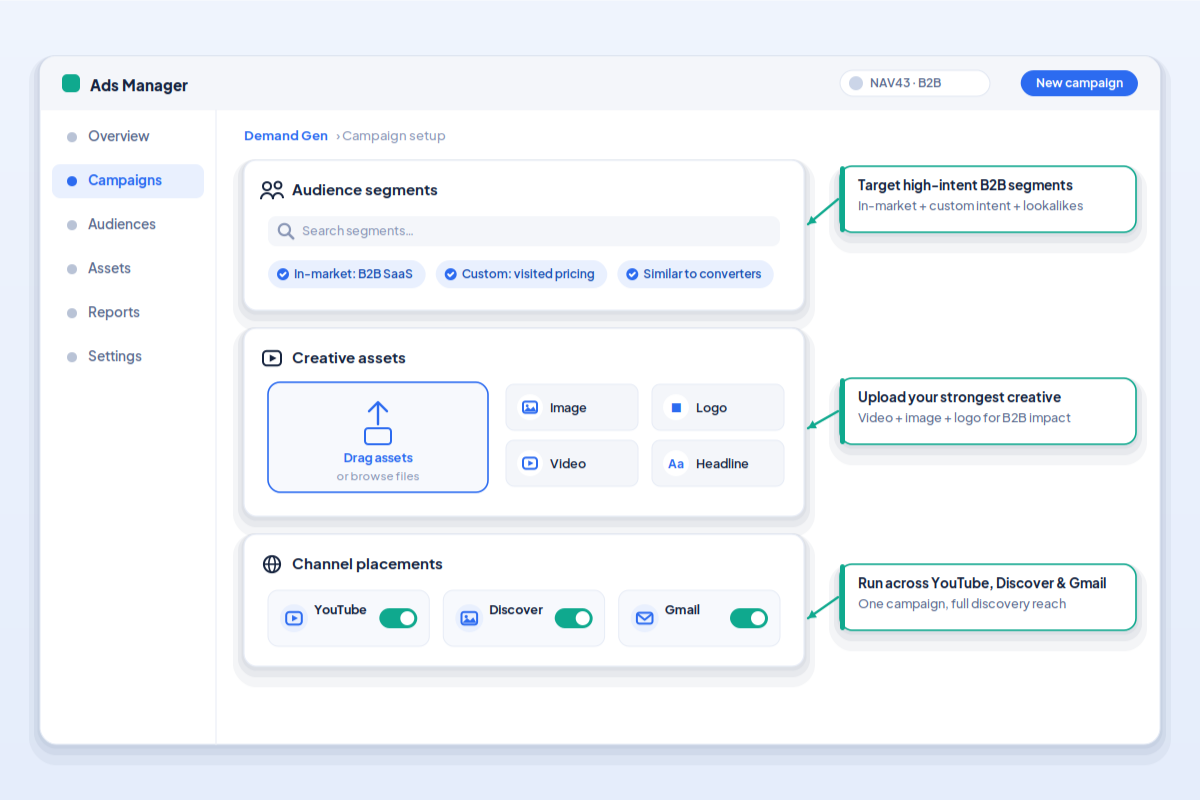
At the top of the funnel, Demand Gen introduces your brand to cold audiences who’ve never heard of you.
Audience targeting approach for B2B:
– Custom segments based on job titles (CIO, VP Marketing, Director of Operations)
– Company size filters (employees, revenue where available)
– Industry targeting through affinity and in-market audiences
– Lookalike audiences built from your CRM’s closed-won customers
– Competitor targeting via custom segments searching for competitor brands
Creative requirements:
– Video: 15-30 seconds for YouTube, 6-15 seconds for Shorts
– Static images: Square and landscape formats
– Clear value proposition in the first 3 seconds
– Thought leadership angle, not hard sell
Advertisers combining video and image assets in Demand Gen campaigns saw 20% more conversions at the same CPA compared to video-only campaigns (Google internal data, 2024-2025). Mix formats for better performance.
Measurement approach:
Demand Gen rarely drives direct conversions from cold audiences. Measure success through:
– View-through conversions (people who saw the ad and later converted)
– Assisted conversions (Demand Gen touchpoint in the conversion path)
– Brand lift studies (increased brand search volume, direct traffic)
– Audience growth (retargeting pool size)
This requires adjusting your attribution expectations. Demand Gen’s value shows up in other campaigns’ performance, not in its own direct conversion metrics.
Phase 2: Capture Intent with AI Max for Search
AI Max for Search is Google’s AI-powered upgrade to traditional Search campaigns. It uses broad match keywords, query matching, and AI-generated headlines to capture intent signals you’d otherwise miss.
For B2B, it serves as the bridge between awareness and conversion. Someone who saw your Demand Gen ad last week is now researching solutions. AI Max catches that search, even if it doesn’t match your exact keywords.
Performance data:
AI Max for Search campaigns deliver 14% more conversions at similar CPA/ROAS, with up to 27% improvement for campaigns using mostly exact/phrase match keywords (Google internal data, 2025).
A word of caution: this is Google’s internal data. Independent testing shows more conservative results in some cases. NAV43 recommends testing AI Max with proper holdout groups before rolling it out fully.
How AI Max complements Demand Gen:
1. Demand Gen creates brand awareness and consideration
2. Awareness drives branded and category searches
3. AI Max captures those searches with relevant messaging
4. AI Max passes audience signals to PMax for further conversion
Without AI Max, you have a gap. Someone sees your Demand Gen ad, searches for your category, and finds a competitor who’s bidding on Search. AI Max closes that gap.
For a deeper dive into AI Max implementation, see our complete AI Max for Search strategy guide.
Phase 3: Convert with Performance Max
At the bottom of the funnel, PMax captures demand from audiences ready to convert. These are people who’ve been exposed to your brand through Demand Gen, searched for your category via AI Max or organic, and are now in active buying mode.
Critical requirements for B2B PMax:
- Value-based bidding tied to CRM pipeline stages. Don’t optimize for form fills. Optimize for pipeline-qualified conversions. If an MQL is worth $500 to your business but a closed-won deal is worth $50,000, your bidding should reflect that.
- Offline conversion imports. This is non-negotiable. Google Ads needs to know which leads became customers. Import MQL, SQL, Opportunity, and Closed-Won stages back to Google via enhanced conversions or CRM integration.
- Brand exclusions. Without exclusions, PMax will happily spend your budget on branded searches that would convert anyway. Use brand exclusions to protect your branded traffic from PMax cannibalization.
- Negative keywords. The 2025 updates allow campaign-level negative keywords. Use them aggressively to exclude irrelevant B2B queries (job seekers, students, DIY searches).
- Longer learning periods. PMax needs data to optimize. B2B sales cycles mean fewer conversions and longer feedback loops. Expect 6+ weeks of learning before performance stabilizes.
The goal isn’t to run PMax in isolation. It’s to run PMax as the conversion layer of a full-funnel system where Demand Gen and AI Max do the heavy lifting of building demand.
Budget Allocation Framework for B2B Google Ads
“It depends” is the honest answer. But here’s a starting framework based on our experience with mid-market B2B clients.
Starting allocation (mature accounts with conversion history):
– Search/AI Max: 50-60% of budget
– Performance Max: 20-30% of budget
– Demand Gen: 15-25% of budget
Starting allocation (new accounts or low brand awareness):
– Search/AI Max: 40-50% of budget
– Performance Max: 10-20% of budget
– Demand Gen: 30-40% of budget
Adjustment triggers:
Increase Demand Gen when:
– Brand search volume is declining or flat
– You’re entering a new market or launching a new product
– Competitor brand searches are growing faster than yours
– Your retargeting audiences are shrinking
Increase PMax when:
– You have strong conversion signals and consistent lead quality
– Your sales team reports high-quality leads from paid channels
– You’ve exhausted obvious Search/AI Max opportunities
– Offline conversion data shows PMax leads closing at high rates
Decrease PMax when:
– Branded search cannibalization is high (check the new reports)
– Lead quality from PMax is lower than that of other channels
– The algorithm is spending heavily on Display with low conversion rates
– You don’t have enough conversion volume to train the algorithm
The NAV43 Budget Framework:
| Metric | Action |
|---|---|
| Brand search volume is declining | Consider increasing Demand Gen allocation |
| Lead quality from PMax is dropping | Consider decreasing PMax and reallocating to Search |
| Assisted conversions from Demand Gen Rising | Maintain or increase Demand Gen |
| CPA from AI Max beating Search | Shift budget toward AI Max |
| PMax consuming >40% of branded queries | Add brand exclusions, consider reducing PMax |
Review allocations monthly, but don’t make changes more frequently than every 4-6 weeks. The algorithms need time to optimize.
Preventing Cannibalization: How to Keep Campaigns from Competing
Left unchecked, your campaigns will eat each other. PMax will claim branded conversions. AI Max will overlap with standard Search. Demand Gen retargeting will compete with PMax remarketing.
Cannibalization prevention tactics:
1. Brand exclusions in PMax
Add your brand name and close variations as brand exclusions. This forces PMax to find conversions from non-branded queries.
2. Audience exclusions in Demand Gen
Exclude existing customers and current leads from Demand Gen. You’re paying premium rates for video and visual placements – don’t waste them on people already in your CRM.
3. Shared negative keyword lists
Create account-level negative keyword lists that all campaigns use. This prevents Search, AI Max, and PMax from bidding on the same irrelevant queries.
4. Audience segmentation
– Demand Gen: Cold audiences, lookalikes, competitor audiences
– AI Max: All users (intent-driven, let the AI work)
– PMax: Warm audiences, past visitors, engaged users
5. Frequency capping
Set frequency caps in Demand Gen to prevent ad fatigue. If someone has seen your video 10 times without engaging, they’re not going to convert on view 11.
6. Regular audits
Check the PMax placement reports monthly. If Display is consuming budget without conversions, consider excluding placements or adjusting creative.
Measurement for Long Sales Cycles: What to Track and When
B2B measurement is broken when you only look at direct conversions. A 6-month sales cycle means today’s Demand Gen view might become next quarter’s closed-won deal.
The NAV43 B2B Measurement Framework:
Immediate metrics (weekly tracking):
– Impressions and reach by campaign type
– Video view rates (Demand Gen)
– Click-through rates by creative
– Cost per click by campaign
– Direct conversions (form fills, demo requests)
Leading indicators (monthly tracking):
– Brand search volume trends
– Direct traffic growth
– Retargeting audience size
– View-through conversions
– Assisted conversions in the path
Pipeline metrics (quarterly tracking):
– MQL to SQL conversion rate by campaign source
– Pipeline influenced by each campaign type
– Average deal size by acquisition source
– Sales cycle length by first-touch campaign
Revenue attribution (ongoing):
– Closed-won revenue by first-touch and multi-touch attribution
– Customer lifetime value by acquisition channel
– Return on ad spend, including offline conversions
Offline conversion setup:
You must connect your CRM to Google Ads. Here’s the high-level process:
- Capture Google Click ID (GCLID) on form submissions
- Store GCLID with the lead record in your CRM
- When lead stage changes (MQL, SQL, Opportunity, Closed-Won), export the GCLID with the conversion value
- Import to Google Ads via Enhanced Conversions or direct upload
- Set up value-based bidding using these offline conversions
Without this, you’re optimizing toward form fills instead of revenue. Google’s AI needs to know which leads became customers.
For HubSpot users, we’ve written a detailed guide on piping LinkedIn leads into HubSpot that covers similar CRM integration principles.
Demand Gen in DV360 vs Google Ads: When to Choose Each
For enterprise B2B brands, there’s an additional decision: should you run Demand Gen in Google Ads or Display & Video 360 (DV360)?
Choose Google Ads Demand Gen when:
– Your budget is under $50,000/month
– You want simplified campaign management
– You’re already running Search and PMax in Google Ads
– You prioritize ease of setup over advanced controls
Choose DV360 Demand Gen when:
– Your budget exceeds $50,000/month
– You need advanced frequency management across publishers
– You want access to additional inventory sources
– You require enterprise-level brand safety controls
– You have a dedicated programmatic team or agency
DV360 offers more sophisticated controls but requires more expertise to manage. For most mid-market B2B brands, Google Ads Demand Gen provides sufficient capabilities. Reserve DV360 for enterprise accounts where the additional control justifies the complexity.
Common Pitfalls: What Most B2B Marketers Get Wrong
After running full-funnel Google Ads strategies for dozens of B2B clients, these are the mistakes we see most often:
1. Running PMax without offline conversion data
PMax optimizes toward what you tell it. If you only track form fills, it finds people who fill out forms – not people who become customers. Every B2B PMax campaign needs offline conversion imports.
2. Measuring Demand Gen by direct conversions
Demand Gen’s job is building awareness and consideration. Measuring it by direct conversions is like measuring a billboard by the number of phone calls it received that day. Track view-through conversions, assisted conversions, and brand lift.
3. Neglecting brand exclusions in PMax
We’ve audited accounts where 50%+ of PMax conversions came from branded queries. That’s not incremental value – that’s paying for traffic you’d get anyway.
4. Using the same creative across all funnel stages
Cold audiences need different messaging than warm audiences. Your Demand Gen video should educate and intrigue. Your PMax creative should convert and close. One-size-fits-all creative underperforms.
5. Insufficient conversion volume for PMax learning
PMax needs approximately 50 conversions per month to optimize effectively. If you’re getting 10 leads a month, PMax will struggle. Either expand your conversion actions or stick with Search.
6. Forgetting about the sales handoff
Full-funnel marketing is meaningless if leads don’t reach sales in usable condition. Integrate your Google Ads data with your CRM. Pass UTM parameters. Enable sales to see the buyer’s journey.
For a B2B lead generation strategy beyond Google Ads, our guide on how AI is changing B2B lead generation covers the broader landscape.
Conclusion: Key Takeaways
The demand gen vs performance max debate isn’t about choosing one over the other. It’s about understanding how they work together across the B2B buyer journey.
What you need to remember:
- Demand Gen builds awareness; PMax captures conversions. Neither works fully without the other. With 80% of the buying journey happening without vendor contact, you need to be present long before the conversion moment.
- AI Max for Search bridges the gap. It captures intent from buyers who’ve seen your Demand Gen ads and are now researching solutions. It’s the connective tissue between awareness and conversion.
- Offline conversion data is non-negotiable. B2B conversions don’t happen in Google Ads. They happen in sales meetings weeks later. Import your CRM data, so Google’s AI optimizes toward revenue, not form fills.
- Budget allocation should flex with performance. Start with a framework, but adjust based on brand search trends, lead quality, and pipeline metrics. No formula works forever.
- Cannibalization prevention requires active management. Brand exclusions, audience segmentation, and negative keywords aren’t optional. Without them, your campaigns compete against each other.
Next Steps
If you’re running only Search or PMax today:
Start testing Demand Gen with 10-15% of your budget. Target lookalike audiences based on your best customers. Measure view-through conversions and brand search lift over 8-12 weeks.
If you’re already running all three campaign types:
Audit for cannibalization. Check PMax placement reports for branded query consumption. Verify your offline conversion imports are working. Review audience overlap between campaigns.
If you’re unsure where to start:
Google Ads delivers an average ROI of 200% when properly structured (InterTeam Marketing, 2025). But “properly structured” is the operative phrase. Most B2B accounts have significant optimization opportunities in campaign structure, conversion tracking, and budget allocation.
Get a comprehensive audit of your current Google Ads setup. We’ll identify cannibalization issues, measurement gaps, and budget allocation improvements specific to your B2B funnel.
The brands winning in B2B aren’t choosing between demand gen and performance max. They’re building systems that work together, are informed by data, are optimized for the pipeline, and are measured against revenue. That’s the playbook.
