How to Get Perplexity to Reference Your Content: The Complete GEO Playbook for AI Citations
Perplexity now processes 780 million queries monthly, growing at 20% month-over-month (Bloomberg Tech Summit / Search Engine Land, 2025). That’s not a typo. And here’s the brutal math that should keep every marketing director awake at night: Perplexity visits approximately 10 pages per query but only cites 3 to 4 in its response (AI Labs Audit, 2026).
Let me paint the picture more clearly. For each query in your target space, Perplexity returns 10 potential sources. Then it picks just 3-4 to actually reference in its answer. The rest? Invisible. Uncited. Unattributed.
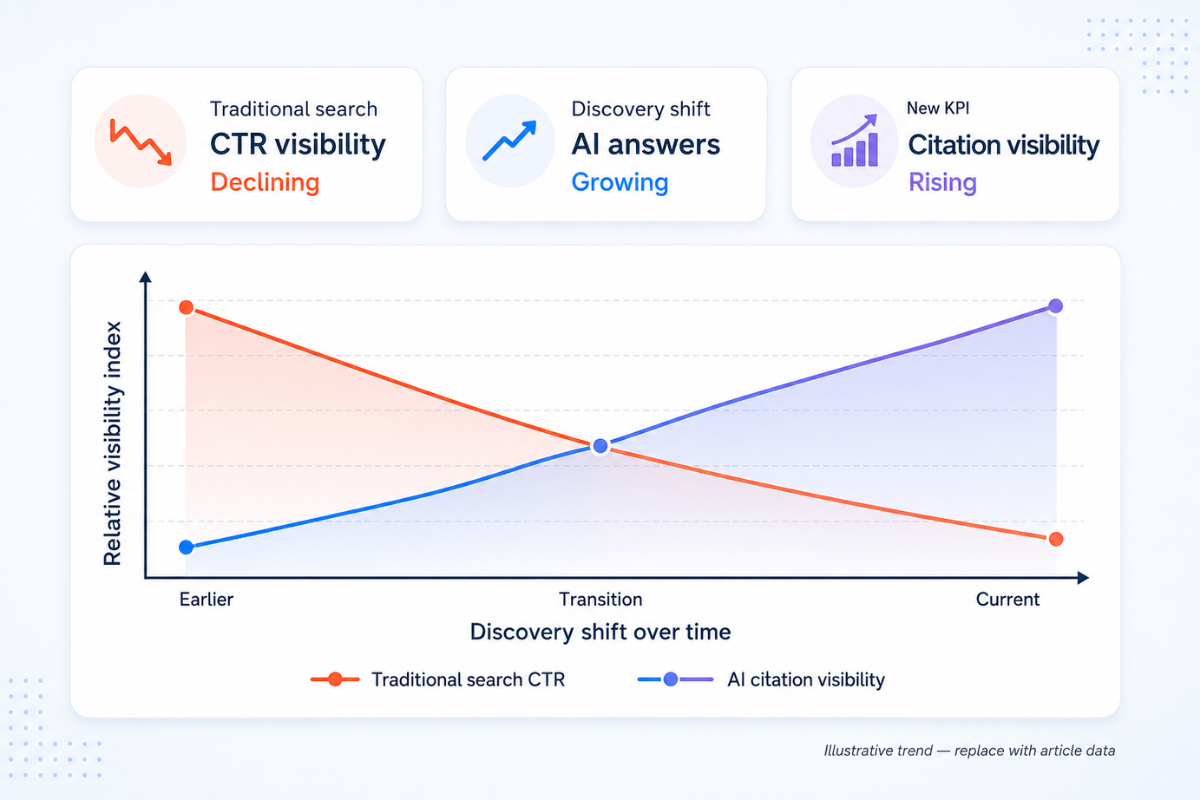
This matters because 90% of B2B buyers now integrate generative AI at some point in their buying journey (Walker Sands, 2025-2026). If your content isn’t being cited, you’re invisible to a growing segment of your pipeline. Gartner predicts traditional search engine volume will drop 25% by the end of 2026 (Gartner, 2025-2026). The window to establish AI citation authority is closing, but it’s not closed yet.
This article delivers what most Perplexity optimization guides miss: a practitioner-tested framework for passing both “gates” of Perplexity’s citation system. I’ll walk you through exactly how to get Perplexity to reference your content, from technical foundations to content structure to measurement.
One thing I should address upfront: yes, Perplexity has faced legal challenges from publishers over content usage and copyright concerns. That’s a real issue and a strategic consideration for your brand. But if you’ve decided optimization is the right play for your business, this guide shows you how to do it effectively.
Why Perplexity Citations Are the New Competitive Moat
Does Perplexity give references? Absolutely. And this is precisely what makes Perplexity uniquely valuable for GEO strategy.
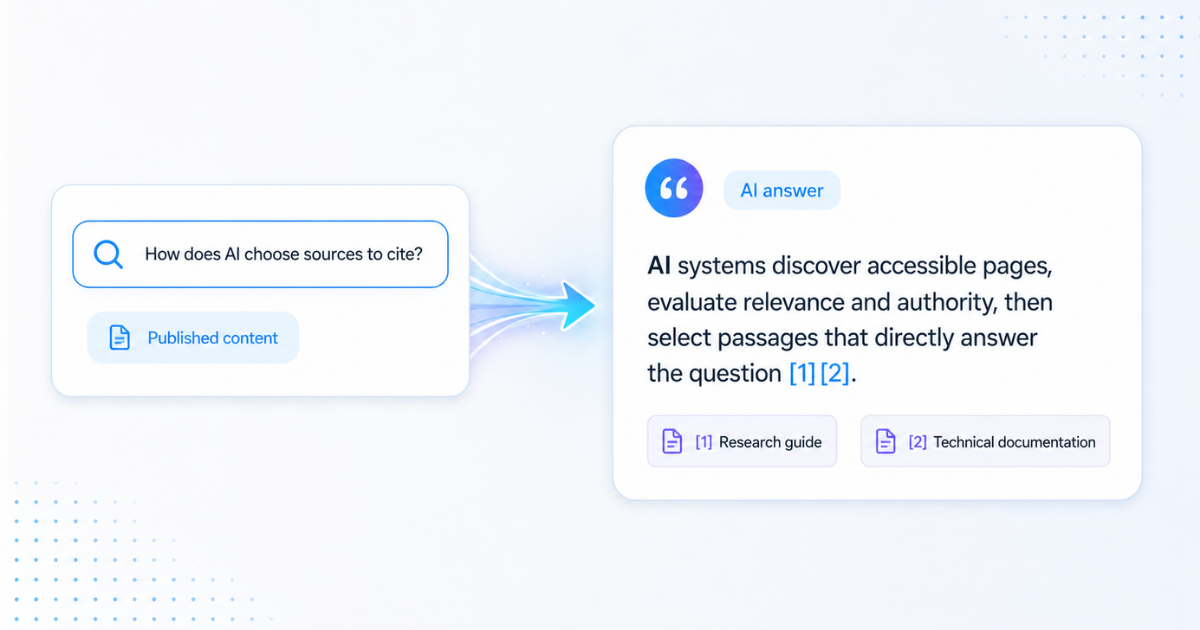
Unlike ChatGPT, where source attribution is inconsistent and often hidden, every Perplexity response includes clickable source references, typically 3-7 per answer. This transparency makes Perplexity the most trackable AI platform for citation strategy. You can see exactly who’s getting cited, for which queries, and in what position.
Perplexity drives 15% of global AI traffic, rising to nearly 20% in the U.S. (SE Ranking, 2025). The platform has grown to 30-45 million monthly active users as of early 2026 (Backlinko / Business of Apps, 2025-2026). These aren’t tire-kickers. These are researchers, buyers, and decision-makers actively seeking answers.
Here’s the strategic shift you need to understand: getting cited builds compounding authority signals, even if click-through rates are lower than in traditional search. When Perplexity cites your content repeatedly for queries in your domain, you’re establishing brand visibility and topical authority that influences future citations. It’s a flywheel effect.
The first-mover window is real. Most enterprise marketing teams have GEO initiatives underway. SMBs largely haven’t started. This creates an opportunity for mid-market brands to establish citation authority before saturation makes it exponentially harder.
The rest of this article introduces what I call the “two-gate system” – a framework that explains why most optimization efforts fail and exactly what to do instead.
How Perplexity Decides What to Cite: The Two-Gate System
Most Perplexity optimization guides treat citation as a single problem. Optimize your content, they say, and citations will follow. This fundamentally misunderstands how Perplexity’s system works.
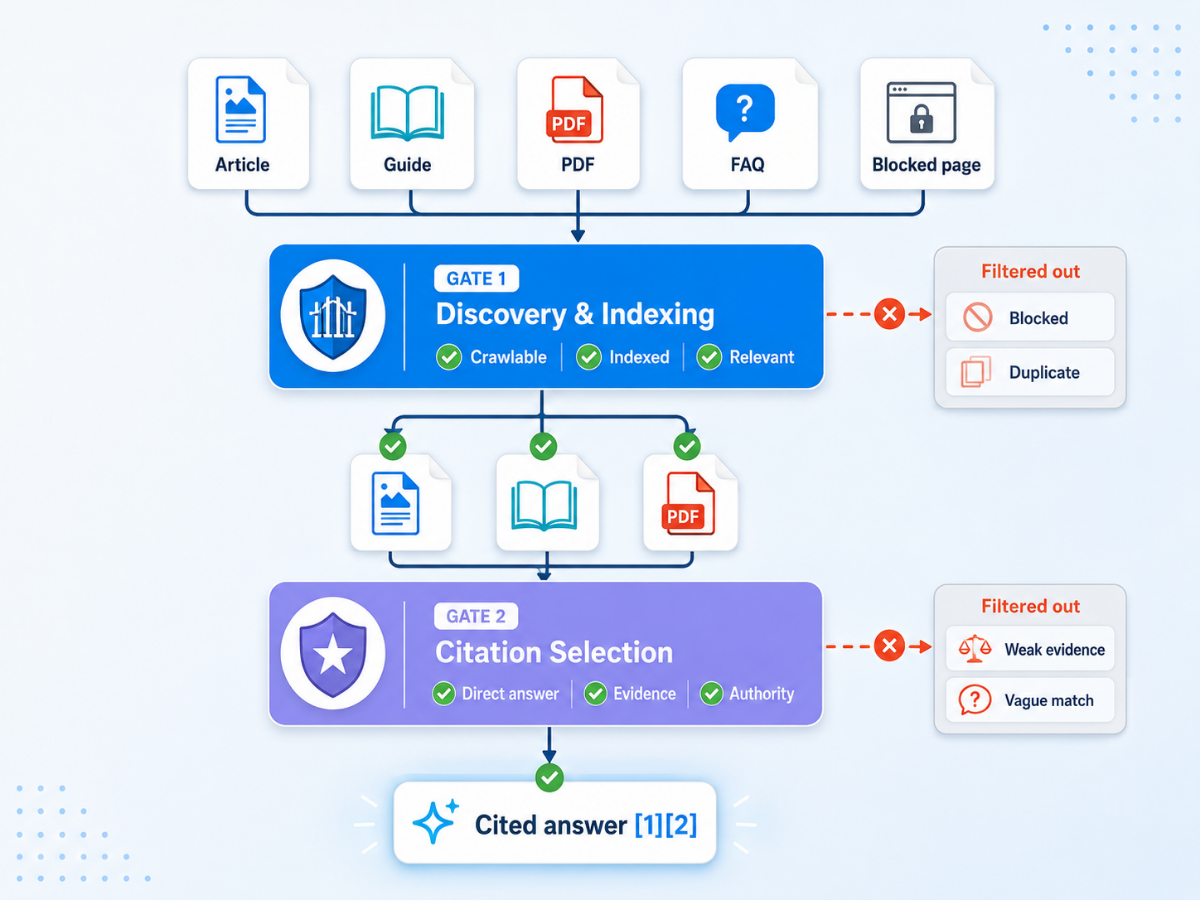
In reality, getting cited requires passing two distinct gates:
Gate 1: Retrieval Selection – Getting your content into the pool of approximately 10 pages Perplexity visits per query. This is about discoverability, indexing, and topical relevance. If you fail here, Perplexity never even sees your content.
Gate 2: Answer Absorption – Having your content actually shape the response AND receive a visible citation. This is about content structure, quotability, and authority signals. Passing Gate 1 but failing Gate 2 means Perplexity visits your page, extracts nothing useful, and cites your competitors instead.
Here’s why this distinction matters: 60% of Perplexity citations overlap with the top 10 Google organic results (Search Engine Land, 2025-2026). Traditional SEO gets you through Gate 1. But traditional SEO alone doesn’t ensure you pass Gate 2.
Imagine you rank #3 for “best CRM for manufacturers” on Google. You’ve likely passed Gate 1. But if your content is a 3,000-word essay with no scannable structure, Perplexity may visit but not cite you. Gate 2 failed. Your competitor with a clearly structured comparison table at position #7 gets the citation instead.
The tactics for each gate are different. The rest of this article treats them separately.
The NAV43 Two-Gate System
Gate 1: Retrieval Selection → Can Perplexity find and access your content?
– Technical accessibility (robots.txt, crawlability)
– Topical relevance and authority
– Content freshness signals
– Cross-platform presenceGate 2: Answer Absorption → Will Perplexity cite your content?
– Content structure and quotability
– Authority and trust signals
– Schema markup for AI comprehension
– Answer-ready formatting
Understanding Perplexity’s Focus Modes (And Which Ones Matter)
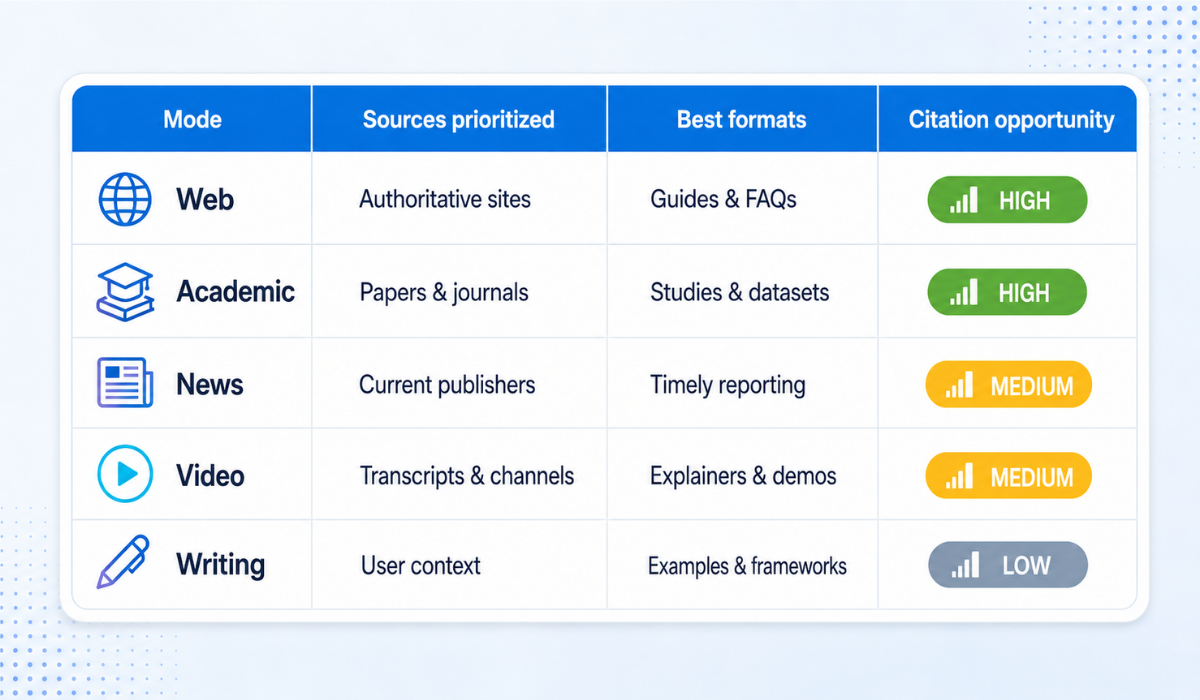
Perplexity offers distinct “Focus Modes” that change source selection behavior: All, Academic, Writing, Wolfram, Video, and Reddit. This matters for your optimization strategy.
Here’s a widely cited stat: Reddit accounts for 46.7% of top Perplexity citations (Stackmatix, 2026). But context is critical. This figure applies specifically when users activate Reddit Focus Mode. In the default “All” mode, the source distribution looks very different.
Academic mode pulls from scholarly sources and research papers. Video mode prioritizes YouTube content. Writing mode emphasizes authoritative prose and well-structured articles. Reddit mode, obviously, places a heavy weight on Reddit discussions.
| Focus Mode | Primary Sources | Optimization Priority |
|---|---|---|
| All (Default) | Web, news, authoritative sites | Website SEO + content structure |
| Academic | Scholarly sources, research papers | Research publications, whitepapers |
| Writing | Well-structured prose, authoritative content | Long-form articles, guides |
| Wolfram | Computational data, facts | Structured data, statistics |
| Video | YouTube primarily | Video content optimization |
| Reddit discussions | Authentic community participation |
For most B2B queries, “All” mode is the default. A marketing director researching “enterprise data integration platforms” almost certainly uses All mode. An academic researching “machine learning bias” is likely to use Academic mode. Optimize for your audience’s likely behavior.
Gate 1: How to Get Your Content Into Perplexity’s Consideration Set
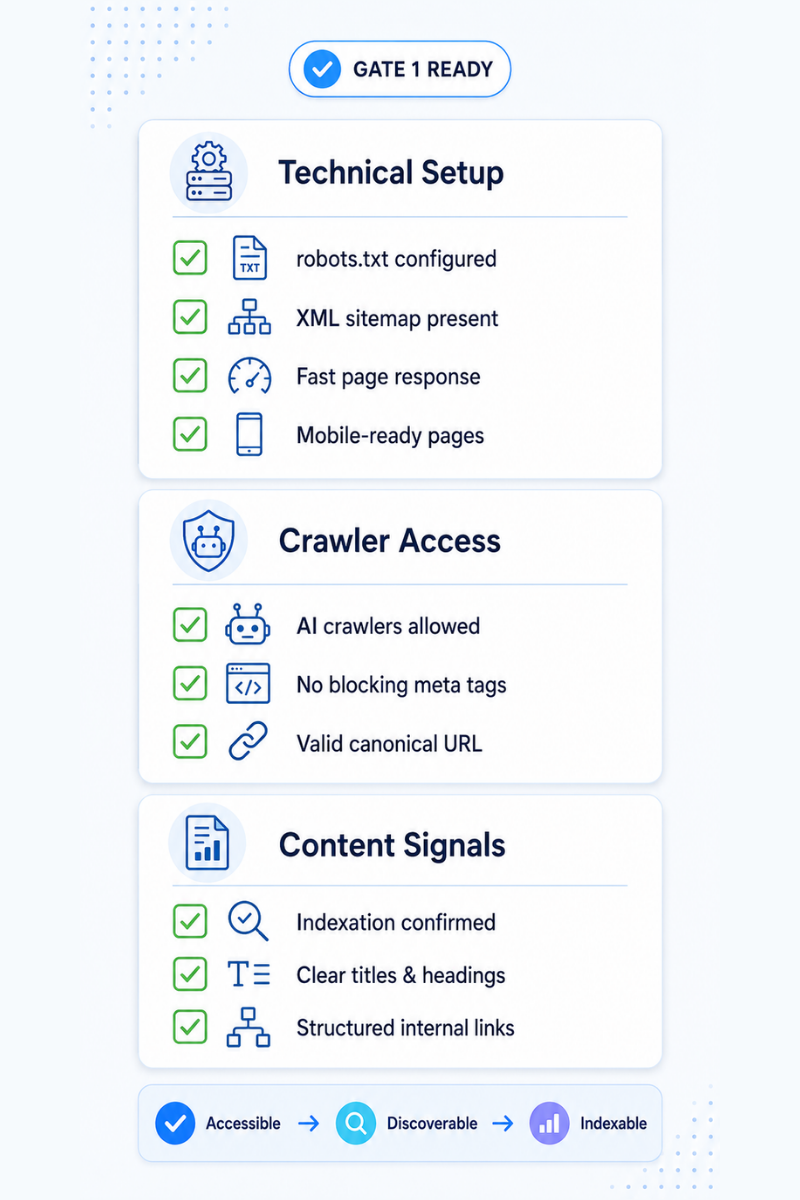
Gate 1 is about making the approximately 10-page pool that Perplexity visits per query. This is table stakes. If you’re not in the pool, nothing else matters.
Traditional SEO is the foundation here: technical health, topical authority, and proper indexation. But there are Perplexity-specific considerations.
Perplexity uses its own crawler (PerplexityBot) and relies on index partnerships and web search APIs. The platform heavily weights content recency, pulling from multiple platforms beyond just websites.
Here’s the most striking data point for Gate 1: 50% of Perplexity citations are content published in 2025 alone (Seer Interactive, 2025). Freshness matters enormously for fast-moving topics.
Technical Foundations: Ensuring PerplexityBot Can Find You
Start with the basics. Confirm your robots.txt allows PerplexityBot. This sounds obvious, but I’ve seen it missed repeatedly.
One of our e-commerce clients discovered their robots.txt was blocking all AI crawlers, a legacy setting from 2023 when AI scraping concerns peaked. Three weeks after the update, they began appearing in Perplexity responses to product category queries. The fix took five minutes. The opportunity cost of not doing it sooner was high.
Beyond robots.txt, ensure technical fundamentals:
Page speed matters. AI crawlers have limited patience. If your page takes 4+ seconds to load, PerplexityBot may timeout or deprioritize your content. Core Web Vitals aren’t just for Google anymore.
Mobile responsiveness is non-negotiable. AI systems process content in various contexts. If your mobile experience is broken, you’re signaling quality issues.
Structured data markup helps Perplexity understand your content structure. FAQ schema, HowTo schema, and Article schema provide explicit signals about what your content covers and how it’s organized.
Maintain a clean XML sitemap with accurate lastmod dates. This helps PerplexityBot find and prioritize your content.
PerplexityBot Access Audit Checklist
- [ ] robots.txt allows PerplexityBot (User-agent: PerplexityBot)
- [ ] Page load time under 3 seconds on mobile
- [ ] Structured data implemented (Article, FAQ, or HowTo schema)
- [ ] XML sitemap current with accurate lastmod dates
- [ ] Canonical tags properly configured
One important note: if you’re blocking AI crawlers for copyright protection reasons, you’re trading off visibility for control. That’s a legitimate strategic choice. But make it deliberately, not accidentally.
For a deeper dive into technical foundations, our technical SEO audit checklist covers the full framework.
The Freshness Factor: Why 2025/2026 Content Wins
The data is clear: 50% of Perplexity citations come from content published in 2025 alone (Seer Interactive, 2025). For rapidly evolving topics, older content gets deprioritized regardless of domain authority.
This doesn’t mean you need to publish everything from scratch. It means freshness signals matter.
Add visible “Last Updated” dates to content. This isn’t about gaming the system. It’s about signaling to both users and AI that your content reflects the current reality.
Refresh evergreen guides quarterly at a minimum. At NAV43, we follow our Content Freshness Protocol: news content reviewed monthly, evergreen guides quarterly, pillar pages semi-annually. This compounds over time.
Include current-year statistics. Content citing 2023 data signals staleness. Content citing 2026 data signals relevance.
We tested two versions of the same guide for a client: one dated “March 2024” and one updated to “January 2026” with current data. The 2026 version was cited more frequently in Perplexity responses over a 30-day monitoring period. Same domain authority, same content depth. The freshness signal made the difference.
That said, freshness alone isn’t enough. It’s a tie-breaker among otherwise comparable content. A fresh article with no depth loses to a slightly older article with genuine expertise.
Beyond Your Website: Building Cross-Platform Citation Authority
Perplexity aggregates from YouTube, LinkedIn posts, Reddit discussions, Quora answers, and forums, not just websites. Building authority across these platforms creates multiple paths into Perplexity’s consideration set.
YouTube strategy: Create video content covering the same topics as your written content. Perplexity’s Video mode pulls directly from YouTube, and video content can be cited even in All mode when relevant.
A SaaS client we work with has started a YouTube series breaking down their blog content into 8-10-minute explainers. Within four months, their YouTube videos were being cited in Perplexity responses even when their blog posts weren’t. The video provided a second path to citation.
LinkedIn strategy: Long-form LinkedIn articles and posts can be cited. Ensure your company and personal profiles are active in your topic areas. LinkedIn’s authority signals compound, meaning consistent posting establishes retrieval eligibility over time.
Reddit/forum strategy: Participate authentically in industry subreddits. When users activate Reddit Focus Mode, authentic contributor answers get cited. This isn’t about promotional posting. It’s about genuine expertise sharing in communities where your audience already gathers.
| Platform | Content Type | Optimization Approach |
|---|---|---|
| Website/Blog | Long-form guides, articles | SEO + structure + freshness |
| YouTube | Explainer videos, tutorials | Clear titles, descriptions, and chapters |
| Articles, long posts | Consistent publishing, author credibility | |
| Community answers | Authentic participation, expertise sharing | |
| Quora | Direct answers | Detailed responses with cited sources |
The compounding effect is real. Multi-platform presence creates multiple entry points into Perplexity’s consideration set for any given query.
Gate 2: Structuring Content for Citation Selection
Passing Gate 1 means Perplexity visits your page. Passing Gate 2 means your content actually gets cited.
The core principle: Perplexity needs to extract a quotable, authoritative snippet. If your content is dense prose without structure, Perplexity struggles to pull citable material. Your competitor’s bulleted summary wins instead.
This is where NAV43’s Answerable Content Framework applies directly.
The NAV43 Answerable Content Framework for Perplexity
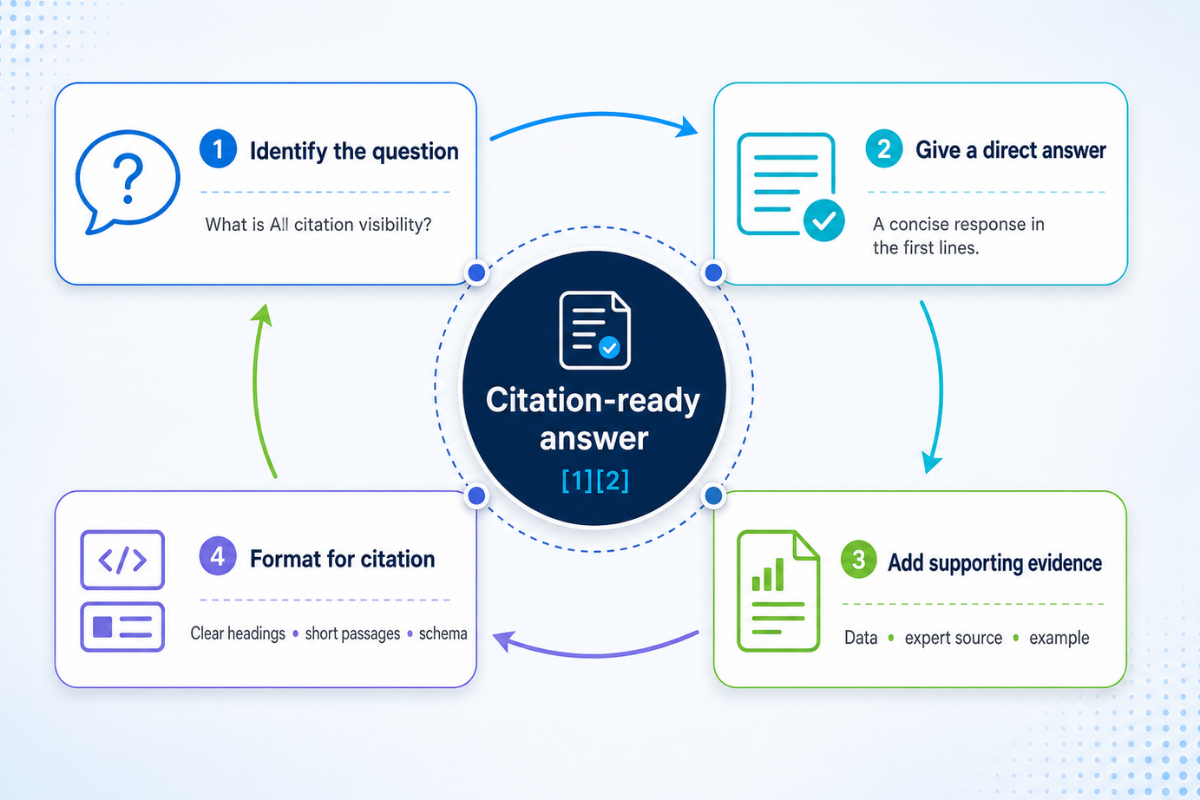
The framework is simple but specific:
1. State the question explicitly. Use an H2 or H3 that mirrors a user query. Not “Overview of Pricing Strategies” but “How Much Does Enterprise CRM Cost?”
2. Provide a 2-3 sentence quotable answer immediately after the question. This is citation bait. Make it direct, specific, and complete enough to stand on its own.
3. Expand with supporting evidence, data, and nuance. The detail matters for depth, but the initial answer is what gets quoted.
4. Include structured elements. Bullet lists, numbered steps, and comparison tables give Perplexity multiple extraction opportunities throughout your content.
5. Use clear subheadings every 150-200 words. Each subheading creates a new citation opportunity. Long, unbroken sections mean Perplexity has fewer hooks to grab.
Here’s the difference in practice:
Before (Dense Prose – Low Citation Rate):
Pricing for enterprise CRM solutions varies significantly based on a number of factors including the number of users, required features, integration complexity, and vendor positioning in the market. Organizations should expect to encounter a range of pricing models from per-user monthly subscriptions to annual enterprise agreements with volume discounts…
After (Answerable Format – High Citation Rate):
How Much Does Enterprise CRM Cost?
Enterprise CRM typically costs $50-150 per user per month for standard tiers, with enterprise agreements ranging from $25,000 to $250,000+ annually depending on user count and feature requirements. Implementation adds 1-2x the annual license cost.
Key factors affecting enterprise CRM pricing:
– User count (most vendors use per-seat pricing)
– Feature tier (basic vs. advanced automation)
– Integration complexity (ERP, marketing automation)
– Contract length (annual vs. multi-year discounts)
One of our clients restructured their pricing page from narrative prose to a clear “How much does X cost?” H2 followed by a direct one-sentence answer and supporting context. Citation rate in Perplexity increased 4x for pricing-related queries.
Template: The Answerable Content Format
“`
[Question mirroring user query]
[Direct 2-3 sentence answer – quotable, specific, complete]
[Supporting paragraph with data, context, or nuance]
Key points:
– [Bullet 1]
– [Bullet 2]
– [Bullet 3][Additional detail as needed]
“`
Authority Signals: What Makes Perplexity Trust Your Content

Content structure gets you extraction opportunities. Authority signals determine whether Perplexity trusts your content enough to cite it over alternatives.
Expert attribution matters. Content with named author credentials and E-E-A-T signals gets preferential treatment. Include author bios that establish relevant expertise. Link to author pages with credentials. Perplexity, like Google, evaluates who is making claims, not just what claims are made.
Data citation signals research depth. Including specific statistics with sources (exactly what you’re reading in this article) signals that your content is grounded in evidence. Vague claims like “studies show” or “research indicates” without specifics are weak signals.
External validation creates trust cascades. Content that’s been cited by other authoritative sources carries those authority signals forward. Backlinks still matter, but in the AI era, they matter for trust signals, not just PageRank.
Domain reputation remains relevant. The 60% overlap between Perplexity citations and top 10 Google results isn’t coincidental (Search Engine Land, 2025-2026). Perplexity factors in domain-level authority. A new blog post on Harvard Business Review carries a different weight than the same content on an unknown domain.
First-party research is a citation magnet. Perplexity prefers original data, surveys, and proprietary insights as primary sources. If you have unique data, structure it for citation. We’ve observed that content with “2026 data from [specific research firm]” gets cited at higher rates than content with generic claims.
For more on building this kind of topical authority, our guide to entity SEO for AEO and GEO covers the knowledge graph approach.
Schema Markup: The Bridge Between Your Content and AI Systems
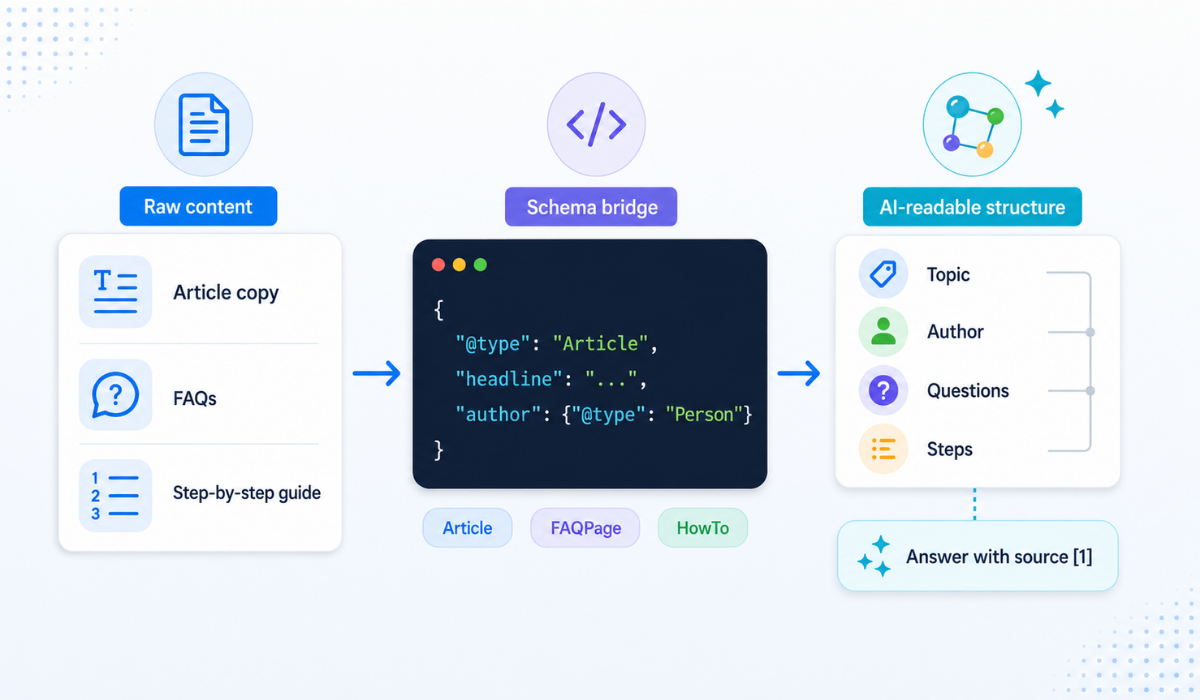
Structured data helps Perplexity (and all AI systems) understand content structure, authorship, and topical focus. It’s not a silver bullet, but it improves comprehension, which improves selection probability.
Priority schema types for Perplexity optimization:
- Article schema: Establishes content type, publication date, author, and publisher
- FAQ schema: Each Q&A pair becomes a discrete citation opportunity
- HowTo schema: Structures procedural content for step-by-step extraction
- Person schema: Establishes author credentials and expertise
- Organization schema: Connects content to brand authorityThe
FAQ schema is particularly valuable. Each Q&A pair is a self-contained answer that Perplexity can cite independently. A single page with 10 FAQ entries has 10 potential citation hooks.
For a complete guide to structured data implementation, see our deep dive into schema markup for AI search visibility.
Note that the schema alone doesn’t guarantee citation. It improves comprehension and retrieval, but content quality and structure remain the determining factors.
Tracking Citation Success: The Metrics That Matter
Unlike Google Search Console, there’s no native Perplexity citation dashboard. You can’t log in and see which queries cited your content. This makes measurement manual, but not impossible.
Manual monitoring approach: Query your target phrases weekly in Perplexity. Document which sources are cited, in what order, and whether your content appears. Build a simple spreadsheet tracking query, date, cited sources, and your position (if any). Over time, patterns emerge.
AI referral traffic tracking: Set up UTM tracking and monitor referral traffic from perplexity.ai in Google Analytics. This doesn’t tell you which queries drove citations, but it shows overall traffic trends from the platform. Rising Perplexity referrals suggest improving citation frequency.
Placement positioning matters. Track not just IF you’re cited, but WHERE. The first citation carries a more visible and authoritative signal than the fourth citation. If you’re consistently appearing but always in position 3-4, your content structure may need work.
Competitive monitoring is essential. Track which competitors are getting cited for your target queries. If Competitor X consistently appears for “enterprise integration platforms” and you don’t, analyze their content structure and authority signals. What are they doing that you’re not?
For a more comprehensive AI visibility measurement framework, our AI visibility audit guide covers the full methodology.
One practical note: don’t obsess over daily fluctuations. AI citation patterns shift based on variations in user queries, content freshness across the web, and platform algorithm updates. Look for trends over weeks and months.
Common Pitfalls: Why Most Perplexity Optimization Fails
After running GEO programs for dozens of clients, patterns emerge. Here’s what I see going wrong most often:
Focusing only on Gate 1. Teams invest heavily in technical SEO and domain authority, then wonder why citations don’t follow. Retrieval without absorption means Perplexity visits but doesn’t cite. Structure your content for extraction, not just indexing.
Ignoring freshness signals. A 2023 guide with incredible depth loses to a 2026 guide with decent depth. Refresh regularly. Add visible dates.
Writing for humans only. Content can be well-written and completely uncitable. Dense prose without structure, without explicit questions, without quotable summaries, fails Gate 2 despite quality.
Treating Perplexity like Google. Same optimization, same results don’t apply. Citation-optimized content requires specific structural elements that traditional SEO doesn’t demand.
Single-platform thinking. Your website alone isn’t enough. YouTube, LinkedIn, and authentic community presence create multiple paths to citation. Diversify your surface area.
Measuring traffic, not citations. Perplexity traffic is a lagging indicator. Citation frequency and position are leading indicators. Track what matters.
Ignoring the controversial question. Some brands have legitimate concerns about being cited by Perplexity, given its legal challenges. If you’re optimizing, do it deliberately with eyes open. If you’re not, intentionally block PerplexityBot.
Conclusion & Next Steps
Getting Perplexity to reference your content isn’t mysterious once you understand the two-gate system. Here’s what we’ve covered:
- Perplexity visits approximately 10 pages per query but only cites 3-4. This brutal selection funnel is the core challenge.
- Gate 1 (Retrieval) requires technical accessibility, topical authority, and content freshness. Traditional SEO is the foundation, with 50% of citations coming from 2025 content (Seer Interactive, 2025).
- Gate 2 (Absorption) requires an answer-ready content structure. Explicit questions, direct 2-3 sentence answers, structured elements, and authority signals determine who gets cited.
- Multi-platform presence multiplies your surface area. YouTube, LinkedIn, and authentic community participation create multiple paths to citation.
- Measurement is manual but essential. Weekly query monitoring, referral traffic tracking, and competitive analysis show whether your strategy is working.
Immediate next steps:
- Run the PerplexityBot Access Audit on your site. Check robots.txt, page speed, and structured data. Five minutes, potentially massive impact.
- Identify your top 10 target queries. Run each in Perplexity and document who’s getting cited. This is your competitive baseline.
- Restructure one high-priority piece of content using the Answerable Content Framework. Test citation improvement over 30 days.
- Add visible “Last Updated” dates to your evergreen content. Schedule quarterly reviews.
The first-mover window for AI citation authority is closing. Enterprise teams are already running GEO programs. But mid-market brands that move now can establish authority before saturation makes it exponentially harder.
Want a complete assessment of your AI search visibility, including Perplexity citation analysis? Get your free Growth Plan, and we’ll show you exactly where you stand and what to prioritize.
The shift from ranking to citation is already underway. The question isn’t whether to adapt, but how fast you can move.
