What Is an AI Visibility Audit? The Complete Guide to Measuring Your Brand’s Presence in AI Search
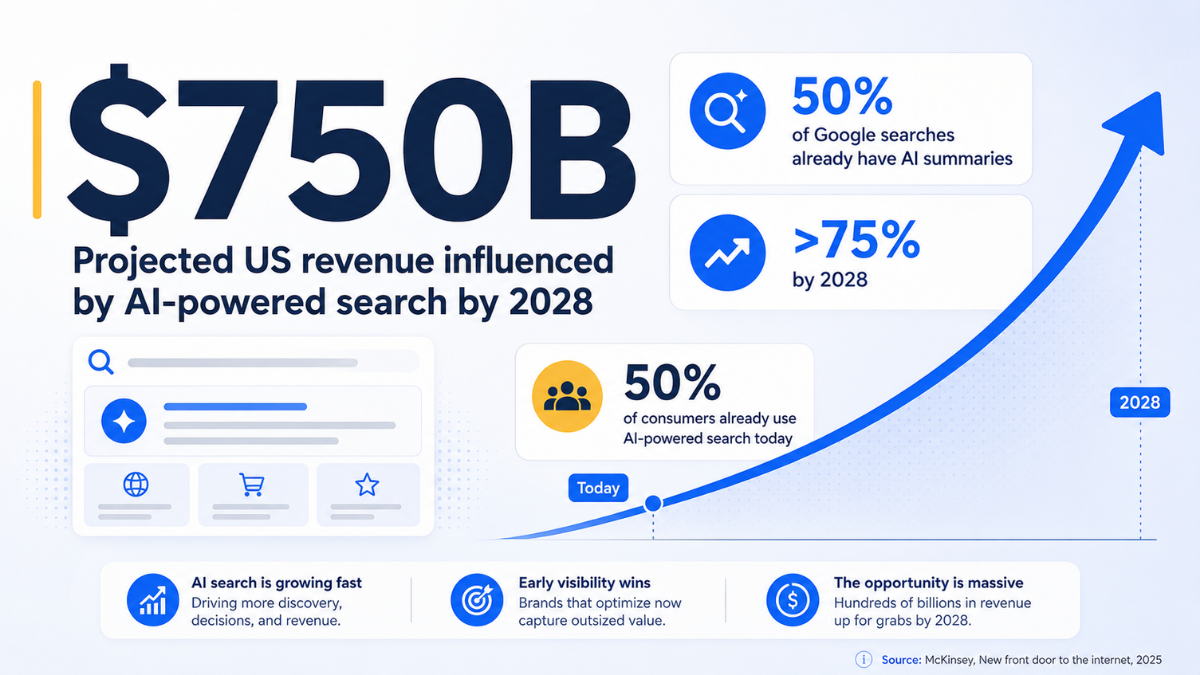
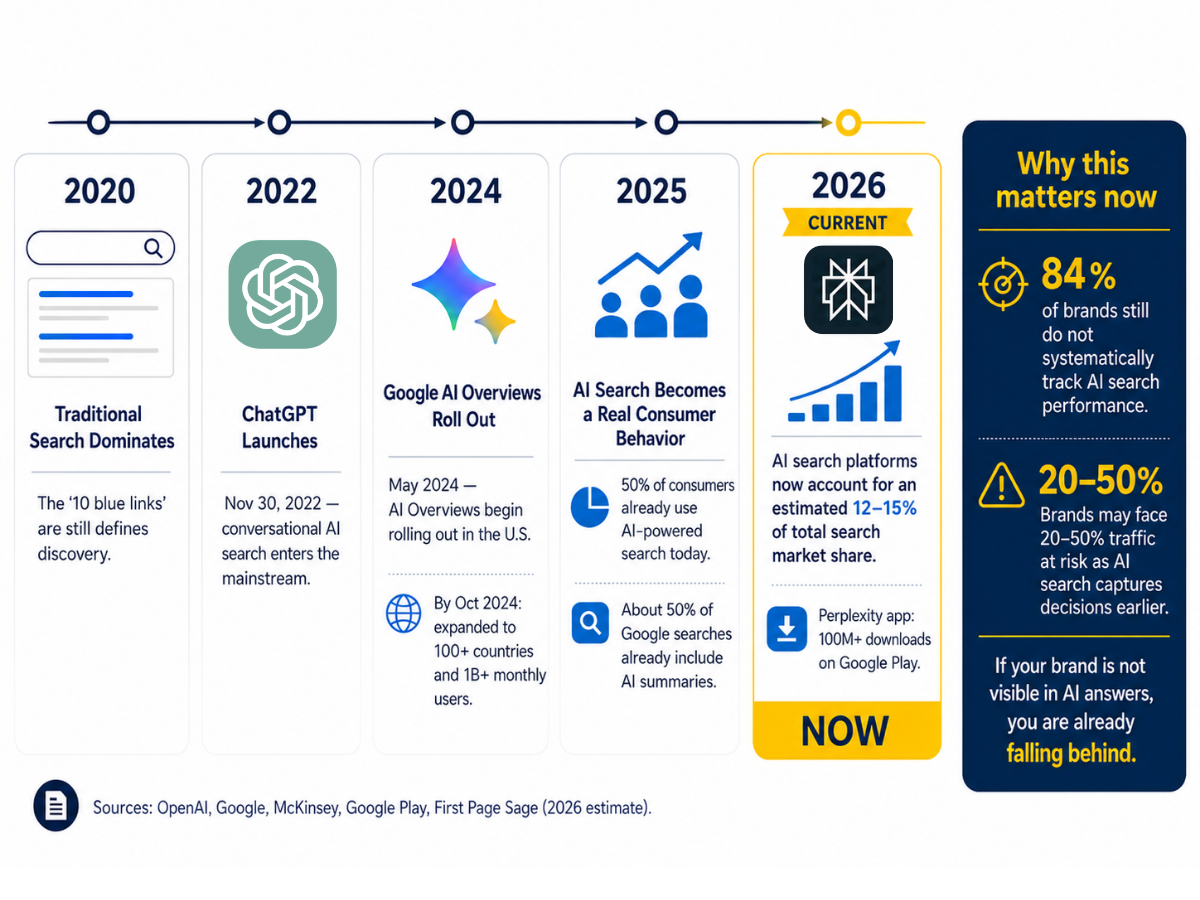 By 2028, $750 billion in US revenue will flow through AI-powered search (McKinsey, 2025). Let that number sink in for a moment. Three-quarters of a trillion dollars in transactions influenced by ChatGPT, Google AI Overviews, Perplexity, and their successors.
Here’s the uncomfortable reality: 50% of consumers now intentionally seek out AI-powered search engines, with a majority saying it’s the top digital source they use to make buying decisions (McKinsey, 2025). Yet only 16% of brands systematically track their performance in these AI search environments (McKinsey CMO Survey, 2025).
The gap between opportunity and action is staggering.
I was reviewing a client’s analytics dashboard last week when the pattern became impossible to ignore. Their traditional SEO metrics looked healthy: stable keyword rankings, consistent organic traffic, solid backlink profile. But when we queried their top 50 product categories in ChatGPT and Perplexity, they appeared in exactly three responses. Their competitors? Fourteen.
This is the visibility crisis hiding in plain sight. Your SEO rankings don’t tell you whether AI systems are recommending your brand. Your Google Search Console data can’t show you how Perplexity describes your products. Your traditional analytics are blind to the conversations happening in AI chat interfaces.
Gartner predicted that by 2026, traditional search engine volume would drop 25%, with search marketing losing share to AI chatbots and virtual agents (Gartner, 2024). We’re now living in that prediction. The brands that understand this shift are already acting. The brands that don’t are watching their market share erode one AI-generated answer at a time.
This guide delivers the complete framework for understanding, conducting, and acting on AI visibility audits. You’ll learn what these audits measure, why they’re distinct from traditional SEO audits, which tools to use, and how to build a systematic approach that connects AI visibility to actual revenue.
What Is an AI Visibility Audit? Definition and Core Components
An AI visibility audit is a systematic evaluation of how, and how often, your brand, products, and content appear in responses generated by AI-powered search engines and chatbots.
Unlike a traditional SEO audit, which measures your position in search engine results pages, an AI visibility audit measures something fundamentally different: whether AI systems cite, recommend, or mention your brand when users ask questions relevant to your business.
The platforms covered by a comprehensive AI visibility audit include:
- ChatGPT (and its web-browsing and search capabilities)
- Google AI Overviews (formerly SGE)
- Perplexity AI
- Claude (Anthropic’s assistant)
- Google Gemini
- Microsoft Copilot (and Bing Chat)
The scale of these platforms is massive. ChatGPT has over 900 million weekly active users globally, while Google AI Overviews reach 1.5 billion monthly users (Superlines/Search Engine Land, 2026). When we talk about AI visibility, we’re referring to its presence in front of billions of potential customers.
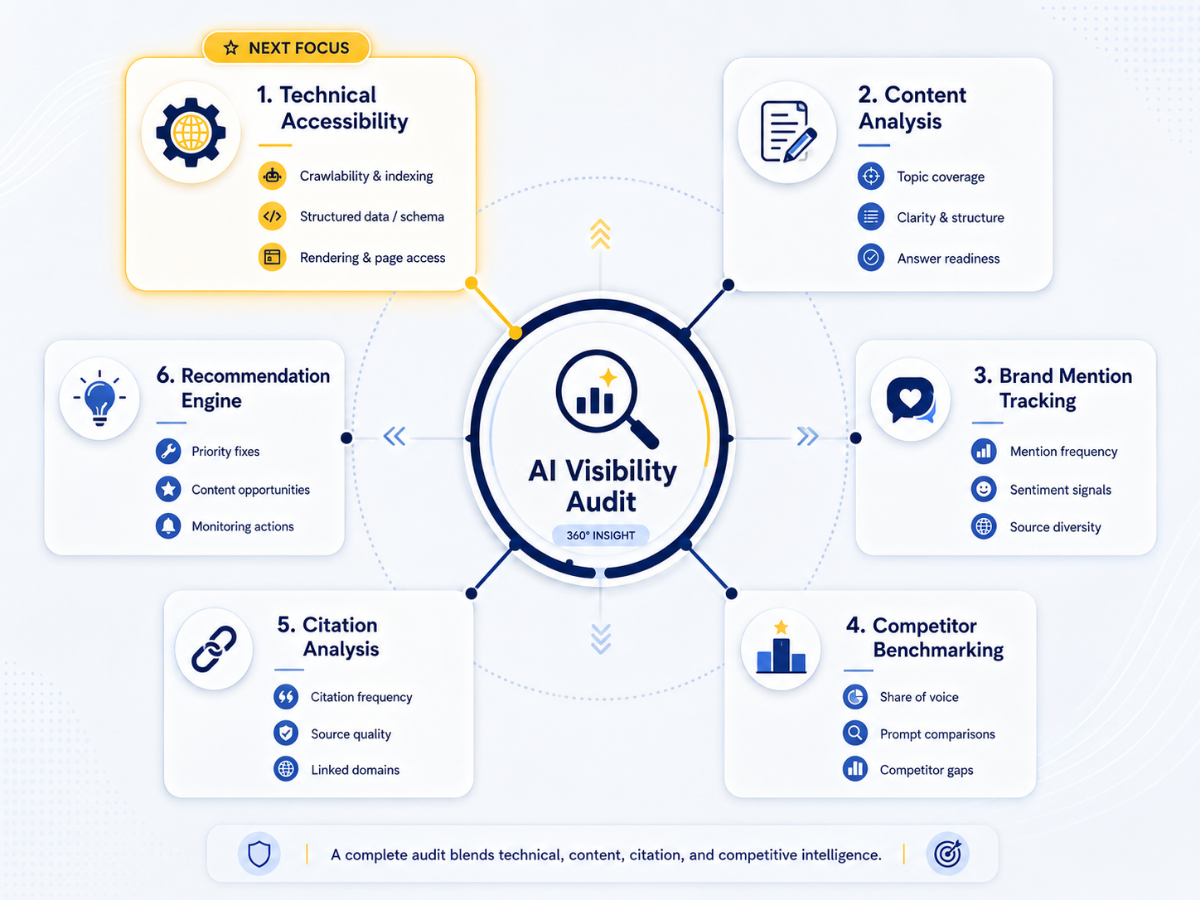
A comprehensive AI visibility audit rests on three core pillars:
Citation Tracking: Are you being mentioned? This measures the frequency and context of your brand’s appearance in AI-generated responses. It answers the fundamental question: when someone asks an AI about your category, does your category appear in the answer?
Sentiment Analysis: How are you being described? AI systems don’t just cite sources; they synthesize information and present opinions. Your audit must capture whether AI describes your brand as positive, neutral, or negative, and how that compares with competitors.
Source Mapping: What content is AI pulling from? Understanding which pages, articles, and third-party sources influence AI responses about your brand is critical for optimization. If AI systems are citing a three-year-old review site instead of your updated product pages, you have a content authority problem.
The business stakes are significant. Brands cited in AI responses gain 38% more organic clicks and 39% more paid clicks compared to brands not cited (Wellows, 2025). AI visibility isn’t just about the AI channel itself. It creates a halo effect that lifts performance across your entire digital presence.
AI Visibility Audit vs. Traditional SEO Audit
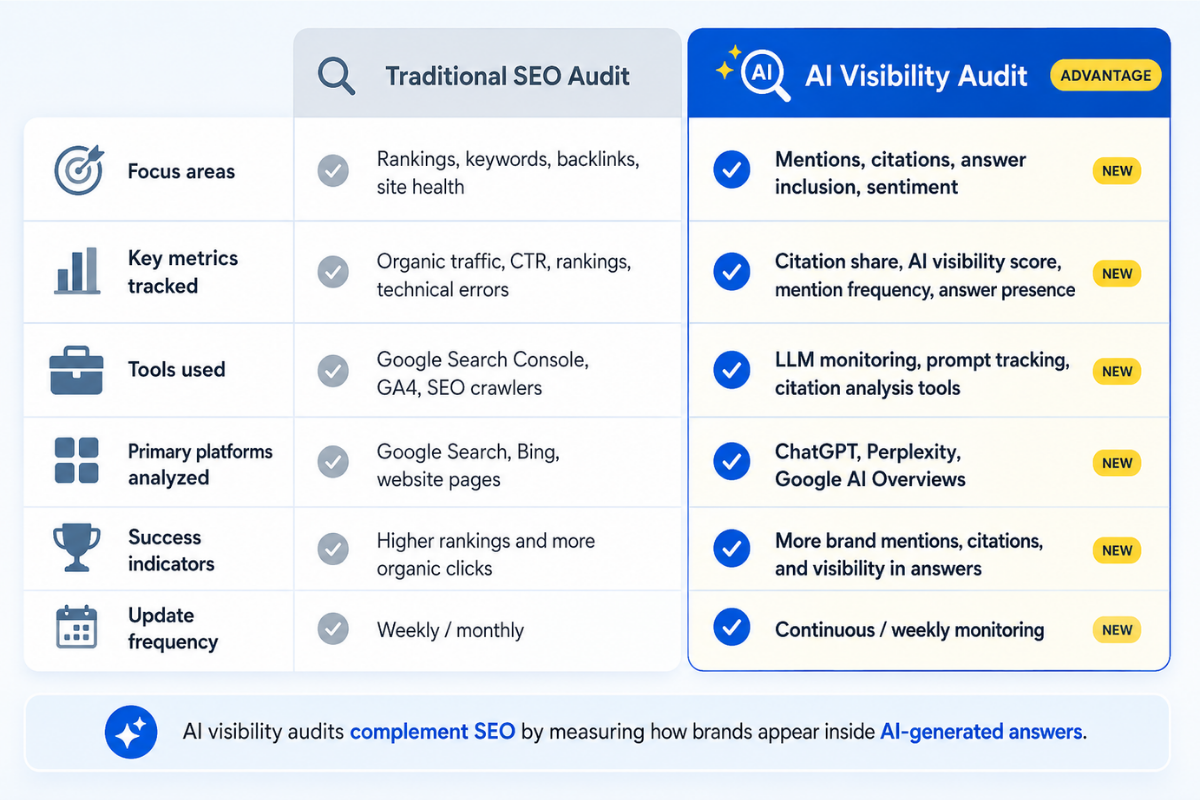
The distinction between an AI visibility audit and a traditional SEO audit isn’t semantic. These are fundamentally different evaluations that measure different signals, use different tools, and optimize for different outcomes.
| Dimension | Traditional SEO Audit | AI Visibility Audit |
|---|---|---|
| Primary Metric | Keyword rankings, SERP positions | Citation frequency, response inclusion rate |
| Data Sources | Google Search Console, rank trackers | AI platform queries, citation monitoring tools |
| Content Focus | On-page optimization, meta tags | Answerable content, quotable statements |
| Technical Focus | Crawlability, Core Web Vitals | AI bot access, structured data for LLMs |
| Competitive Analysis | Backlink profiles, domain authority | Share of voice in AI responses, sentiment comparison |
| Frequency | Monthly to quarterly | Weekly to bi-weekly (due to AI response volatility) |
| Business Outcome | Organic traffic, SERP visibility | Brand mentions, recommendation frequency, citation authority |
| Tools Used | Ahrefs, SEMrush, Screaming Frog | Otterly.ai, Profound, HubSpot AEO Grader |
Here’s the critical insight: 83.3% of AI Overview citations come from pages beyond the traditional top-10 search results (BrightEdge, 2025). Your page could rank #1 for a keyword yet remain invisible to AI systems. Conversely, a page ranking #47 could be the primary source AI cites for your category.
This is why you need both audits. Your SEO audit optimizes for crawlers and rankings. Your AI visibility audit optimizes for LLM citation and accuracy. At NAV43, we treat these as complementary disciplines, not replacements. The brands winning in 2026 are those running both audits in parallel, feeding insights from each into the other.
Why AI Visibility Audits Are Non-Negotiable in 2026
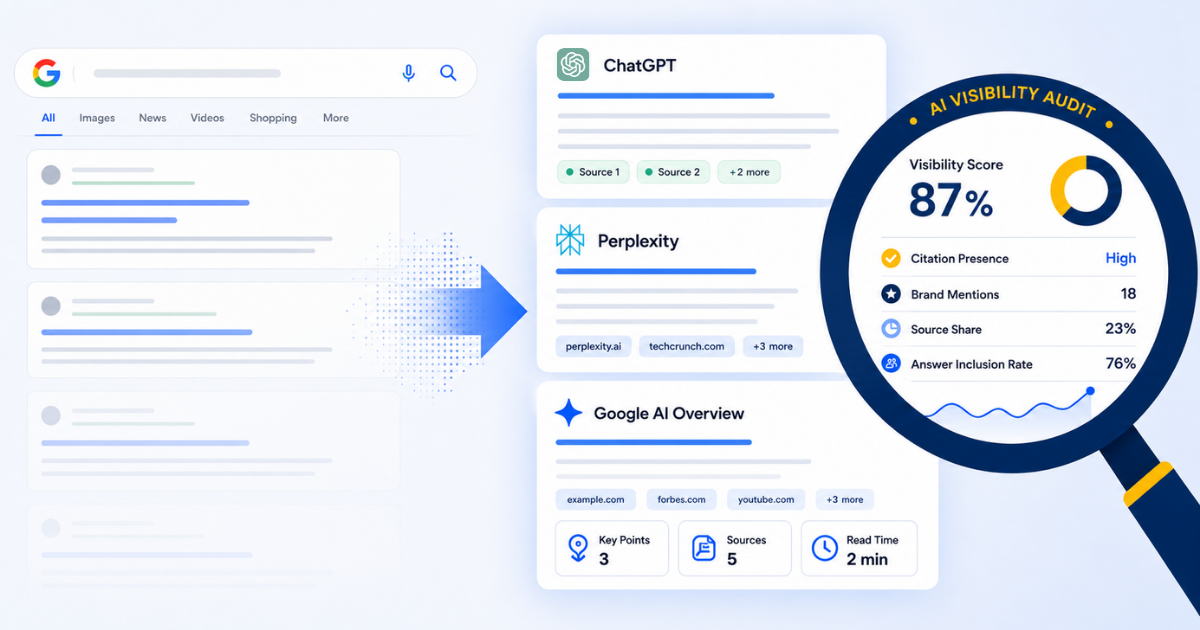
The data on AI search adoption has moved from “emerging trend” to “market reality” faster than most marketing teams anticipated.
AI search traffic increased 527% year-over-year across tracked properties (Previsible AI Traffic Report, 2025). Zero-click searches hit 69% in 2025, and when AI Overviews appear, organic click-through rates drop 61% (Wellows, 2025). For brands still relying exclusively on traditional search metrics, this means watching your traffic erode without understanding why.
McKinsey’s research is blunt: unprepared brands may experience a decline in traffic from traditional search channels of 20-50% (McKinsey, 2025). This isn’t a prediction. It’s already happening to brands that haven’t adapted.
The “visibility volatility” problem compounds this challenge. Only about 30% of brands remain visible in back-to-back AI responses for the same query (AirOps, 2026). Unlike traditional rankings, which tend to be stable week-to-week, AI citations fluctuate dramatically. A brand cited on Monday might be absent on Wednesday. This volatility makes ongoing monitoring essential. A snapshot audit helps, but systematic tracking is what reveals patterns and opportunities.
Here’s what makes this moment critical: 54% of US marketers plan to implement GEO (Generative Engine Optimization) within 3-6 months (eMarketer, 2025-2026). The GEO market has grown from $848 million in 2025 to a projected $33.7 billion by 2034, with a 50.5% CAGR (Dimension Market Research). Early movers are establishing citation authority that compounds over time. Late entrants will face an uphill climb against entrenched competitors.
The Revenue Connection That Most Brands Are Missing
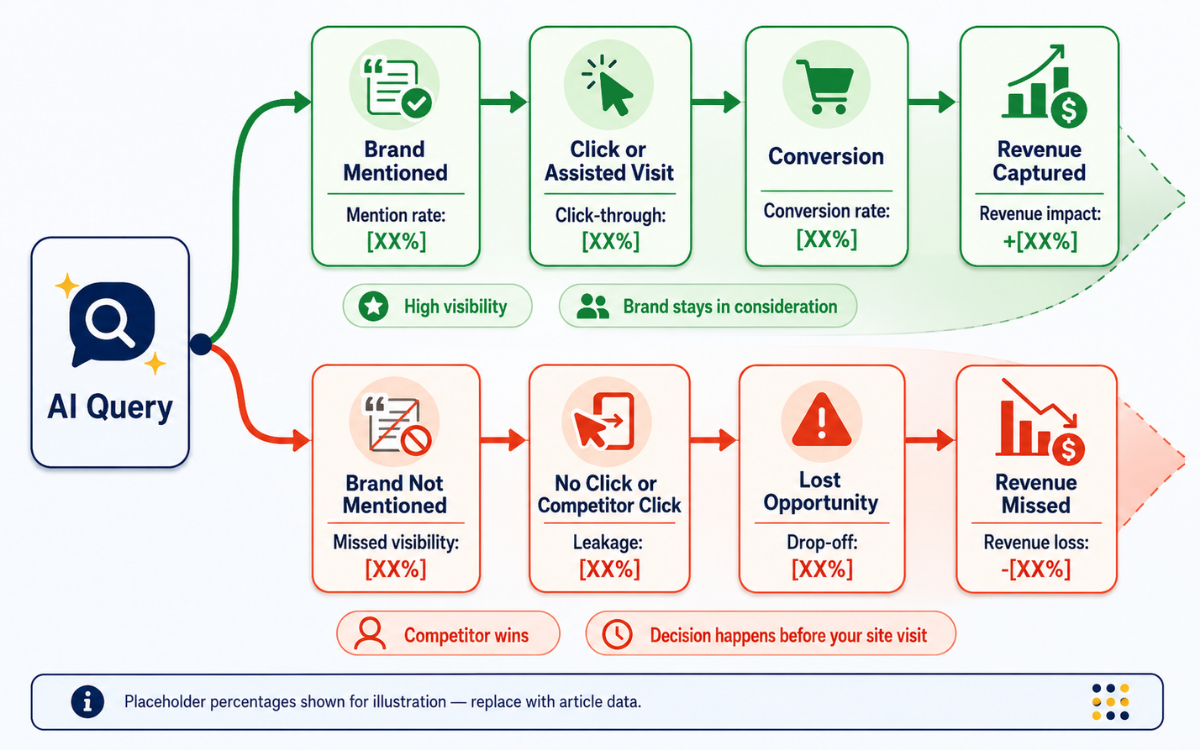
Let me connect the dots between AI visibility and actual revenue, because this is where most content on AI audits falls short.
The $750 billion flowing through AI search by 2028 (McKinsey, 2025) represents market share you’re either capturing or ceding to competitors. When someone asks ChatGPT, “What’s the best CRM for mid-market B2B companies?” and your brand doesn’t appear, you’ve lost a potential customer before they ever visit your website.
But here’s what makes AI visibility particularly valuable: AI-referred traffic converts at 4-5x the rate of traditional organic search traffic (Washington Post CRO via Digiday/Pixis, 2025). Users who discover your brand through AI recommendations arrive with higher intent and stronger pre-qualification. The AI system has already done the vetting for them.
There’s also a compounding effect at play. Once your content is cited by AI systems, several things happen:
- Your authority signals strengthen, making future citations more likely
- Third-party content about your brand gets indexed and influences AI training
- Your brand becomes associated with specific categories and use cases in the AI’s knowledge base
Brands not tracking AI visibility are flying blind while competitors gain citation momentum. By the time traditional metrics reveal the problem, usually through declining organic traffic, the competitive gap may already be significant.
This is why an AI SEO content strategy that includes systematic visibility auditing is no longer optional. It’s the foundation of search marketing in 2026 and beyond.
Three Types of AI Visibility Audits (And When to Use Each)
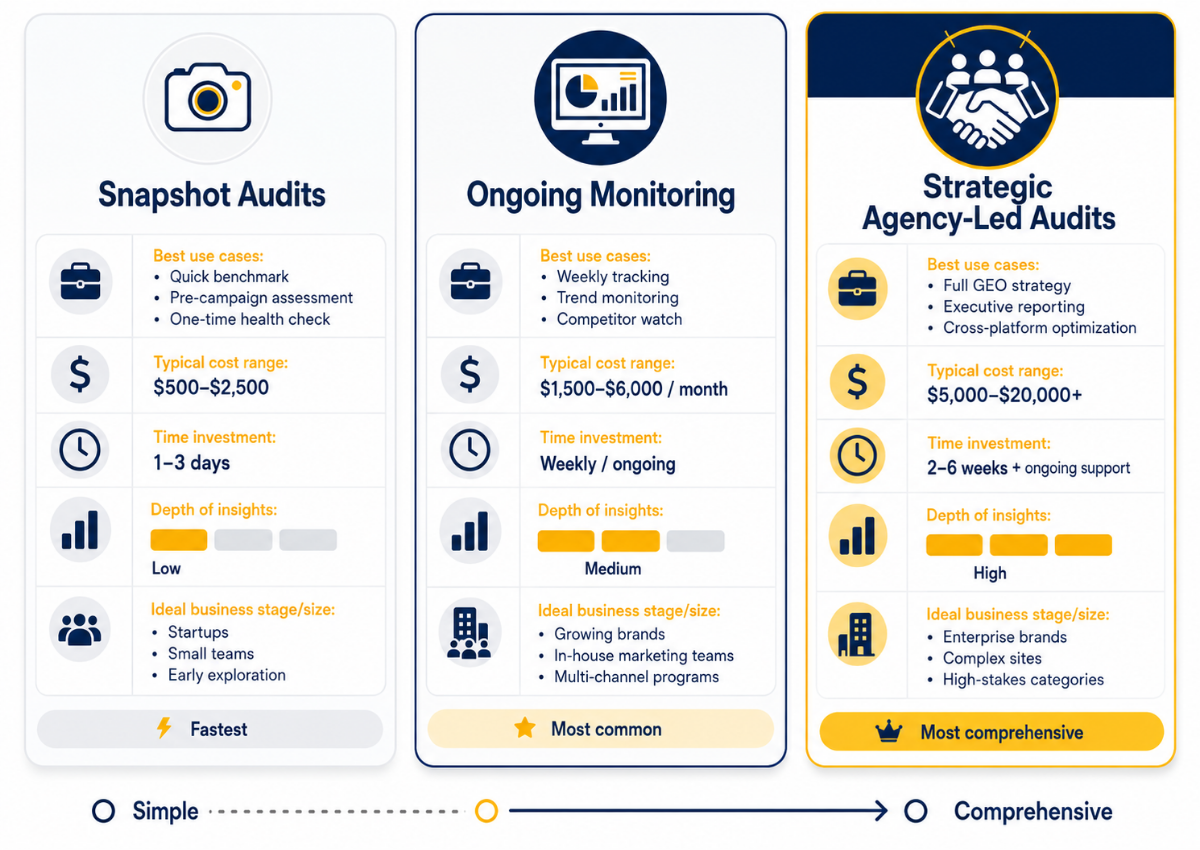
Not all AI visibility audits are created equal. The right approach depends on your current situation, resources, and objectives. Here’s the decision framework we use with clients at NAV43.
Type 1: Snapshot Audits (Free Tools, One-Time Assessment)
A snapshot audit provides a point-in-time check of your brand’s AI visibility across key queries. Think of it as a diagnostic that confirms whether you have a problem and roughly where it exists.
Best for: Initial baseline assessment, quick competitive check, validating that investment in deeper analysis is warranted.
What it involves:
- Select 20-50 high-priority queries relevant to your business
- Run each query through ChatGPT, Perplexity, and Google AI Overviews
- Document which queries surface your brand, in what context, and with what sentiment
- Compare against 3-5 key competitors running the same queries
Limitations: No trend data, limited query coverage, entirely manual process, and no systematic sentiment tracking.
Example tools: HubSpot AEO Grader (free), manual querying with documented protocols.
Time investment: 2-4 hours for a basic audit, 8-12 hours for comprehensive coverage.
Output: Basic visibility score, list of queries where you do and don’t appear, and initial competitive positioning.
A snapshot audit is how most brands discover they have an AI visibility problem. It’s not sufficient for ongoing optimization, but it’s the right starting point if you’ve never assessed this channel.
Type 2: Ongoing Monitoring (Subscription Platforms)
Ongoing monitoring automates the tracking of AI visibility metrics over time across multiple platforms. This is the right approach for brands with established content libraries that need trend analysis, competitive benchmarking, and alert systems.
Best for: Marketing teams with existing content investments, brands seeing traffic fluctuations they can’t explain, and competitive industries where share of voice matters.
What it involves:
- Platform setup with your priority query list (typically 100-500 queries)
- Automated daily or weekly tracking across ChatGPT, Perplexity, Google AI Overviews, and other platforms
- Dashboard access showing visibility trends, citation sources, and sentiment patterns
- Alert systems for significant visibility changes
- Competitive comparison features
Key capabilities: Trend analysis over time, multi-platform coverage, citation source mapping, sentiment tracking, and competitive benchmarking.
Example tools: Otterly.ai, SE Ranking AI Search Toolkit, Semrush AI Visibility Toolkit, Ahrefs AI Visibility Checker.
Typical cost range: $100-$500/month, depending on query volume and platform coverage.
Output: Interactive dashboards, trend reports, competitive gap analysis, citation source mapping, and actionable alerts.
This tier is where most mid-market brands should operate. The automation eliminates the manual overhead of snapshot audits while providing the trend data necessary for strategic decision-making.
Type 3: Strategic Agency-Led Audits (Comprehensive Assessment)
A strategic audit combines technical accessibility analysis, content quality assessment, competitive research, and action planning into a comprehensive evaluation. This is the enterprise approach for brands making significant content investments or facing meaningful traffic declines.
Best for: Enterprise brands with large content libraries, e-commerce companies with extensive product catalogs, regulated industries needing compliance review, and brands preparing $50K+ content investments.
What’s included:
- Technical bot access review (robots.txt configuration, schema markup, rendering)
- E-E-A-T signal assessment across your content library
- Multi-platform visibility analysis with deep competitive comparison
- Content gap identification with business-value prioritization
- Source ecosystem mapping (who influences AI responses in your category)
- Prioritized action roadmap with resource requirements
- Ongoing measurement framework and KPI definitions
Time investment: 2-4 weeks for comprehensive assessment.
Output: Detailed audit report, prioritized recommendations with effort estimates, implementation roadmap, ongoing measurement framework, and executive summary for stakeholder alignment.
Which Audit Type Is Right for You?
Use this quick decision framework:
- Never assessed AI visibility before? Start with a snapshot audit to validate the problem exists.
- Have content and need trend data? Invest in subscription monitoring tools.
- Planning $50K+ in content investment or facing unexplained traffic declines? Commission a strategic agency-led audit.
The Complete Scope of an AI Visibility Audit
A comprehensive AI visibility audit covers five core components. Many tools and services only address one or two of these. Understanding the full scope helps you evaluate whether your current approach has gaps.
1. Technical Accessibility Assessment
Before AI systems can cite your content, they need to access it. This component evaluates whether your technical infrastructure supports or blocks AI crawlers.
Key questions:
- Does your robots.txt allow AI crawlers like GPTBot, ClaudeBot, and PerplexityBot?
- Are your pages rendering properly for AI agents?
- Is your structured data implementation helping AI systems understand your content?
- Are page speed issues preventing efficient AI crawling?
Many brands inadvertently block AI crawlers, either through legacy robots.txt rules or overly aggressive bot management. Technical accessibility is foundational. If AI systems can’t access your content, nothing else matters.
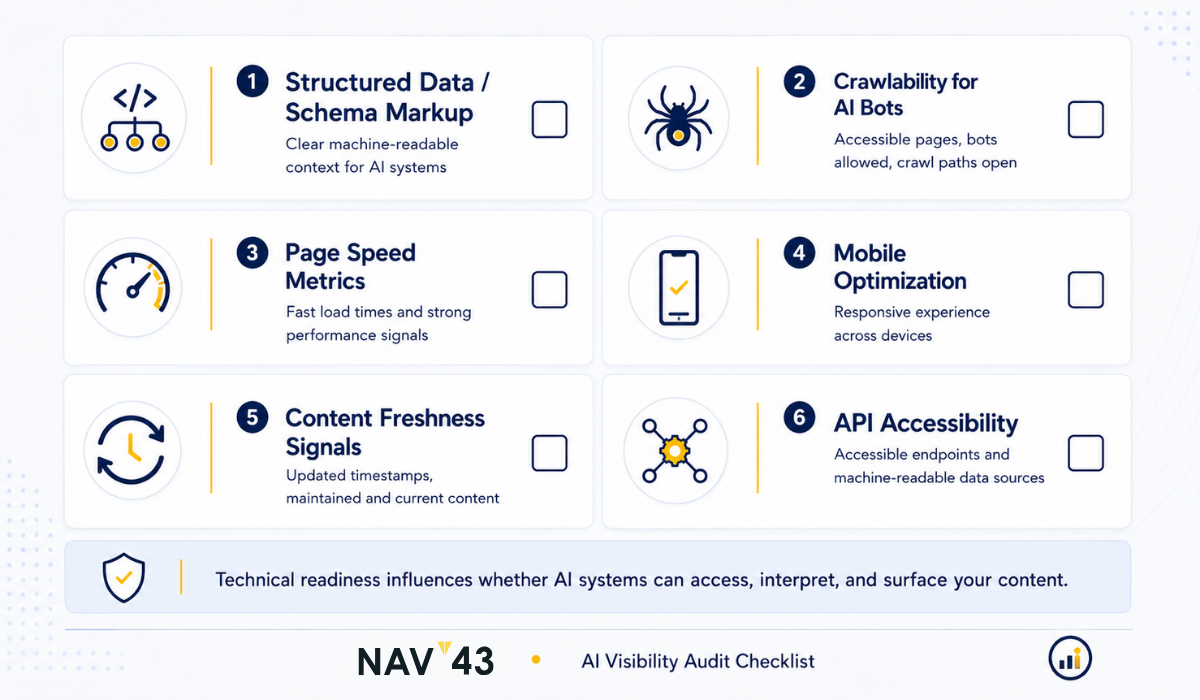
Technical Accessibility Checklist:
- Robots.txt reviewed for AI bot rules (GPTBot, ClaudeBot, PerplexityBot, GoogleOther)
- Schema markup validated for FAQ, Article, Product, and Organization types
- Core Web Vitals passing on critical pages
- JavaScript rendering tested for AI crawler compatibility
- Sitemap includes all the content you want AI systems to access
- No inadvertent blocks in CDN or firewall rules
For a deeper dive into technical accessibility, our technical SEO audit checklist covers the foundational elements that affect both traditional and AI search visibility.
2. Content Quality and E-E-A-T Signal Analysis
AI systems prioritize content that demonstrates Experience, Expertise, Authoritativeness, and Trustworthiness. This component evaluates how well your content signals these qualities.
The data here is compelling. Content with statistics increases AI visibility by 25-37%, while authoritative content with expert quotes scores 22.3% higher in AI citation rates (industry research). Pages with well-organized headings are 2.8x more likely to earn AI citations.
Assessment criteria:
- Author credentials: Are your authors identified with verifiable expertise?
- Source citations: Does your content cite authoritative sources?
- Content freshness: When was it last updated? Is the information current?
- Factual accuracy: Can AI systems verify your claims against other sources?
- Clear structure: Do headings and subheadings make your content scannable?
This component also evaluates whether your content provides direct, quotable answers to questions. Our Answerable Content Framework emphasizes stating the question explicitly, providing a 2-3 sentence quotable answer, then expanding with evidence. AI systems can extract and cite this format much more easily than content that buries answers in lengthy paragraphs.
3. Multi-Platform Visibility Tracking
AI visibility isn’t monolithic. Your brand might appear frequently in ChatGPT responses while being completely absent from Perplexity, or vice versa. This component tracks visibility across all major AI platforms.
Platforms to monitor:
- ChatGPT (both GPT-4o and web-search enabled versions)
- Google AI Overviews
- Perplexity AI
- Claude (Anthropic)
- Google Gemini
- Microsoft Copilot
What to track per platform:
- Citation frequency for priority queries
- Position within response (mentioned first, mentioned in passing, etc.)
- Source attribution (which of your pages is being cited)
- Competitive comparison (who else appears in the same responses)
The variation across platforms can be dramatic. Citation rates, sentiment, and brand mention patterns vary significantly across AI systems. A brand dominating in Perplexity might be invisible in Google AI Overviews. Multi-platform tracking reveals these gaps.
Here’s a critical insight: brands’ own websites account for only 5-10% of the sources AI-powered search references in many categories (McKinsey, 2025). Understanding the full source ecosystem, including third-party sites, review platforms, and industry publications, matters as much as tracking your own content performance.
4. Sentiment and Accuracy Assessment
Citation alone isn’t enough. How AI systems describe your brand matters enormously for conversion.
Sentiment categories:
- Positive: Brand recommended, praised, or positioned favorably
- Neutral: Brand mentioned factually without evaluation
- Negative: Brand criticized, positioned unfavorably, or associated with problems
Accuracy dimensions:
- Is product/service information current and correct?
- Are pricing references accurate?
- Are feature claims factually true?
- Are comparisons with competitors fair and accurate?
Misinformation detection is particularly important. AI systems occasionally present incorrect information confidently. If ChatGPT is telling users your product lacks a feature it actually has, or quoting outdated pricing, you have a reputation risk that needs immediate attention.
This component also includes a comparison of competitive sentiment. How do AI systems describe your competitors? Is your brand positioned as the premium option, the budget alternative, or something else entirely? These positioning signals influence buyer perception long before they visit your website.
5. Competitive Benchmarking and Gap Analysis
The final component maps your position relative to competitors and identifies specific opportunities for improvement.
Key analyses:
- Share of voice: Your citation frequency vs. competitors for the same queries
- Content gap identification: Topics where competitors are cited but you’re invisible
- Source authority analysis: Which third-party sites influence AI responses in your category
- Opportunity prioritization: Where can you realistically win visibility based on current content assets and competitive intensity
This component answers the strategic question: where should we invest our optimization efforts for maximum impact?
| Component | What’s Assessed | Key Metrics | Tools/Methods | Frequency |
|---|---|---|---|---|
| Technical Accessibility | Bot access, schema, rendering | Crawl success rate, schema validation score | Screaming Frog, Schema validators, robots.txt testing | Quarterly |
| Content Quality | E-E-A-T signals, answer format | Citation rate by content type, freshness score | Manual review, content auditing tools | Monthly |
| Multi-Platform Visibility | Brand mentions across AI platforms | Citation frequency, platform coverage | Otterly.ai, manual queries, API monitoring | Weekly |
| Sentiment and Accuracy | Brand perception, factual correctness | Sentiment score, error rate | AI query sampling, brand monitoring | Weekly |
| Competitive Benchmarking | Share of voice, gaps | SOV percentage, opportunity score | Competitive tracking tools, manual analysis | Bi-weekly |
AI Visibility Audit Tools: A Practical Comparison
The tool landscape for AI visibility has evolved rapidly. In 2024, most brands relied on manual querying. By mid-2025, a new category of specialized platforms emerged. Today, you have meaningful options at every budget level.
Here’s an objective comparison based on our evaluation of these tools in client work.
Enterprise and Agency-Grade Tools
Semrush AI Visibility Toolkit
Part of the broader Semrush SEO suite, this toolkit integrates AI visibility tracking with existing Semrush workflows. It tracks AI Overviews and generative search visibility, connecting these metrics to traditional SEO data. Best for teams already invested in Semrush who want a unified platform.
Ahrefs AI Visibility Checker
Ahrefs has added emerging AI tracking features that complement their industry-leading backlink analysis. The competitive analysis focus makes this valuable for understanding how domain authority and link profiles correlate with AI citations. Still developing, but promising for existing Ahrefs users.
Profound
Enterprise-focused platform with comprehensive multi-platform tracking and API integrations. Designed for teams that need to connect AI visibility data to data warehouses and business intelligence tools. Higher price point, but robust for sophisticated measurement requirements.
Best for: Agencies managing multiple clients, enterprise teams with existing investment in these platforms, and brands needing integration with broader MarTech stacks.
Specialized AI Visibility Platforms
Otterly.ai
Purpose-built for AI search tracking from the ground up. Strong multi-platform coverage across ChatGPT, Perplexity, Google AI Overviews, and others. Competitive benchmarking features are well-developed. The focused scope means deep capabilities in AI visibility without the overhead of broader SEO features.
SE Ranking AI Search Toolkit
Combines traditional SEO tracking with AI visibility monitoring. Good for teams transitioning from SEO-only workflows who want to add AI visibility without switching platforms entirely. Growing feature set with regular updates.
Amplitude AI Visibility
Distinct from general AI visibility tools. Amplitude’s feature connects behavioral analytics to AI visibility data. Useful for teams wanting to understand how AI-referred traffic behaves differently from other sources. More analytics-focused than monitoring-focused.
Best for: Mid-market brands wanting specialized capabilities, teams prioritizing AI visibility as a distinct discipline, and companies seeking purpose-built solutions.
Free and Entry-Level Options
HubSpot AEO Grader
Free tool for basic Answer Engine Optimization assessment. Good starting point for brands that have never evaluated AI visibility. Limited in scope but zero cost to validate whether deeper investment is warranted.
Manual Querying Protocol
Systematic testing across AI platforms with documented queries and responses. Free but time-intensive. We recommend this approach for initial snapshot audits before committing to paid tools.
WordLift AI Audit
Focuses on “agentic AI readiness,” specifically, technical accessibility for AI agents. Slightly different from visibility measurement, but valuable for understanding whether your technical foundation supports AI citation.
Best for: Initial assessment, budget-constrained teams, validating need for paid tool investment.
| Tool | Type | Platforms Tracked | Key Strength | Pricing Tier | Best For |
|---|---|---|---|---|---|
| Semrush AI Visibility | Enterprise Suite | AI Overviews, GenAI | SEO integration | $$$$ | Existing Semrush users |
| Ahrefs AI Visibility | Enterprise Suite | Emerging coverage | Backlink correlation | $$$$ | Existing Ahrefs users |
| Profound | Enterprise Specialized | Multi-platform | API and data warehouse | $$$$$ | Enterprise, data teams |
| Otterly.ai | Specialized | ChatGPT, Perplexity, AIO | Purpose-built depth | $$$ | Mid-market focus |
| SE Ranking | Specialized | Multi-platform | SEO transition | $$ | Teams adding AI to SEO |
| Amplitude AI Visibility | Analytics | Behavioral focus | User behavior link | $$$ | Analytics-first teams |
| HubSpot AEO Grader | Free | Limited | Zero cost entry | Free | Initial validation |
| WordLift AI Audit | Technical | Agent accessibility | Technical readiness | $$ | Technical assessment |
NAV43’s tool stack in client audits typically combines Otterly.ai for ongoing monitoring, manual deep-dive queries for qualitative analysis, and technical crawling tools for accessibility assessment. The specific combination depends on client needs, existing tool investments, and integration requirements with their MarTech stack. For guidance on how AI visibility fits into your broader technology ecosystem, see our MarTech stack framework.
The NAV43 AI Visibility Audit Framework: A Step-by-Step Process
This is the proprietary process we’ve developed from dozens of client engagements. It works whether you’re conducting the audit internally or evaluating agency partners. The framework addresses the ROI measurement gap that most competitive content misses.
Phase 1: Query Universe Development (Week 1)
The audit’s value depends entirely on asking the right questions. This phase builds your priority query list.
Step 1: Map buyer journey questions. Your audience doesn’t search AI systems with keywords. They ask questions. Map these questions across the buyer journey: awareness stage questions like “What is [category]?” and “How does [category] work?”, consideration stage questions like “Best [category] for [use case]” and “Compare [solution A] vs [solution B]”, and decision stage questions like “Is [your brand] right for [specific need]?” and “[Your brand] reviews.”
Step 2: Include all query types. Cover branded queries that include your brand name, category queries about your product or service category, competitive queries comparing you to competitors, and problem queries about the issues your solution addresses.
Step 3: Prioritize by business value. Not all queries matter equally. Prioritize by search volume indicators, conversion potential, competitive intensity, and current content coverage.
Typical scope: 50-200 priority queries for initial audit, expanding over time.
Output: Prioritized query list organized by journey stage and business value, with query categorization documented.
Phase 2: Baseline Visibility Assessment (Week 1-2)
With your query list defined, run the baseline assessment across all target platforms.
Step 1: Execute queries across platforms. Run each priority query through ChatGPT (with and without web search enabled), Google AI Overviews, Perplexity AI, Claude, and Microsoft Copilot.
Step 2: Document response characteristics. For each query and platform combination, capture whether your brand appears, its position within the response, the context of the mention, the sentiment, factual accuracy, and which of your pages is attributed as a source.
Step 3: Calculate baseline metrics. Compute your overall citation rate (percentage of queries where your brand appears), platform-specific rates, sentiment distribution across positive, neutral, and negative mentions, and accuracy rate for mentions with correct information.
Step 4: Run competitive comparison. Run the same queries for 3-5 key competitors to provide share-of-voice benchmarking and reveal where they are winning visibility you’re not.
Output: Baseline visibility scorecard with competitive benchmarks, documented in a format that supports ongoing tracking.
Phase 3: Source and Content Analysis (Week 2)
This phase investigates why you are or aren’t being cited.
Step 1: Map citation sources. For queries where you appear, identify which content sources AI platforms cite. For queries where you don’t appear, identify which competitor or third-party sources are being cited instead.
Step 2: Analyze the characteristics of cited content. What do your cited pages share in common? Patterns typically emerge around content structure, direct answer format, E-E-A-T signals, freshness, and comprehensive topic coverage.
Step 3: Identify content gaps. What content do competitors have that you lack? What questions are you not addressing that AI systems want to answer? This gap analysis feeds directly into content strategy.
Step 4: Complete technical assessment. Verify AI crawlers can access your content by checking robots.txt configuration, schema markup implementation, and JavaScript rendering.
Output: Content gap report with specific recommendations, technical fix list, E-E-A-T signal inventory.
Phase 4: Action Planning and Prioritization (Week 3)
Convert analysis into prioritized action.
Step 1: Categorize opportunities into technical fixes (bot access, schema, rendering), content optimization (improving existing content for AI citation), content creation (new content to fill gaps), and third-party influence strategies to improve how external sources describe you.
Step 2: Score each recommendation by impact (potential visibility improvement), effort (resources required), and timeline (how quickly it can be executed).
Step 3: Build a prioritized roadmap that balances quick wins with strategic investments. Technical fixes often provide the fastest ROI. Content optimization follows. Content creation is long-term but often has the highest impact.
Output: Prioritized action roadmap with timeline, resource requirements, and success metrics.
Phase 5: Measurement Framework and ROI Tracking (Week 3-4)
The missing element in most AI visibility programs is the connection between visibility and business outcomes.
AI visibility KPIs to define:
- Citation rate (overall and by platform)
- Share of voice vs. competitors
- Sentiment score
- Accuracy rate
- Citation source distribution
Business metrics to connect:
- AI-referred traffic (trackable via referrer analysis)
- AI-referred conversion rate
- Brand search volume trends
- Assisted conversions where AI is in the path
Reporting cadence:
- Weekly: Citation rate and sentiment monitoring
- Monthly: Competitive share of voice analysis
- Quarterly: Full audit refresh and strategy review
For detailed guidance on measuring AI SEO performance, our AI SEO KPI framework provides the measurement architecture needed for these audits.
Output: Measurement framework document, dashboard configuration, reporting templates.
Common Pitfalls in AI Visibility Auditing
After conducting dozens of these audits, we’ve identified the patterns that most often derail programs. Avoid these mistakes.
Auditing once and assuming the results hold. AI citation is volatile. Only 30% of brands remain visible in back-to-back AI responses for the same query (AirOps, 2026). A one-time audit provides a snapshot, not a strategy. Build ongoing monitoring into your process.
Focusing only on your own content. Brands’ own websites account for only 5-10% of sources AI references in many categories (McKinsey, 2025). Third-party sites, review platforms, and industry publications often influence AI responses more than your content does. Your audit must map the full source ecosystem.
Ignoring sentiment and accuracy. Being cited isn’t automatically good. If AI systems describe your product negatively or provide inaccurate information, citations hurt rather than help. Every audit must assess how you’re being described, not just whether you’re mentioned.
Treating AI visibility as separate from SEO. The most effective approach integrates AI visibility auditing with traditional SEO. Technical fixes often improve both. Content improvements that boost AI citation typically strengthen traditional rankings too. Run both audits, but don’t silo the insights.
Not connecting visibility to revenue. AI visibility is a leading indicator, not an end goal. If your audit doesn’t include a framework for linking visibility improvements to traffic, conversions, and revenue, you’re measuring activity rather than outcomes. Build ROI tracking into your process from the start.
Underinvesting in the query universe. The audit’s value depends on asking the right questions. Brands that rush through query development or simply repurpose their SEO keyword list miss the full picture. Invest time in understanding what your audience actually asks AI systems.
Getting Started: Your AI Visibility Audit Action Plan
The window to build AI citation authority is open, but the competitive landscape is accelerating. Early movers are compounding advantages that will become increasingly difficult to close.
If you’ve never assessed your AI visibility, start this week with a manual snapshot audit. Select 30 high-priority queries that represent your most important product categories and buyer journey stages. Run each through ChatGPT, Perplexity, and Google AI Overviews. Document every instance where a competitor is cited, and you’re not. That gap analysis is your starting point.
If you already have a baseline and need trend data, evaluate the subscription monitoring platforms covered in this guide. Otterly.ai and SE Ranking offer accessible entry points for mid-market teams. The $100-$300 monthly investment pays for itself quickly when it reveals a visibility gap you can act on.
If you’re making significant content investments or facing unexplained traffic declines, commission a comprehensive strategic audit before allocating budget. The intelligence it produces will reshape your content priorities and almost certainly prevent more wasted spend than the audit costs.
The brands that treat AI visibility as a systematic, measurable discipline are building durable competitive advantages. The brands treating it as a curiosity are watching those advantages compound against them.
AI search is not the future. It’s the present. Your buyers are already using it to make decisions. The only question is whether you appear in those decisions as the recommended solution or whether a competitor does.
Ready to assess your brand’s AI visibility? Get a free growth plan from the NAV43 team, including an evaluation of your current AI citation presence and specific recommendations for improving your visibility across ChatGPT, Perplexity, and Google AI Overviews.
