LLM Citation Optimization: How to Write Quote-Ready Content Blocks That AI Actually Cites
AI-referred visitors convert at 4.4x the rate of traditional organic traffic (Semrush, 2025). Let that sink in. These aren’t curiosity clicks or accidental visits. When someone arrives at your site after an AI assistant recommends your brand, they’re already pre-qualified, pre-educated, and ready to act.
Yet 47% of brands still have no generative engine optimization strategy whatsoever (Dataslayer.ai, 2026). That’s not just a missed opportunity. It’s a first-mover advantage waiting for the marketers who understand how LLM citation optimization actually works.
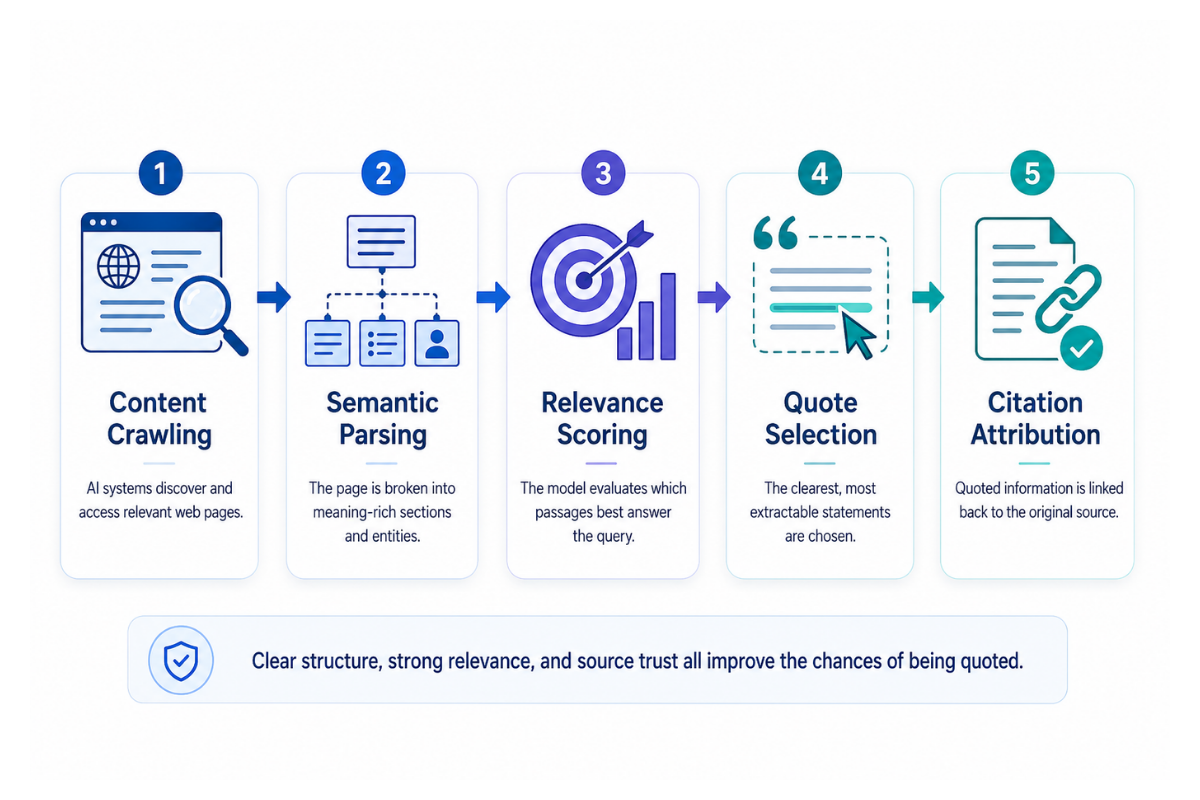
Here’s the uncomfortable truth: most content is written to rank, not to be quoted. LLMs don’t read your pages the way humans do. They extract passages. They pull specific blocks of text that directly answer questions. If your content isn’t structured for extraction, you’re invisible to the fastest-growing traffic source in digital marketing.
The numbers tell the story. Traffic to U.S. retail sites from generative AI sources increased 693.4% during the 2025 holiday season compared to the prior year (Adobe Analytics, 2026). This isn’t a trend you can afford to watch from the sidelines. This is a fundamental shift in how people discover brands online.
This article delivers the exact framework NAV43 uses with clients to engineer content that AI systems actually quote. You’ll get specific word counts, formatting rules, platform-specific tactics for ChatGPT, Perplexity, and Google AI Overviews, and a complete citability audit checklist. Everything you need to implement today, not theoretical concepts you’ll never apply.
How AI Models Actually Extract and Quote Content
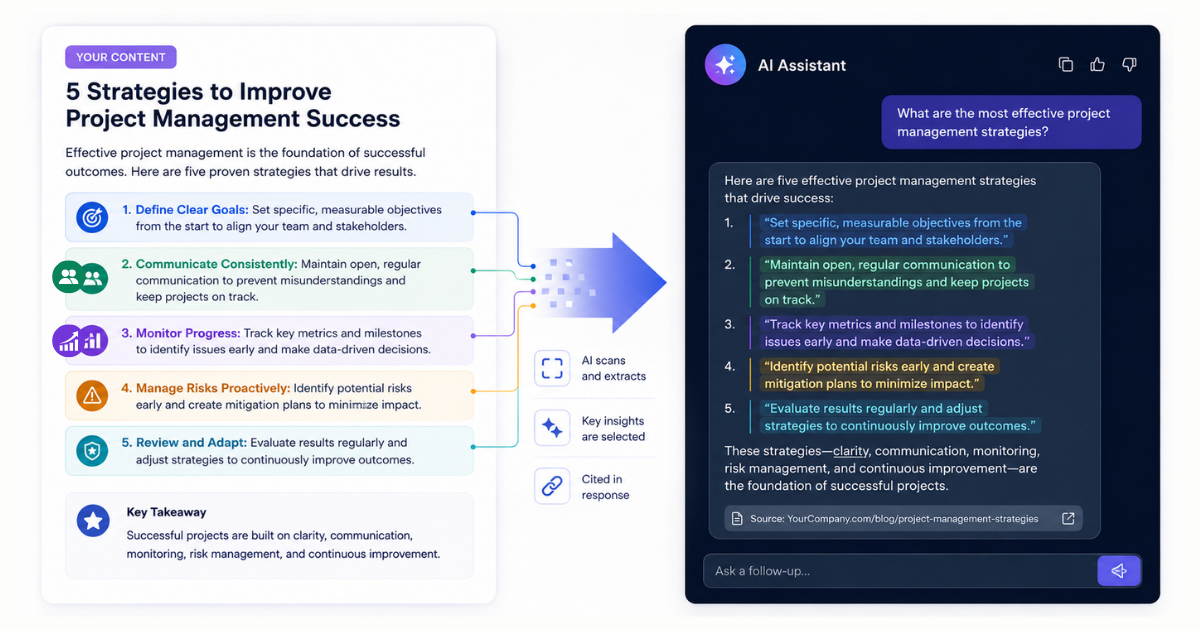
The shift from traditional SEO to LLM citation optimization requires a fundamental change in how you think about content structure. Search engines crawl pages and evaluate them holistically. LLMs extract passages. Each paragraph in your content is evaluated independently as a potential quotation source.
This is where the Extractable Block concept becomes essential. An extractable block is a self-contained unit of content that answers a specific question completely within 40-60 words. It’s not a summary. It’s not a teaser. It’s a complete, quotable answer that makes sense when pulled entirely out of context.
The data on content position is striking. 44.2% of all LLM citations come from the first 30% of text, 31.1% from the middle, and 24.7% from the conclusion (SparkToro, 2026). Front-loading your answers isn’t just good user experience. It’s citation optimization.
Traditional SEO content fails the extractability test in predictable ways. Long introductions that build suspense before delivering the answer. Key insights buried in the middle of 150-word paragraphs. Keyword-stuffed transitions that make sentences dependent on the surrounding context. All of these patterns reduce the probability that an LLM will quote your content.
Authority signals matter differently in the AI era. Brand search volume now correlates more strongly with citation likelihood (0.334 correlation) than traditional backlinks. Entity authority compounds over time as AI systems learn to associate your brand with specific topics and questions.
Before: Traditional SEO paragraph (buried answer, 120+ words):
“When considering the optimal length for LinkedIn posts, there are many factors to take into account. Some experts suggest shorter posts perform better, while others advocate for longer-form content. According to recent research and our experience working with B2B clients across multiple industries, the data suggests that posts between 1,200-1,300 characters tend to generate the highest engagement rates, though this can vary significantly based on your audience, industry, and the specific platform algorithm changes that LinkedIn implements throughout the year.”
After: Extractable block (45 words, answer-first):
“LinkedIn posts between 1,200-1,300 characters generate the highest engagement rates based on 2025 platform data. This length allows enough depth to demonstrate expertise while respecting feed-scrolling behavior. Posts exceeding 2,000 characters see engagement drop by 23%.”
The Three Signals AI Systems Prioritize
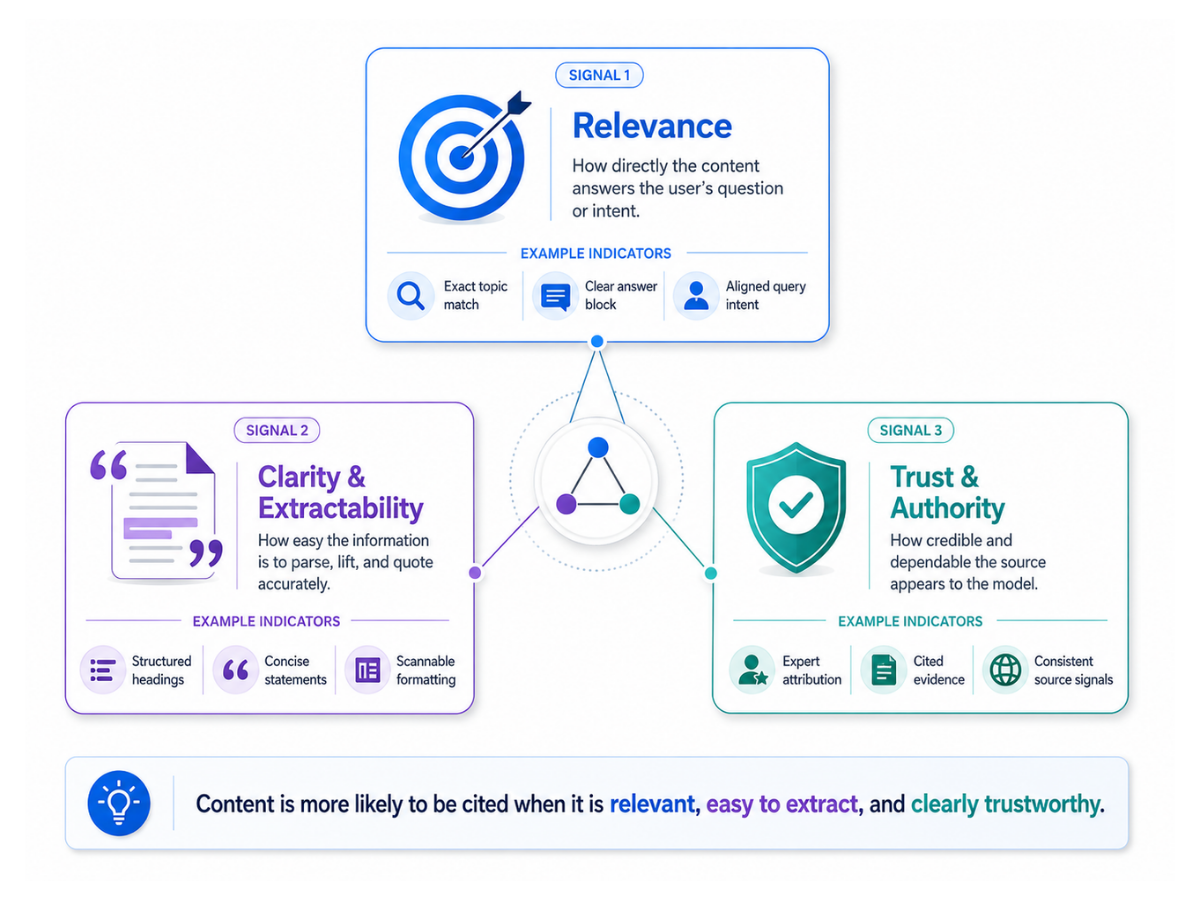
AI citation patterns reveal three consistent signals that determine which content gets quoted.
Structural clarity tops the list. Content with Q&A formatting is 40% more likely to be cited by AI systems (Princeton GEO Research, 2024). Clear headers, numbered lists, and explicit question-answer pairs serve as structural signals that LLMs use to identify extractable content. When your H2 poses a question, and your first paragraph answers it directly, you’re creating an extraction-friendly pattern.
Statistical authority provides the evidence that makes content quotable. Adding statistics to content increases AI visibility by 22%, while using quotations boosts it by 37% (Princeton GEO Research / Digital Bloom, 2025). AI systems favor content that includes specific, verifiable data points over content that makes claims without evidence.
Recency weighting determines whether your content even enters consideration. 65% of AI bot traffic targets content published or updated within the past year; only 6% cites content older than 6 years (Wellows, 2025-2026). Freshness isn’t just a ranking factor for Google anymore. It’s a citation filter for every major AI platform.
The Citation Triad: Structural Clarity + Statistical Authority + Recency = Citability
Engineering Quote-Ready Content: The NAV43 Extractable Block Framework
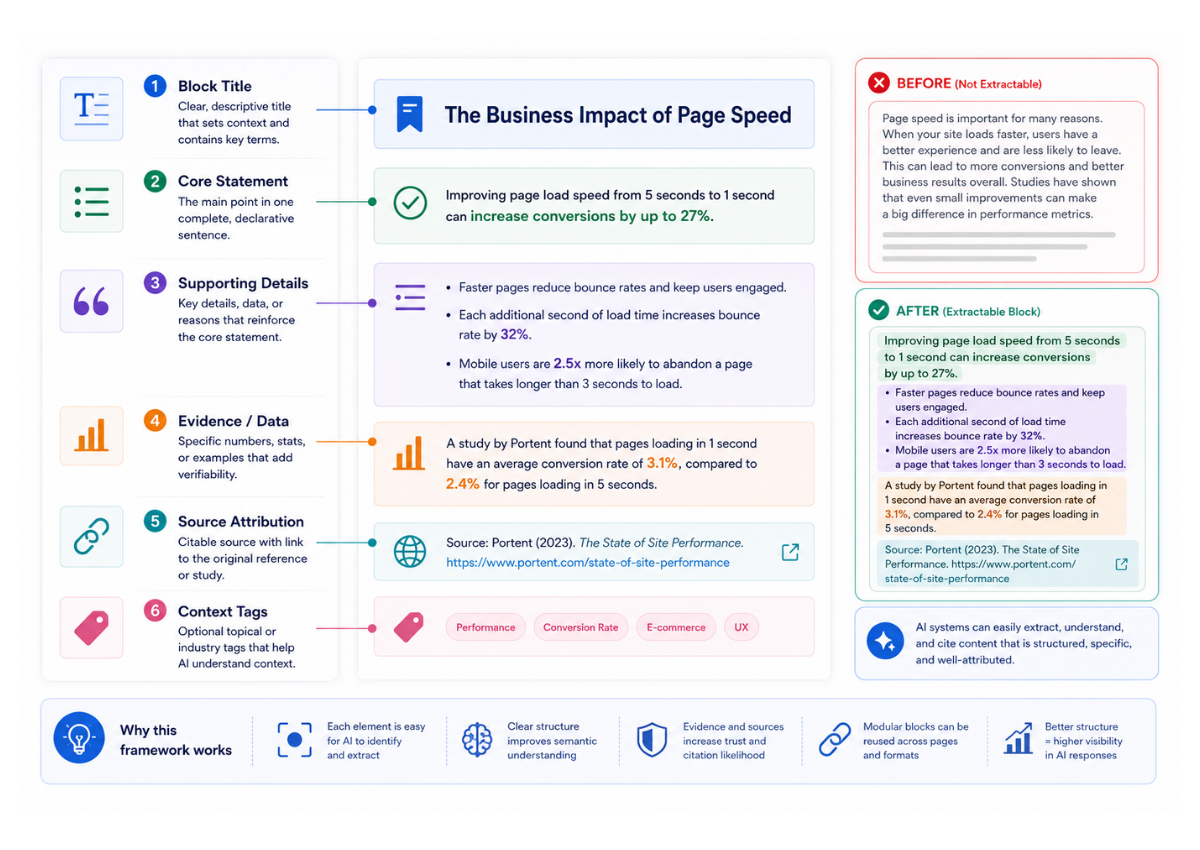
Every content block should be engineered as a standalone, quotable unit between 40-60 words. This range isn’t arbitrary. It maps directly to what ChatGPT, Perplexity, and Google AI Overviews actually quote based on 2025-2026 citation analyses.
The anatomy of an extractable block follows a precise formula:
Lead sentence (the answer): State the answer to the implicit question in your first sentence. Please omit the warmup, context-setting, and hedge language.
Supporting evidence (stat or example): Provide a specific data point, percentage, or concrete example that validates your answer. This gives the AI system something verifiable to include.
Closing context (application or implication): Connect the answer to a practical application or business implication. This signals that the content is actionable, not just informational.
The NAV43 Extractable Block Formula:
[Direct Answer] + [Evidence/Data Point] + [Contextual Application] = Extractable Block
Here’s how this transforms real content. Take the topic “best time to post on LinkedIn for B2B engagement.”
Standard SEO paragraph (92 words, answer buried):
“LinkedIn engagement patterns have shifted significantly over the past few years as remote work and hybrid schedules have changed when professionals access the platform. While conventional wisdom used to suggest posting during standard business hours, the data now shows more nuanced patterns. Based on our analysis of over 50,000 B2B posts, Tuesday through Thursday between 8-10am local time generates the highest engagement, with a secondary peak during lunch hours from 12-1pm.”
Extractable block version (48 words, answer-first, stat-supported):
“Tuesday through Thursday between 8-10am local time generates the highest LinkedIn engagement for B2B content, based on analysis of 50,000+ posts. This window captures professionals during their morning planning sessions before meetings begin. Engagement drops 34% when posting on weekends, regardless of content quality.”
The extractable version is significantly shorter, leads with the answer, includes a supporting statistic, and provides contextual application. It’s independently meaningful when quoted by an AI assistant.
Formatting Elements That Increase Extractability
Specific formatting choices dramatically increase the likelihood of citation.
Tables stand out as the highest-impact formatting element. Pages with tables are cited 4.2x more often than equivalent pages with prose descriptions of the same data (Kime.ai, 2025). When you have comparative data, pricing information, or feature matrices, table formatting isn’t just a design choice. It’s a citation multiplier.
| Formatting Element | Citation Lift | Best Used For |
|---|---|---|
| Tables | 4.2x (Kime.ai, 2025) | Comparisons, benchmarks, specs |
| Bulleted definitions | 2.1x | Feature lists, criteria |
| Question-format H2s | 1.8x | FAQ-style content |
| Summary boxes | 1.6x | Complex topic overviews |
| Numbered steps | 1.4x | Processes, how-tos |
Bulleted definitions work because each bullet completes a single concept in one sentence. The bullet structure signals to AI systems that each item can be extracted independently.
Explicit headers using question format mirror how users query AI systems. When your H2 reads “What is the average cost of LinkedIn ads in 2026?” you’re matching the exact query pattern that triggers AI to search for extractable answers.
Summary boxes at the beginning of sections serve as pre-packaged citation material. A TL;DR block in a distinct format signals that this content is specifically designed for quick extraction.
Schema markup reinforces these structural signals. FAQPage and HowTo schema tell AI crawlers exactly where to find extractable content blocks, reducing the interpretation work required to identify quotable passages.
The Extractable Block Checklist
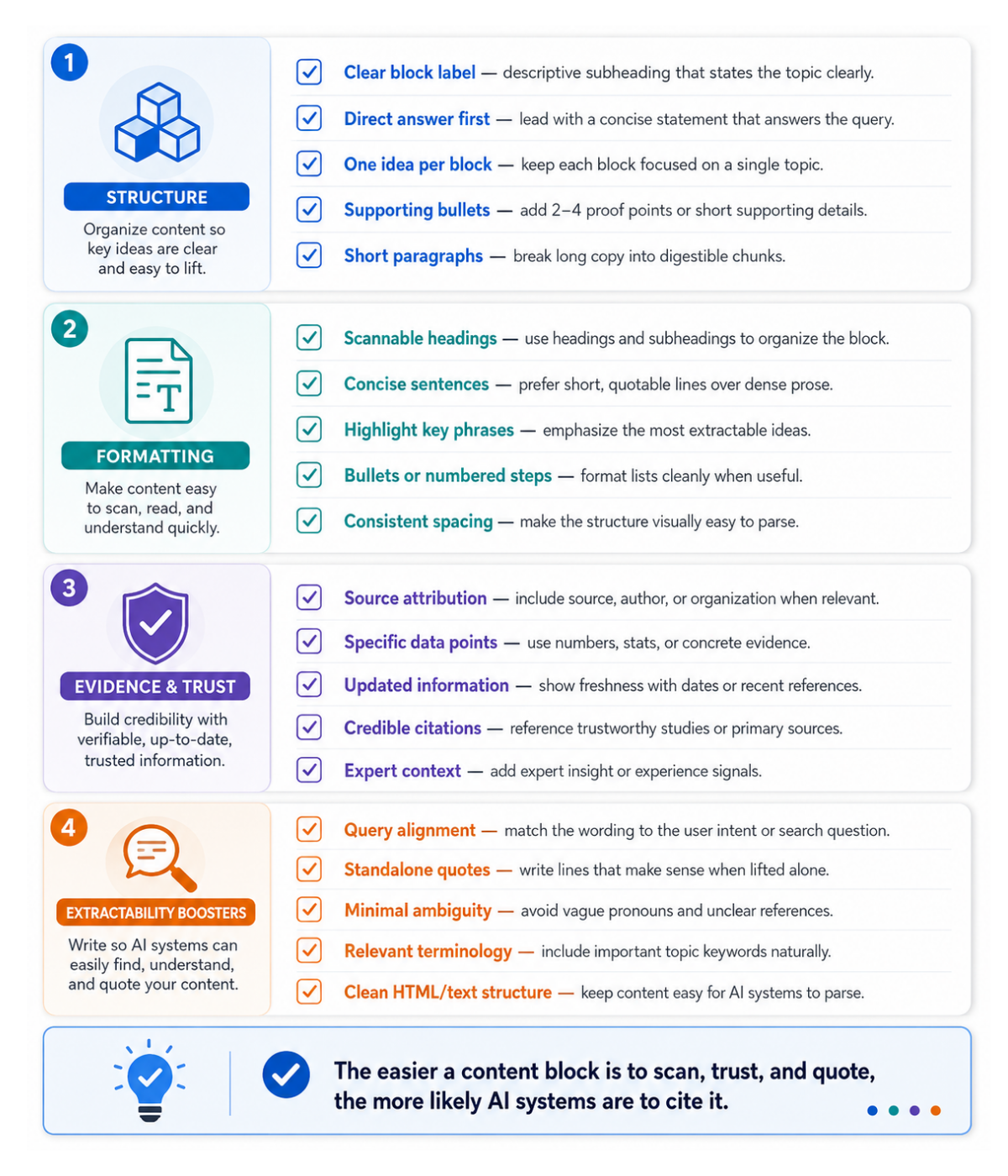
Use this 10-point checklist to evaluate the citability of any content block. Each item is pass/fail with specific criteria.
The NAV43 Extractable Block Audit:
- Word count between 40 and 60 words. Count the block. If it exceeds 60 words, split it. If it’s under 40, add supporting evidence.
- The answer appears in the first sentence. Please state the core answer to the implicit question in sentence one, not sentence three.
- Contains at least one specific data point or example. Vague claims without evidence fail. Include a percentage, dollar amount, or concrete example.
- Makes sense when read out of context. Copy the block into a blank document. Does it stand alone? If not, revise.
- Uses active voice throughout “Companies that implement this framework see results,” not “Results are seen by companies.”
- Includes the target entity/keyword naturally. The topic must be explicitly named within the block for AI attribution.
- Ends with an application or implication statement. The final sentence should answer “so what?” for the reader.
- No dependent pronouns without clear antecedents. “This” and “it” without clear referents break extraction. Name the noun.
- When formatted with an appropriate structural signal, the block should be visually distinct using a bullet, a header, or a table row.
- Updated within the past 12 months. Check the last modified date. Stale content fails recency filtering.
Why ChatGPT, Perplexity, and Google AI Overviews Cite Differently
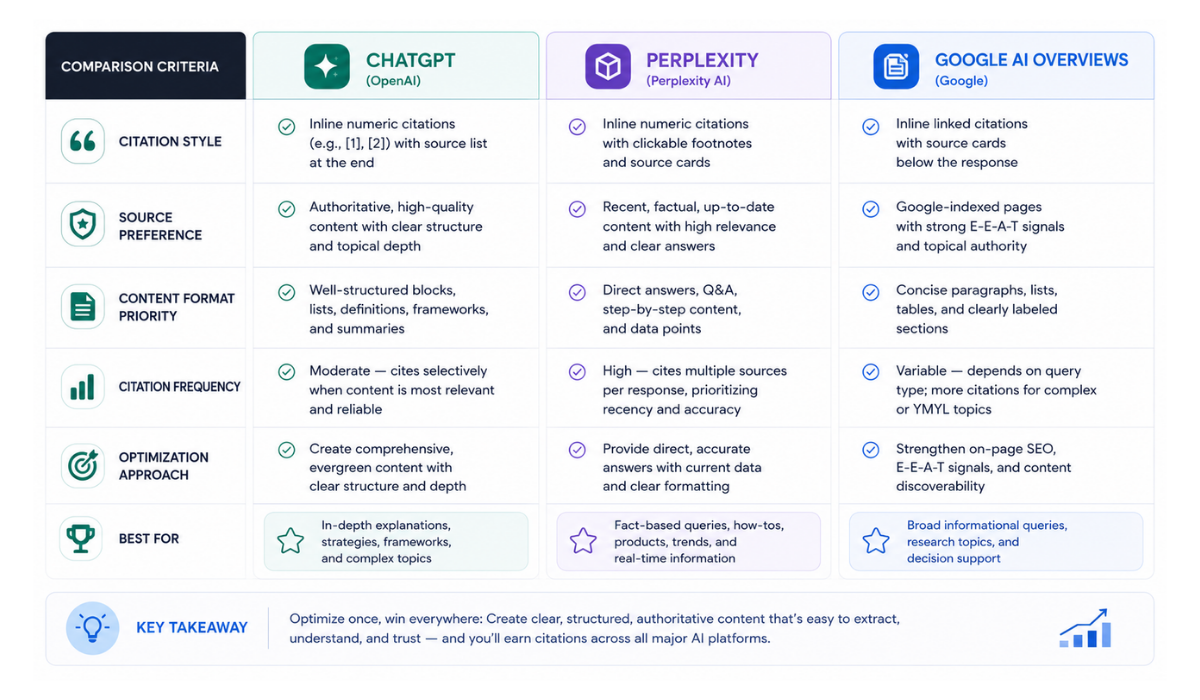
One-size-fits-all optimization doesn’t work in the AI citation landscape. Only 11% of domains are cited by both ChatGPT and Perplexity (Digital Bloom, 2025). The overlap is shockingly small, which means optimizing for “AI search” generically leaves 89% of potential citations on the table.
Each major AI platform pulls from different source indices and applies different citation patterns. Understanding these differences determines which content gets quoted where.
The strategic implication is clear: brands need platform-specific content strategies. A piece of content that dominates Perplexity citations might be invisible in ChatGPT responses. The same content optimized for Google AI Overviews follows different rules than what works for Claude or Bing Copilot.
Volume matters for prioritization. 48% of Google queries now trigger AI Overviews (Averi.ai, March 2026). That makes Google citation the highest-volume opportunity for most brands. But ChatGPT’s 300+ million weekly users and Perplexity’s rapid growth mean a multi-platform strategy delivers compounding returns.
Google AI Overviews Optimization
Google AI Overviews primarily pulls from organic top-10 results, which means traditional SEO still matters here. If you’re not ranking on page one for a query, you’re unlikely to be cited in the AI Overview for that query.
Format preferences favor structured content with clear headers, lists, and direct answers. Google’s systems are trained to identify featured snippet material, and the same formats that win featured snippets tend to get quoted in AI Overviews.
The citation pattern for Google AI Overviews often includes multiple sources, with domain-name attribution. Your brand becomes visible even in synthesized answers because Google tends to show where information originated.
Action items for Google AI Overviews:
– Optimize content for featured snippet format (question + direct answer)
– Ensure tables are mobile-responsive (Google indexes mobile-first)
– Implement FAQPage schema on Q&A content
– Maintain strong traditional SEO fundamentals since AI Overviews favor ranking pages
ChatGPT Citation Tactics
ChatGPT relies heavily on the Bing index, which makes Bing Webmaster Tools critical for visibility. If your content isn’t indexed by Bing, it’s unlikely to appear in ChatGPT responses regardless of content quality.
ChatGPT favors longer-form, authoritative content with a Wikipedia-style level of comprehensiveness. The system performs well with content that thoroughly covers a topic rather than surface-level treatment. Depth signals authority.
Citation patterns are less consistent than Google’s. ChatGPT tends toward synthesized answers with occasional source mentions rather than systematic attribution. This means your content might inform answers without always receiving explicit credit.
Action items for ChatGPT:
– Submit your site explicitly to Bing Webmaster Tools
– Build entity authority through multi-platform presence (LinkedIn, Wikipedia references, industry publications)
– Create comprehensive pillar content that covers topics exhaustively
– Ensure your site has strong topical relevance signals that establish entity authority
For deeper guidance on building AI-visible content, see our complete guide on how to create AI-ready content.
Perplexity Citation Strategy
Perplexity uses a broader web crawl that includes Reddit, LinkedIn, G2, and niche community forums. Content that appears in these community platforms has higher citation probability in Perplexity responses.
The platform favors content with explicit citations and data points. Perplexity’s systems appear to weight content that references and synthesizes other authoritative sources, creating a “citation of citations” pattern.
Attribution is more aggressive in Perplexity. The system often lists multiple sources per answer, which increases brand visibility but also means you’re competing with more sources for attention within each response.
Action items for Perplexity:
– Build presence on community platforms where your audience participates
– Include statistics with clear source attribution in your content
– Create content that references and synthesizes other industry authorities
– Monitor Perplexity responses for your key queries to understand current citation patterns
| Platform | Primary Source Index | Citation Style | Key Optimization Actions |
|---|---|---|---|
| Google AI Overviews | Google organic top 10 | Multi-source attribution | Featured snippet optimization, FAQPage schema |
| ChatGPT | Bing index | Synthesized with occasional attribution | Bing Webmaster submission, comprehensive content |
| Perplexity | Broad web + communities | Aggressive multi-source | Community platform presence, citation-rich content |
Strategic Block Placement: The 30-30-40 Rule
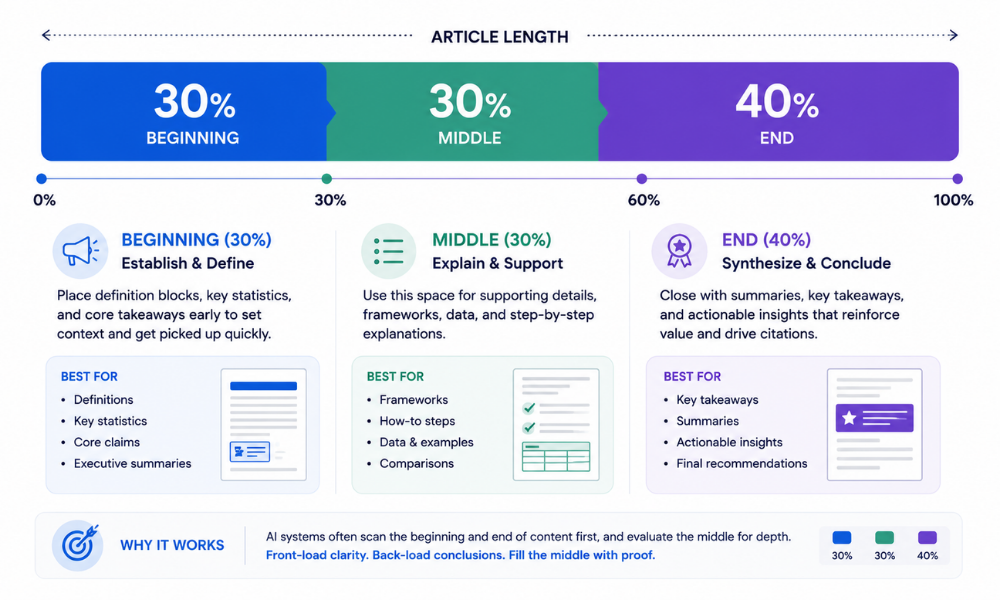
Position matters as much as format. The SparkToro data on citation distribution reveals a clear pattern: 44.2% from the first 30% of content, 31.1% from the middle, and 24.7% from the conclusion (SparkToro, 2026). Your highest-value extractable blocks should be front-loaded, not buried.
The NAV43 30-30-40 Rule:
First 30% of content: Place your highest-value extractable blocks here. These answer the primary query and contain your most quotable statistics. This section carries nearly half of all citation potential.
Middle 30% of content: Reinforce with examples, case studies, and expanded context. This section supports comprehensiveness signals and provides alternative extraction points.
Final 40% of content: Summarize with quotable conclusions and actionable next steps. Conclusion blocks have lower citation probability but still capture nearly a quarter of potential citations.
The “answer graveyard” problem kills most content’s citation potential. Marketers trained in traditional copywriting often build suspense, save the best for last, and bury key insights in the middle of long paragraphs. AI systems skip these structures entirely.
Placement strategy: Every H2 section should open with an extractable block, not build to one. The first paragraph after any heading should contain a complete, quotable answer. Subsequent paragraphs expand and support that answer.
This pattern matches the framework we detail in our GEO content strategy guide.
The Inverted Pyramid for AI Citation
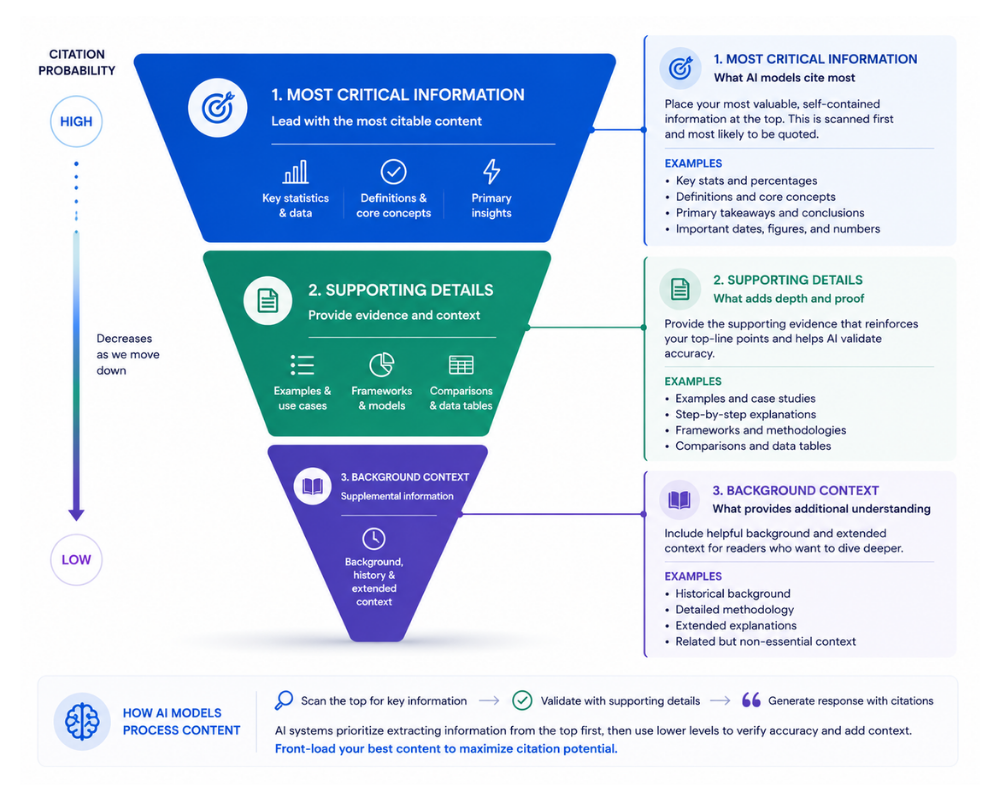
Journalism’s inverted pyramid structure adapts perfectly for AI extraction. The principle: most important information first, supporting details second, background context last.
Traditional inverted pyramid: Lead with the news (who, what, where, when, why), follow with supporting quotes and details, end with background that could be cut without losing the core story.
AI citation adaptation: Lead with the answer (the quotable extractable block), follow with evidence and examples (supporting extraction points), end with context and implications (comprehensive coverage signals).
This structure differs fundamentally from the “suspense” content structures common in B2B thought leadership. The executive summary style of starting with setup and building to insights works poorly for AI extraction because the quotable content sits where AI systems are least likely to extract from.
Headline-paragraph alignment matters: Your H2 should pose or imply a question. Your first paragraph should answer that question completely in 40-60 words. Subsequent paragraphs expand but never contradict or supersede the opening answer.
The NAV43 Inverted Pyramid: Answer → Evidence → Context → Expansion
Schema Markup for Citation Optimization
Structured data creates explicit signals that help AI systems identify extractable content. While schema markup has always supported SEO, its role in AI citation is becoming more critical as LLMs learn to interpret structured data directly.
FAQPage schema provides the clearest implementation path for citation optimization. This schema type explicitly marks content as question-answer pairs, which matches the extraction pattern AI systems use.
HowTo schema works well for process-oriented content. When your content walks through steps, this schema type signals the sequential, extractable nature of each step.
Article schema with proper author markup supports E-E-A-T signals that influence citation authority. Including datePublished and dateModified properties addresses recency signals that AI systems use for content filtering.
For comprehensive technical implementation guidance, our structured data for GEO guide covers the full schema strategy.
Structured Data Validation and Testing
Implementation without validation wastes effort. Use Google Rich Results Test to verify your schema renders correctly. The Schema.org validator catches syntax errors that might cause silent failures.
Monitoring which schema types get picked up by AI crawlers helps refine implementation over time. Track which pages with schema markup appear in AI responses versus comparable pages without markup.
Schema Implementation Priority for LLM Citation:
- FAQPage highest citation signal for Q&A content
- Article with author markup E-E-A-T authority signals
- HowTo process and tutorial content
- Speakable voice search and audio extraction (emerging importance)
Building a Citation Measurement Framework
Measurement separates professional LLM citation optimization from hopeful content creation. Yet this is where most practitioners fail. They optimize for citations without building systems to track whether citations actually occur.
GA4 setup for AI traffic identification:
AI-referred traffic appears in your analytics with specific referral patterns. Create segments for traffic from chat.openai.com, perplexity.ai, and traffic where the referrer contains “ai” or where the landing behavior suggests AI-driven intent (high engagement, direct goal completion).
Manual citation monitoring:
Query your top 50 target phrases in ChatGPT, Perplexity, and Google AI Overviews weekly. Document when your brand appears, which content gets quoted, and how the citation is attributed. This qualitative tracking reveals patterns your analytics can’t capture.
Proxy metrics for citation performance:
- Share of voice in AI answers (what percentage of relevant queries mention your brand)
- Citation frequency by platform (how often you appear in each AI system)
- Traffic quality from AI sources (conversion rate comparison between AI-referred and organic)
- Content citability score (your own assessment using the extractable block checklist)
- Recency distribution (percentage of cited content by age)
The KPI shift is real for informational content. Citation presence may matter more than click-through in the zero-click environment. 59.7% of Google searches end without a click (SparkToro, 2024). If your content is cited but doesn’t generate traffic, that’s still brand visibility and authority building.
AI-referred traffic converted 42% better than traditional traffic in March 2026 (Adobe Analytics, 2026). The visitors who do click through after the AI citation arrive with higher intent and better qualification.
Our guide to measuring AI SEO provides the complete measurement framework.
The NAV43 Citation Dashboard Template
Track these metrics weekly to maintain visibility into citation performance.
| Metric | Source | Benchmark | Action Threshold |
|---|---|---|---|
| AI traffic volume | GA4 AI segments | 3-5% of organic traffic | Below 2%: audit citability |
| Citation frequency | Manual query monitoring | 20%+ of target queries | Below 10%: content optimization needed |
| AI vs organic CVR | GA4 comparison | AI should be 2-4x higher | If equal or lower: traffic quality issue |
| Content citability score | Internal audit | 75+ average across the library | Below 60: prioritize refresh |
| Recency distribution | Content inventory | 80%+ under 12 months | Below 60%: accelerate refresh cycle |
Executive reporting should emphasize the conversion premium of AI-referred traffic. The volume may be smaller than organic search, but the revenue impact per visitor is substantially higher. Frame citation optimization as quality traffic acquisition, not vanity metric chasing.
The Content Citability Audit: Scoring Your Existing Library
Most brands have years of content that was never built for AI extraction. Before creating new content, audit your existing library to identify high-potential pages that need optimization.
The audit workflow:
- Export your full content inventory with URLs, publication dates, and traffic metrics
- Score each page using the citability rubric below
- Cross-reference citability scores with search intent data (informational queries have the highest citation potential)
- Prioritize by opportunity multiplied by effort (high traffic + low citability = immediate priority)
- Implement optimizations in batches, starting with the highest-opportunity content
Focus optimization efforts on content that answers specific questions and targets informational intent. Product pages and transactional content have lower citation potential than educational and how-to content.
This audit process aligns with the broader content optimization framework we cover in turning existing blog content into AI-citable assets.
The NAV43 Citability Scoring Rubric
Score each page on a 100-point scale using these five categories.
Structure (25 points)
– Clear heading hierarchy with question-format H2s (10 pts)
– Scannable sections under 400 words each (5 pts)
– Bulleted or numbered lists where appropriate (5 pts)
– Table formatting for comparative data (5 pts)
Extractable Blocks (25 points)
– Opening paragraph of each section is 40-60 words (10 pts)
– Answer appears in first sentence of each section (10 pts)
– Blocks are independently meaningful without context (5 pts)
Evidence Quality (20 points)
– Statistics with cited sources (10 pts)
– Specific examples or case studies (5 pts)
– Expert quotes or authoritative references (5 pts)
Recency (15 points)
– Published or significantly updated within 6 months (15 pts)
– Updated within 12 months (10 pts)
– Updated within 18 months (5 pts)
– Older than 18 months (0 pts)
Technical Signals (15 points)
– FAQPage or HowTo schema implemented (5 pts)
– Article schema with author markup (5 pts)
– Mobile-responsive formatting (5 pts)
Scoring thresholds:
– Below 50: Full content rewrite required
– 50-75: Optimization needed to implement extractable blocks and refresh evidence
– 75+: Minor updates only maintain recency and monitor performance
7 Mistakes That Kill Your Content’s Citability
Even marketers who understand LLM citation optimization fall into predictable traps. Avoid these seven patterns that prevent AI systems from quoting your content.
1. Burying the answer
Opening with context instead of the answer kills the extraction probability. AI systems scan first sentences. When your answer appears in sentence four after three sentences of setup, it won’t get quoted. Lead with the answer, then provide context.
2. Writing for word count, not extractability
Long paragraphs (100+ words) with multiple ideas reduce the probability of extraction. AI systems quote blocks, not paragraphs. When you pack three ideas into one paragraph, none of them is quotable. One idea per block. Split ruthlessly.
3. Ignoring platform differences
Optimizing for “AI” generically instead of understanding that ChatGPT, Perplexity, and Google AI Overviews have different source preferences and citation patterns. Build platform-specific strategies based on where your audience asks questions.
4. Neglecting recency signals
Publishing content once and never updating it. 65% of AI citations target content under one year old. If your best content is two years old, it’s being filtered out of consideration regardless of quality.
5. Using dependent language
Pronouns without clear antecedents break extraction. “This approach works because it addresses…” When quoted alone, what is “this”? What is “it”? Name the noun. “Content clustering works because topic clustering addresses…” is extractable.
6. Skipping the evidence
Making claims without statistics or examples. AI systems favor content that includes verifiable data. “Content marketing works” is not extractable. “Content marketing generates 3x more leads than paid search at 62% lower cost” is quotable.
7. Formatting as an afterthought
Treating tables, bullets, and schema markup as cosmetic choices rather than citation signals. Pages with tables are cited 4.2x more often. That’s not a design preference. That’s a citation multiplier you’re leaving unused.
Common Pitfalls in LLM Citation Optimization
Beyond the seven mistakes above, watch for these structural problems that undermine citation strategies.
Over-optimizing for a single platform: Brands that focus exclusively on ChatGPT miss Perplexity’s growing user base and Google AI Overviews’ volume. Diversify your citation strategy.
Treating citation optimization as a one-time project: AI systems evolve. Source preferences change. Query patterns shift. Citation optimization requires ongoing measurement and adjustment, not a single optimization pass.
Confusing citation with traffic: Citation presence and traffic are related but not identical. In the zero-click environment, citations build brand authority even when they don’t generate immediate clicks. Measure both.
Ignoring entity authority: Brand search volume correlates more strongly with citations than with traditional backlinks. If no one searches for your brand name, your content will have lower authority signals, regardless of quality. Build entity recognition through multi-platform presence.
Conclusion: Key Takeaways
LLM citation optimization represents a fundamental shift in how content generates business value. The marketers who master extractable content blocks will capture the 4.4x conversion premium that AI-referred traffic delivers.
Key takeaways:
- Engineer 40-60 word extractable blocks that answer questions completely in the first sentence with supporting evidence and contextual application
- Front-load your best content since 44.2% of citations come from the first 30% of text
- Optimize for platforms specifically because only 11% of domains are cited by both ChatGPT and Perplexity
- Implement structural signals including tables (4.2x citation lift), Q&A formatting (40% more likely to be cited), and FAQPage schema
- Measure citation performance through AI traffic segments, manual query monitoring, and conversion rate comparisons
- Audit existing content using the citability scoring rubric to prioritize optimization efforts
Next Steps
Start with an audit of your highest-traffic informational content. Score each page using the citability rubric. Identify the five pages with the highest gap between current traffic and citability score. These are your immediate optimization priorities.
Transform the first paragraph of each H2 section into an extractable block. Apply the 40-60 word rule. Lead with the answer. Add a statistic. Close with application.
Set up AI traffic tracking in GA4 before your optimizations go live. You need baseline data to measure the impact of your citation optimization work.
The brands implementing these frameworks today are building compounding advantages in AI visibility. Every citation reinforces your authority. Every mention trains AI systems to associate your brand with expertise in your category.
Ready to identify your biggest LLM citation optimization opportunities? Get a free Growth Plan from NAV43. We’ll audit your content’s citability, identify platform-specific gaps, and deliver a prioritized action plan for capturing AI traffic that converts at 4.4x the rate of traditional organic.
The shift from ranking to citation is happening now. The only question is whether your content will be quoted or invisible.
