How to Turn Existing Blog Content into AI-Citable Assets
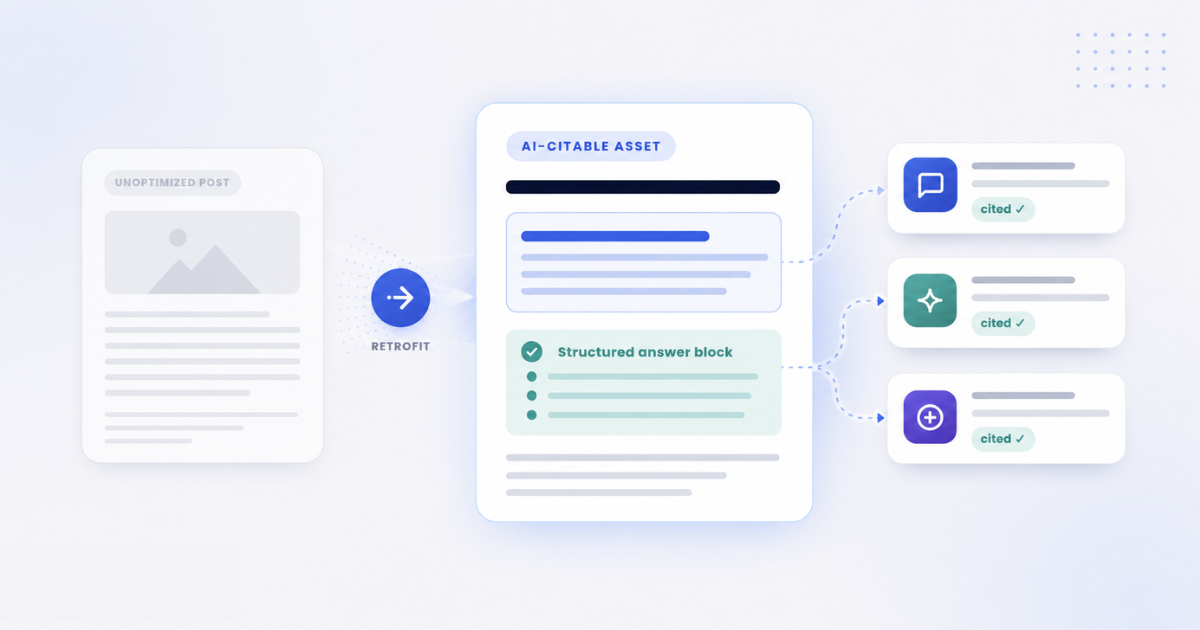
Most brands are sitting in a content graveyard. Hundreds of blog posts, buried deep in archives, are completely invisible to the AI systems now shaping how buyers discover solutions. I was reviewing a B2B client’s content library last week, 340 published articles, solid traffic, decent rankings, and discovered a brutal truth: ChatGPT cited exactly zero of them when asked about their core product category.
The content wasn’t bad. It was structured incorrectly.
Here’s a stat that should reframe how you think about your existing content: ChatGPT cites only 15% of the pages it retrieves; 85% are retrieved but never quoted (Seer Interactive, 2026). Your articles might be getting pulled into AI systems’ context windows, but they’re not making the cut for citation. Even more telling: 44.2% of all LLM citations come from the first 30% of text (Growth Memo, 2026). Most existing content buries the good stuff in paragraph 17, exactly where AI systems stop looking.
The opportunity here isn’t about creating more content. It’s about transforming what you already have. AI-referred sessions jumped 527% year-over-year in the first five months of 2025 (Previsible, 2025). That traffic is going somewhere, and right now, it’s probably not going to you.
This article covers the exact framework we use at NAV43 to audit existing content for AI citation potential, restructure it for extraction, and measure the results. You’ll walk away with a scoring matrix, a transformation playbook, and a measurement cadence you can implement this quarter.
Why Your Existing Content Isn’t Getting Cited by AI
The Citation Gap Problem
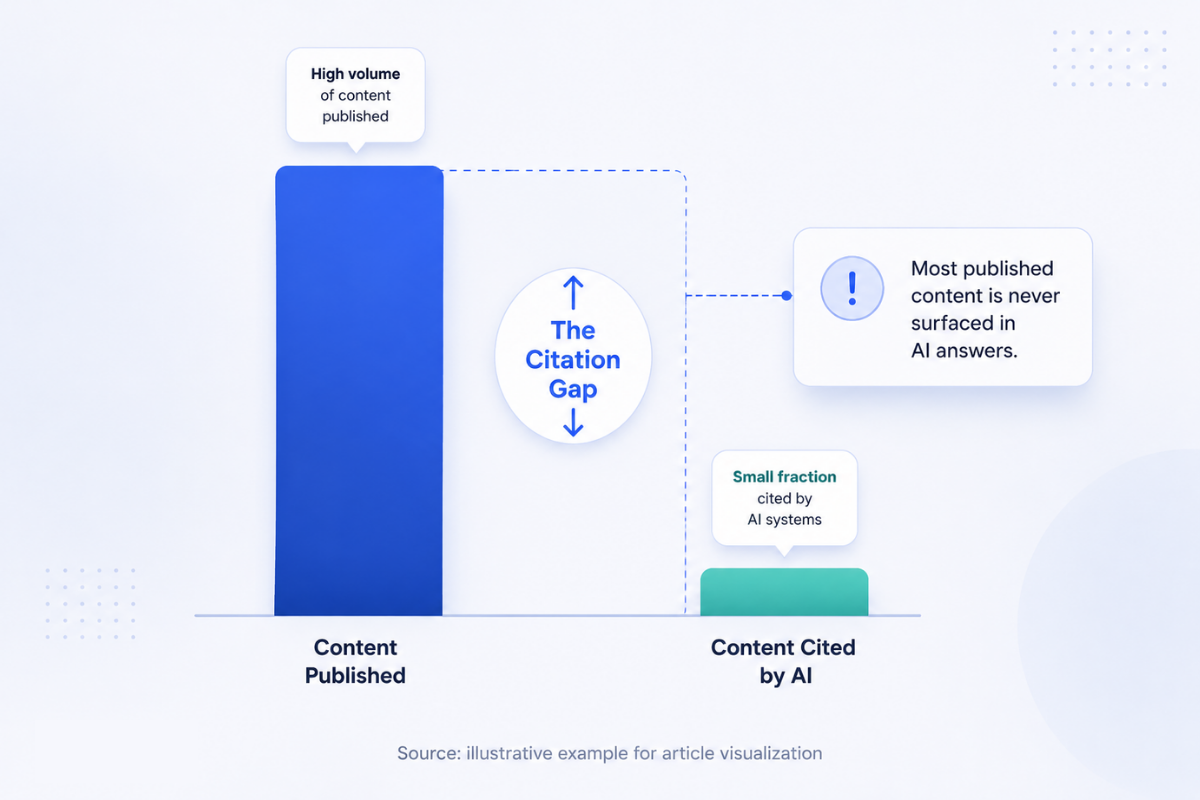
Here’s the uncomfortable reality: most existing blog content was optimized for a different game entirely. The 2019 SEO playbook focused on click-through: write compelling titles, nail the meta description, and get users to your page. Once they landed, you could take your time building to the payoff.
AI systems don’t work that way. They extract, synthesize, and cite, often without sending a single visitor to your site.
93% of searches in Google’s AI Mode end without a click (Industry research, 2025). The game has fundamentally changed. AI Overviews now appear in over 60% of all searches, up from 25% in mid-2024 (Ahrefs, 2025). Your content isn’t competing for position one anymore. It’s competing to be the source AI systems quote when users never see a search results page at all.
Traditional SEO content follows a narrative arc: hook, context, exploration, conclusion. AI systems don’t read narratives. They scan for extractable statements, clear factual claims, and quotable answers. If your best insight lives in the middle of a 2,500-word post, surrounded by setup and context, it might as well not exist.
What AI Systems Actually Want
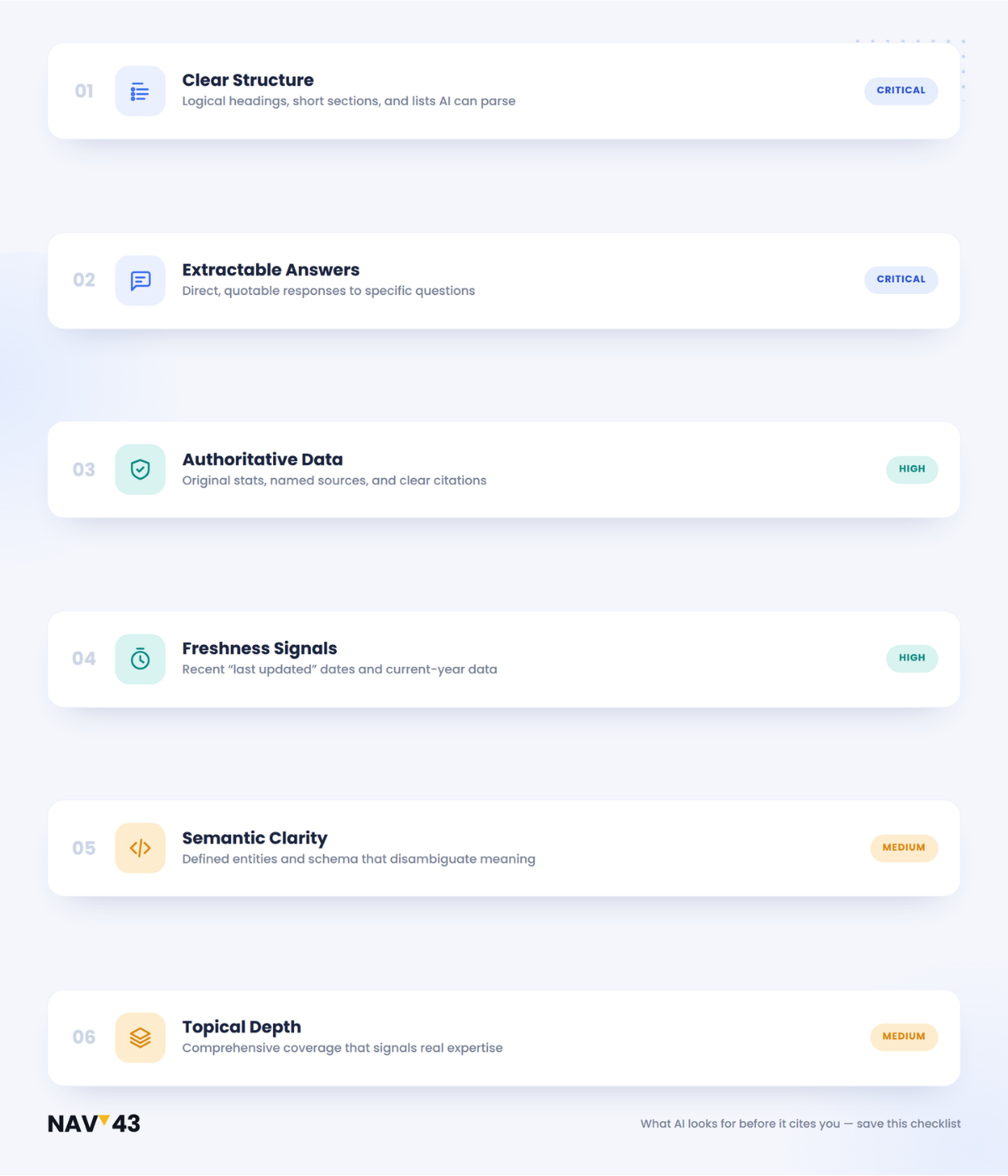
The signals that drive AI citations look nothing like traditional ranking factors. Content updated within the past 3 months is twice as likely to be cited by ChatGPT as older, outdated pages (SE Ranking, 2025). Freshness isn’t a nice-to-have. It’s table stakes.
The recency bias is stark: 85% of AI Overview citations were published in the last two years, with 44% from 2025 alone (Seer Interactive, 2025). That 2021 pillar post you’re so proud of? AI systems are actively deprioritizing it in favor of newer competitors.
Beyond freshness, AI systems prioritize:
- Factual density: specific numbers, data points, and verifiable claims
- Clear structure: hierarchical headings that signal topic boundaries
- Quotable statements: self-contained sentences that make sense out of context
- Schema markup: structured data that helps AI understand content relationships
Here’s what surprised us most in our research: brand mentions correlate with AI citation probability at 0.664, compared with just 0.218 for backlinks (Ahrefs, 2025). The old model was about link authority. The new model is about being named, quoted, and recognized as a source.
The AI Citation Reality Check
Your content isn’t competing for clicks anymore. It’s competing to be the source AI systems quote. If your best insights are buried in paragraph 17, they don’t exist to AI.
The AI Content Citability Audit: Finding Your Hidden Assets
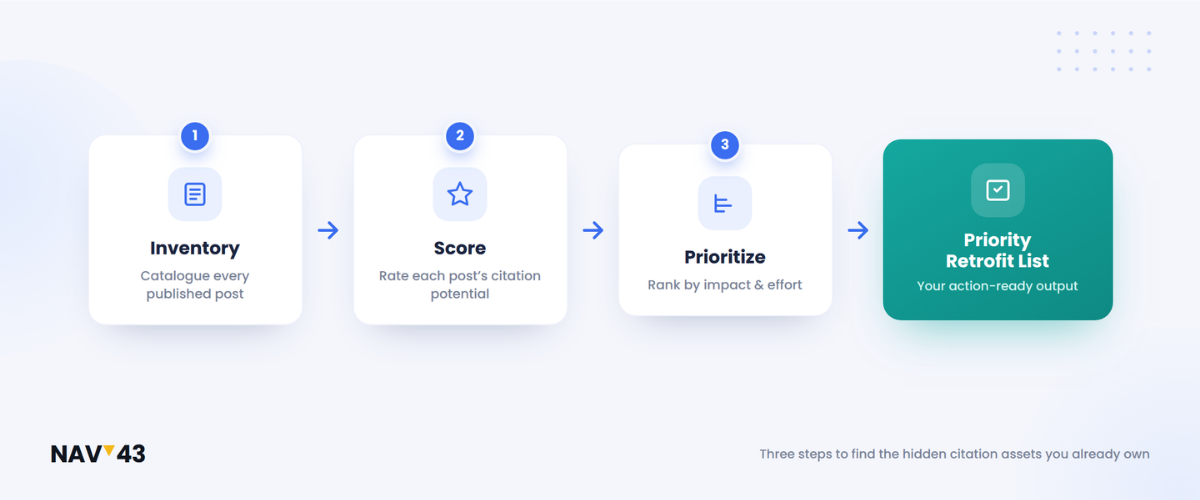
Before you start restructuring content, you need to know what you’re working with. This isn’t about gut feel. It’s about systematically identifying which posts have the highest potential to become AI-citable assets.
Step 1: Inventory Your Existing Content Library
Start with a complete export of your blog inventory. You need visibility into URL and title, publish date and last updated date, word count, topic and category, current organic traffic from your analytics platform, and conversion contribution if tracked.
Group posts into content clusters around your core expertise areas. If you’re a SaaS company, you might have clusters around implementation, integration, pricing models, and use cases. If you’re B2B services, cluster by service line, industry vertical, and buyer journey stage.
Flag everything older than 12 months as a priority candidate for transformation. That content is approaching the danger zone for AI citation relevance.
Step 2: Score Each Post for Citation Potential
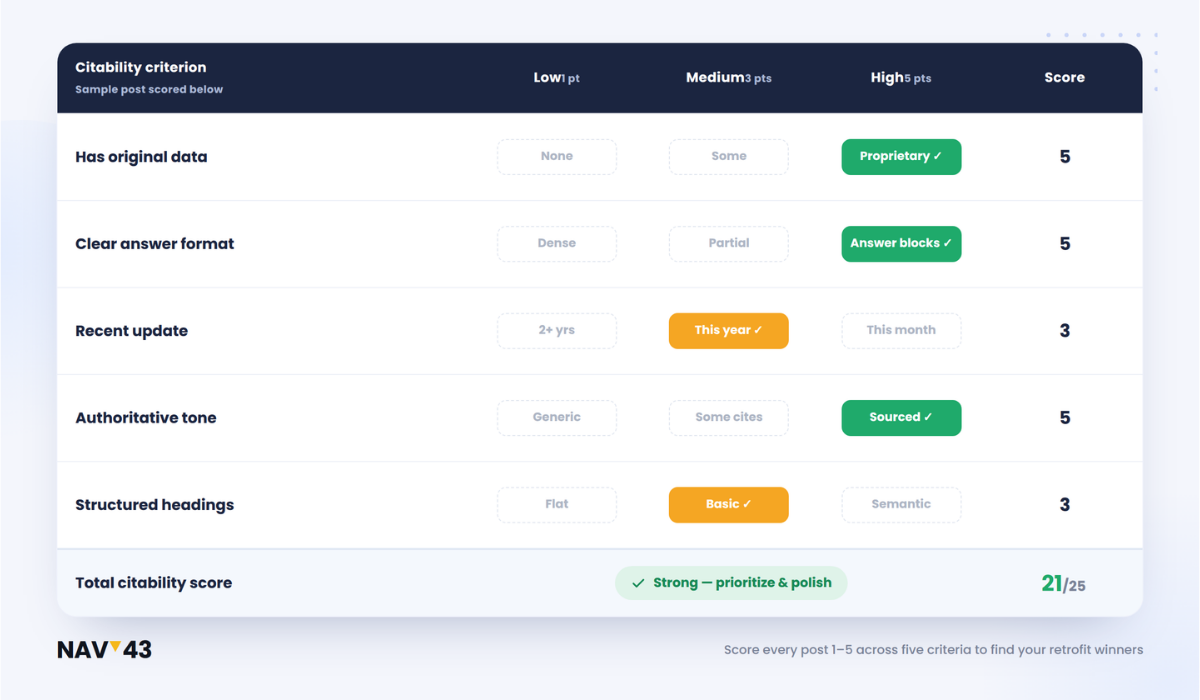
We developed the NAV43 Citation Potential Scoring Framework to systematically evaluate content for AI citability. Score each post across five factors:
| Factor | High Score (3) | Medium Score (2) | Low Score (1) |
|---|---|---|---|
| Freshness | Updated within 3 months | Updated 3-12 months ago | Updated over 12 months ago |
| Factual Density | 5+ stats/data points | 2-4 stats/data points | 0-1 stats/data points |
| Structure | Clear H2/H3 hierarchy, summary boxes | Some structure | Wall of text |
| Quotable Statements | Multiple clear, extractable claims | Some extractable content | No clear takeaways |
| Schema Markup | Full implementation | Partial implementation | None |
Total possible score: 15 points
- Posts scoring 12+: Citation-ready with minor updates
- Posts scoring 8-11: High potential, needs restructuring
- Posts scoring below 8: Archive or consolidate candidates
Step 3: Prioritize by Strategic Value
Raw citation potential isn’t enough. Cross-reference your citation potential score with current organic traffic (high-traffic posts have existing authority signals), conversion contribution (posts driving leads or sales deserve priority), strategic topic importance (does this post support your core service positioning?), and competitive landscape (are competitors getting cited for this topic?).
One of our B2B clients had 340 blog posts. After running this audit, we identified 28 high-potential posts that generated 60% of their organic conversions but had citation scores below 8. Those 28 posts became the transformation priority, not the entire library.
Identify your “top 20” posts for immediate transformation. Prove ROI at scale before expanding the program. For detailed guidance on building content that AI systems prioritize, see our complete guide to AI-ready content.
The Content Transformation Playbook: 5 Retrofits That Drive AI Citations
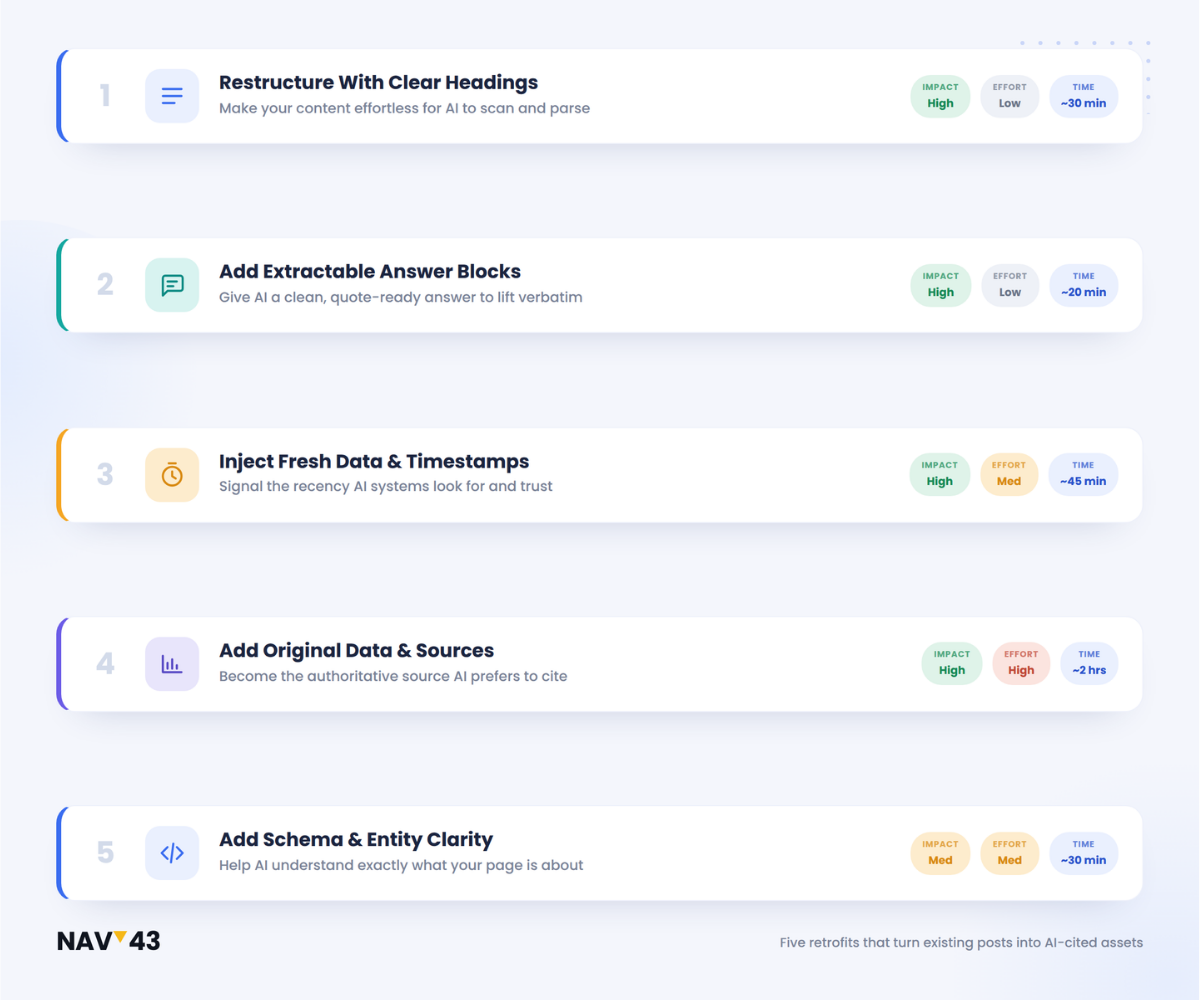
Once you’ve identified your priority posts, it’s time to transform them. These five retrofits are the specific changes that move content from “retrieved but ignored” to “cited and attributed.”
Retrofit 1: Front-Load Your Best Insights
Remember that 44.2% stat? The first 30% of your text is where AI systems do most of their citation shopping (Growth Memo, 2026). Your most valuable, quotable statements need to live in the opening paragraphs, not the conclusion.
This is the inverted pyramid for the AI era. State the answer first, then explain it.
Before: “After extensive research across multiple client engagements and industry benchmarks, we’ve found that content freshness plays a significant role in AI citation behavior…”
After: “Content updated within 3 months is 2x more likely to be cited by ChatGPT (SE Ranking, 2025). Here’s why freshness matters more than ever for AI visibility…”
Add a “TL;DR” or “Key Takeaways” box immediately after your introduction. This isn’t just for human readers. It’s a concentrated zone of quotable statements that AI systems can extract directly. Learn more about structuring content for AI extraction in our GEO content strategy guide.
Retrofit 2: Add Extractable Answer Blocks
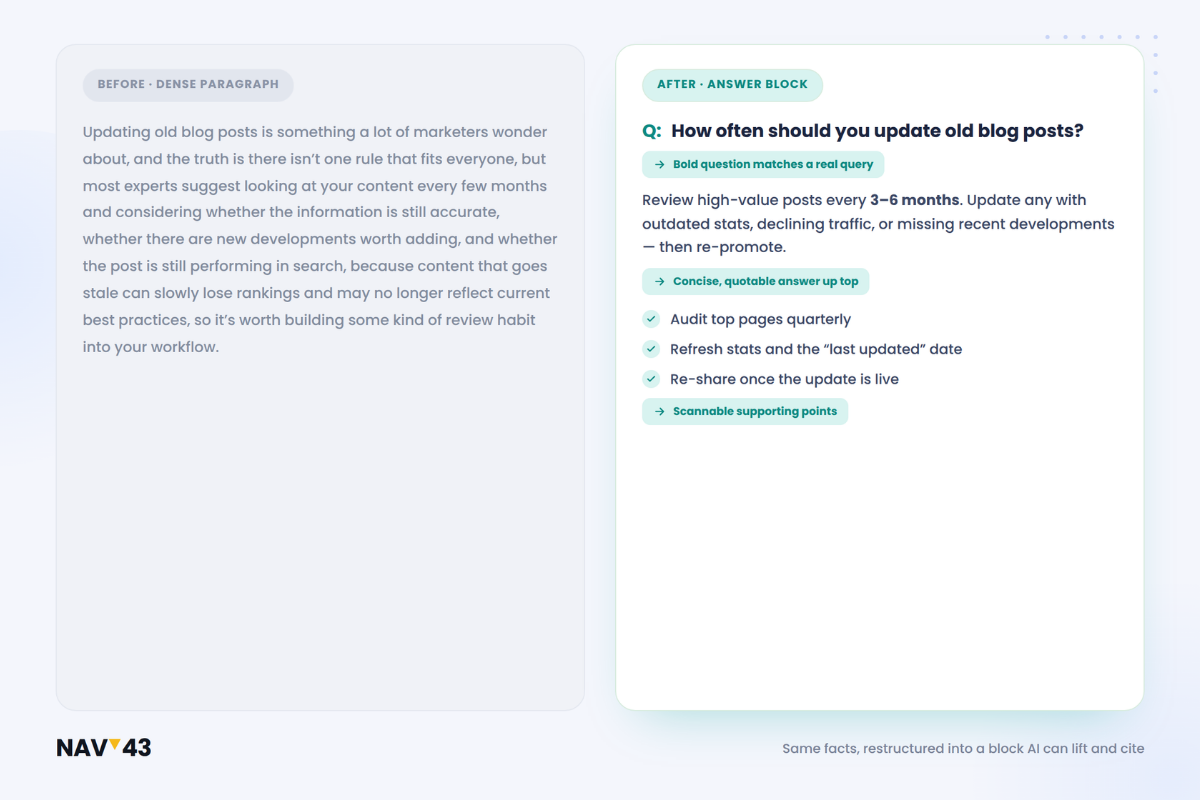
AI systems cite self-contained statements that make sense without surrounding context. Your job is to create these extraction points throughout every post.
Adding statistics can increase AI visibility by 22%, while using quotations can boost it by 37% (Digital Bloom/Princeton GEO Research, 2025). But the statistics and quotations need to be formatted for extraction.
Use bold text, summary boxes, or dedicated “The Bottom Line” sections. Each H2 section should contain at least one 2-3 sentence answer that AI can quote directly.
The Answer Block Formula:
[Clear Question as H3]
[2-3 sentence direct answer with specific data]
[One sentence of context or implication]
Example:
How often should you update content for AI citation?
Content updated within the past 3 months is twice as likely to be cited by ChatGPT compared to older pages. This means quarterly content refreshes are the minimum standard for posts you want AI systems to recognize. Set calendar reminders now: your citation probability depends on it.
Retrofit 3: Inject Fresh Data and Update Timestamps
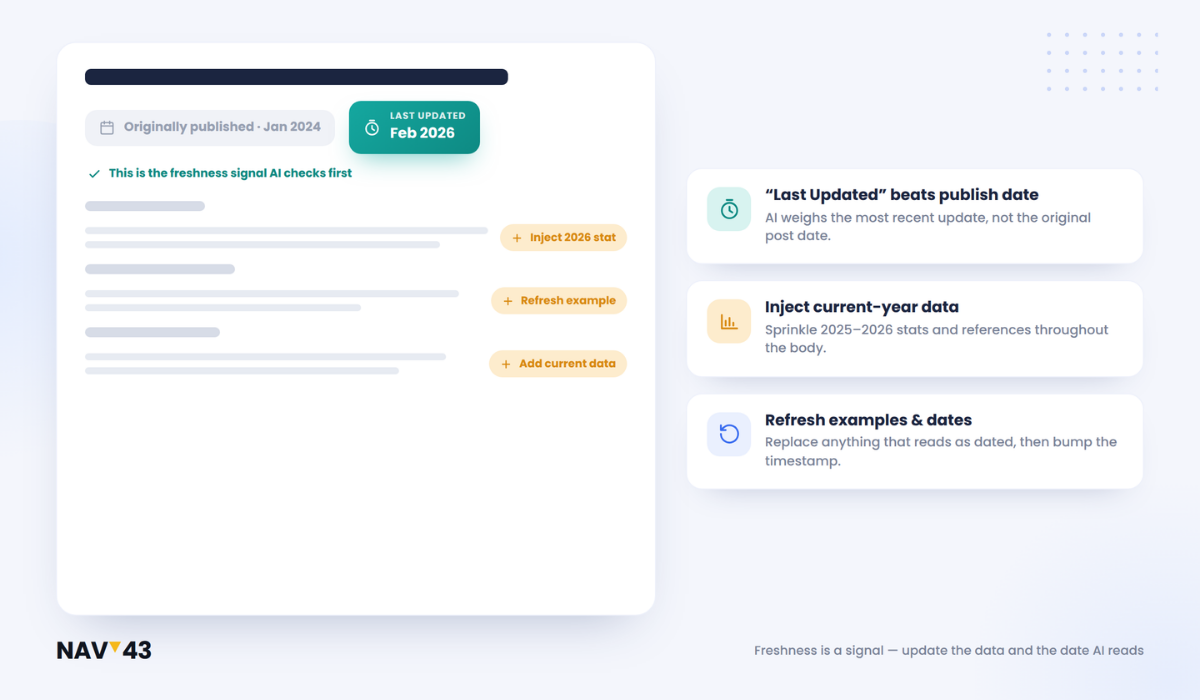
The freshness signal is one of the most powerful levers you have. Content updated within the past 3 months is 2x more likely to be cited (SE Ranking, 2025), and implementing this retrofit is straightforward.
For each priority post, replace outdated statistics with 2024-2026 data sources, add “Last Updated: [Date]” prominently at the top of the article, update your schema markup to reflect the new modification date, and add at least 20% new material to trigger re-evaluation by search engines.
Even adding a new section, updating examples, or incorporating recent industry developments counts as substantive fresh content. The goal is to demonstrate that the post reflects current reality, not historical snapshots.
Set a quarterly review cadence for your top 20 posts. Put it in your marketing calendar. Freshness compounds: posts you update consistently build citation momentum over time.
Retrofit 4: Implement Structured Data Markup
Here’s the retrofit most teams skip, and it’s costing them dearly. Content with proper schema markup shows 30-40% higher visibility in AI-generated answers (Dataslayer, 2025). That’s not a marginal improvement. That’s the difference between being cited and being ignored.
Priority schema types for blog content:
- Article/BlogPosting: basic content type signals
- FAQPage: for any Q&A content within posts
- HowTo: for step-by-step guides and processes
- Organization: establishes publisher credibility
- Author/Person: critical for E-E-A-T signals
Ensure your author schema includes expertise signals. AI systems are looking for evidence that the person behind the content has relevant credentials. This isn’t vanity. It’s verification. For a comprehensive walkthrough of structured data implementation, see our GEO structured data guide.
Retrofit 5: Go Multimodal
Text-only content is leaving citation potential on the table. Pages combining text, images, video, and structured data see 156% higher selection rates for AI citations (Wellows/AI Mode Boost, 2025).
For each priority post, add relevant images with descriptive alt text (AI systems read alt text; make it count), embedded or linked video content where applicable, data tables and charts (AI systems extract from structured visual data), and infographics summarizing key points that create additional extraction opportunities.
You don’t need to produce Hollywood-quality video. A simple screen recording walking through a framework, or a data visualization created in Canva, adds multimodal signals that differentiate your content from text-only competitors.
The 5-Retrofit Quick Reference Checklist
- Key insights appear in first 30% of content
- At least one answer block per major section
- All statistics updated to 2024-2026 sources
- “Last Updated” date visible and accurate
- Article, Author, and FAQ schema implemented
- At least one image, table, or visual per 500 words
Amplifying AI Visibility Through Distribution
Transforming your owned content is necessary but not sufficient. Here’s a finding that changed how we approach AI visibility for clients: distributing content to a wide range of publications can increase AI citations by up to 325% compared to only publishing on your own site (Stacker, 2025).
The Third-Party Citation Advantage
The data is even more striking when you look at source attribution: brands are 6.5x more likely to be cited through third-party sources than their own domains (Stacker, 2025). AI systems appear to weigh third-party validation heavily. If an industry publication quotes you, that carries more citation weight than the same statement on your own blog.
This shifts the emphasis from owned media to earned media for AI visibility. Your content transformation work creates the raw material; distribution amplifies its reach into the sources AI systems trust most.
Distribution Strategies for Existing Content
Once you’ve transformed a post, extend its reach:
- Repurpose into guest articles for industry publications. Take your key frameworks and data points and pitch them as contributed content to relevant trade media.
- Extract insights as LinkedIn articles or posts with links back to the original. The professional context adds credibility signals.
- Pitch data points to journalists covering your space. If your post contains original research or unique benchmarks, that’s newsworthy.
- Syndicate to platforms like Medium, industry newsletters, or partner blogs. Each syndication creates another potential citation source.
We helped a SaaS client repurpose three pillar posts into six guest articles. Within 90 days, their brand was cited in ChatGPT responses for their core product category, up from zero previous mentions. The content existed before; the distribution made it visible.
Brand Mention Strategy
Given the correlation between brand mentions and AI citation probability (0.664 versus 0.218 for backlinks), your distribution strategy should prioritize getting named and quoted, not just linked.
The new link building isn’t about anchor text and domain authority. It’s about being recognized as an authoritative voice in your space. Every guest article, podcast appearance, and industry comment that mentions your brand by name contributes to AI citation probability.
For a deeper dive into measuring brand visibility across AI platforms, see our guide to measuring brand visibility in ChatGPT and Perplexity.
Answering the Hard Questions About AI and Citations
Let’s address the questions that come up in nearly every client conversation about AI-citable content.
Can AI-Generated Content Be Cited by AI Systems?
Yes, AI-generated content can absolutely be cited by AI systems. LLMs don’t discriminate based on authorship origin. They evaluate content quality, structure, and factual density.
However, here’s what we’ve observed: pure AI-generated content without human oversight rarely gets cited. Why? It typically lacks the factual density, original data points, and E-E-A-T signals that drive citations. AI-generated content tends toward general summaries; AI systems looking for citations want specific, authoritative claims.
The differentiator is quality and structure, not origin. Human-edited, fact-checked, AI-assisted content performs well. Content that’s obviously templated, generic, or lacking in original insight, regardless of who or what wrote it, gets passed over.
Our AI content creation workflows guide covers how to balance AI efficiency with the quality signals that drive citations.
What is the “30% Rule” in AI?
This term causes confusion because it has multiple meanings in different contexts. There is no single “30% rule” that governs AI content or citations.
Common interpretations include an AI assistance ratio where some practitioners suggest AI should handle roughly 30% of content work with humans doing 70%, academic guidelines where some institutions suggest no more than 30% of submitted work should come from AI, and the content positioning stat from Growth Memo (2026) showing that 44.2% of citations come from the first 30% of text, which is sometimes misquoted as a “30% rule.”
There is no formal threshold stating “30% AI content is acceptable” from a search or citation perspective. Google’s guidance focuses on helpfulness and quality, not authorship origin. AI systems citing content focus on extractability and authority, not production method.
NAV43’s position: use AI as a tool, but ensure human expertise, editing, and fact-checking drive the final output. The goal is quality content that serves users and attracts citations. How you produce it matters less than what you produce.
Is AI Itself a Citable Source?
Major style guides, including APA and MLA, now have guidance on citing AI tools as sources. However, best practice is nuanced.
AI-generated answers should not be cited as primary sources. ChatGPT and similar tools synthesize information from other sources. They’re aggregators, not originators. Citing “ChatGPT said X” is like citing “Wikipedia said X”: it’s not where the information originated.
Best practice: use AI to find information and identify sources, then cite the original source the AI referenced. For academic or professional content, always verify AI claims against primary sources before including them.
If you must cite an AI interaction specifically (for example, documenting how an AI responded to a particular prompt), follow the APA guidelines for generative AI references, which require noting the AI tool, version, and date of interaction.
Common Pitfalls When Transforming Content for AI Citability
After running this process with dozens of clients, these are the mistakes that most commonly derail transformation initiatives.
Pitfall 1: Surface-level updates only. Changing the “Last Updated” date without adding substantive new content doesn’t fool AI systems. They evaluate actual content freshness, not just metadata. If you update the date but leave the 2022 statistics intact, you’re signaling freshness without delivering it.
Pitfall 2: Over-optimizing for one AI platform. ChatGPT, Perplexity, and Google AI Overviews have different citation behaviors. Chasing platform-specific tricks creates fragile optimization. Instead, optimize for principles: structure, freshness, factual density, and quotability work across all systems.
Pitfall 3: Ignoring schema markup. This is the most overlooked retrofit. A 30-40% visibility improvement is significant (Dataslayer/Industry Research, 2025), and implementation is relatively straightforward for most content management systems. Yet teams consistently deprioritize it because it feels technical. Don’t leave this on the table.
Pitfall 4: Burying the transformation in a backlog. US enterprises dedicated an average of 12% of their digital marketing budgets to generative engine optimization in 2025, with 94% planning to increase spending in 2026 (eMarketer, 2025). Your competitors are investing now. Waiting means falling further behind as the citation gap widens.
Pitfall 5: Measuring only traffic. AI citations may not drive clicks. 93% of AI Mode searches end without one. If you’re only tracking sessions, you’re missing the impact. You need to track brand mentions, citation appearances, and assisted conversions, not just direct traffic.
Pitfall 6: Transforming everything at once. Start with your top 20 posts by citation potential and strategic value. Prove ROI before scaling. Trying to retrofit 200 posts simultaneously leads to shallow updates that don’t move the needle.
Measuring AI Citation Performance
Transformation without measurement is guesswork. Here’s how to track whether your retrofits are actually driving AI citation improvements.
Metrics That Matter
Citation appearances: Track how often your brand or content appears in AI-generated answers. This requires manual sampling or specialized tools. Query your target phrases in ChatGPT, Perplexity, and Google AI Overviews, and document whether you’re cited, who else is cited, and the nature of the citation.
Brand mention growth: Monitor mentions of your brand across the web using tools like Mention, Brand24, or Google Alerts. AI citation probability correlates with brand mention frequency.
AI-referred traffic: Segment your analytics to identify sessions originating from AI platforms. ChatGPT, Perplexity, and similar tools generate identifiable referral traffic. AI-referred sessions jumped 527% year-over-year in early 2025 (Previsible, 2025). This traffic source is measurable and growing.
Share of voice in AI responses: For your core topic areas, what percentage of AI citations include your brand versus competitors? This is the AI equivalent of share-of-voice metrics.
Building a Measurement Cadence
Weekly: Sample 10-15 key queries in ChatGPT, Perplexity, and Google AI Overviews. Document citation presence, citation competitors, and any changes from prior weeks. This manual sampling takes 30-45 minutes and provides ground-truth data.
Monthly: Review AI-referred traffic trends in analytics. Compare month-over-month growth. Identify which transformed posts are generating AI referrals.
Quarterly: Re-audit your top 20 posts for citation potential score changes. Have your retrofits improved scores? Which factors show the most improvement?
Annually: Full content library re-audit and strategic prioritization. Identify the next cohort of posts for transformation based on updated traffic, conversion, and competitive data.
For a comprehensive framework for measuring AI visibility, see our guide to measuring AI SEO.
Conclusion and Next Steps
The shift is already here. By 2026, over one-third of web content will be created specifically for GenAI-powered search (Gartner, 2025). The brands that retrofit their existing content today will compound authority while competitors are still figuring out where to start.
Key takeaways:
- Your existing content library is an untapped asset. The content isn’t bad. It’s structured for a different era. Transformation, not creation, is the highest-ROI play.
- AI citation potential is measurable. Use the Citation Potential Scoring Framework to identify your top 20 posts. Don’t transform blindly. Transform strategically.
- Front-loading insights is the highest-impact retrofit. 44.2% of citations come from the first 30% of text (Growth Memo, 2026). Move your best content forward.
- Freshness and schema are non-negotiable. Content updated within 3 months is 2x more likely to be cited (SE Ranking, 2025). Schema markup drives 30-40% higher AI visibility (Dataslayer/Industry Research, 2025). These aren’t optional.
- Distribution amplifies everything. Third-party citations drive 6.5x higher brand citation probability. Transform your content, then extend its reach.
The measurement framework matters. Set up weekly citation sampling, monthly traffic reviews, and quarterly re-audits. What gets measured gets improved.
Your 5 Next Steps
- Export your full blog inventory this week
- Score your top 50 posts using the Citation Potential Matrix
- Identify your top 20 transformation priorities
- Apply the 5 retrofits to your first 5 posts within 30 days
- Set up AI citation tracking and measure for 90 days
Ready to transform your content library into AI-citable assets? NAV43’s GEO Content Audit identifies your highest-potential posts and delivers a prioritized transformation roadmap. Get your free AI visibility assessment.
The window for early-mover advantage is closing. Start this week.
