Ultimate Guide to Google Ads PPC Management
Last updated: May 2026
TL;DR: Google PPC advertising delivers an average $2 return for every $1 spent, with top-performing campaigns achieving 8:1 ROAS. This guide covers the complete Google Ads ecosystem – Search, Display, YouTube, Shopping, Performance Max, AI Max, and Demand Gen – plus NAV43’s proven 9-step optimization process that has helped clients achieve 10x ROAS improvements while reducing wasted spend by up to 40%.
What Is Google PPC Advertising and Why Does It Matter?
Google PPC advertising is a pay-per-click model where businesses bid on keywords to display ads across Google’s network – including Search, Display, YouTube, Shopping, and Discovery placements. Advertisers only pay when users click their ads, making it one of the most measurable and controllable forms of digital marketing available today.
Here’s a statistic that should grab your attention: 93% of marketers consider PPC an effective channel, and businesses earn approximately $2 in revenue for every $1 spent on Google Ads, with top campaigns seeing 8:1 returns (Google Economic Impact Report, 2023). As someone who has managed millions in ad spend, I can tell you these aren’t just numbers – they represent real growth opportunities for mid-market companies.
If you’re running a business with $10M-$300M in revenue, you’re likely already investing significantly in Google Ads. However, here’s the challenge I see repeatedly: many mid-market companies struggle to maximize their return on investment. They face wasted spend on irrelevant clicks, poor conversion tracking that obscures actual performance, and lack the specialized expertise to effectively leverage Google’s advanced AI-driven features.
Google PPC Advertising Platform Comparison
| Platform | Best For | Avg. CPC Range | Funnel Stage | Key Strength |
|---|---|---|---|---|
| Search Ads | High-intent capture | $1-$50+ | Bottom | Intent-based targeting |
| Display Ads | Brand awareness | $0.50-$5 | Top/Middle | Massive reach |
| YouTube Ads | Video engagement | $0.10-$0.30 per view | Top/Middle | Emotional storytelling |
| Shopping Ads | E-commerce products | $0.30-$2 | Bottom | Visual product showcase |
| Performance Max | Full-funnel automation | Varies by goal | All stages | AI-driven optimization |
| Demand Gen | Visual storytelling | $0.20-$3 | Top/Middle | Feed-based discovery |
Google Ads offers an unparalleled suite of advertising options – from Search and Display to YouTube, Shopping, and the game-changing Performance Max campaigns. With modern AI tools like Smart Bidding and automated optimization, the platform can deliver exceptional results – but only when managed strategically.
This comprehensive guide walks you through everything needed to succeed with Google Ads PPC management. Whether you’re a marketing decision-maker evaluating your current approach or considering partnering with a specialist agency, you’ll gain expert insights into platform options, proven strategies, and NAV43’s battle-tested 9-step optimization process. For teams exploring how AI is transforming paid media management, our guide on agentic AI for PPC covers the autonomous advertising era in depth.
Setting Up Your Google Ads Account for Success
Getting started with Google Ads is straightforward, but setting up your account correctly is crucial for long-term success and maximizing ad revenue. Begin by visiting the Google Ads website and creating a new account. You’ll be prompted to enter your business name, email address, and a secure password. Next, set up your billing information, including your preferred payment method and billing address, to ensure your ads can run without interruption.
Once your account is active, you can start creating your first campaign immediately. This involves defining your campaign goals – whether that’s driving website traffic, generating leads, or boosting sales – and setting your initial advertising budget. You’ll also choose your targeting options, such as location, language, and audience segments, to ensure your ads reach the right users.
Google Ads offers a suite of tools and resources to help you get started, including step-by-step tutorials, webinars, and access to a dedicated account manager for personalized support (Google Ads Help Center, 2024). Utilize these resources to become familiar with the platform and best practices for effective campaign management.
Remember, the key to effective ad management is ongoing monitoring and optimization. Regularly review your campaign performance, adjust your targeting, and refine your ad copy to ensure you’re meeting your business goals. For teams using HubSpot, integrating your Google Ads data creates powerful closed-loop reporting – learn how in our HubSpot + Google Ads integration guide.
Google Ads Platforms Overview: Search, Display, YouTube, Shopping, and Performance Max

Success in Google Ads management requires understanding and leveraging the full advertising ecosystem. Each platform serves a unique purpose in your marketing funnel, and utilizing them strategically creates a comprehensive PPC strategy that captures customers at every stage of their journey.
Search Ads – Capturing High-Intent Prospects
Search ads are the backbone of most successful PPC campaigns. These text ads appear when users actively search for products or services on Google, making them incredibly valuable for capturing high-intent prospects. When someone searches “enterprise CRM software” or “industrial packaging suppliers,” they’re signaling clear commercial intent.
The power of Search ads lies in their precision. Through keyword targeting, ad extensions (such as sitelinks, callouts, and structured snippets), and strategic bid management, you can ensure your business appears at the crucial moment when prospects are ready to engage. According to WordStream’s 2024 benchmarks, the average conversion rate for Search ads across industries is 4.40%, with top performers exceeding 10% (WordStream, 2024).
Display Ads – Expanding Reach Across the Web
While Search captures demand, Display creates it. These visual banners and responsive ads appear across Google’s Display Network – millions of websites, apps, and Gmail inboxes reaching over 90% of internet users worldwide (Google, 2024). For mid-market companies, Display ads excel at building brand awareness and keeping your solutions top-of-mind during the consideration phase.
The targeting capabilities are remarkably sophisticated. You can reach audiences by demographics, interests, and behaviors, place ads contextually on relevant websites, or remarket to past visitors who didn’t convert. The key is precision – carefully crafted targeting prevents budget waste and ensures your ads reach genuinely interested prospects.
YouTube Ads – Engaging Audiences with Video
YouTube isn’t just for entertainment – it’s the world’s second-largest search engine with over 2 billion logged-in users monthly (YouTube, 2024) and a powerful B2B marketing platform. Video ads (pre-roll, mid-roll, and Discovery) enable mid-market firms to showcase complex products, share customer success stories, and foster emotional connections with their audience.
For SaaS companies, YouTube excels at showcasing products through demonstrations. Manufacturing firms use it to showcase their capabilities. Professional services firms build trust through thought leadership content. The platform’s targeting options – by interests, keywords, or remarketing lists – ensure your videos reach the right decision-makers at scale.
Shopping Ads – Showcasing Products for E-Commerce
For companies selling physical products, Shopping ads are often the highest-converting campaign type. These product listing ads feature images, prices, and your store name directly in search results and the Shopping tab. Users see exactly what they’re getting before clicking, leading to highly qualified traffic.
Success with Shopping campaigns requires more than just uploading a product feed. You need optimized product data in Google Merchant Center, effective competitive pricing strategies, and well-structured campaigns. When done right, Shopping ads often deliver the highest ROAS of any campaign type for e-commerce businesses.
AI Max – Google’s AI-Powered Search Campaign Evolution
AI Max represents Google’s latest evolution in Search advertising. This AI-powered campaign setting takes a keyword-less approach, using machine learning to understand user intent based on your website and landing pages. The system automatically matches ads to relevant queries without requiring exact keyword lists.
For mid-market brands, AI Max is particularly valuable when launching new products or entering markets where search patterns aren’t well-established. By combining high-quality landing pages with robust conversion tracking, AI Max can scale lead generation more efficiently than traditional manual campaign builds while reducing setup complexity.
Demand Gen Campaigns – Visual Storytelling Across Google Feeds
Demand Gen campaigns have replaced Discovery campaigns, offering immersive visual-first advertising across YouTube Shorts, YouTube In-Feed, Discover, and Gmail. These campaigns excel at generating interest before users actively search, making them perfect for upper- and mid-funnel marketing.
With carousel ads, short videos, and swipeable formats, Demand Gen lets mid-sized businesses tell compelling brand stories. The AI-based audience expansion and first-party data integration make it an ideal complement to performance-driven campaigns like Search or Performance Max, filling your funnel with engaged prospects.
Performance Max – AI-Driven All-in-One Campaigns
Performance Max is Google’s most advanced campaign type, automating ad delivery across all Google channels from a single campaign. Using sophisticated AI, it optimizes budget allocation and targeting in real-time to find converting customers wherever they are in the Google ecosystem.
Think of Performance Max as having an AI-powered media buyer working 24/7, continuously testing and optimizing across Search, Display, YouTube, Gmail, and Discover. You provide conversion goals and creative assets; Google’s machine learning handles the complex optimization.
Real-world example: One of our e-commerce clients achieved a 10x return on ad spend (ROAS) increase after transitioning to Performance Max – moving from $50,000 monthly spend with 2:1 ROAS to the same spend delivering 20:1 ROAS within 90 days. This demonstrates the power of these AI-optimized campaigns when properly configured with accurate conversion tracking and quality creative assets.
Key Benefits of Google PPC Advertising for Mid-Market Companies
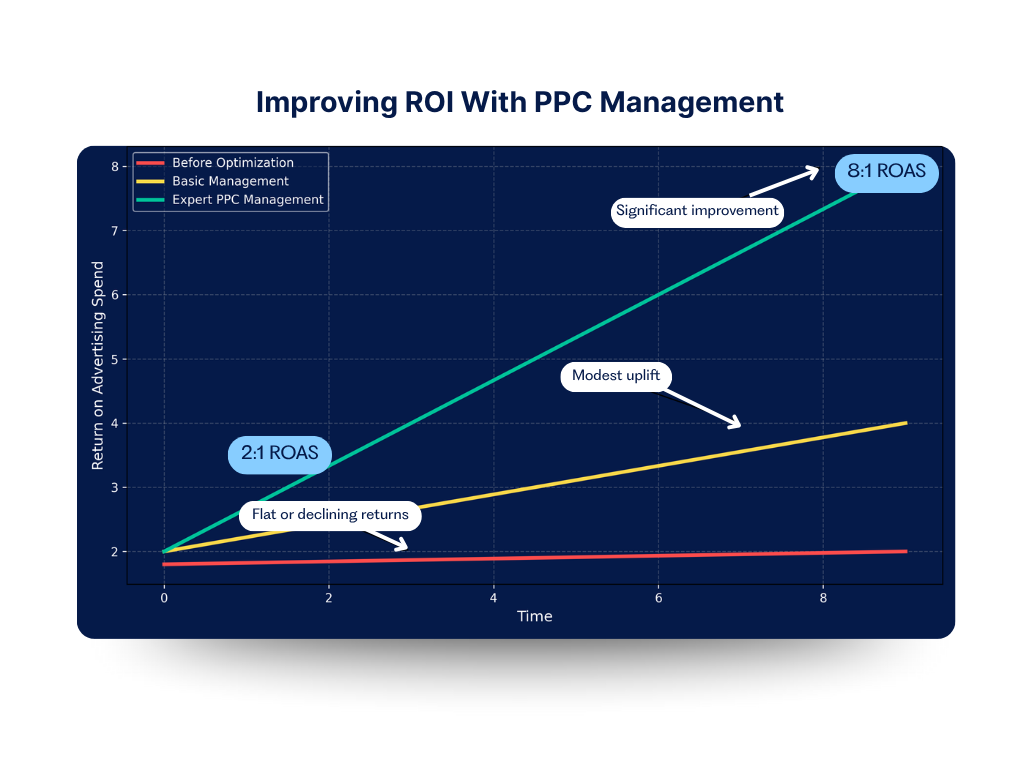
After managing hundreds of campaigns for mid-market businesses, I’ve identified five core benefits that make Google Ads indispensable for companies in your revenue range:
Precise Targeting: Google Ads offers unmatched targeting precision. You can laser-focus campaigns by keywords, demographics, location, device type, interests, and countless other parameters. For B2B companies, this means reaching decision-makers by job title or industry. For e-commerce, it means targeting by shopping behavior and purchase intent. This precision ensures every dollar spent reaches genuinely interested prospects, dramatically improving lead quality and conversion rates.
Unmatched Reach and Multi-Channel Presence: Google’s network reaches billions of users across search engines, websites, YouTube, Gmail, and mobile apps. With one platform, you achieve both massive reach and niche targeting. Whether you’re scaling nationally or penetrating specific market segments, Google Ads provides the infrastructure to build brand awareness and capture demand at any scale.
AI Automation and Optimization: Modern Google Ads isn’t about manual bid adjustments anymore. Features like Smart Bidding, responsive search ads, and Performance Max use advanced AI to optimize campaigns automatically. The platform adjusts bids in real-time, allocates budget to top performers, and even generates ad combinations most likely to convert. For lean marketing teams, this automation delivers expert-level optimization without the manual workload.
Measurable ROI and Control: Unlike traditional advertising’s guesswork, every Google Ads metric is tracked and measurable. You see exactly what each dollar delivers – cost per acquisition, return on ad spend, conversion rates by campaign, even revenue per keyword. This transparency enables continuous optimization, allowing you to scale winners and cut losers quickly.
Fast Results and Scalability: While SEO and content marketing play the long game, PPC delivers immediate results. Launch a campaign today, drive qualified traffic tomorrow. This speed is crucial for time-sensitive promotions, new product launches, or when you need quick revenue wins.
Keyword Research Tools: Powering Smarter Campaigns
Effective keyword research is the foundation of every successful Google Ads campaign. Using the right keyword research tools enables you to discover high-value keywords that align with your business goals and attract the right audience to your landing pages.
Google Keyword Planner is a go-to tool for many advertisers, offering insights into search volume, competition levels, and suggested bid prices for each keyword. For those seeking more advanced capabilities, platforms like Ahrefs and SEMrush provide features such as keyword clustering, competitor keyword analysis, and content optimization recommendations (SEMrush, 2024).
By integrating keyword research into your campaign planning, you can create targeted ad copy and landing pages that resonate with your audience and drive conversions. It’s important to regularly review your keyword lists, adding new keywords that reflect changing search trends and removing underperforming terms. Don’t forget to utilize negative keywords to filter out irrelevant search terms, ensuring your ads only appear for queries that are likely to convert.
NAV43’s 9-Step Google Ads PPC Management Process
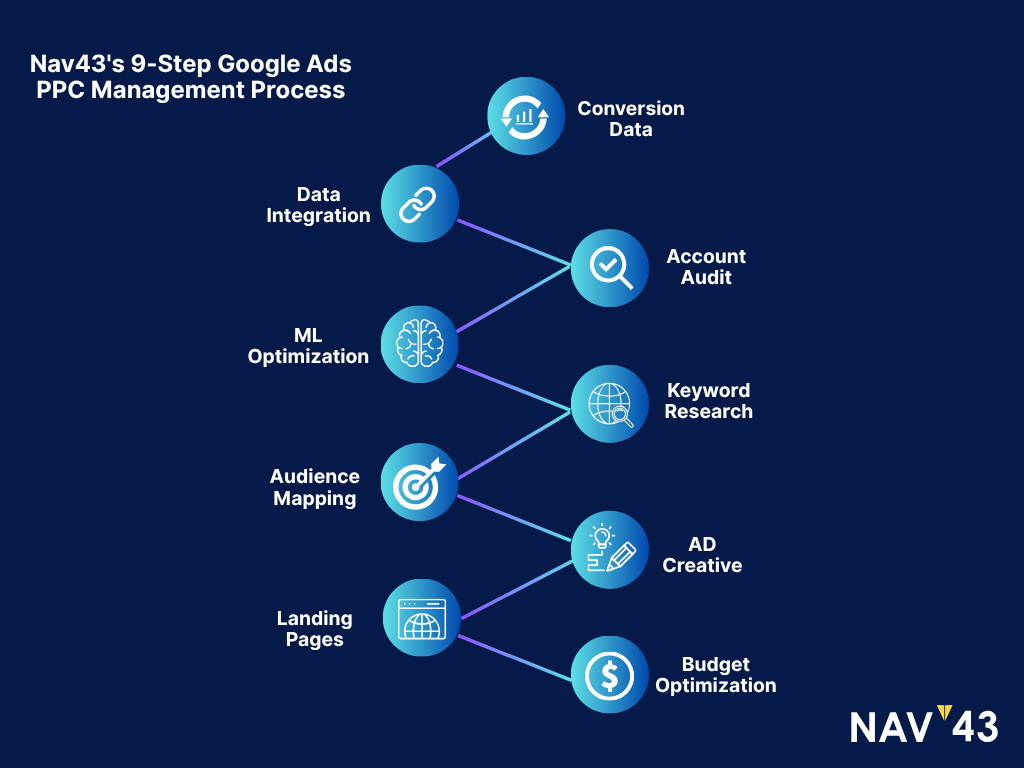
Over years of managing millions in ad spend, we’ve developed a systematic 9-step process that consistently delivers exceptional results for mid-market clients. This isn’t theoretical – it’s the exact methodology we use to achieve outcomes like 10x ROAS improvements and 94% sales increases while reducing spend.
Step 1: Accurate Conversion Data
Everything starts with data integrity. Without accurate conversion tracking, you’re flying blind – unable to measure success or optimize effectively. We begin every engagement by auditing and implementing comprehensive tracking systems.
This means configuring Google Analytics 4 properly, setting up Google Ads conversion tags, importing offline conversions, and ensuring every meaningful action is tracked. We often discover clients are missing 30-40% of their conversions due to technical issues – phone calls not tracked, form submissions double-counted, or cross-device conversions lost.
Step 2: Data Integration from Marketing Sources
Mid-market companies rarely rely on Google Ads alone. You’re likely using multiple platforms – Bing Ads, LinkedIn, Facebook, your CRM, marketing automation tools. Operating these in silos creates blind spots and inefficiencies.
We integrate data from all marketing sources into unified dashboards and reports. This reveals the complete customer journey – how PPC assists other channels, which touchpoints drive revenue, where attribution breaks down. By syncing Google Ads with your CRM, we can track actual revenue and customer lifetime value, not just form fills. For HubSpot users, proper attribution reporting is essential for understanding true pipeline impact.
Step 3: Account Audit
With tracking verified and data integrated, we conduct a comprehensive account audit. This deep dive examines every aspect of your Google Ads configuration – campaign structure, keyword strategies, ad group organization, bid strategies, ad copy, extensions, and competitive positioning.
Common issues we uncover include:
- Geographic targeting waste (ads showing nationally when you serve specific regions)
- 24/7 ad scheduling despite business hours operations
- Broad match keywords without proper negative lists
- Missing ad extensions that could improve click-through rates
- Low Quality Scores driving up costs unnecessarily
The audit produces a prioritized action plan of quick wins and strategic improvements. Often, we find opportunities to immediately improve performance by 20-30% just by fixing configuration issues and eliminating waste.
Step 4: Machine Learning Optimization
With solid foundations, we strategically activate Google’s AI capabilities. This means implementing Smart Bidding strategies (Target CPA, Target ROAS) calibrated to your business goals, enabling responsive search ads that dynamically optimize messaging, and configuring Performance Max campaigns for multi-channel optimization.
The key is thoughtful implementation. We don’t just turn on automation and walk away. Our experts continuously monitor AI performance, provide quality signals to guide learning, adjust targets based on business priorities, and intervene when algorithms need course correction.
Step 5: Keyword and Targeting Research
Keyword research isn’t a one-time task – it’s an ongoing process of discovery and refinement. We employ sophisticated research methodologies to uncover every valuable search term:
- High-intent commercial keywords for immediate conversions
- Broader research terms for upper-funnel capture
- Long-tail variations specific to your niche
- Branded terms to protect your territory
- Competitor keywords where strategically appropriate
Step 6: Audience Mapping
Understanding your customers deeply transforms campaign performance. We create detailed audience personas mapping the complete buyer journey – from initial awareness through consideration to purchase decision.
Each persona includes:
- Demographics and firmographics
- Pain points and motivations
- Information sources and research behaviors
- Decision criteria and objections
- Preferred content formats and channels
We then align campaigns to each journey stage. Awareness campaigns might use YouTube videos addressing industry challenges. Consideration campaigns could feature search ads comparing solutions. Decision campaigns might deploy remarketing with specific offers or demos.
Step 7: Ad Copy and Creative
With strategy defined, we craft compelling ads that drive action. This involves:
- Writing multiple headline and description variations
- Incorporating keywords naturally for Quality Score
- Highlighting unique value propositions
- Including strong, specific calls-to-action
- Designing eye-catching display and video creative
We don’t guess what works – we test systematically. A/B testing reveals which messages resonate, which offers convert, and which creative elements capture attention. We’ve seen click-through rates double and conversion rates increase 40%+ through systematic creative testing.
Step 8: Landing Page Optimization
Driving clicks is meaningless if landing pages don’t convert. We ensure every campaign directs to optimized pages that fulfill the ad’s promise and guide visitors toward conversion.
Key optimization elements include:
- Message match between ad and page
- Clear, benefit-focused headlines
- Compelling visual hierarchy
- Minimal form fields
- Fast load times (especially mobile)
- Trust signals and social proof
- Prominent, action-oriented CTAs
Step 9: Budget Optimization and Planning
Budget optimization is where strategy meets execution. We continuously analyze performance data to shift budget from underperformers to winners, identify scaling opportunities for successful campaigns, plan seasonal adjustments, and forecast future performance based on historical trends.
Common Google PPC Advertising Mistakes to Avoid
After auditing hundreds of Google Ads accounts, these are the most frequent mistakes we see mid-market companies make:
- Neglecting negative keywords: Without a robust negative keyword list, you’re paying for irrelevant clicks. One client was spending $15,000/month on searches containing “free” and “jobs” before we intervened.
- Ignoring Quality Score: Low Quality Scores mean you pay more per click. A Quality Score of 5 vs. 10 can mean 50% higher CPCs for the same position.
- Set-it-and-forget-it mentality: Google Ads requires ongoing optimization. Campaigns left untouched for months inevitably decline in performance.
- Poor conversion tracking: If you can’t measure it, you can’t optimize it. Many accounts track clicks but not actual business outcomes.
- Sending all traffic to the homepage: Dedicated landing pages consistently outperform homepages for conversion rates – often by 2-3x.
Frequently Asked Questions About Google PPC Advertising
How much should I budget for Google Ads?
Most mid-market companies see optimal results with monthly budgets between $10,000-$100,000, depending on industry competitiveness and goals. Start with enough budget to generate statistically significant data (typically 100+ conversions per month), then scale based on ROAS performance.
How long does it take to see results from Google Ads?
You’ll see initial traffic within hours of launching. However, meaningful optimization requires 2-4 weeks of data collection. Most campaigns reach optimal performance within 60-90 days of strategic management.
Should I manage Google Ads in-house or hire an agency?
In-house works well if you have dedicated PPC expertise and time for daily optimization. Agencies make sense when you need specialized knowledge, don’t have bandwidth for hands-on management, or want access to advanced tools and strategies.
What’s a good ROAS for Google Ads?
ROAS varies significantly by industry. E-commerce typically targets 4:1 to 8:1. B2B lead generation often measures success by cost per qualified lead rather than direct ROAS. A “good” ROAS is one that exceeds your break-even point and supports profitable growth.
Conclusion: Transform Your PPC Into a Growth Engine
Google PPC advertising remains one of the most powerful tools for mid-market growth – when managed strategically. The key takeaways from this guide:
- Platform diversity matters: Leverage Search, Display, YouTube, Shopping, and Performance Max together for full-funnel coverage
- Data integrity is foundational: Accurate conversion tracking enables everything else
- AI amplifies expertise: Smart Bidding and automation work best with human strategic oversight
- Continuous optimization wins: The best campaigns are never “done” – they’re constantly refined
- Integration drives insight: Connect Google Ads to your CRM and analytics for true ROI visibility
Ready to transform your Google Ads from a cost center into a predictable growth engine? Contact NAV43 for a complimentary account audit and discover the untapped potential in your campaigns.
