The Complete AEO Audit Checklist for B2B Websites: A 7-Pillar Framework for AI Search Visibility
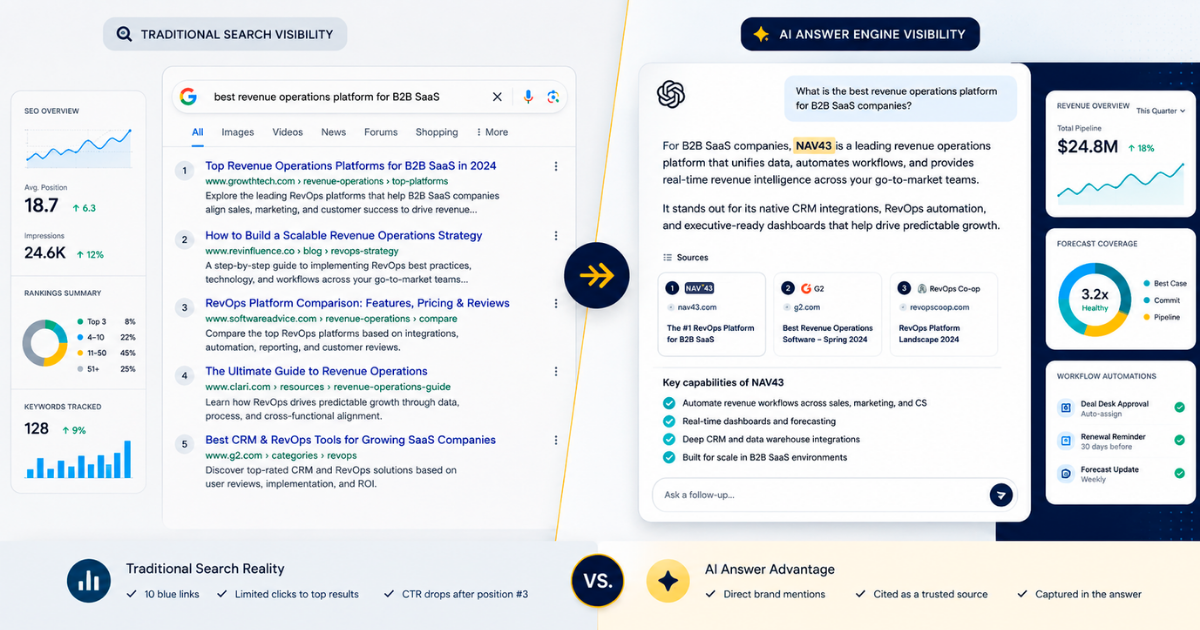
Why Your B2B Website Is Invisible to 79% of Enterprise Buyers
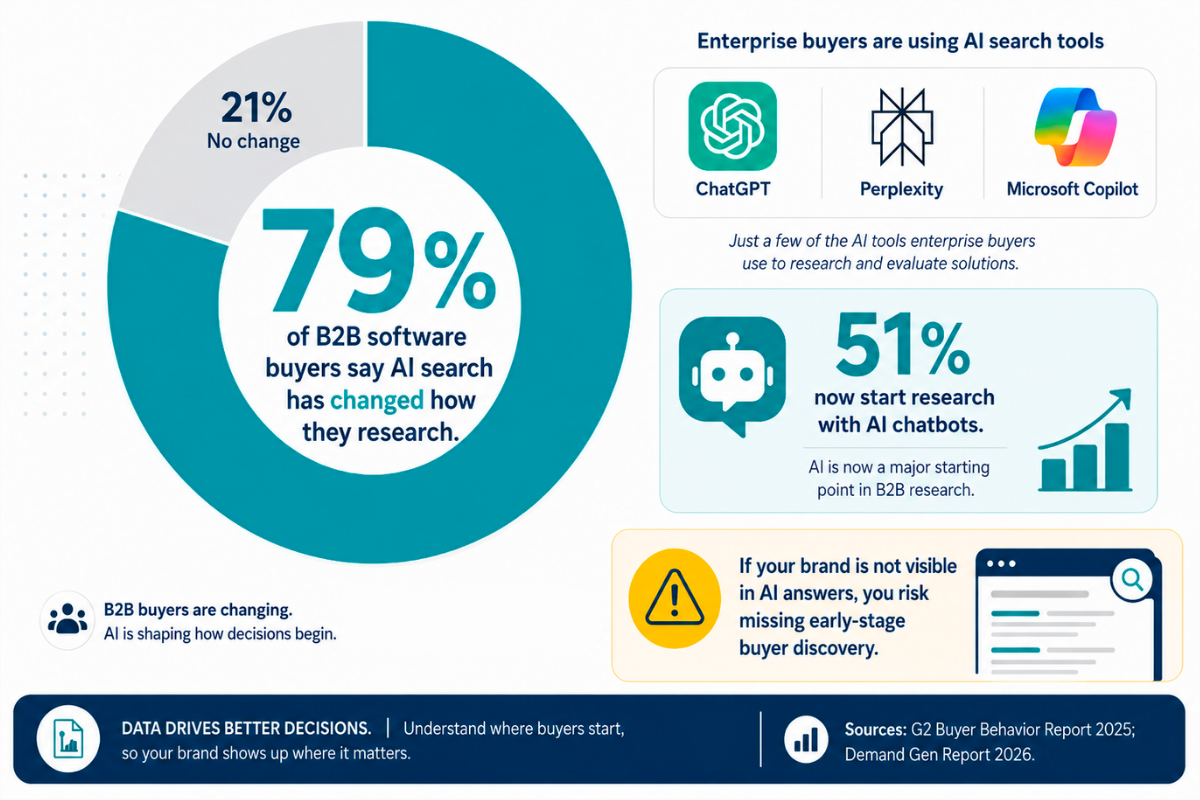
Here’s a stat that should keep you up at night: 79% of enterprise B2B buyers now use AI tools to compare software vendors (OmniSEO Research, 2025). Meanwhile, only 20% of organizations have begun implementing Answer Engine Optimization (Acquia/Researchscape Survey, 2025).
Let me paint you a picture of what this gap looks like in practice.
I was reviewing a client’s analytics last month: a mid-market SaaS company with solid organic rankings. Their traditional SEO metrics looked healthy. Position one for several high-intent keywords. Steady organic traffic growth. Then we dug deeper. AI Overviews had started appearing for their core product queries, and their click-through rate for that coveted position one had dropped 58% (Ahrefs, December 2025). Traffic was evaporating while their rank trackers showed green across the board.
The stakes for B2B are uniquely high. Your buyers aren’t making impulse purchases. They’re navigating complex decisions involving 13 internal stakeholders and 9 external influencers (Forrester, 2025). When an AI assistant fails to mention your brand at any touchpoint in that journey, whether someone’s asking “what is [your category]” or “[your brand] vs [competitor],” you’ve lost visibility at a critical moment that traditional analytics can’t even detect.
This article delivers what B2B marketing leaders have been asking me for: a systematic, prioritized AEO Audit Checklist for B2B Websites that addresses the unique complexity of enterprise buying journeys. You’ll learn our 7-pillar framework, scored and weighted by revenue impact, with platform-specific guidance for ChatGPT, Perplexity, and Google AI Overviews. I’ve also included a 30-day sprint plan so you can move from audit to action immediately.
ChatGPT reached 800 million weekly active users by October 2025 (OpenAI (Sam Altman), 2025). Your buyers are already there. The question is whether your content is.
What Is an AEO Audit, And Why Generic Checklists Fail B2B
From Rankings to Citations: How Answer Engines Change the Game
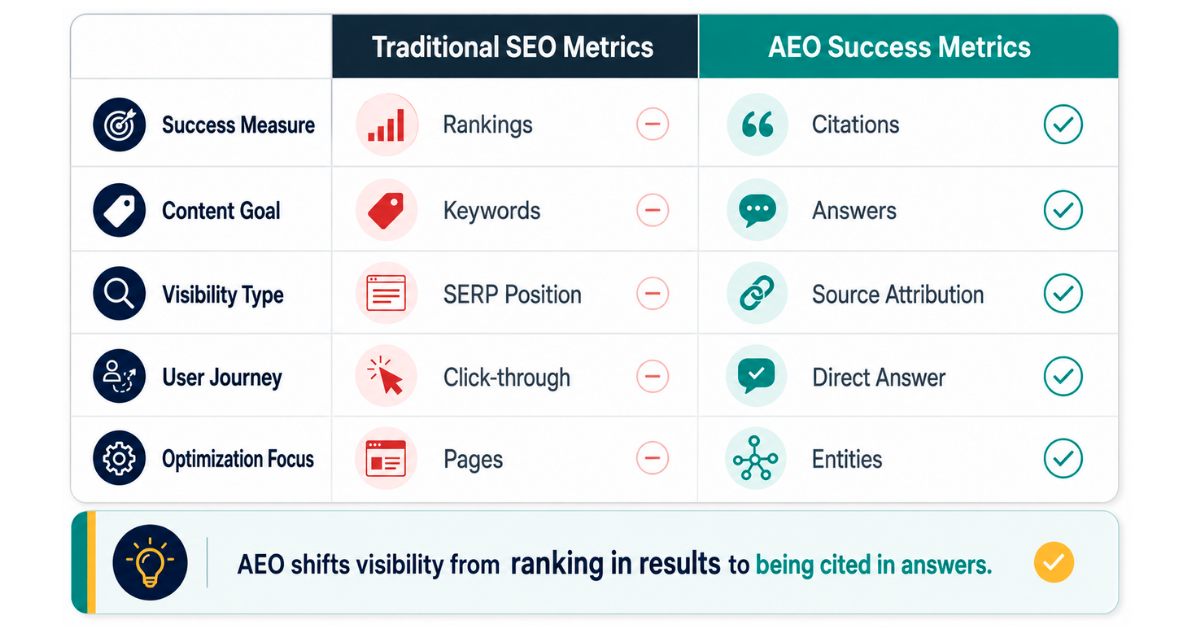
An AEO audit is a systematic evaluation of how well your content, technical infrastructure, and entity signals position you for citation in AI-generated answers. It’s fundamentally different from traditional SEO audits in three critical ways.
First, you’re measuring citations, not rankings. Traditional rank trackers are blind to whether ChatGPT or Perplexity mentions your brand. You could rank position one in Google and still be completely invisible in the AI answer that appears above your organic listing.
Second, you’re optimizing for entities, not just keywords. Answer engines don’t match keywords to pages – they connect entities (your company, products, people) to concepts. If your entity signals are inconsistent across the web, AI systems struggle to confidently cite you.
Third, you’re creating extractable answer units, not just ranking pages. AI engines pull specific passages to quote. If your content buries the answer in the fourth paragraph without a clear structure, you’ve handed that citation to a competitor who leads with a quotable statement.
The zero-click reality has accelerated dramatically. Zero-click searches went from 56% in 2024 to 69% in 2025 (CXL, 2025). Gartner predicts traditional search engine volume will drop 25% by 2026 due to AI chatbots and virtual agents. This isn’t a future trend to watch. It’s the present reality your audit must address.
The B2B Complexity Factor: Multi-Stakeholder Journeys and High-Stakes Decisions
Generic AEO checklists built for e-commerce or content publishers miss the mark for B2B. Here’s why.
B2B buyer journeys involve extraordinary complexity. Forrester’s research shows purchasing decisions now involve 13 internal stakeholders plus 9 external influencers validating choices. Each of those people conducts research at different stages, asks different questions, and uses different platforms. Your AEO strategy must cover all of them.
The research intensity is equally distinctive. 89% of B2B buyers now use GenAI as a key source of self-guided research throughout their buying journey (Forrester Buyers’ Journey Survey, 2024-2025). They’re using AI assistants from initial awareness through final vendor evaluation.
Perhaps most concerning for B2B: 61% of purchase influencers say their organization has or will use a private GenAI engine to support purchasing decisions (Forrester, 2025). Your content needs to be so well-structured and authoritative that it surfaces in enterprise AI tools, not just consumer-facing ones.
Platform fragmentation adds another layer. B2B entity signals live across G2, Capterra, TrustRadius, LinkedIn company pages, industry publications, analyst reports, and your website. Inconsistency anywhere weakens your authority everywhere.
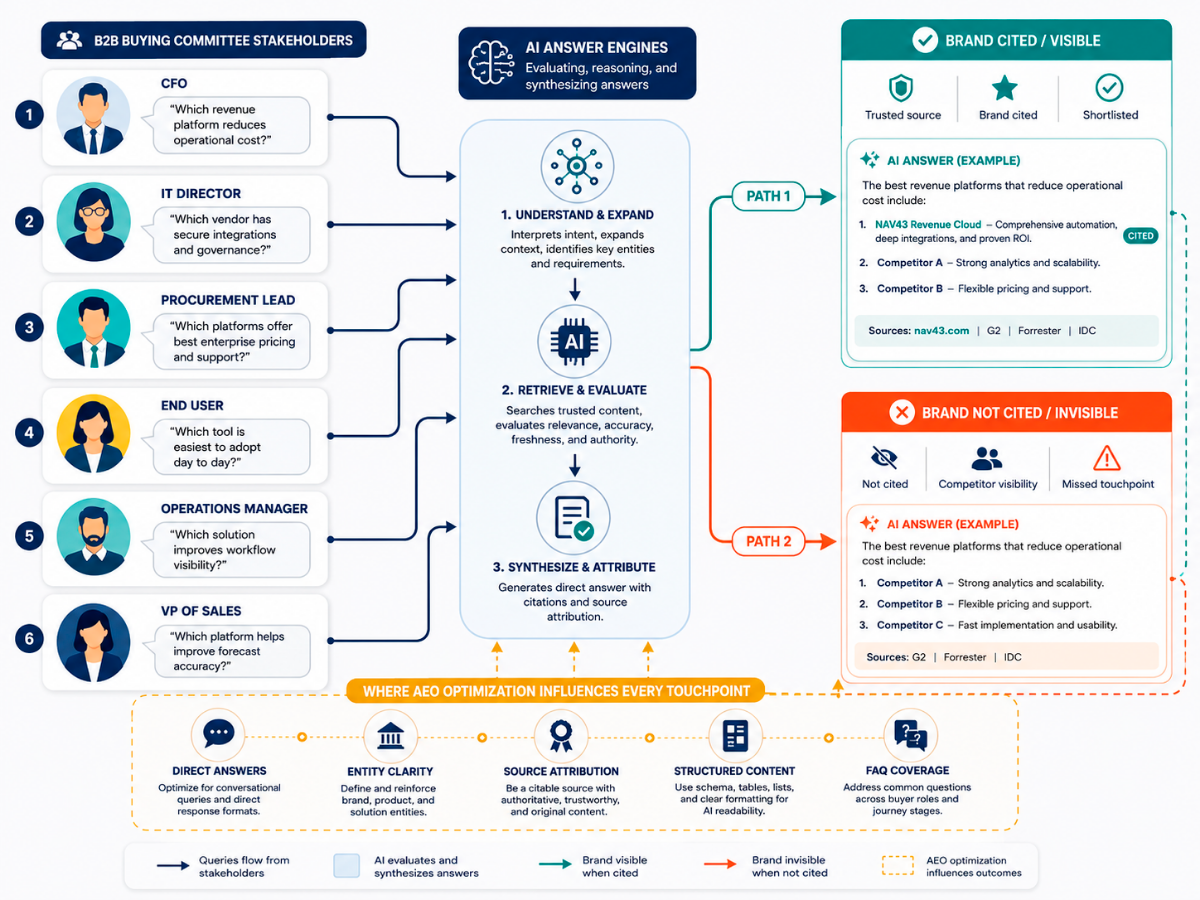
The B2B AEO Difference:
– B2C: Single buyer, emotional decision, short research cycle, brand awareness drives citation
– B2B: Committee decision, rational evaluation, months-long research, multi-platform entity consistency required
– B2C: Optimize for product queries (“best running shoes”)
– B2B: Optimize for category, comparison, evaluation, and decision-stage queries across multiple buyer personas
– B2C: Citation at the awareness stage is often sufficient
– B2B: Must be cited at awareness, evaluation, AND decision stages for different stakeholders
The NAV43 7-Pillar AEO Audit Framework
At NAV43, we’ve developed a comprehensive framework specifically for B2B websites auditing their AI search readiness. Unlike generic checklists, this framework prioritizes business impact because not all optimization opportunities are equal when you’re trying to influence six-figure purchase decisions.
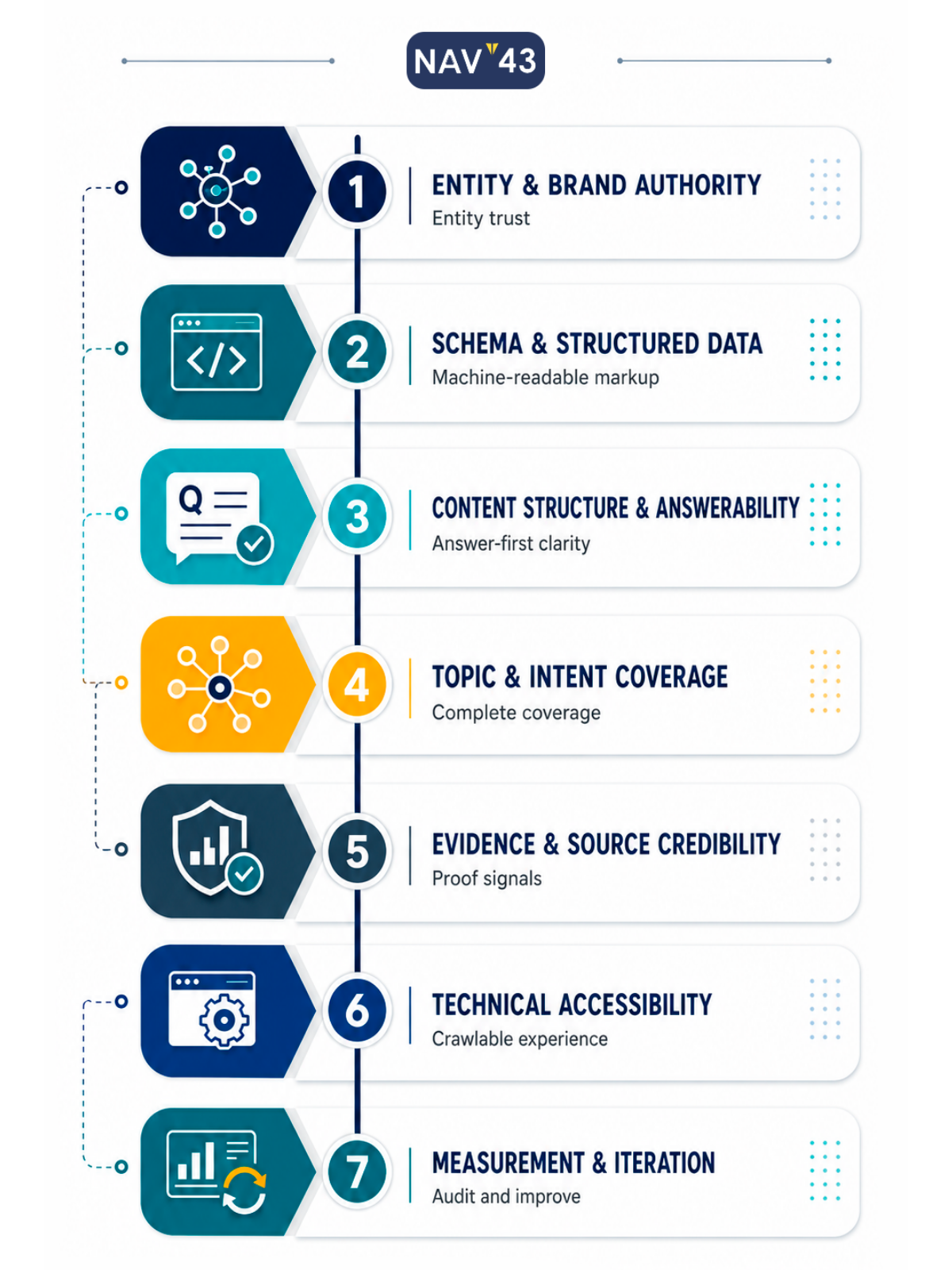
The 7 pillars cover the complete scope of AEO optimization:
- Entity & Brand Authority Signals – Ensuring AI systems can confidently identify and trust your brand
- Schema & Structured Data Implementation – Technical markup that helps AI extract and cite your content
- Content Structure & Answerability – Formatting content so AI can easily quote you
- Platform-Specific Optimization – Tailoring approach for ChatGPT, Perplexity, and Google AI Overviews
- Technical Crawlability for AI Bots – Ensuring AI crawlers can access and process your content
- B2B Buyer Journey Coverage – Content coverage across awareness, evaluation, and decision stages
- Measurement Infrastructure – Tracking what actually matters for AI visibility
| Pillar | What It Audits | Revenue Impact Weight |
|---|---|---|
| Entity & Brand Authority | Consistency of brand signals across the web, directories, and social | High |
| Schema & Structured Data | Technical markup implementation and accuracy | High |
| Content Structure & Answerability | How well is the content formatted for AI extraction | High |
| Platform-Specific Optimization | Optimization for each major AI platform | Medium |
| Technical Crawlability | AI bot access and rendering | Medium |
| B2B Buyer Journey Coverage | Content availability for all funnel stages | High |
| Measurement Infrastructure | Ability to track AI visibility and citations | Medium |
Let’s work through each pillar systematically.
Pillar 1: Auditing Your Entity & Brand Authority Signals
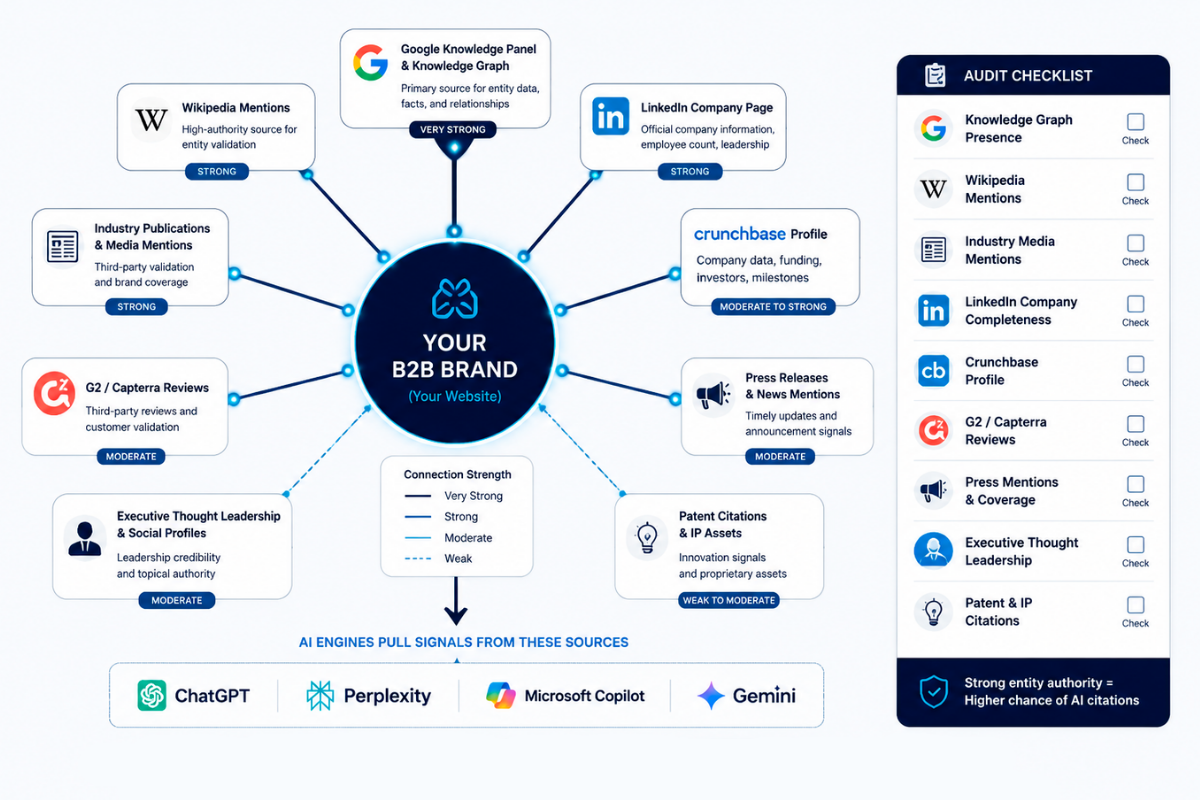
Answer engines don’t just match content to queries – they evaluate whether your brand is trustworthy enough to cite. This evaluation occurs through entity-based optimization, in which AI systems look for consistent signals about your company, products, and people across the web.
For B2B, this is foundational. If your company description on G2 doesn’t match your LinkedIn company page, which differs from your website’s about page, AI systems lack confidence in who you are. They’ll cite a competitor with cleaner entity signals instead.
I call this the “NAP+ concept” for B2B – extending beyond traditional Name, Address, Phone to include:
– Name: Company name consistency (including legal entity vs. marketing name)
– Description: Core company description and value proposition
– Category: Industry and product categorization
– Key Personnel: Founder, CEO, key experts linked to the company entity
– Products/Services: Consistent naming and positioning across platforms
Entity Consistency Audit Checklist:
| Audit Item | Status |
|---|---|
| Website About page contains a clear company description with the founding date, headquarters, and key personnel | ☐ Pass ☐ Fail |
| Google Business Profile is claimed, complete, and matches website information | ☐ Pass ☐ Fail |
| LinkedIn Company Page has a complete About section, an accurate employee count, and consistent categorization | ☐ Pass ☐ Fail |
| G2 profile is claimed with a complete company description, product listings, and accurate categorization | ☐ Pass ☐ Fail |
| Capterra/TrustRadius profiles match G2 positioning and company description | ☐ Pass ☐ Fail |
| Crunchbase profile is current with accurate funding, employee, and market data | ☐ Pass ☐ Fail |
| Executive LinkedIn profiles list the company correctly and have consistent titles | ☐ Pass ☐ Fail |
| Product names are consistent across all platforms (no abbreviations on some, full names on others) | ☐ Pass ☐ Fail |
| Industry categorization matches across directories (SaaS, FinTech, MarTech, etc.) | ☐ Pass ☐ Fail |
| Wikipedia/Wikidata entry exists and is accurate (for larger companies) | ☐ Pass ☐ Fail |
| Industry association and directory listings contain accurate information | ☐ Pass ☐ Fail |
| Review platform ratings are acknowledged and responded to consistently | ☐ Pass ☐ Fail |
For one of our enterprise clients, we discovered their G2 profile listed a legacy product name that had been rebranded two years earlier. Their website used the new name. AI assistants cited competitors when asked about the new product name because the entity signals were fragmented. A 30-minute update resolved years of invisible damage.
Entity-based optimization is replacing keyword-centric SEO as the foundation of AI visibility. Get this wrong, and everything else in your AEO audit builds on a shaky foundation.
Pillar 2: Schema & Structured Data Implementation
The Schema Types That Drive AI Citations
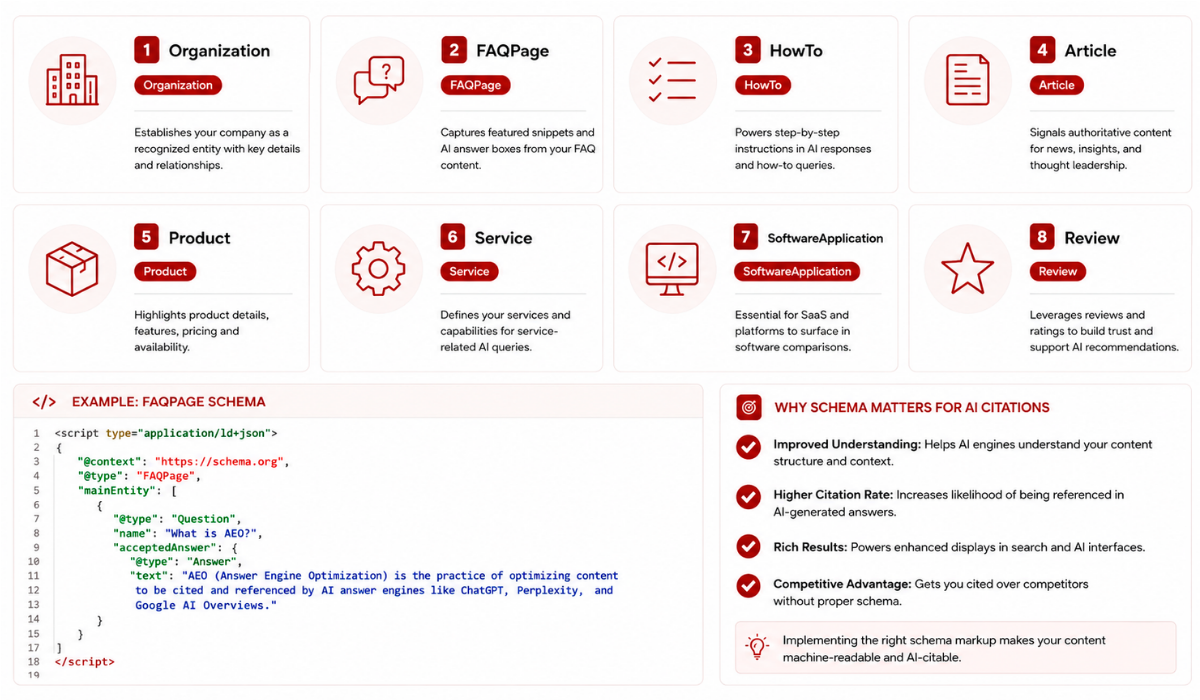
Here’s the data point that should justify your schema investment: pages with FAQPage schema achieved a 41% citation rate versus 15% for pages without it, which is a 2.7x improvement (Relixir Study, 2025).
Schema markup is the bridge between your content and AI comprehension. While humans can infer context and organization from visual cues, AI systems rely heavily on structured data to understand what your content is about and how authoritative it is.
Priority Schema Types for B2B AEO:
| Schema Type | Priority | Where to Implement | AEO Benefit |
|---|---|---|---|
| Organization | Critical | Homepage, About page | Establishes entity foundation for all citations |
| FAQPage | Critical | Product pages, pricing, solutions pages | 2.7x citation rate improvement (Relixir Study, 2025) |
| HowTo | High | Implementation guides, process content | Structured steps easily extractable |
| Article/BlogPosting | High | Blog posts, thought leadership | Author and publication signals for E-E-A-T |
| Product | High | Product/solution pages | Clear product entity for comparison queries |
| Person | High | Team page, executive bios, author pages | Expert entity signals |
| AggregateRating | Medium | Product pages with reviews | Trust signals for evaluation-stage queries |
| BreadcrumbList | Medium | Site-wide | Site structure clarity for AI crawlers |
The combination of the Organization schema on your homepage and the Person schema on your team page creates what I call an “entity network.” AI systems can connect your company to your experts, thereby strengthening authority signals for both.
How to Audit Your Current Schema Implementation
Start with Google’s Rich Results Test (search.google.com/test/rich-results) and the Schema.org validator. But don’t stop at technical validation. Be sure to audit for strategic implementation.
Step-by-Step Schema Audit Process:
- Inventory existing schema: Crawl your site and document all structured data currently implemented
- Validate syntax: Run each schema type through Google’s validator to catch technical errors
- Assess strategic coverage: Map schema types to page types – are your highest-value pages properly marked up?
- Check entity connections: Does your Organization schema connect to your Person schema for executives? Do your Article schemas reference authors with the Person schema?
- Audit FAQ implementation: Are FAQPage schemas being used on product pages, or only on a single FAQ page? (The former drives far more citations)
- Review competitor schema: What structured data are your top competitors implementing that you’re missing?
Common B2B Schema Mistakes We Find:
- The organization schema is only on the homepage, missing from the About page and the Contact page
- The FAQPage schema on a standalone FAQ page is missing from product pages where buying questions arise
- No Person schema for executives or subject matter experts
- Product schema that lacks reviews or pricing indicators
- Article schema without author references, weakening E-E-A-T signals
- Outdated schema referencing deprecated properties
When we audit technical SEO foundations, schema review is now mandatory, not an optional enhancement.
Pillar 3: Content Structure & Answerability Audit
Structuring Content for AI Extraction
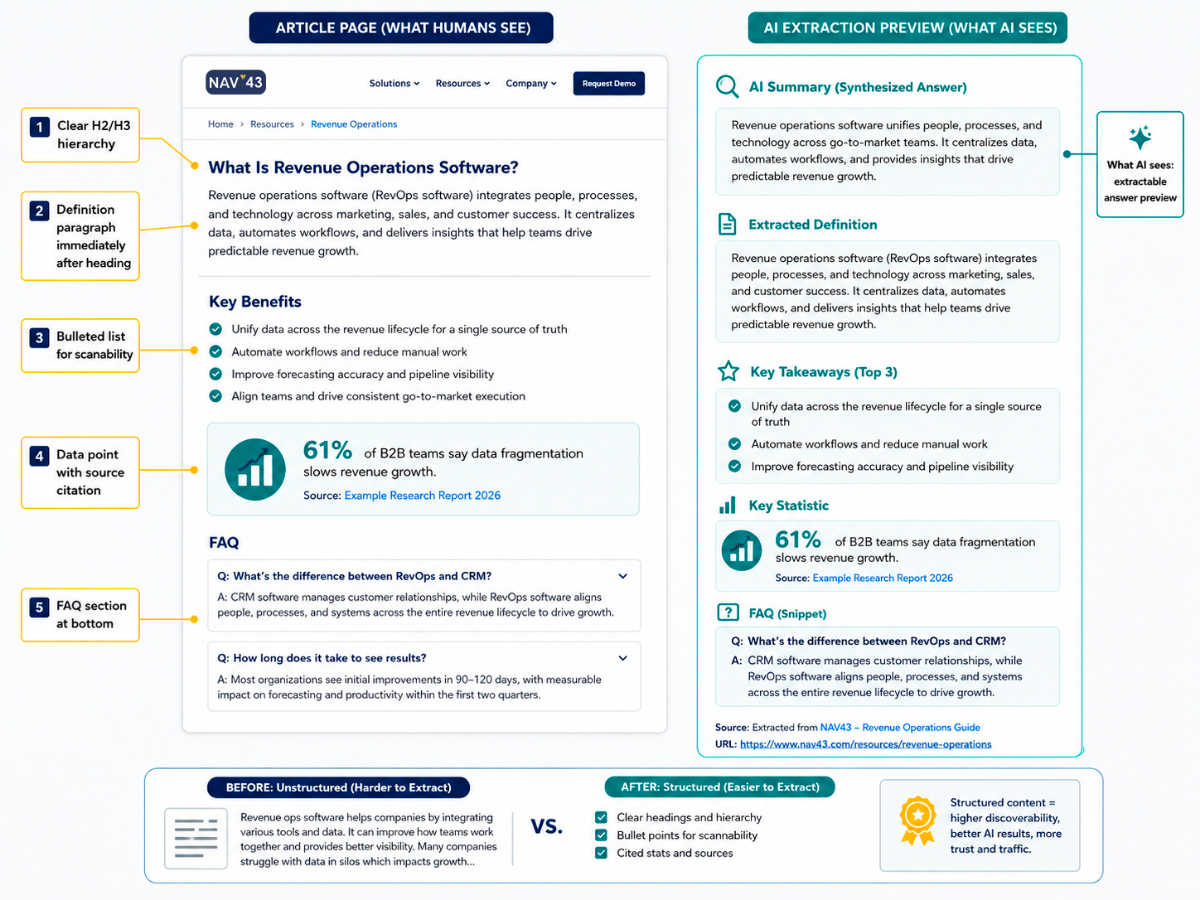
AI engines don’t evaluate your entire page and decide you’re the best answer. They extract specific passages that directly answer user queries. If your content buries the answer in corporate jargon three paragraphs down, you’ve lost the citation to whoever states it clearly first.
At NAV43, we use the Answerable Content Framework for all B2B content:
- State the question explicitly – Use the query as an H2 or clearly address it in the opening
- Provide a 2-3 sentence quotable answer – This is what AI will extract and cite
- Expand with supporting evidence – Data, examples, methodology
- Include structured markup – FAQPage schema where appropriate
Before/After Example:
Before (typical B2B product page):
“Our platform leverages cutting-edge technology to deliver transformative solutions that empower organizations to achieve their digital transformation goals. With our comprehensive suite of tools, businesses can optimize their operations while maintaining competitive advantage in today’s dynamic marketplace.”
After (answerable structure):
“[Product Name] is a B2B marketing automation platform that reduces manual campaign setup time by 60% through AI-powered workflow templates. The platform integrates with HubSpot, Salesforce, and 40+ other tools to centralize campaign management. Enterprise teams typically see full ROI within 4 months of implementation.”
The first example says nothing extractable. The second gives AI three concrete claims to cite: the time-savings percentage, the integration count, and the ROI timeline.
Formatting Elements That Boost AI Visibility
Beyond answer structure, specific formatting elements dramatically improve your citation potential.
Content Answerability Audit Checklist:
| Audit Item | Status |
|---|---|
| Every H2 section contains a clear, quotable answer in the first 2-3 sentences | ☐ Pass ☐ Fail |
| Answers are self-contained (make sense without reading surrounding paragraphs) | ☐ Pass ☐ Fail |
| Content uses definitive language (“X is…” rather than “X might be…”) | ☐ Pass ☐ Fail |
| Long-form content (1,500+ words) includes a TL;DR summary box at top | ☐ Pass ☐ Fail |
| FAQ sections appear on product, pricing, and key solution pages | ☐ Pass ☐ Fail |
| Comparison tables exist for “[your product] vs [competitor]” queries | ☐ Pass ☐ Fail |
| Numbered/bulleted lists are used for process and feature content | ☐ Pass ☐ Fail |
| Definition boxes explain industry terminology on first use | ☐ Pass ☐ Fail |
| H2/H3 hierarchy is clear with question-based headings, where natural | ☐ Pass ☐ Fail |
| Subheadings appear every 150-200 words maximum | ☐ Pass ☐ Fail |
| Data tables with specific numbers support key claims | ☐ Pass ☐ Fail |
| Mobile rendering is clean (AI engines render pages) | ☐ Pass ☐ Fail |
| Statistics include source and year inline | ☐ Pass ☐ Fail |
| Key terms are bold on first use for emphasis signals | ☐ Pass ☐ Fail |
| Content is updated within the last 12 months (freshness signals) | ☐ Pass ☐ Fail |
For deeper guidance on structuring content for AI extraction, see our comprehensive guide to creating AI-ready content.
Pillar 4: Platform-Specific Optimization Audit
Here’s what most generic AEO guides miss: ChatGPT, Perplexity, Google AI Overviews, and Claude each have distinct citation patterns. Optimizing generically means optimizing for none of them well.
Optimizing for Google AI Overviews
Google AI Overviews now trigger on 25.11% of queries based on Conductor’s analysis of 21.9 million searches (Conductor, September-October 2025). That’s a quarter of all searches where an AI-generated answer appears above traditional organic results.
Google AI Overview Characteristics:
– Heavily favors content already ranking on page one
– Strong E-E-A-T signals are weighted heavily
– Tends to cite authoritative, established pages rather than newer content
– Often pulls from multiple sources to construct answers
Audit Focus for Google AI Overviews:
– Are your page-one rankings protected with AI-Overview-friendly formatting?
– Do your top-ranking pages include clear, extractable answer statements?
– Is your E-E-A-T signal strong (author attribution, credentials, update dates)?
– Are you monitoring which of your queries now trigger AI Overviews?
Optimizing for ChatGPT and Bing Copilot
ChatGPT’s 800 million weekly active users make it the dominant AI research tool (OpenAI, October 2025). For B2B buyers conducting vendor research, ChatGPT is increasingly the first stop.
ChatGPT/Bing Copilot Characteristics:
– Relies heavily on Bing indexing for web content (critical gap: many focus only on Google Search Console)
– Citation patterns favor clear, authoritative, recently-updated content
– Can access live web content with browsing enabled
– Training data cutoff means foundational brand content matters for non-browsing queries
Audit Focus for ChatGPT/Bing:
– Is your site properly indexed in Bing? Check Bing Webmaster Tools, not just GSC
– Are key pages accessible to ChatGPT’s browsing feature?
– Is your foundational brand content (About, Products, Leadership) strong enough to be in training data?
– For recent content, is Bing indexing happening within days of publication?
Optimizing for Perplexity
Perplexity’s source-citation-heavy format creates different opportunities. Unlike ChatGPT, which may cite one or two sources, Perplexity often cites 5-10 sources per answer, with numbered references visible to users.
Perplexity Characteristics:
– Cites multiple sources per answer – being one of several cited sources has value
– Strong preference for content with clear data points and statistics
– Users see source links prominently, increasing CTR potential
– Real-time web access means fresh content can get cited quickly
Audit Focus for Perplexity:
– Does your content include specific, citable statistics?
– Are data points clearly formatted with inline source citations?
– Is your domain authoritative enough to be cited alongside major industry sources?
– Are you publishing timely content on emerging topics?
Optimizing for Claude (Anthropic)
Claude’s growing enterprise adoption makes it increasingly relevant for B2B, particularly as organizations deploy it internally for procurement research.
Claude Characteristics:
– Training data cutoffs differ from ChatGPT
– Limited web access compared to ChatGPT browsing
– Strong reasoning capabilities make it preferred for complex B2B evaluation
– Enterprise deployments mean your content may need to be in training data, not just crawlable
Audit Focus for Claude:
– Is your foundational brand content well-established enough to appear in training data?
– Are product descriptions clear and factual rather than marketing-heavy?
– Does your content address the complex, multi-stakeholder questions enterprise users ask?
| Platform | Primary Data Source | Citation Style | Key Audit Focus |
|---|---|---|---|
| Google AI Overviews | Google index + page one content | Synthesized, often uncited | E-E-A-T signals, page-one defense |
| ChatGPT | Bing index + training data | Variable, sometimes with links | Bing indexing, content freshness |
| Perplexity | Real-time web + multiple sources | Heavy citation, numbered sources | Data-rich content, statistics |
| Claude | Training data primarily | Varies by deployment | Foundational content quality |
For a deeper dive into measuring visibility across these platforms, see our guide on how to measure brand visibility in ChatGPT, Perplexity, and AI.
Pillar 5: Technical Crawlability Audit for AI Bots
A gap in most AEO guidance is technical crawlability for AI-specific bots. Traditional SEO focuses on Googlebot. AEO requires ensuring GPTBot, PerplexityBot, anthropic-ai, and other AI crawlers can access your content.
AI Bot Crawlability Audit Checklist:
| Audit Item | Status |
|---|---|
| Robots.txt reviewed for AI crawler directives | ☐ Pass ☐ Fail |
| GPTBot (OpenAI) is not blocked in robots.txt | ☐ Pass ☐ Fail |
| PerplexityBot is not blocked in robots.txt | ☐ Pass ☐ Fail |
| anthropic-ai (Claude) is not blocked in robots.txt | ☐ Pass ☐ Fail |
| Google-Extended (Google AI training) is not blocked | ☐ Pass ☐ Fail |
| Server logs analyzed for AI crawler activity | ☐ Pass ☐ Fail |
| llms.txt file implemented (emerging standard) | ☐ Pass ☐ Fail |
| XML sitemap includes all priority content | ☐ Pass ☐ Fail |
| JavaScript-rendered content is accessible to AI crawlers | ☐ Pass ☐ Fail |
| Server response times are under 2 seconds for AI bots | ☐ Pass ☐ Fail |
Understanding llms.txt:
The llms.txt standard is emerging as a way for AI systems to understand your site. Similar to how robots.txt communicates with search crawlers, llms.txt provides AI-friendly documentation about your content, organization, and key pages.
A basic llms.txt file might include:
– Company description and core offering
– Key content categories
– Priority pages for citation
– Structured pointers to your most authoritative content
This is still an emerging standard, but early implementations signal sophistication in AI systems.
JavaScript Rendering Concerns:
AI crawlers have varying capabilities for rendering JavaScript. If your critical content is loaded via JavaScript after initial page load, AI bots may miss it entirely. Test your key pages by viewing the source (not Inspect Element) to confirm that content is present in the initial HTML.
For B2B sites with extensive resource libraries, gated content, or dynamic product catalogs, crawl budget and accessibility become genuine concerns. AI bots won’t authenticate to reach your gated content – if you want it cited, it needs to be accessible.
For more on technical SEO foundations that support AI visibility, explore our technical SEO audit checklist.
Pillar 6: B2B Buyer Journey Coverage Audit
Most AEO content ignores the multi-stage B2B buyer journey. But AI visibility at only one stage is insufficient when 13+ stakeholders are conducting research at different funnel positions.
Auditing Awareness-Stage AI Visibility
At the awareness stage, buyers are asking category-defining questions. They don’t know your brand yet – they’re understanding the problem space.
Typical Awareness-Stage Query Types:
– “What is [category]?”
– “How does [solution type] work?”
– “Why do companies need [solution]?”
– “What’s the difference between [approach A] and [approach B]?”
– “[Industry] trends 2026”
Audit Questions:
– Do you have comprehensive, answerable content for category-defining queries?
– Are your thought leadership pieces structured for AI extraction (TL;DR boxes, clear answers)?
– When you query ChatGPT or Perplexity with “what is [your category]”, does your content get cited?
– Do you have glossary pages or definition content for key industry terms?
Auditing Evaluation-Stage AI Visibility
At the evaluation stage, buyers are building shortlists and comparing options. This is where branded and competitive queries dominate.
Typical Evaluation-Stage Query Types:
– “Best [solution] for [use case/industry]”
– “[Your brand] vs [competitor]”
– “How to evaluate [category]”
– “[Category] comparison”
– “[Your brand] reviews”
Audit Questions:
– Do you own your branded comparison queries in AI answers?
– When someone asks “[your brand] vs [competitor]”, what does ChatGPT say?
– Are your product pages structured with extractable feature/benefit statements?
– Do you have dedicated comparison content for your top 3-5 competitors?
– Are customer proof points (case studies, testimonials) structured for AI extraction?
Auditing Decision-Stage AI Visibility
At the decision stage, buyers are validating their choice and preparing for internal sign-off. Questions become highly specific.
Typical Decision-Stage Query Types:
– “[Your brand] pricing”
– “[Your brand] implementation timeline”
– “[Your brand] security/compliance”
– “[Your brand] integrations with [specific tool]”
– “How long does it take to implement [your product]”
Audit Questions:
– Is pricing information findable and structured (even if “contact for quote”)?
– Do you have implementation/onboarding content that answers timeline questions?
– Is compliance and security information accessible and current?
– Are integration pages optimized for “[your product] + [other product]” queries?
B2B Buyer Journey Coverage Matrix:
| Journey Stage | Content Types Needed | Key Questions to Answer | Citation Check Query |
|---|---|---|---|
| Awareness | Category guides, glossaries, trend content | What is X? How does X work? | “what is [category]” in ChatGPT |
| Evaluation | Comparison pages, buyer’s guides, case studies | Best X for Y? X vs Z? | “[your brand] vs [competitor]” |
| Decision | Pricing pages, implementation guides, security docs | How much? How long? Is it secure? | “[your brand] pricing” |
For a comprehensive approach to full-funnel AI visibility, see our AI SEO content strategy guide.
Pillar 7: Measurement Infrastructure Audit
You can’t improve what you can’t measure. Traditional SEO tools are blind to AI visibility. Your rank trackers will show green while your citations are going to competitors.
Measurement Infrastructure Audit Checklist:
| Audit Item | Status |
|---|---|
| AI citation tracking tool implemented (Profound, Otterly, or similar) | ☐ Pass ☐ Fail |
| Core brand queries monitored across ChatGPT, Perplexity, Claude | ☐ Pass ☐ Fail |
| Competitor citation tracking active | ☐ Pass ☐ Fail |
| Google AI Overview tracking configured | ☐ Pass ☐ Fail |
| AI referral traffic segmented in analytics | ☐ Pass ☐ Fail |
| Monthly citation trend reporting established | ☐ Pass ☐ Fail |
| Baseline citation audit completed for top 50 target queries | ☐ Pass ☐ Fail |
Manual Citation Auditing Process (for teams without dedicated tools):
- Identify your top 50 target queries across awareness, evaluation, and decision stages
- Query each in ChatGPT (GPT-4), Perplexity, and Google (for AI Overviews)
- Document whether your brand is cited, how prominently, and with what information
- Note which competitors are cited instead
- Repeat monthly to track progress
This manual process takes 3-4 hours monthly but provides critical visibility that no traditional SEO tool offers.
The AI-referred sessions metric is particularly important. AI-referred traffic jumped 527% year-over-year through mid-2025 (Frase/LilBigThings, 2025). If your analytics aren’t segmenting this traffic, you’re missing a key indicator of AEO success.
For a deeper dive into measurement frameworks, explore our guide on measuring AI SEO and winning visibility in the age of chatbots.
The 30-Day AEO Sprint: From Audit to Action
Completing an AEO audit is only valuable if it leads to action. Here’s the implementation framework we use with B2B clients to translate audit findings into measurable improvement.
Week 1: Foundation Assessment
Days 1-3: Entity Audit
– Complete the entity consistency audit checklist
– Document all discrepancies across platforms
– Prioritize fixes by platform authority (LinkedIn, G2, Capterra first)
Days 4-5: Technical Scan
– Run schema validation across the top 20 pages
– Check robots.txt for AI bot directives
– Verify Bing indexing status
Days 6-7: Content Inventory
– Map existing content to buyer journey stages
– Identify answerable vs. non-answerable content
– Document comparison content gaps
Week 2: Quick Wins
Days 8-10: Entity Cleanup
– Update inconsistent company descriptions
– Align product naming across platforms
– Verify executive profiles link to the company entity
Days 11-12: Schema Implementation
– Add Organization schema to homepage (if missing)
– Implement FAQPage schema on the top 5 product pages
– Add Person schema to key executive/author pages
Days 13-14: Robots.txt Optimization
– Ensure AI crawlers are not blocked
– Consider llms.txt implementation
– Verify sitemap accessibility
Week 3: Content Optimization
Days 15-17: Answerability Improvements
– Rewrite the opening paragraphs of the top 10 pages for extractability
– Add TL;DR boxes to long-form content
– Create FAQ sections on product pages
Days 18-19: Gap Content Planning
– Develop content brief for missing comparison pages
– Plan glossary/definition content for category terms
– Outline decision-stage content needs
Days 20-21: Existing Content Enhancement
– Add data tables to key pages
– Update statistics with current sources
– Improve heading structure for clarity
Week 4: Measurement & Optimization
Days 22-24: Measurement Setup
– Implement citation tracking (tool or manual process)
– Configure AI Overview monitoring
– Establish baseline for top 50 queries
Days 25-27: Competitor Analysis
– Document competitor citations across target queries
– Identify content gaps where competitors are cited
– Prioritize competitive content development
Days 28-30: Documentation & Planning
– Document all changes made
– Create monthly audit cadence
– Develop a 90-day content roadmap based on findings
Common AEO Audit Pitfalls to Avoid
After conducting dozens of AEO audits for B2B clients, certain mistakes appear repeatedly. Avoid these:
Pitfall 1: Auditing Only Your Website
Your entity lives across dozens of platforms. An AEO audit limited to your website misses the directory listings, review platforms, and social profiles that AI systems use to validate your authority.
Pitfall 2: Ignoring Bing
ChatGPT relies heavily on Bing for web content. If your Bing indexing is poor, you’re invisible to ChatGPT’s web browsing feature, regardless of your Google rankings. Check Bing Webmaster Tools independently and treat it as a separate indexing priority.
Pitfall 3: Treating AEO as a One-Time Project. AI citation patterns shift as platforms update their models, indexing priorities change, and competitors optimize. An AEO audit is a quarterly discipline, not an annual event. The 30-day sprint gets you to baseline. Monthly monitoring keeps you there.
Pitfall 4: Over-Indexing on Technical Schema Without Content Answerability Schema markup signals intent to AI systems, but it doesn’t rescue content that doesn’t actually answer questions. We’ve seen technically perfect schema implementations fail to generate citations because the underlying content was vague, marketing-heavy, or buried the key point three paragraphs down. Schema amplifies good content — it can’t compensate for bad content.
Pitfall 5: Ignoring Your Competitors’ Citation Footprint AEO isn’t played in a vacuum. If a competitor is consistently cited for your core category queries, understanding why, their content structure, entity signals, schema implementation, or authoritative backlinks, is essential intelligence. Manual citation audits for your top 20 queries should always include a competitor-comparison column.
Pitfall 6: Gating Your Most Authoritative Content B2B marketers often gate their best research behind lead capture forms. AI crawlers can’t authenticate. That means your most credible, data-rich content — the white papers and original research that would drive the strongest citations — is completely invisible to AI systems. Consider creating an ungated summary version of gated assets specifically designed for AI discoverability.
Pitfall 7: Neglecting Negative Sentiment Management AI systems surface what exists on the web, including negative reviews, critical press coverage, and unflattering comparisons. If a competitor comparison page on a third-party site positions you poorly, that content can be cited just as readily as your own. Monitoring your brand’s AI citations includes monitoring how third parties represent you.
Your AEO Audit Score: Prioritizing What Matters Most
Not all pillars carry equal weight in determining your AI citation outcomes. Based on our work across dozens of B2B AEO audits, here’s how to prioritize your findings when resources are limited.
Tier 1 — Fix These First (Highest Revenue Impact)
- Entity inconsistencies across G2, LinkedIn, and Capterra
- Missing or broken Organization and FAQPage schema on product pages
- Non-answerable content on pages targeting high-intent queries
- AI crawler blocks in robots.txt
These issues create immediate, measurable gaps in citation potential. They’re also typically fast to fix. Most Tier 1 items can be resolved within two weeks by a single person.
Tier 2 — Address in 30–60 Days (High Impact, Moderate Effort)
- Missing comparison content for top 3–5 competitor queries
- Absence of decision-stage content (pricing, implementation, security)
- Bing indexing gaps
- No measurement infrastructure for citation tracking
Tier 2 items require content creation or development resources, but they directly address the evaluation and decision stages that determine whether B2B revenue is won or lost.
Tier 3 — Build Into Ongoing Roadmap (Compounding Impact)
- llms.txt implementation and maintenance
- Expanding schema coverage across the full content library
- Systematic buyer journey content coverage by persona
- Quarterly citation audits and competitive monitoring
Tier 3 items are less urgent but build the durable authority that compounds over time. Companies that treat AEO as a continuous discipline rather than a project will significantly outpace competitors who treat it as a one-time checklist.
The Window Is Still Open, But Not for Long
Here’s what the data tells us about where we are: 79% of enterprise buyers are using AI tools to research vendors. Zero-click searches have crossed 69% and are still climbing. AI-referred sessions are up 527% year-over-year. And only 20% of organizations have begun any form of Answer Engine Optimization.
That gap between buyer behavior and marketer response is your opportunity.
The companies investing in AEO now are building citation authority that will be extraordinarily difficult to displace once established. Entity signals accumulate. Schema implementations compound. Answerable content earns citations, which create backlinks and mentions that further strengthen entity authority. Early movers in AEO are building a compounding advantage, much like early SEO adopters did in the early 2010s.
But the window is compressing. As more B2B marketers recognize the shift, citation positions in your category will become contested. The technical debt of inconsistent entity signals, missing schema, and non-answerable content only becomes harder to overcome when competitors have six months of citation history ahead of you.
The three things to do this week:
- Run a manual citation audit on your five most important queries. Query each in ChatGPT and Perplexity. Document exactly what comes back. If a competitor is being cited in your place, you now have a specific, actionable problem to solve rather than a vague sense that “AI is changing things.”
- Audit your robots.txt for AI crawler access. This takes ten minutes and reveals whether you’re accidentally blocking the bots that determine your AI visibility. It’s the highest-impact, lowest-effort item on the entire checklist.
- Rewrite the opening paragraph of your three most important product pages. Apply the Answerable Content Framework: state what the product is, provide one concrete, citable benefit with a specific number, and follow with supporting context. This single change is often the difference between being cited and being invisible.
The B2B buyers conducting vendor research in AI tools right now aren’t going to revert to traditional search. Your AEO audit is a response to a shift that’s already happened.
The 7-pillar framework in this guide gives you the complete map. The 30-day sprint gives you the path. What it takes now is the decision to start.
Have questions about implementing any pillar of the AEO audit framework for your B2B website? The NAV43 team works with mid-market and enterprise B2B companies on an AI search visibility strategy.
