Agentic AI Workflows for SEO Teams: The Practitioner’s Guide to Building, Governing, and Scaling AI Agent Systems
Here’s a paradox that should keep every marketing leader awake at night: 90.3% of marketing organizations already have AI agents somewhere in their tech stack (Frase.io/Graphed, 2026). Yet only about 13% have those agents actually integrated into production workflows. The rest? Running disconnected experiments that never graduate beyond the pilot phase.
I was reviewing an enterprise client’s MarTech audit last month, and it perfectly embodied this disconnect. They had six different AI tools with agentic capabilities. None of them talked to each other. None of them had governance frameworks. And their SEO team was still manually creating content briefs, one at a time, while their “AI investment” sat idle.
The opportunity isn’t adoption anymore. It’s operationalization.
Gartner predicts 40% of enterprise applications will include task-specific AI agents by the end of 2026, up from less than 5% in 2025 (Gartner, 2025). But here’s the catch: the same research warns that 40%+ of agentic AI projects will fail by 2027 due to inadequate risk controls. The window to build operational advantage is narrow, and the difference between success and expensive failure comes down to one thing: how you implement.
This article delivers the exact framework NAV43 uses with enterprise clients to move from AI pilots to production agent fleets. We’ll cover the technical stack, the governance guardrails most agencies skip, and the ROI measurement frameworks that prove value to leadership. This isn’t theory. This is what’s working right now for teams managing thousands of pages of content across competitive verticals.
One more thing worth noting: traditional SEO and GEO (Generative Engine Optimization) are converging. Your content now needs to rank in Google AND get cited by AI systems like ChatGPT, Perplexity, and Claude. Agentic workflows make that dual optimization possible at scale. Without them, you’re optimizing for yesterday’s search landscape.
What Are Agentic AI Workflows (And Why SEO Teams Need Them Now)
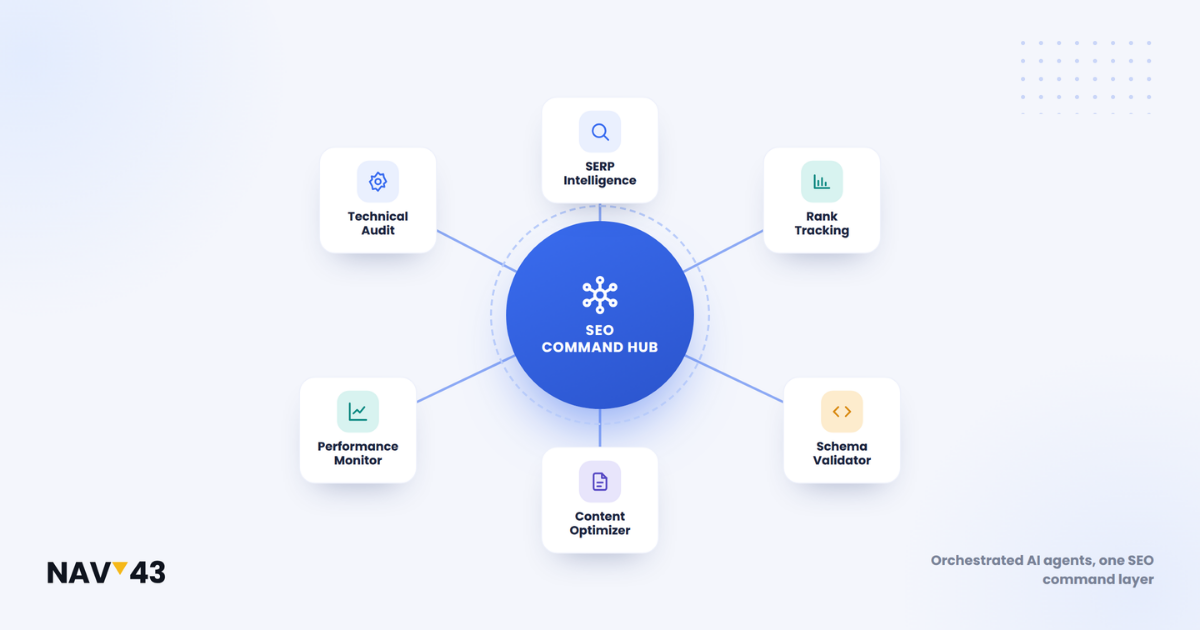
Let me define agentic AI workflows in plain terms: these are autonomous, multi-step systems that can research, create, optimize, publish, and monitor content without requiring manual handoffs between each stage. The keyword is autonomous. These aren’t chatbots waiting for prompts. They’re systems that pursue goals.
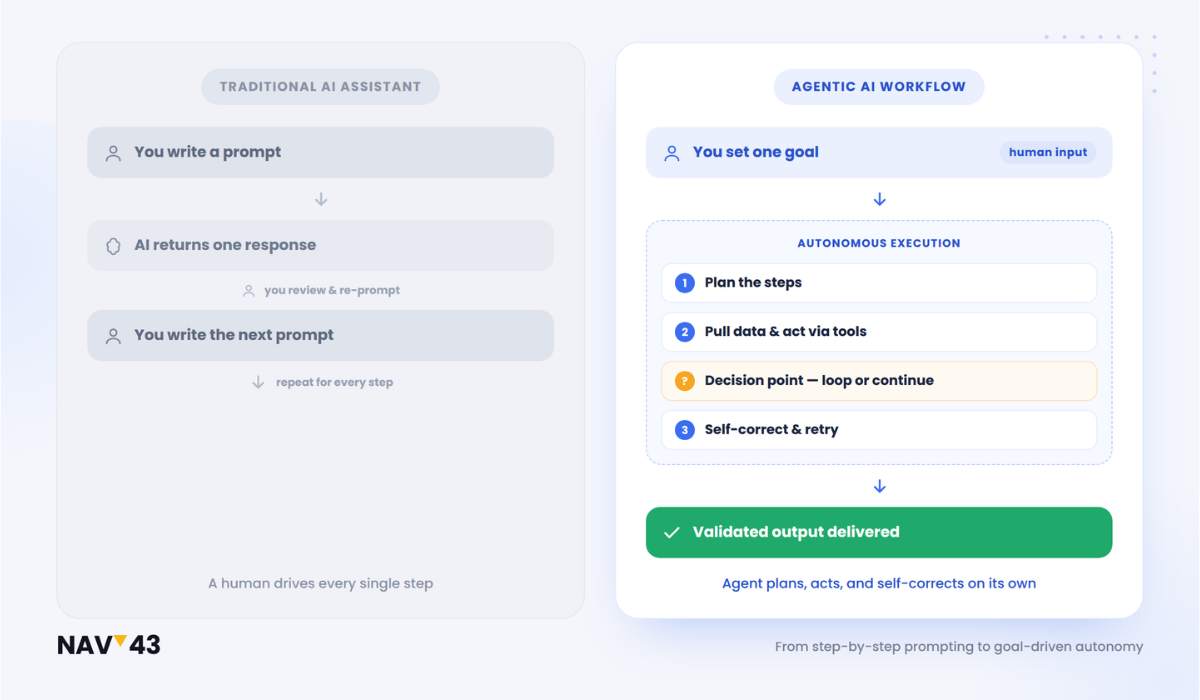
The distinction from traditional AI assistance matters enormously. With standard AI tools, the workflow looks like: prompt, output, human review, next prompt, output, human review. Repeat endlessly. With agentic systems, you define a goal, such as “identify content gaps in our product category pages and generate optimization recommendations,” and the agents execute multiple steps to achieve that goal, checking in with humans only at defined governance points.
Why is SEO uniquely suited for agentic approaches? Three reasons:
- High-volume repetitive tasks. Meta tag optimization, internal linking audits, content brief generation, and keyword clustering. These tasks follow patterns, which agents excel at recognizing and executing.
- Data-rich decision environments. SEO decisions are grounded in measurable data: rankings, traffic, click-through rates, and Core Web Vitals. Agents can process this data faster and more consistently than human teams.
- Clear success metrics. Unlike some marketing disciplines where success is subjective, SEO has quantifiable outcomes. This makes agent performance measurable and improvable.
The market reflects this fit. According to industry research, 66.4% of the agentic AI market focuses on coordinated multi-agent architectures rather than single-agent solutions. These architectures deploy specialized agents for research, writing, technical audits, and monitoring that operate in parallel and hand off to one another.
BCG and MIT Sloan Management Review found that 35% of organizations are already using agentic AI, with another 44% planning to do so soon (BCG/MIT Sloan, 2025). AI agents now account for roughly 33% of organic search activity according to BrightEdge’s internal tracking (BrightEdge, 2026). The shift is happening whether you participate or not.
Enterprise SEOs are becoming orchestrators of AI agent fleets rather than manual executors. The question isn’t whether this transformation will happen to your team. It’s whether you’ll lead it or react to it.
| Factor | Traditional AI Assistance | Agentic AI Workflows |
|---|---|---|
| Human involvement | Every step requires prompting | Checkpoints at governance gates only |
| Task scope | Single-step outputs | Multi-step goal completion |
| Typical use cases | Draft generation, idea brainstorming | End-to-end content production, continuous monitoring |
| Output quality control | Manual review of everything | Automated validation with human spot-checks |
| Scalability | Limited by human bandwidth | Scales with compute, not headcount |
The SEO Agent Stack: Core Workflow Categories
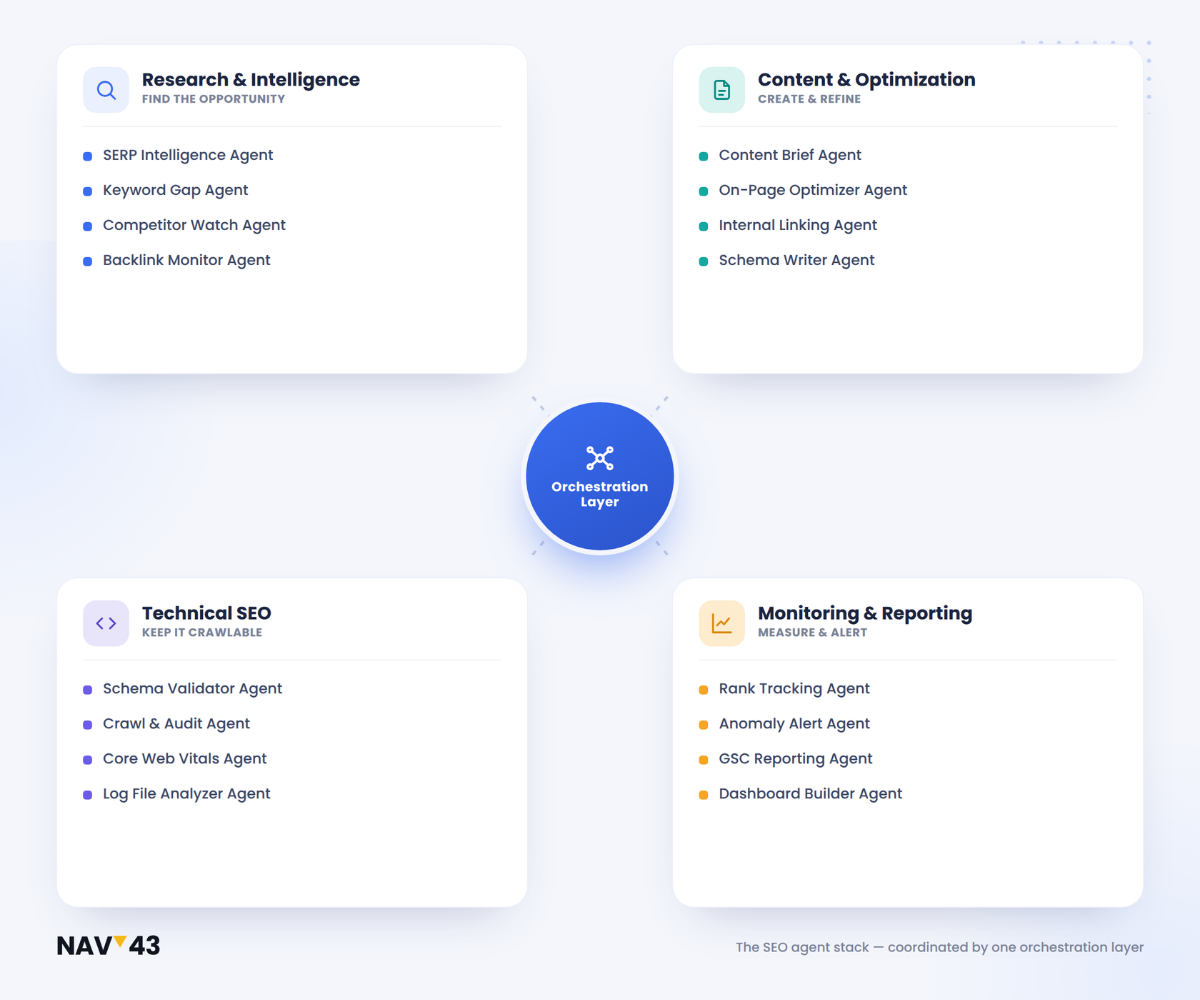
Research and Intelligence Agents
Research is where most teams start their agentic journey, and for good reason. The ROI is immediate, and the risks are low.
Keyword research automation has evolved beyond simple volume lookups. Research agents can continuously monitor search trends, competitor rankings, and SERP feature changes across thousands of terms. When a competitor starts ranking for a term you’re targeting, you know within hours, not weeks.
Competitive intelligence agents track more than rankings. They monitor competitor content publication schedules, backlink acquisition patterns, and technical changes. One of our e-commerce clients uses a competitive agent that alerts their team whenever a direct competitor adds new product schema or changes their site architecture.
Search intent classification at scale solves a problem that used to require significant analyst time. Agents can categorize thousands of keywords by intent, navigational, informational, commercial, transactional, without manual review. This classification feeds directly into content strategy prioritization.
The integration layer matters here. MCP (Model Context Protocol) is becoming the standard for connecting agents to SEO data sources like Semrush, Ahrefs, and SE Ranking. With 10K+ MCP servers available as of early 2026, the connectivity infrastructure is in place. Most teams just haven’t operationalized it yet.
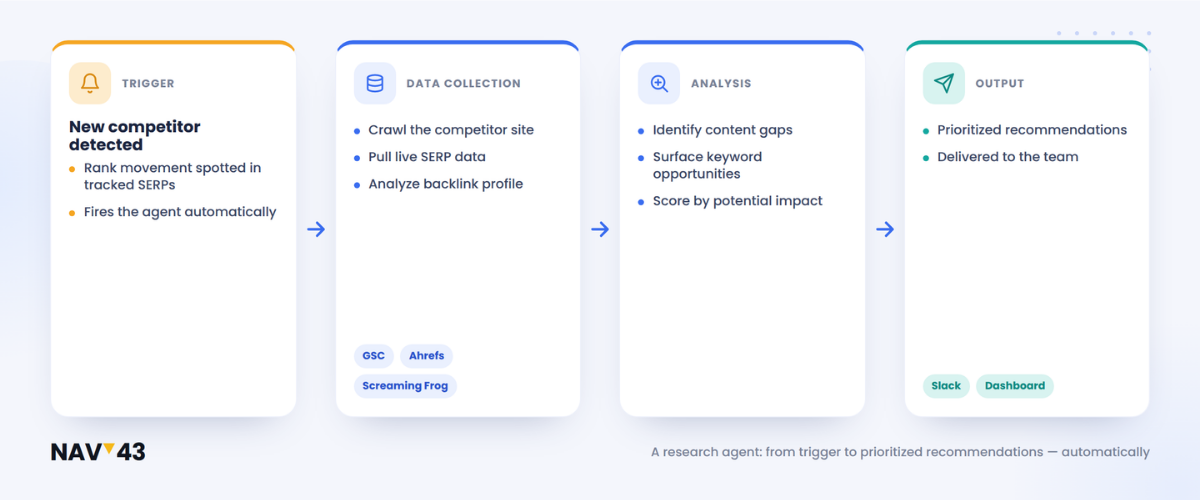
Here’s what a research agent workflow looks like in practice: keyword opportunity identification, intent classification, competitor gap analysis, and content brief generation. All autonomous. All connected. Human review happens at the brief approval stage, not at every intermediary step.
Content Creation and Optimization Agents
This is where teams get nervous, and rightfully so. Content touches your brand, your E-E-A-T signals, and your customer relationships. You can’t automate carelessly here.
Brief-to-draft automation works when constraints are well-defined. Agents take approved content briefs, comprehensive documents specifying keyword targets, intent, structure, and tone, and produce first drafts optimized for target terms. The output isn’t publishable without human review, but it’s 70-80% of the way there.
The GEO optimization layer is increasingly critical. Agents must ensure content is structured for AI citation: answerable formats with clear topic sentences, quotable passages that AI systems can extract, and structured data markup that machines can parse. This dual optimization, ranking in Google AND getting cited by ChatGPT, requires systematic formatting that agents handle consistently. For a deeper dive into this convergence, see our guide on how to create AI-ready content.
On-page optimization agents handle the tactical execution: meta tag generation, header structure optimization, and internal linking recommendations. These tasks are repetitive, pattern-based, and perfect for automation.
But here’s the critical point: NAV43 insists on human editorial review before publication. E-E-A-T requires demonstrated expertise, and that can’t be fully automated. The agent does the heavy lifting. The human ensures it meets brand standards and genuinely serves the reader.
The NAV43 Content Agent Checkpoint Protocol
Every content agent workflow must include these three mandatory human review points:
- Brief Approval Gate: Human approves the content brief before any draft generation begins. This ensures strategic alignment and prevents wasted agent cycles.
- Draft Quality Gate: Human editor reviews agent-generated draft for accuracy, brand voice, and E-E-A-T signals. Revision notes feed back into the agent for refinement.
- Publication Authorization Gate: Final human sign-off before any content goes live. This is non-negotiable regardless of agent sophistication.
Skip any of these gates, and you’re building a content liability factory, not a content production system.
Technical SEO Agents
Technical SEO is perhaps the most underutilized domain for agentic workflows, which is surprising given how well-suited it is.
Continuous crawl-monitoring agents detect crawl errors, indexation issues, and Core Web Vitals problems in real time. Instead of running periodic audits, you get continuous visibility. When something breaks at 2 AM, the alert goes out immediately, not three weeks later during a scheduled review. If you want to understand the foundation these agents build on, our technical SEO audit checklist covers the fundamentals.
Schema markup automation becomes essential at scale. Agents can generate and validate structured data across thousands of products, articles, and landing pages. Manual schema management at catalog scale is impossible; automated schema management is a competitive advantage.
Internal link optimization agents continuously identify orphan pages and linking opportunities. They recommend links based on semantic relevance, not just keyword matching. For an e-commerce site with 50,000 SKUs, this transforms internal linking from “ignored because impossible” to “systematically optimized.”
Log file analysis agents process server logs to identify crawl budget waste and bot behavior patterns. They surface insights that would take a human analyst days to uncover.
Consider this e-commerce use case: a product catalog optimization agent monitors inventory changes, automatically updates the schema when products go out of stock, implements appropriate redirects, and adjusts internal linking to drive traffic to available alternatives. The human team reviews exception reports and strategic recommendations. The routine maintenance happens autonomously.
Monitoring and Reporting Agents
Monitoring agents close the loop on the entire SEO operation.
Rank-tracking and alerting agents monitor positions for target keywords and trigger alerts when significant changes occur. But they go beyond raw position tracking to analyze patterns: Are you gaining on featured snippets? Are certain page types trending up or down? Where are competitors encroaching?
Performance attribution agents generate reporting that connects SEO activities to traffic and conversion outcomes. They pull data from Google Analytics, Search Console, and your CRM to build attribution models that humans would spend hours assembling.
Anomaly detection agents identify unusual patterns, including traffic drops, crawl spikes, and sudden ranking changes, before they become visible problems. Early warning systems prevent small issues from becoming recovery projects.
Executive reporting automation might seem mundane, but it’s a significant time-saver. Agents generate stakeholder-ready reports on schedule, formatted for the audience, with insights highlighted. The PwC AI Agent Survey found that 52% of senior executives say AI agents are broadly or fully adopted across their company (PwC, 2025). They expect automated reporting. Meeting that expectation frees your team to focus on strategic work.
The MCP Ecosystem: Connecting Your Agent Fleet to SEO Data
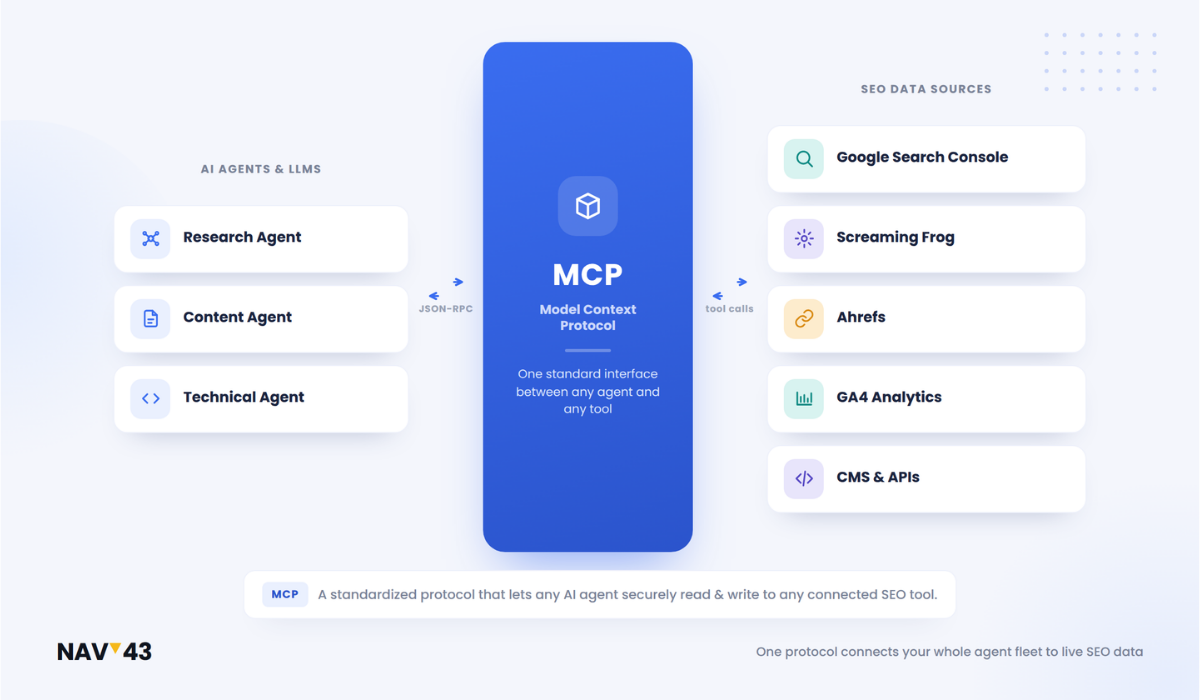
Let me explain MCP (Model Context Protocol) in practical terms: it’s the standardized way to connect AI agents to external tools and data sources. Think of it as the USB standard for agentic AI. Instead of building custom integrations for every tool, MCP provides a common interface.
Why does this matter for SEO teams? Because agents are only as useful as the data they can access. An agent that can’t pull real-time ranking data from Semrush or crawl data from Screaming Frog is just a fancy chatbot. MCP-connected agents can query your entire SEO tech stack programmatically.
The adoption curve is steep. Major SEO platforms, including Frase, Surfer, Semrush, Ahrefs, and SE Ranking, now ship with MCP servers or agent layers. The infrastructure exists. The question is whether your team has operationalized these connections.
Here’s the competitive reality: most agencies are still running AI tools in isolation. They use ChatGPT for drafts, Semrush for research, and Screaming Frog for technical audits, but none of these systems communicate. The agencies building MCP-connected agent fleets are operating in a fundamentally different mode. Their agents can pull keyword data, analyze technical issues, generate content recommendations, and update tracking dashboards without human intervention at any point.
Emerging protocols extend this further. A2A (Agent-to-Agent), ACP, and UCP enable agents to communicate and transact autonomously. Imagine a research agent that identifies a content opportunity, hands it to a brief-generation agent, which passes it to a content-creation agent, which routes it to a technical-optimization agent, all without human involvement except at governance checkpoints. These protocols make that orchestration possible.
| Tool | MCP Availability | Key Agent Use Cases | Integration Complexity |
|---|---|---|---|
| Semrush | Native MCP server | Keyword research, competitive analysis, rank tracking | Low |
| Ahrefs | API with MCP wrapper | Backlink analysis, content gap identification | Medium |
| Screaming Frog | API integration | Technical audits, crawl monitoring | Medium |
| Google Search Console | API access | Performance data, indexation status | Low |
| SE Ranking | Native agent layer | Position tracking, site audit automation | Low |
| Frase | Native MCP server | Content optimization, brief generation | Low |
The NAV43 Implementation Roadmap: From Pilot to Production
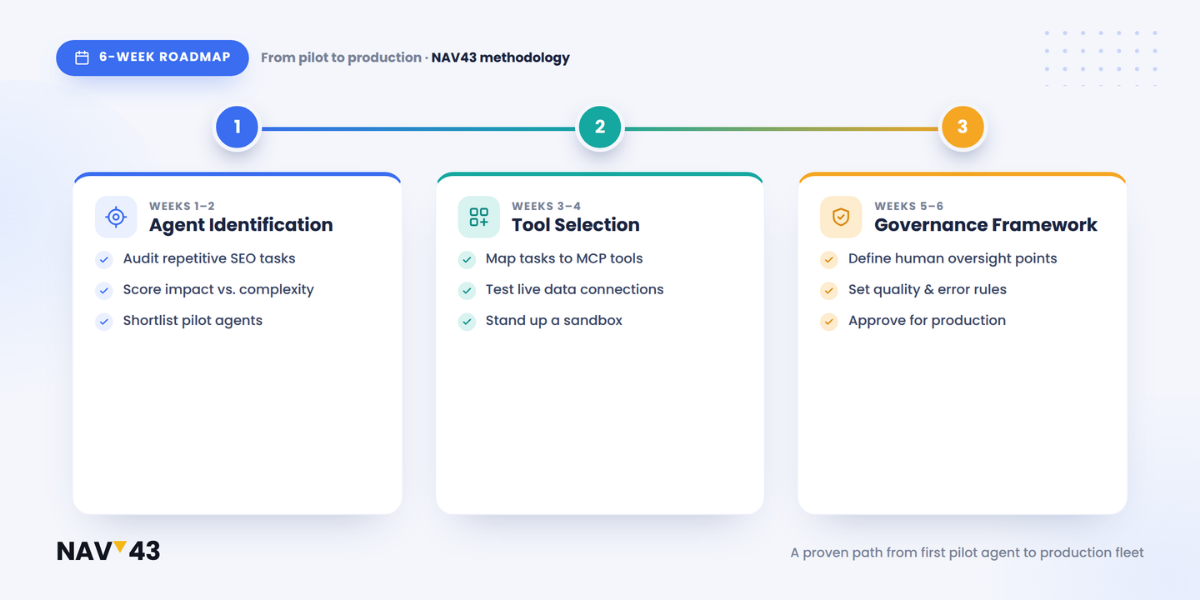
Phase 1: Agent Identification and Prioritization (Weeks 1-2)
Before selecting any tools, you need to audit your current workflows. The goal is to identify the 20% of tasks consuming 80% of your team’s time. These are your automation targets.
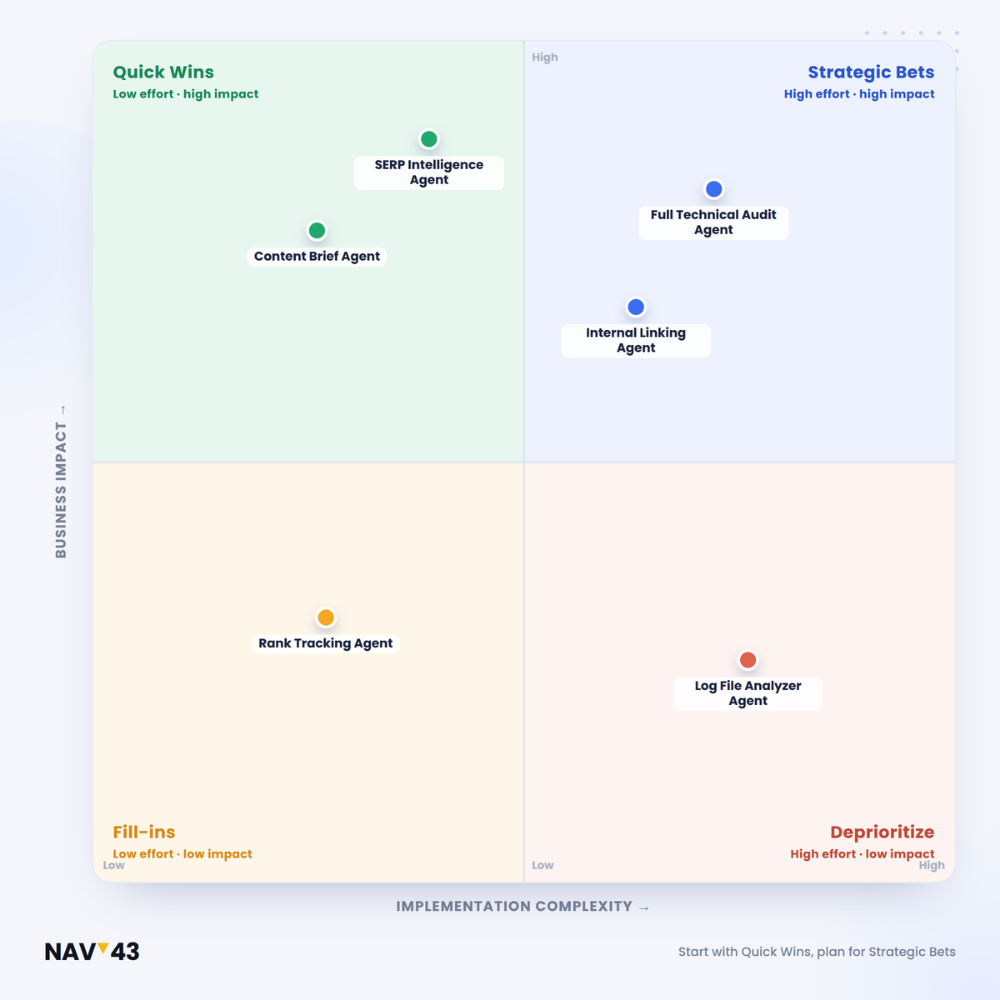
Categorize each task by automation potential. The best candidates are high-volume, rule-based, and have clear success criteria. Content brief generation fits perfectly. Strategic content planning does not.
Our prioritization framework: start with low-risk, high-frequency tasks, not your most important content. Your first agent deployment should be something that, if it fails completely, doesn’t damage your brand or tank your rankings. Research and reporting agents typically fit this criteria. Publication agents do not.
Stakeholder alignment is essential at this stage. Leadership needs to understand this is “collaborative intelligence,” not full automation. If executives expect you to fire half your team because “AI does it now,” you’ll face either organizational resistance or quality disasters. Set realistic expectations early.
Agent Opportunity Assessment Checklist
Use these criteria to evaluate whether a task is suitable for agentic automation:
- Task occurs at least weekly with consistent structure
- Clear inputs and outputs can be defined
- Success criteria are objectively measurable
- Errors are detectable and reversible
- Task doesn’t require real-time human judgment for brand safety
- Data sources needed are API-accessible or MCP-ready
- Current process is documented and repeatable
- Team has capacity to monitor agent performance during pilot
- Failure wouldn’t cause significant brand, revenue, or SEO damage
- ROI from automation justifies implementation effort
If a task checks fewer than 7 boxes, it’s not ready for agentic automation yet.
Phase 2: Tool Selection and Architecture (Weeks 3-4)
Evaluate your existing stack’s compatibility before purchasing anything new. Do your current tools have MCP servers or API access for agents? Often, the capabilities you need already exist but aren’t activated.
The build vs. buy decision matters here. Off-the-shelf agent platforms like Frase, Surfer, and the emerging HubSpot AI agents work well for standard use cases. Custom builds make sense when you have unique data sources or workflows that don’t fit templates. Our experience at NAV43: we start with the data architecture before selecting any agent platform. Understanding how information will flow between systems prevents expensive rearchitecture later.
Document your data flow mapping thoroughly. Every agent needs defined inputs, outputs, and handoff points. Skip this step, and you’ll build systems that can’t integrate with each other.
Consider integration with your existing MarTech stack. How will agentic SEO workflows connect to HubSpot, Salesforce, or your CDP? Lead intelligence from SEO agents should flow into your CRM. Campaign performance data should feed back into optimization agents. For teams running HubSpot automations, this integration is especially critical.
Phase 3: Governance Framework Design (Weeks 5-6)
This is the make-or-break phase. Remember Gartner’s warning: 40%+ of agentic AI projects will fail by 2027 due to inadequate risk controls (Gartner, 2025). Most of those failures will happen to teams that rushed past governance to get to the “exciting” deployment phase.
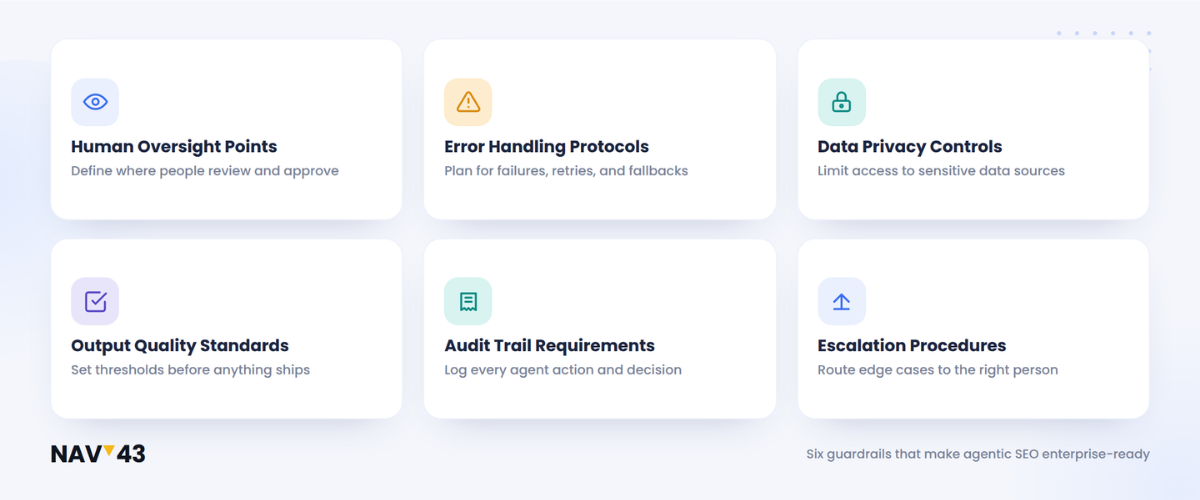
Authority boundaries must be crystal clear. What can agents do autonomously? What requires human approval? For content agents, we recommend autonomous draft generation and human-required publication approval. For technical agents: autonomous monitoring and alerting, human-required implementation of changes. Define these boundaries in writing and enforce them technically, not just procedurally.
Audit trail requirements protect you legally and operationally. Every agent action should be logged: what was done, when, based on what data, with what outcome. When something goes wrong (and it will), you need to trace the failure to its source.
Quality control protocols combine automated checks with human review thresholds. Agents should run validation passes on their own output. Content agents should check for factual-accuracy signals, brand-voice compliance, and SEO optimization scores before flagging content as ready for human review.
Rollback procedures are your insurance policy. How do you quickly disable or reverse agent actions if something goes catastrophically wrong? If your content agent starts publishing off-brand content at scale, you need a kill switch that works in minutes, not hours.
The NAV43 Agent Governance Framework
Layer 1: Authority Boundaries
Define permitted autonomous actions for each agent type, specify approval requirements for high-impact decisions, and establish escalation paths for ambiguous situations.Layer 2: Approval Workflows
Map human checkpoint gates to specific workflow stages, define approval criteria and turnaround time expectations, and create bypass procedures for urgent situations with elevated logging.Layer 3: Audit Logging
Log every agent action with timestamp, data inputs, and outputs. Retain logs for minimum 90 days (longer for regulated industries). Implement regular log review as part of governance cadence.Layer 4: Quality Thresholds
Set minimum quality scores for agent outputs before human review, define rejection criteria that automatically route outputs for revision, and track quality metrics over time to identify agent performance degradation.Layer 5: Rollback Procedures
Document step-by-step rollback for each agent type, test rollback procedures quarterly, and maintain manual process documentation as fallback.
Phase 4: Pilot Deployment and Iteration (Weeks 7-10)
Start with a single workflow. Don’t deploy multiple agent types simultaneously. You need to isolate variables to understand what’s working and what isn’t.
Define success metrics before launch. What does “working” look like for this specific workflow? Time saved? Output quality scores? Error rates? If you can’t measure it, you can’t improve it.
Design your feedback loop deliberately. How will humans flag agent errors? How will those corrections feed back into agent improvement? The agents that perform well in production are those with robust learning loops, not those with the best initial prompts.
Iteration cadence during pilot: weekly reviews minimum. Examine agent outputs, error logs, human override frequency, and team feedback. Adjust parameters, prompts, and governance rules based on what you learn.
Our typical pilot approach at NAV43: we start with a research agent. Lowest risk, highest learning value. Research agents can surface insights that inform strategy without touching customer-facing content. If they make mistakes, you’ve wasted some analyst time reviewing bad recommendations. You haven’t published anything problematic.
Phase 5: Scaling to Production Fleet (Weeks 11+)
Moving from pilot to production requires meeting specific criteria. We look at:
- Error rate below defined threshold (set based on your quality standards for content agents)
- Human override frequency declining over time
- Output quality scores meeting or exceeding manual benchmarks
- Team feedback indicating productivity gains
Once one workflow is stable, introduce agents that hand off to it. A research agent might pass keyword opportunities to a brief-generation agent. A technical audit agent might pass recommendations to a content optimization agent. Building these handoffs incrementally reduces integration risk.
Team roles evolve during this phase. SEO team members shift from executors to orchestrators. They’re managing agent fleets, reviewing exception reports, and making strategic decisions rather than executing repetitive tasks. This transition requires change management, not just technical implementation.
Continuous governance review is non-negotiable. Monthly audits of agent behavior and output quality catch drift before it becomes damage. Agents can degrade over time as the data they rely on changes. Your governance framework should include scheduled performance reviews.
The numbers support this trajectory: 34% of enterprise marketing teams now run at least one autonomous agent in production, up from 14% in Q4 2025 (Digital Applied, 2026). Meanwhile, 93% of IT leaders report intentions to introduce autonomous agents within the next 2 years (MuleSoft/Deloitte, 2025). The teams deploying now are building advantages that will compound.
Measuring ROI: Attribution Frameworks for Agentic SEO
The attribution challenge is real. How do you isolate gains from agentic workflows versus other SEO activities happening simultaneously? Without clear metrics, you can’t justify continued investment or identify opportunities for improvement.
Time savings measurement is the most straightforward metric. Track hours reclaimed from low-value tasks. BCG’s research found AI-powered workflows cut low-value work time by 25-40% (BCG, 2025). If your team spent 20 hours weekly on content brief creation before agents, and now spends 5 hours on review and approval, that’s measurable ROI.
Speed-to-execution metrics capture efficiency gains that don’t show up in hours. How long did it take to go from keyword opportunity identification to published content before agents? After agents? If your content velocity increased from 4 pieces per week to 12, that acceleration has strategic value.
Output quality metrics ensure you’re not trading speed for effectiveness. Track error rates (how often do humans reject agent outputs?), revision frequency (how much editing do agent drafts require?), and ranking performance (does agent-influenced content rank as well as human-only content?). Quality degradation negates time savings.
Revenue attribution is the ultimate measure. Connect agent-driven activities to traffic, conversions, and pipeline. If research agents identified opportunities that led to content that generated leads, trace that chain. This requires proper UTM tagging and CRM integration, but it’s the story leadership wants to hear.
Comparison methodology strengthens your case. Where possible, run A/B tests: workflows with agent involvement versus traditional processes. This isolates the agent contribution from other variables. It’s not always practical, but when you can do it, the data is compelling.
| Metric Category | Specific KPIs | Measurement Method | Benchmark Target |
|---|---|---|---|
| Time Savings | Hours reclaimed weekly | Task tracking pre/post implementation | 25-40% reduction in low-value work (BCG, 2025) |
| Speed | Content production cycle time | Timestamp tracking from brief to publish | 30-50% acceleration (BCG, 2025) |
| Quality | Agent output acceptance rate | Human review acceptance/rejection tracking | 90%+ acceptance rate |
| Quality | Ranking performance of agent content | Position tracking by content source | Equal or better than manual baseline |
| Revenue | Traffic from agent-optimized content | GA4 attribution by content tag | Positive trend quarter over quarter |
| Revenue | Leads/conversions from agent workflows | CRM attribution by source | Measurable pipeline contribution |
E-Commerce Spotlight: Agentic Workflows for Catalog-Scale SEO
E-commerce presents unique challenges and opportunities for agentic SEO. When you’re managing 50,000+ SKUs, manual optimization isn’t just inefficient. It’s impossible.
Product catalog optimization at scale is the flagship use case. Agents can generate unique product descriptions, optimize category pages, and manage faceted navigation SEO across massive inventories. They identify thin content pages, generate optimization recommendations, and track performance by product category. A human team reviewing 50,000 product pages would take months. An agent fleet processes the same catalog in hours.
Dynamic inventory-based content requires automation to work at all. Agents that create and remove content based on stock levels prevent SEO damage caused by thousands of out-of-stock pages being indexed. They implement appropriate redirects, update internal linking, and adjust category page content based on real-time inventory data.
Review and UGC optimization address E-E-A-T signals that search engines increasingly value. Agents identify products with strong user-generated content and feature that content prominently. They flag products lacking reviews for promotional campaigns. They ensure the review schema is correctly implemented across the catalog.
Seasonal and promotional automation keeps content fresh without constant human attention. Agents adjust meta titles and descriptions for seasonal relevance, update internal linking to support promotional landing pages, and scale back seasonal content when the moment passes.
E-Commerce Agent Use Cases
- Catalog health monitoring: Continuous scanning for thin content, missing meta data, broken internal links, and schema errors across entire product database
- Dynamic description generation: Creating unique, optimized product descriptions based on product attributes and category context
- Out-of-stock management: Automated redirects, related product linking, and content adjustments when products go unavailable
- Review aggregation and featuring: Identifying high-value UGC and implementing schema for star ratings and review counts
- Category page optimization: Adjusting facet combinations, improving navigation hierarchy, and optimizing category descriptions
- Seasonal content rotation: Scheduling meta tag updates, landing page modifications, and internal link changes based on calendar
- Competitor price monitoring: Tracking competitor product pages and alerting on pricing changes that affect conversion
- Image optimization: Automated alt text generation, image compression recommendations, and visual search optimization
The SEO content marketing strategies that work for e-commerce depend on this kind of systematic optimization. Agents make the systematic part achievable at a catalog scale.
The GEO Convergence: Optimizing for AI Citations and Google Rankings
Here’s the convergence that’s reshaping SEO strategy: traditional search optimization and GEO (Generative Engine Optimization) are merging. Your content must now perform in both paradigms simultaneously.
AI agents now account for roughly 33% of organic search activity (BrightEdge, 2026). When someone asks ChatGPT or Perplexity for a product recommendation, the AI cites sources. Being cited drives awareness, credibility, and increasingly, direct traffic. But the content that gets cited isn’t always the content that ranks #1 on Google. The optimization requirements overlap but aren’t identical.
Agentic workflows accelerate GEO because agents can continuously monitor AI citation performance across ChatGPT, Perplexity, Claude, and other systems. Manual monitoring at scale is impossible. Automated monitoring creates feedback loops that inform content strategy.
Answerable content at scale is a core GEO requirement. Agents can identify question-based queries in your keyword set and generate structured, quotable content that AI systems can extract and cite. The GEO content strategy we use with clients depends on this systematic approach to quotability.
Citation monitoring agents track when and where your content gets cited by AI systems. This visibility was nearly impossible before the advent of agentic tools. Now, teams can see which content earns citations, which competitor content gets cited instead, and what formatting patterns correlate with citation frequency.
Schema markup automation bridges the gap between your content and AI comprehension. Structured data helps AI systems understand what your content is about, who created it, and why it’s authoritative. Implementing schema at scale without agents is a bottleneck that most teams have given up on clearing. For a technical deep-dive, see our structured data for GEO guide.
Gartner’s prediction puts this in stark terms: by 2028, 90% of B2B buying will be AI-agent-intermediated, pushing over $15 trillion through AI-agent exchanges (Gartner Strategic Predictions, 2026). If you’re not optimizing for AI citation now, you’re optimizing for a search landscape that’s disappearing.
Common Pitfalls: Why Agentic AI Projects Fail (And How to Avoid Each)
Based on our implementation work with enterprise clients, these are the failure modes we see most often.
Pitfall 1: Skipping the governance phase. This is the number one cause of failure according to Gartner’s research. Teams rush to deploy agents without defining authority boundaries, audit trails, or rollback procedures. Then something goes wrong, there’s no way to trace it, and leadership pulls the plug on the entire initiative. Solution: Implement the NAV43 governance framework before any production deployment. Governance isn’t overhead. It’s infrastructure.
Pitfall 2: Starting with high-stakes workflows. Deploying content publication agents as your first agentic project is like learning to drive in a Formula 1 race. Solution: Pilot with research or reporting agents. Build competence before touching customer-facing content.
Pitfall 3: Expecting full automation. If your implementation plan involves eliminating human review, you’re building a liability generator. AI systems hallucinate. They miss nuance. They don’t understand brand voice at the level humans do. Solution: Design for “collaborative intelligence” with mandatory human checkpoints. Agents handle volume. Humans ensure quality.
Pitfall 4: Ignoring E-E-A-T signals. Automated content that lacks demonstrated expertise, experience, authority, and trust will perform poorly regardless of technical optimization. Google’s quality raters and AI citation systems both favor content with clear human expertise behind it. Solution: Ensure human experts review and refine agent outputs. Include bylines, author pages, and editorial oversight that signals genuine expertise.
Pitfall 5: Building disconnected agent silos. An agent that can’t access your SEO data sources is just an expensive chatbot. Teams deploy agents without MCP connections or API integrations, then wonder why they’re not seeing productivity gains. Solution: Invest in data architecture before agent selection. Map your data flows first.
Pitfall 6: Neglecting change management. Agentic workflows change how your team operates. Team members who feel threatened by automation will resist adoption. Solution: Position agents as capability multipliers, not job replacements. Focus training on orchestration skills.
Pitfall 7: Failing to measure ROI. If you can’t prove the value of your agentic investment, budget cuts will eventually end your program. Solution: Establish baseline metrics before deployment. Track time savings, output quality, and business outcomes continuously.
Conclusion: The Competitive Window Is Open Now
The shift to agentic AI workflows isn’t optional for competitive SEO teams. It’s happening now, and the window for building first-mover advantage is narrow.
The core opportunity is operationalization, not adoption. Ninety percent of marketing organizations have AI agents in their stacks, but only 13% have them integrated into workflows that generate measurable results (Frase.io/Graphed, 2026). That gap is where competitive advantage lives. The teams closing it now will be compounding those advantages while competitors are still running disconnected pilots.
Governance is not optional overhead. Gartner’s warning about 40%+ project failure rates is grounded in real patterns. The teams that skip the governance phase because it feels like it slows down deployment are exactly the teams that end up with failed initiatives, damaged content, and leadership skepticism that sets back their AI programs by years. Build the framework before you build the fleet.
The SEO professional’s role is genuinely changing. The orchestrator model, in which your team designs systems, sets governance rules, reviews strategic outputs, and manages agent performance, is not a diminution. It’s an upgrade. Teams that embrace this transition become exponentially more capable. Teams that resist it become bottlenecks.
MCP connectivity and the GEO convergence are the two infrastructure priorities that will define SEO’s competitive positioning over the next three years. Agents without data access are expensive toys. And content that only ranks in Google but never gets cited by AI is optimized for a shrinking share of search. Both problems are solvable, and the roadmap in this guide gives you the framework to solve them systematically.
Start this week. Audit your workflows. Identify your first low-risk pilot. Build your governance framework before you deploy a single agent. The teams building agent fleets today are establishing citation authority and operational efficiency that will compound for years.
Ready to assess your team’s readiness for agentic AI? Get a free growth plan that includes an evaluation of your current workflows and specific recommendations for where agentic automation will drive the highest ROI.
