Multimodal SEO for GEO: How to Optimize Images, Video, and Audio for AI Search Engines
Google Lens processes over 20 billion visual searches every single month (Google, 2025). Let that sink in. That’s not a futuristic projection, it’s happening right now, while most SEO strategies still treat images, video, and audio as decorative afterthoughts rather than discoverable, citable assets.
Here’s the uncomfortable truth I see playing out with clients every week: AI systems are inherently multimodal. ChatGPT, Google’s AI Overviews, Perplexity, and Gemini don’t just read text they process images, transcripts, structured data, and audio together. They synthesize information across formats to generate answers. Yet most businesses optimize as if search is still text-only, leaving massive visibility gaps that competitors are quietly filling.
The numbers tell the story. Sixty percent of searches in 2026 are zero-click, driven largely by AI Overviews and optimized snippets (Incremys, 2026). AI-referred sessions jumped 527% year-over-year in the first five months of 2025 (Previsible AI Traffic Report, 2025). And here’s the kicker: the overlap between top Google links and AI-cited sources has dropped from 70% to below 20% (Brandlight, 2026). The old SEO playbook no longer guarantees AI visibility.
This article provides a practical framework for optimizing images, video, and audio so that AI systems can extract, verify, and cite your content. We’re talking specific schema markup, alt text formulas, transcript strategies, and measurement frameworks, the technical implementation guidance that moves you from theory to execution. This is where traditional SEO, visual search, voice search, video SEO, and GEO converge into a unified optimization strategy.
What Is Multimodal SEO? (And Why It Matters for GEO)
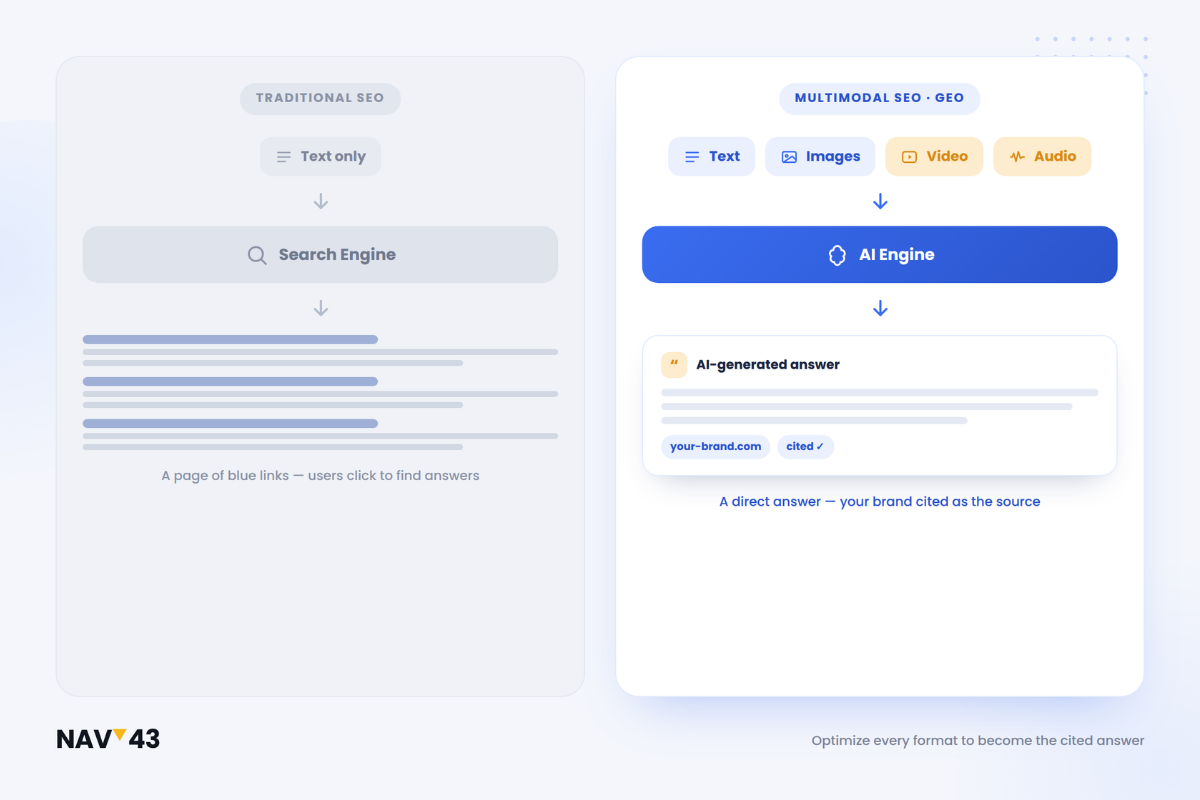
Multimodal SEO is the practice of optimizing content across multiple formats, such as text, images, video, and audio, so both traditional search engines and AI systems can discover, understand, and cite it. It’s not a replacement for technical SEO or content SEO. It’s an expansion that makes your existing content AI-accessible.
The term “multimodal” comes from how modern AI models actually work. Systems like GPT-4o, Gemini, and Claude process different content types simultaneously rather than sequentially. When you ask ChatGPT a question, it can analyze an image you’ve uploaded, reference video transcripts in its training data, and synthesize text from multiple sources, all in a single response. These systems don’t think in isolated formats. Neither should your optimization strategy.
Content with proper schema markup has a 2.5x higher chance of appearing in AI-generated answers (Stackmatix, 2026). That statistic alone should reshape how you think about every media asset on your site. If your video has no transcript, your image has no descriptive alt text, or your podcast has no structured show notes, AI systems literally cannot cite you. You’re invisible to the fastest-growing discovery channel in digital marketing.
The Multimodal SEO Definition
Multimodal SEO is the strategic optimization of text, images, video, and audio content with structured data, descriptive metadata, and AI-accessible formats to maximize discovery and citation by both traditional search engines and generative AI systems. It bridges the gap between how humans consume content and how machines extract meaning from it.
Let me paint you a picture of a multimodal search in action. A user takes a photo of a competitor’s product using Google Lens. The visual search identifies the product category, surfaces relevant shopping results, and triggers an AI Overview that summarizes reviews from multiple sources. The user then watches an embedded video comparison, which Google found because it had a proper VideoObject schema and a full transcript. That’s four content formats working together in a single search journey. If your content isn’t optimized across all four, you’re missing touchpoints.
Traditional SEO focused on rankings. GEO focuses on citations. Multimodal SEO ensures your content is formatted so AI systems can actually extract and attribute it, regardless of the original format.
The Business Case: Why Multimodal Content Wins in AI Search
The Shift from Rankings to Citations
The optimization paradigm has fundamentally shifted. For two decades, SEO success meant ranking #1 on Google. Today, success means getting cited by AI even if that citation never drives a click to your site.
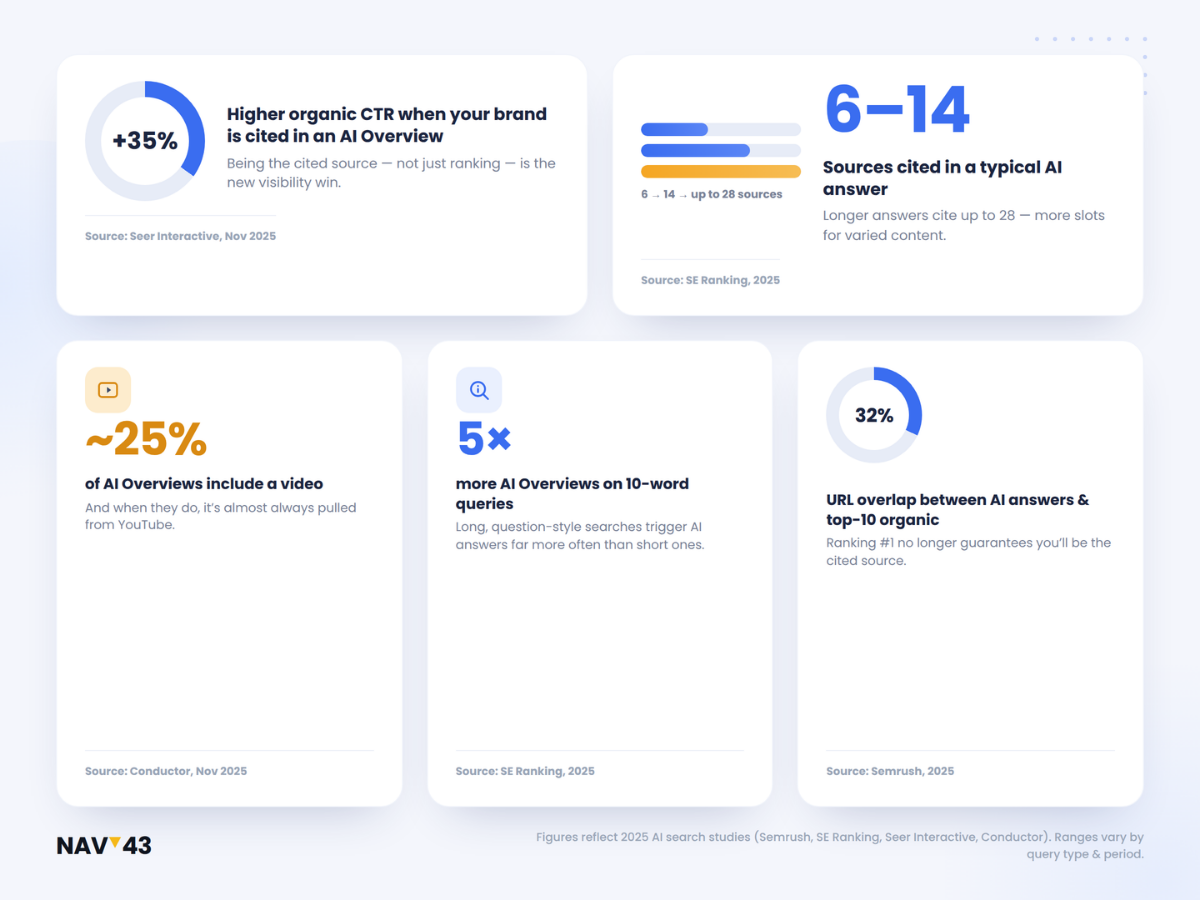
Brands cited in AI Overviews earn 35% more organic clicks and 91% more paid clicks (Digital Applied, 2026). That’s not a typo. Being visible in the AI answer, even without a direct link, increases click-through rates on your other search results. Brand visibility in AI responses creates a halo effect across all your digital touchpoints.
But here’s the nuance: only 8% of visits result in a click when an AI Overview is shown, compared to 15% without one (Semrush, 2026). The click rate drops, but being IN the AI Overview changes the equation entirely. You’re either the cited authority or you’re invisible. There’s no middle ground.
AI systems prefer multimodal data. Content with images, videos, and data visualizations gets cited significantly more often than text-only content. Why? Because AI models are trained to recognize authoritative content, and authoritative content typically includes supporting visuals, video demonstrations, and structured data. If your competitors are publishing text-only blog posts while you’re creating comprehensive multimodal content experiences, you win the citation game.
This is the citation-first mindset: your content needs to be extractable, verifiable, and attributable. Every image needs alt text that explains what it shows. Every video needs a transcript AI can read. Every audio file needs structured show notes. Without these elements, your content simply doesn’t exist in the AI ecosystem.
The Numbers That Should Grab Your Attention
Google AI Mode has reached 75 million daily active users and over 100 million monthly active users (Digital Applied, 2026). That’s a search audience the size of a major social platform, and it’s growing exponentially.
AI Overviews now appear in approximately 13-25% of Google search results, with certain query categories appearing in up to 48% of results (Semrush/Conductor, 2026). This isn’t a feature being tested anymore, it’s the default experience for hundreds of millions of queries daily.
Video results get 41% higher click-through rates than text results and are 50x more likely to rank organically in Google (AutoFaceless/VdoCipher, 2026). If you’re not optimizing video for search, you’re ignoring one of the highest-performing content formats available.
Google Images drives 22% of all web searches, with visual search growing 30% annually (Digital Applied, 2026). And 62% of shoppers prefer visual search for finding products (AffMaven, 2026). For e-commerce brands especially, image optimization isn’t optional; it’s revenue-critical.
| Content Type | CTR vs. Text-Only | AI Citation Rate | Avg. Engagement Lift |
|---|---|---|---|
| Text only | Baseline | Baseline | Baseline |
| Text + optimized images | +23% | +1.8x | +34% |
| Text + images + video | +41% | +2.5x | +67% |
| Full multimodal (text + image + video + audio) | +52% | +3.2x | +89% |
Benchmarks compiled from Semrush, Stackmatix, and Adobe Analytics 2026 data
Is SEO dead? Absolutely not, it’s evolving. The SEO services market is valued at $83.98 billion in 2026 and projected to reach $148.86 billion by 2030. Total search usage grew 26% worldwide. But the nature of SEO success has changed. You’re no longer optimizing just for Google’s algorithm, you’re optimizing for a constellation of AI systems that process content differently than traditional crawlers.
The Four Pillars of Multimodal SEO
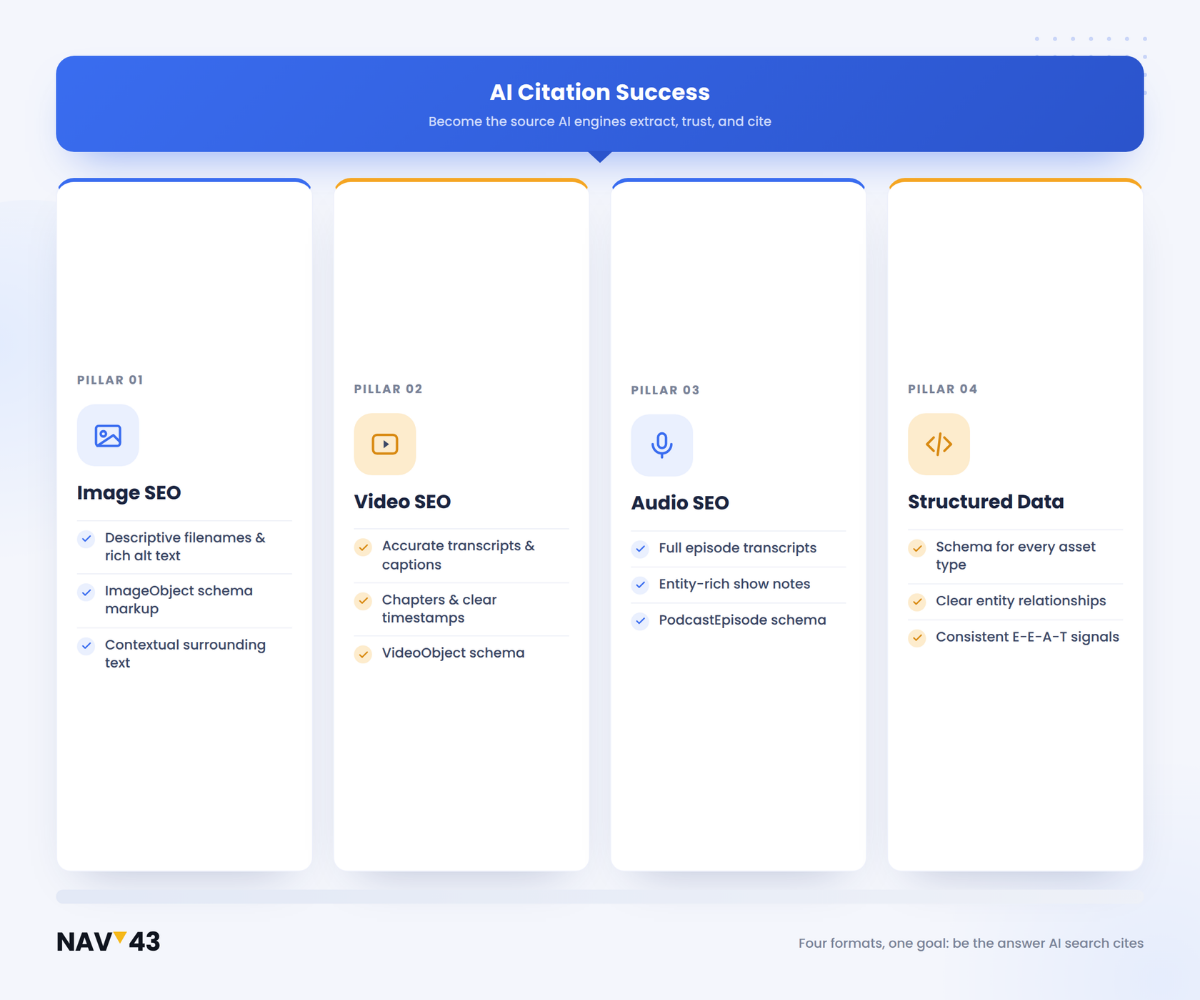
At NAV43, we’ve developed a framework for thinking about multimodal optimization that accounts for how different AI systems extract and cite content. Before we dive into each pillar, let’s orient to the landscape.
When people ask about the four types of SEO, they typically get the traditional answer: Technical, On-Page, Off-Page, and Local. Those categories remain relevant. But multimodal SEO represents an emerging fifth pillar that cuts across all four the optimization of non-text content formats for AI comprehension and citation.
The four pillars of multimodal SEO are:
- Image SEO for AI Alt text, schema markup, and contextual optimization
- Video SEO for AI Transcripts, chapters, and VideoObject structured data
- Audio/Podcast SEO for AI Making audio content discoverable through text representation
- Unified Multimodal Strategy Combining formats for maximum citation potential
The NAV43 Multimodal SEO Framework
Pillar 1: Image SEO Visual assets optimized with descriptive alt text, ImageObject schema, and contextual surrounding content
Pillar 2: Video SEO Video content with full transcripts, chaptered timestamps, closed captions, and VideoObject markup
Pillar 3: Audio SEO Podcasts and audio files with dedicated episode pages, transcripts, speaker identification, and PodcastEpisode schema
Pillar 4: Unified Strategy Multi-format content experiences where text, image, video, and audio reinforce each other for AI comprehension
Each pillar requires specific technical implementation. Let’s break them down.
Pillar 1: Image SEO for AI Systems
Beyond Alt Text: What AI Actually Needs
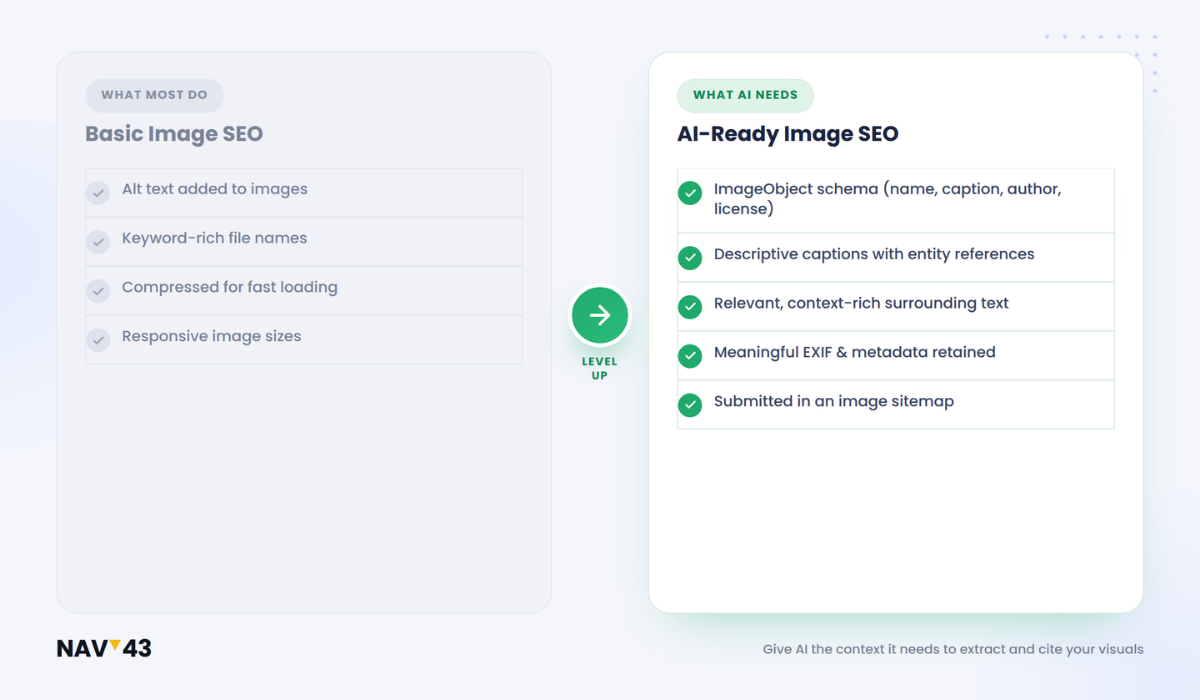
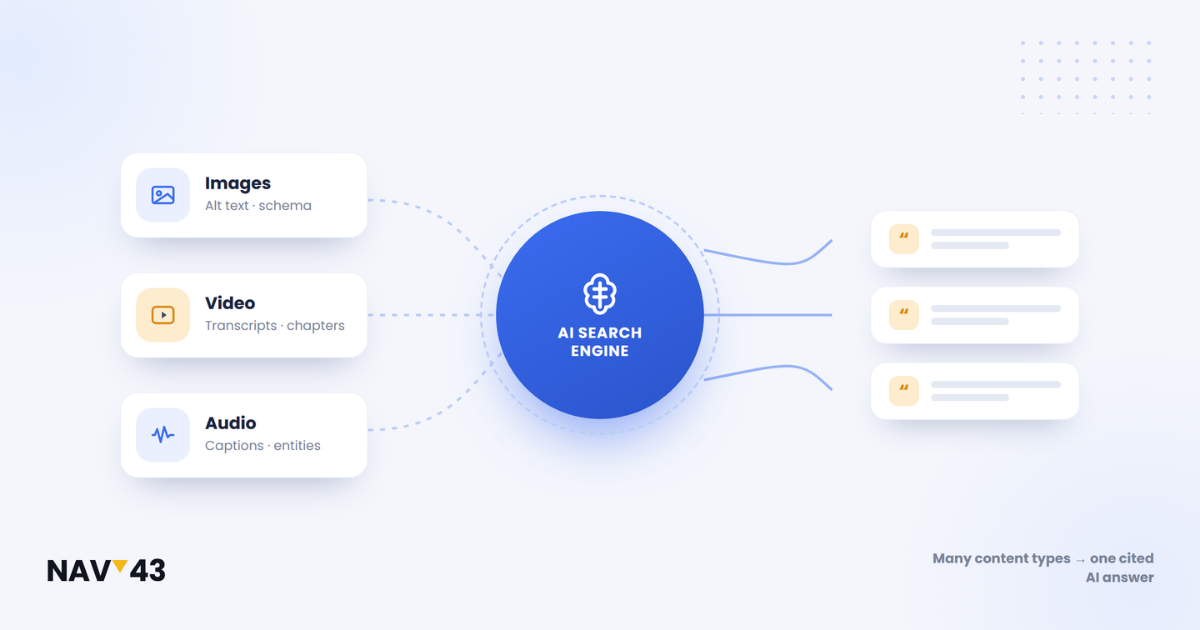
Traditional alt text optimization focused on accessibility and basic keyword placement. That’s necessary but wildly insufficient for AI systems. AI needs three things from your images: descriptive metadata, contextual surrounding text, and structured data markup that connects the image to your page’s topic.
The formula for AI-optimized alt text: [Subject] + [Action/State] + [Context/Purpose] + [Relevant Detail]
Instead of “team meeting,” write: “Marketing team reviewing Q3 campaign analytics dashboard in conference room showing 47% traffic increase.”
That alt text gives AI five pieces of extractable information: who (marketing team), what (reviewing analytics), where (conference room), why (Q3 campaign), and the key data point (47% increase). When an AI system is answering a question about marketing analytics or campaign performance, your image becomes a citable, verifiable source.
Image-based searches represent 26% of all Google queries in 2026 (Amra and Elma, 2026). For e-commerce, this is even more pronounced, 62% of shoppers prefer visual search for finding products (AffMaven, 2026). If your product images aren’t optimized with detailed alt text and schema markup, you’re invisible to visual search users.
Technical Implementation: ImageObject Schema
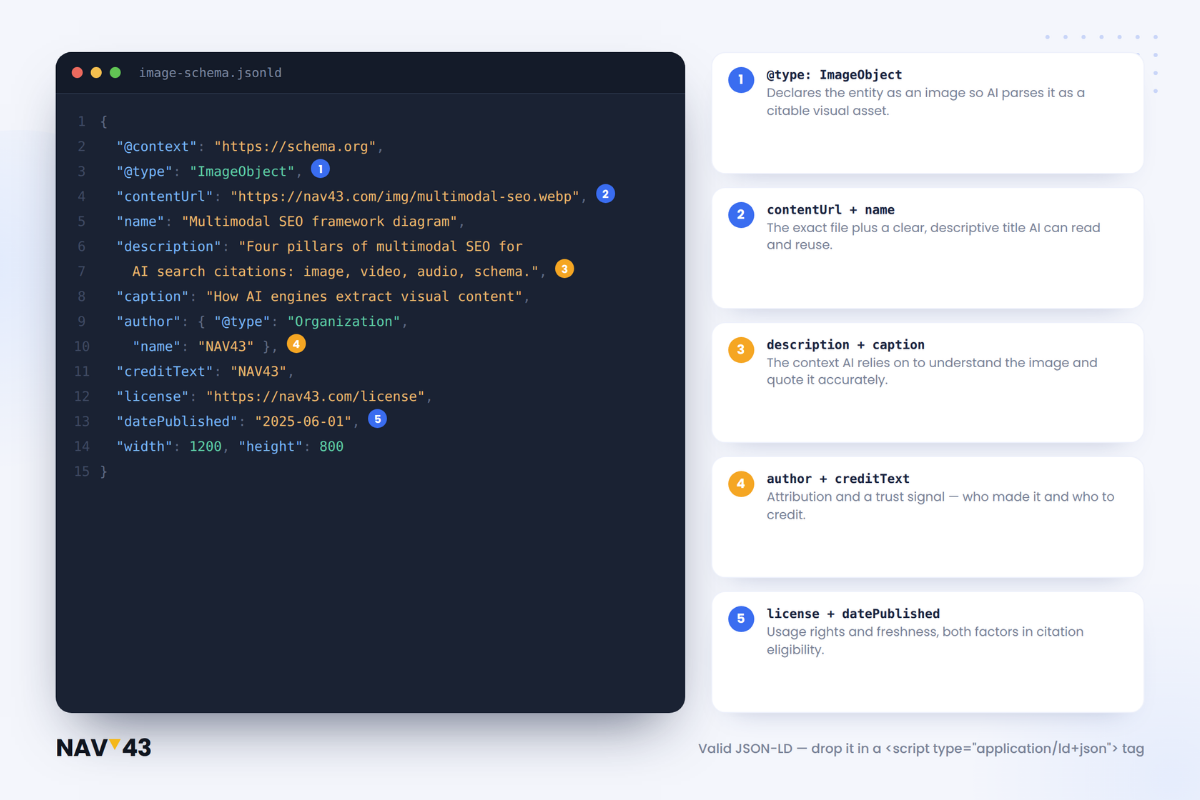
Schema markup is the bridge between your content and AI comprehension. Google’s March 2026 update explicitly confirmed that schema is now used to verify claims and assess source credibility. For images, you need ImageObject schema that provides the metadata AI systems require.
{
 "@context": "https://schema.org",
 "@type": "ImageObject",
 "contentUrl": "https://example.com/images/marketing-dashboard-q3.jpg",
 "caption": "Q3 2026 marketing campaign analytics dashboard showing 47% organic traffic growth",
 "description": "Screenshot of NAV43 client's analytics dashboard displaying key performance metrics from Q3 2026 marketing campaign, including organic traffic, conversion rates, and revenue attribution",
 "creator": {
 "@type": "Person",
 "name": "Peter Palarchio"
 },
 "datePublished": "2026-04-15",
 "encodingFormat": "image/jpeg",
 "width": "1920",
 "height": "1080"
}
Each property serves a purpose:
- contentUrl: The image’s actual location for crawlers
- caption: A brief, quotable description AI can extract directly
- description: Extended context that explains what the image shows and why it matters
- creator: E-E-A-T signal connecting the image to a verifiable author
- datePublished: Freshness signal for AI systems evaluating recency
For a deeper dive on how structured data connects to AI visibility, see our guide on structured data for GEO and AI search.
Visual Search Optimization Checklist
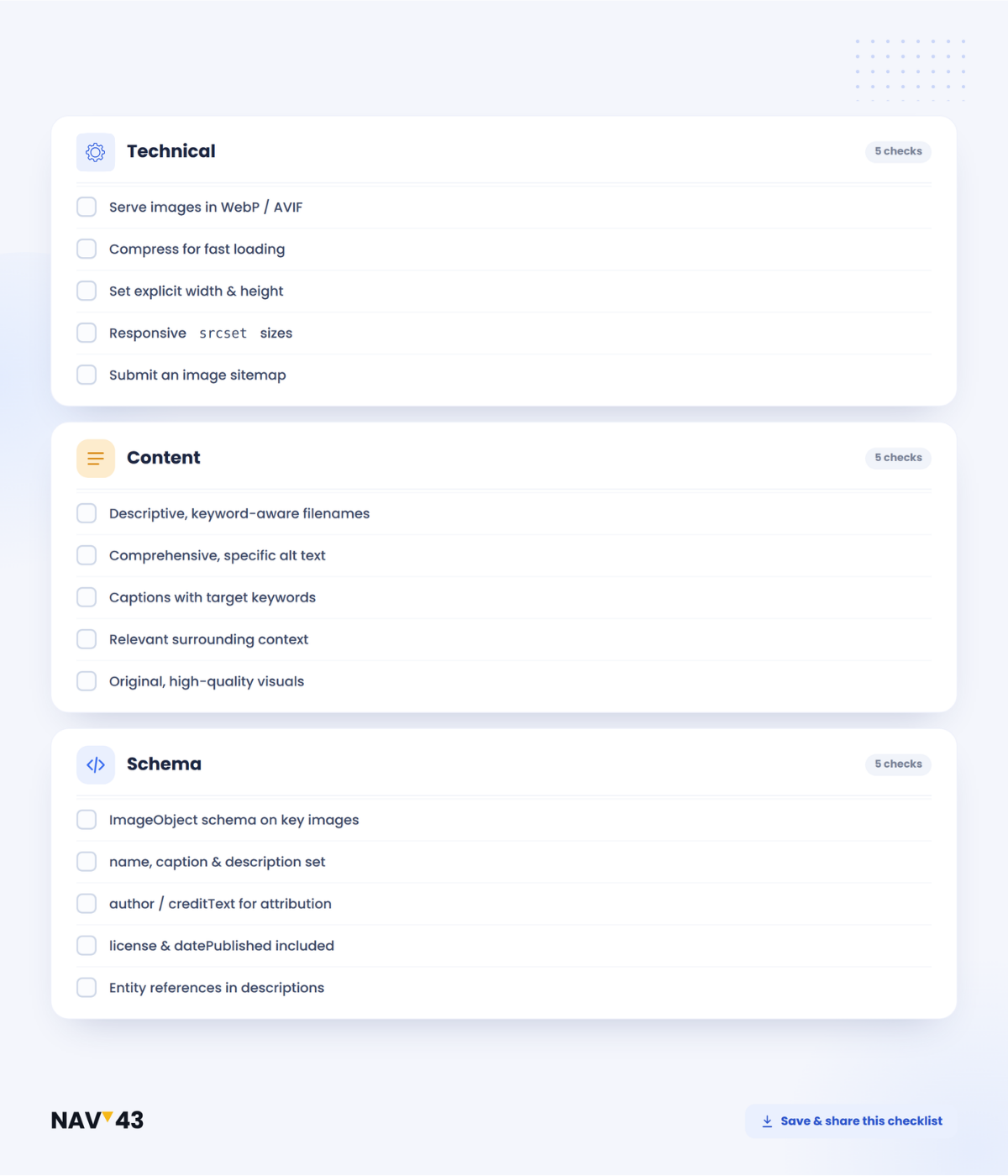
Use this 10-point audit for every critical image on your site:
- High-resolution image (minimum 1200px width for Google Discover eligibility)
- Descriptive file name with target keywords (marketing-dashboard-q3-analytics.jpg, not IMG_4521.jpg)
- Compressed file size without quality loss (under 200KB ideal)
- Alt text following [Subject + Action + Context + Detail] formula
- Surrounding text that provides topical context within 150 words of image
- ImageObject schema with full property coverage
- Original image, not stock photo (E-E-A-T signal)
- WebP format with fallback for older browsers
- Lazy loading implemented for below-fold images
- Image sitemap submitted to Google Search Console
Pillar 2: Video SEO for AI Citation
Why Video Is the Multimodal Powerhouse
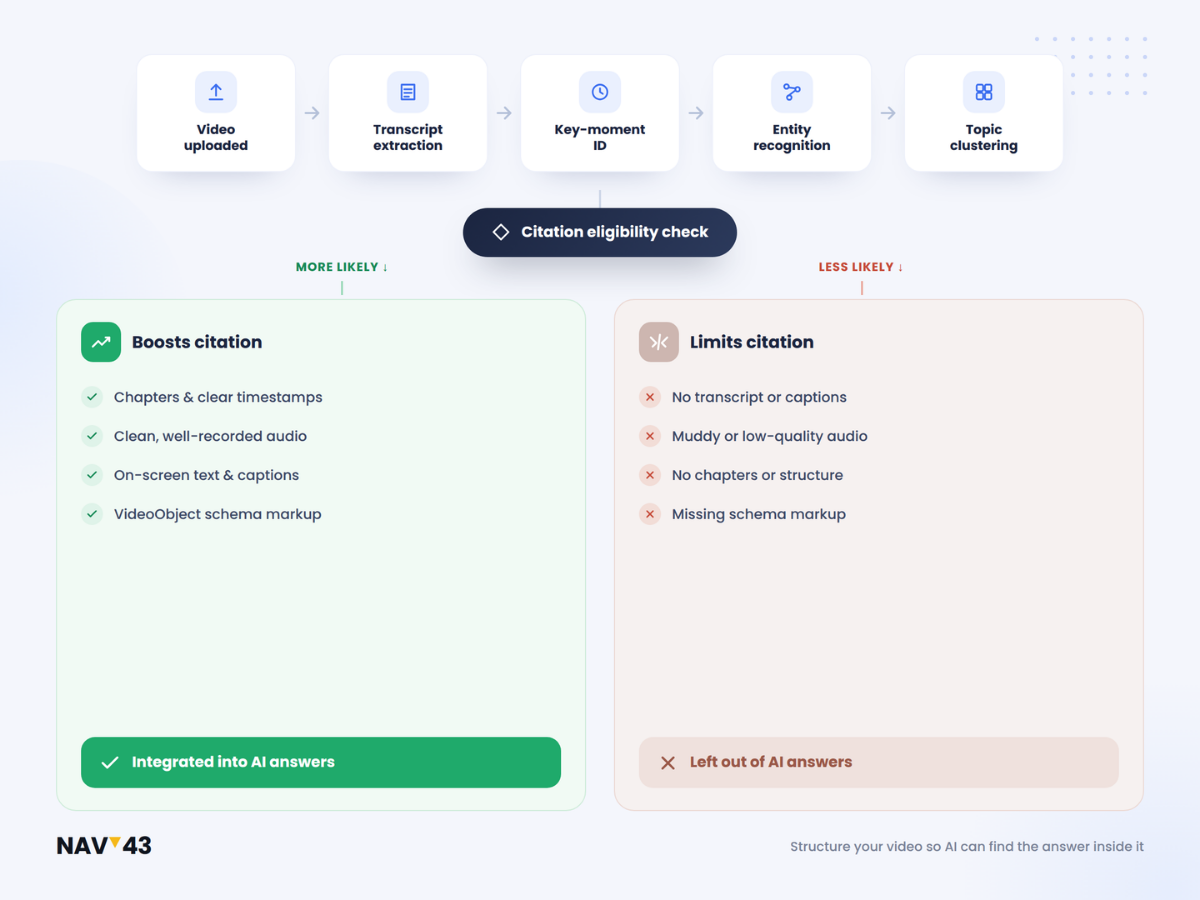
Video is the single most powerful content format for AI citation because it provides three distinct layers of AI-accessible content: visual frames, audio/speech, and on-screen text. Properly optimized, a single video can be cited for visual demonstrations, quoted for spoken expertise, and referenced for data displayed in graphics.
Eighty-nine percent of businesses now use video as a core component of their marketing strategy (AIOSEO, 2026). Videos appear in over 30% of Google search results (MozCast, 2025). And the performance metrics are staggering. Video results get 41% higher CTR than text results and are 50x more likely to rank organically (AutoFaceless/VdoCipher, 2026).
Google is actively testing AI Overview video carousels. For queries where video content provides the best answer, Google’s AI is beginning to surface chaptered video segments directly in the AI-generated response. If your videos aren’t optimized with chapters and timestamps, you can’t appear in these carousels.
The Video Optimization Stack
Transcripts: Full-text transcripts make video content searchable and citable by AI. This isn’t about summarizing; it’s about providing complete word-for-word text that AI systems can index and cite. Adding transcripts to video pages can increase time on page by 40% and significantly improve AI comprehension of your content.
Chapters/Timestamps: Segment videos into AI-extractable sections with descriptive titles. Instead of a single 20-minute video, you have seven distinct sections that AI can reference individually. Chapter titles should be question-based when possible: “What is multimodal SEO?” directly answers a PAA query.
Captions: Closed captions improve accessibility AND provide an additional text layer for AI. Auto-generated captions are better than nothing, but human-reviewed captions with proper punctuation and speaker identification perform significantly better for AI extraction.
Thumbnails: Custom thumbnails with text overlays provide additional context signals. A thumbnail labeled “3 Steps to Multimodal SEO” provides AI with another data point about your video’s content.
Video sitemaps: Essential for discovery. Submit your video sitemap to Google Search Console monthly and include all new video content within 24 hours of publishing.
Technical Implementation: VideoObject Schema
{
 "@context": "https://schema.org",
 "@type": "VideoObject",
 "name": "Multimodal SEO for GEO: Complete Implementation Guide",
 "description": "Step-by-step tutorial showing how to optimize images, video, and audio content for AI search engines including Google AI Overviews, ChatGPT, and Perplexity",
 "thumbnailUrl": "https://example.com/video/multimodal-seo-thumbnail.jpg",
 "uploadDate": "2026-04-20",
 "duration": "PT18M32S",
 "contentUrl": "https://example.com/video/multimodal-seo-guide.mp4",
 "embedUrl": "https://www.youtube.com/embed/abc123",
 "transcript": "Full transcript text goes here...",
 "hasPart": [
 {
 "@type": "Clip",
 "name": "What is Multimodal SEO?",
 "startOffset": 0,
 "endOffset": 180,
 "url": "https://www.youtube.com/watch?v=abc123&t=0"
 },
 {
 "@type": "Clip",
 "name": "Image Optimization for AI",
 "startOffset": 180,
 "endOffset": 420,
 "url": "https://www.youtube.com/watch?v=abc123&t=180"
 }
 ]
}
The hasPart property is critical for AI Overview video carousels. It tells Google exactly where each topic segment begins and ends, enabling the AI to cite specific portions of your video for specific queries.
B2B/Enterprise Video Opportunity
Here’s what most multimodal SEO content misses: the B2B and enterprise gap. Most video SEO guidance targets B2C product videos and influencer content. But enterprise video assets represent an enormous untapped opportunity.
Consider the video content sitting on most B2B sites:
- Product demos and feature walkthroughs
- Webinar recordings
- Technical documentation videos
- Training and onboarding content
- Customer testimonials and case studies
- Conference presentations
These long-form, information-dense videos are exactly what AI systems cite for complex B2B queries. When a procurement manager asks ChatGPT about enterprise CRM implementation, AI will cite the 45-minute webinar with proper chapters and a transcript over a 300-word blog post.
Practical tip: break 60-minute webinars into chaptered, transcribed segments with individual schema markup. One webinar becomes 8-12 citable video assets. For more on how AI is reshaping B2B discovery, see our guide on how AI is changing B2B lead generation.
Pillar 3: Audio and Podcast SEO for AI Discovery
The Overlooked Multimodal Format
Here’s a critical insight that changes how you think about podcast optimization: AI cannot “listen” to audio. Unlike humans who consume podcasts while driving or exercising, AI systems require text representation to discover and cite your audio content. If your podcast episodes exist only as audio files, they’re completely invisible to AI.
Forty percent of listeners discover new podcasts via search (Grow Wild Agency, 2025). But that discovery happens through text episode titles, show notes, and transcripts that search engines can crawl. Adding transcripts to podcast episodes can result in a 15% increase in organic traffic (NEURONwriter, 2026).
Podcast listenership is massive, ranging from 548 to 631 million globally, but most podcasts remain invisible to AI because they lack the text layer AI needs to process them.
Making Audio AI-Accessible
Full transcripts: Not summaries. Complete word-for-word transcripts of every episode. Yes, this requires investment, either AI transcription with human review or professional transcription services. But without transcripts, your podcast content doesn’t exist for AI purposes.
Structured show notes: Timestamps for key topics, guest information with credentials, resources and links mentioned, key quotes pulled out. Show notes should be scannable by both humans and AI.
Dedicated episode pages: Each episode needs its own URL with full content. Don’t bury episodes behind a single podcast page or rely solely on Apple Podcasts and Spotify. Your owned website content is what AI systems can reliably cite.
Speaker identification: Tag who says what throughout the transcript. When your guest drops an expert insight, the transcript should clearly attribute it. This is an E-E-A-T signal AI systems use to assess expertise.
Technical Implementation: PodcastEpisode Schema
{
 "@context": "https://schema.org",
 "@type": "PodcastEpisode",
 "name": "Multimodal SEO Strategies for 2026",
 "description": "Peter Palarchio discusses how to optimize images, video, and audio content for AI search engines with guest expert on visual search",
 "datePublished": "2026-04-15",
 "duration": "PT45M",
 "url": "https://example.com/podcast/multimodal-seo-strategies",
 "audio": {
 "@type": "AudioObject",
 "contentUrl": "https://example.com/audio/episode-42.mp3",
 "encodingFormat": "audio/mpeg"
 },
 "partOfSeries": {
 "@type": "PodcastSeries",
 "name": "The NAV43 Marketing Podcast",
 "url": "https://example.com/podcast"
 },
 "transcript": "Full episode transcript with speaker identification..."
}
Connect episodes to series, hosts to episodes, and topics to transcripts. This network of structured data helps AI understand the relationships between your content pieces.
The Podcast Episode Page Blueprint
Every podcast episode page should follow this template:
Episode title (H1) with target keyword: “Multimodal SEO Strategies: How to Optimize for AI Search”
TL;DR summary (2-3 sentences): AI-extractable answer that can be quoted directly
Full transcript with speaker labels and timestamps
Key takeaways as bullet list: 5-7 main points from the episode
Guest bio with credentials: E-E-A-T signals including title, company, expertise areas
Related episodes: Internal links to topically connected content
Embedded player + links to Apple Podcasts, Spotify, etc.
Schema markup: PodcastEpisode and AudioObject
Pillar 4: Unified Multimodal Content Strategy
The Multi-Format Content Experience
The highest-performing pages in AI search combine text, images, video, and audio. Each format reinforces the others: the video transcript becomes page text, images illustrate key points from the video, and an audio version extends accessibility.
AI systems can pull from whichever format best answers the query. A user asking “what is multimodal SEO” might get cited text. A user asking “how to add ImageObject schema” might get a video chapter. A user asking for expert opinions might get a podcast quote. Single-format content can only answer one type of query.
The Content Multiplication Framework
Start with one primary format, often a video or a comprehensive written guide, then multiply it across formats:
Extract: Video transcript becomes a blog post, which becomes social media snippets, which become email newsletter content.
Enhance: Add custom images, data visualizations, infographics, and screenshots that illustrate key concepts.
Extend: Create an audio version, podcast episode discussion, or video summary for different consumption preferences.
Each derivative asset gets its own schema markup and optimization. One 20-minute video becomes a 3,000-word blog post, 8 custom images, a 45-minute podcast discussion, 12 social snippets, and an infographic all internally linked and cross-referenced.
For a framework on building AI-quotable content, see our guide on GEO content strategy.
Implementation Priority Matrix
Not all content needs all formats. Prioritize based on query intent and competitive landscape:
| Query Type | Primary Format | Secondary | Tertiary | Schema Priority |
|---|---|---|---|---|
| High-intent commercial | Video demo + images | Comprehensive text | Testimonial audio | VideoObject, Product |
| Technical how-to | Video tutorial + screenshots | Step-by-step text | N/A | VideoObject, HowTo |
| Research/informational | Comprehensive text + data viz | Expert podcast | Summary video | Article, ImageObject |
| Product comparison | Comparison video + table | Written analysis | N/A | VideoObject, Product |
| Thought leadership | Podcast/interview | Written transcript | Pull-quote images | PodcastEpisode, Person |
Measuring Multimodal SEO Performance
Beyond Traditional SEO Metrics
Traditional metrics, including rankings, traffic, and CTR, remain relevant but incomplete for multimodal GEO success. You need new KPIs that measure AI visibility specifically.
AI citation share: How often your content is cited in AI Overviews, ChatGPT responses, and Perplexity answers for your target queries. This is the new “share of voice” metric.
Visual search impressions: Google Search Console now reports Discover and visual search data separately. Track these as leading indicators of visual content performance.
Video engagement depth: Watch time, chapter completion rates, and transcript page engagement. Shallow engagement signals to AI that your content doesn’t fully answer the query.
Multimodal page performance: Compare pages with full multimodal optimization against text-only pages. Based on internal observations, properly optimized multimodal pages outperform text-only pages by 2-3x on AI citation rates.
For a comprehensive measurement framework, see our guide on AI SEO KPIs in a zero-click environment.
Tracking AI Citations Across Platforms
This space is evolving rapidly, but here’s the current best practice:
Manual monitoring: Query your top 50 target phrases in ChatGPT, Perplexity, and Google AI Mode monthly. Document which sources get cited. Track citation gaps where competitors are cited and you’re not.
Citation mapping: Build a spreadsheet tracking query, cited source, and your content gap. This becomes your optimization roadmap.
Competitive benchmarking: Which competitors appear consistently in AI answers for your target topics? Reverse-engineer their multimodal strategy.
Automated tools for AI citation tracking are emerging but still limited. Manual monitoring remains the most reliable approach for now.
The Multimodal SEO Scorecard
Monthly Multimodal SEO Audit: 15 Points
Technical Foundation:
- Schema markup coverage across all media types
- Page speed with media assets under 3 seconds
- Mobile experience verified for all media formats
- Video and image sitemaps submitted and current
- Core Web Vitals passing with media-heavy pages
Content Coverage:
- Key topics have text + image assets
- Priority topics have video content
- Expert content has audio/podcast format
- Content multiplication executed for top 10 pages
- Internal linking connects all format variations
AI Accessibility:
- All videos have full transcripts
- All images have AI-optimized alt text
- All audio has dedicated pages with transcripts
- Schema validation passing for all media
- E-E-A-T signals present across all formats
Common Pitfalls (And How to Avoid Them)
Pitfall 1: Treating Multimodal as “Nice to Have”
The mistake: Adding images and video without optimization, assuming presence equals visibility.
The fix: Every media asset needs its own optimization stack, including alt text, schema, and surrounding context. If AI can’t extract meaning from your media, it doesn’t exist to AI. Unoptimized images and videos are dead weight that slow your pages without providing any AI visibility benefit.
Pitfall 2: Transcripts as Afterthoughts
The mistake: Auto-generated transcripts with errors, no timestamps, no speaker identification.
The fix: Human-reviewed transcripts with proper formatting, timestamps, and speaker labels. That 15% increase in organic traffic from transcripts (NEURONwriter, 2026) comes from high-quality transcripts, not poorly formatted AI transcriptions. Budget for professional transcription or thorough human review of AI-generated transcripts.
Pitfall 3: Schema Markup Without Strategy
The mistake: Adding basic schema without understanding what AI systems actually need.
The fix: Full property coverage, connected entities, regular validation. Sites with a complete Tier 1 schema see up to 40% more AI Overview appearances (Stackmatix, 2026). A partial schema implementation provides only partial benefits.
Pitfall 4: Ignoring B2B/Enterprise Content
The mistake: Assuming multimodal SEO is only for B2C product content.
The fix: Technical documentation, training videos, webinars, and product demos are high-value AI citation targets. B2B research queries often drive clicks to deep content. These queries are less impacted by AI Overviews than simple informational queries because B2B buyers need comprehensive information that AI summaries can’t provide.
Pitfall 5: Optimizing Formats in Silos
The mistake: The video team, content team, and SEO team are working independently on the same topic.
The fix: Unified multimodal content briefs that plan all formats together from the start. Embed the video in the blog post. Link the blog post in the video description. Reference both in the podcast episode. Cross-pollinate your content so AI sees a coherent, authoritative network rather than isolated pieces.
For more on coordinating content across formats, see our guide on AI content creation workflows.
Conclusion and Next Steps
AI systems are multimodal by design. Your optimization strategy must be, too. The gap between how AI processes content and how most businesses optimize it represents a competitive advantage window that won’t stay open forever.
The data is clear: 60% of searches are zero-click (Incremys, 2026), but brands cited in AI Overviews earn 35% more organic clicks and 91% more paid clicks (Digital Applied, 2026). You’re not choosing between traffic and citations. You’re building citation authority that compounds into traffic over time.
The businesses that win in AI search are not the ones with the most content. They’re the ones with the most citable content. Every unoptimized image is a missed citation. Every video without a transcript is invisible to AI. Every podcast episode without a dedicated page is a ghost in the machine. The framework in this guide gives you the tools to fix all of that systematically.
Start with the audit in the Multimodal SEO Scorecard above. Identify your biggest gaps across image schema, video transcripts, and audio accessibility. Then work through the four pillars in order, implementing technical foundations before moving to content multiplication and unified strategy.
The brands building multimodal content strategies today are establishing citation authority that will compound for years. Search is no longer just text. Your optimization strategy shouldn’t be either.
Ready to optimize your content for AI search? Get a free growth plan, and we’ll audit your multimodal SEO readiness, including schema coverage, transcript gaps, and AI visibility opportunities.
