Generative Engine Optimization Checklist for B2B Brands: The Complete Guide to AI Search Visibility
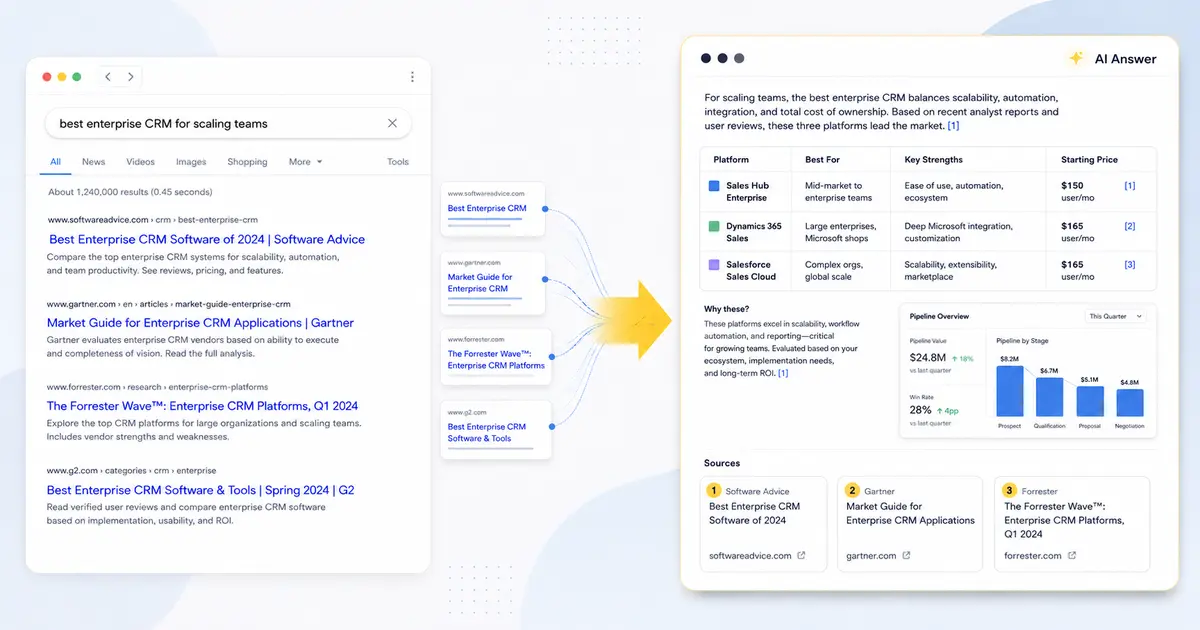
Here’s a stat that should make every B2B marketer pause: 89% of B2B buyers are now using generative AI at every stage of the purchase process (Forrester, 2025). They’re asking ChatGPT for vendor recommendations. They’re using Perplexity to compare software solutions. They’re relying on Google AI Overviews to build their shortlists before they ever visit your website.
And here’s the uncomfortable reality: only 23% of marketers are currently investing in prompt tracking and GEO measurement (Incremys, 2025-2026).
That gap is either your biggest threat or your greatest opportunity. It depends entirely on what you do next.
I was reviewing the AI visibility of a mid-market SaaS company last month. They ranked #3 on Google for “best enterprise CRM for manufacturing,” which is a position they’d worked years to achieve. But when I queried that same phrase in ChatGPT, Perplexity, and Google’s AI Overview, they weren’t mentioned once. Not in the top recommendations. Not in the comparison tables. Not even as an alternative worth considering.
Their competitors, some ranking lower on traditional search results, were being cited repeatedly. The buying committee was forming its shortlist before any human ever clicked through to my client’s website.
This is the new reality of B2B discovery. And this generative engine optimization checklist is built to help you adapt.
What you’ll get from this article:
– A complete, immediately actionable GEO checklist designed specifically for B2B buyer journeys
– The NAV43 B2B GEO Readiness Framework – the exact system we use with enterprise clients
– Technical implementation guidance for schema markup, structured data, and AI crawler access
– A measurement framework that connects AI visibility to pipeline impact, not just traffic metrics
– Phase-by-phase implementation timeline, you can start executing this week
Let’s build your AI visibility strategy from the ground up.
Why B2B Brands Can’t Ignore Generative Engine Optimization
The B2B Buyer Journey Has Fundamentally Changed
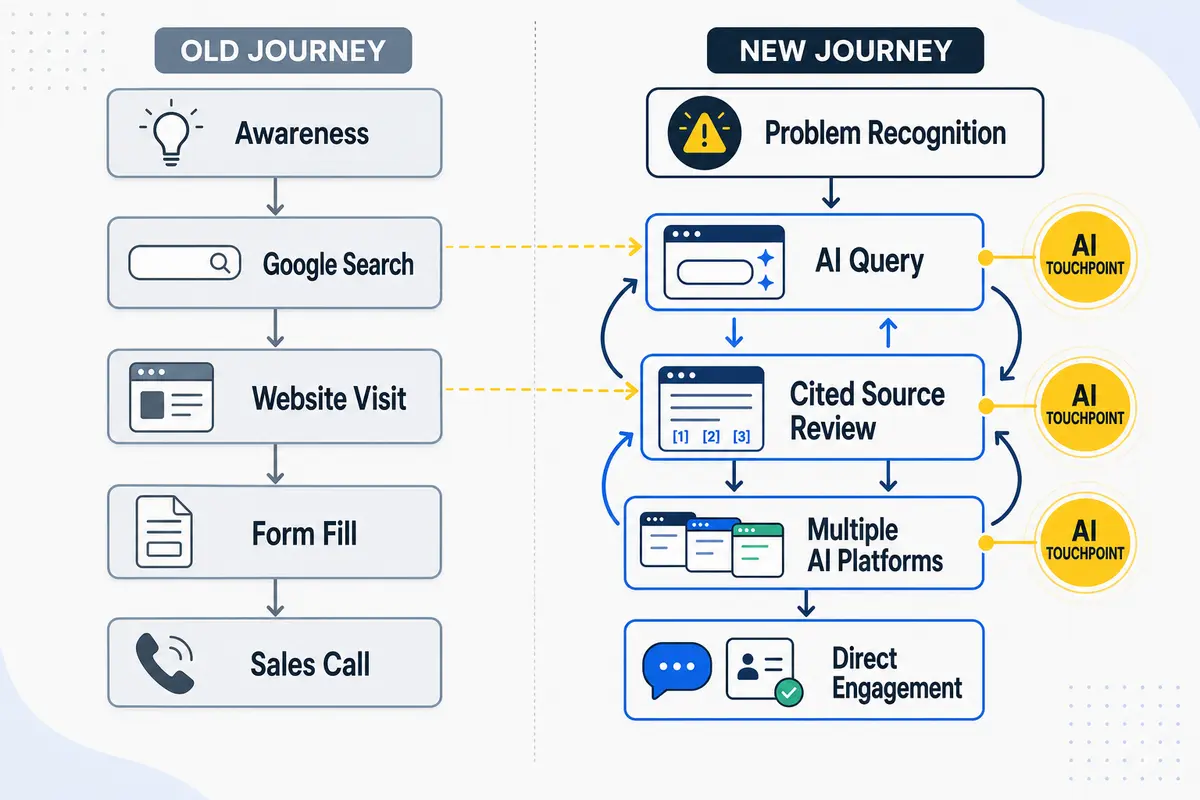
The way your prospects research solutions has shifted dramatically – and most B2B marketing teams haven’t caught up.
Consider this: 58% of users have now replaced traditional search engines with AI-driven tools for product and service discovery (Capgemini, 2025). For B2B buyers evaluating complex solutions with long sales cycles, that number is likely even higher. They’re not just Googling your product category anymore. They’re asking conversational questions like “What CRM integrates best with our existing ERP?” or “Compare the top three vendors for enterprise supply chain optimization.”
Gartner predicted that traditional search engine volume would drop 25% by 2026 due to AI chatbots and virtual agents (Gartner, 2024). We’re watching that prediction unfold in real time.
The implications for B2B are profound. Your buyers are forming opinions, building shortlists, and eliminating vendors before they ever engage with your sales team. They’re asking AI for recommendations, and AI is answering, with or without your brand in the response.
Here’s a scenario that plays out thousands of times daily: A VP of Operations at a manufacturing company needs to evaluate inventory management systems. Instead of running a Google search and clicking through ten blue links, she opens ChatGPT and asks: “What are the best inventory management systems for mid-market manufacturers with multiple warehouse locations?”
ChatGPT responds with a curated list of four vendors, complete with pros and cons, pricing tiers, and implementation considerations. Your competitor is in position one. Your brand isn’t mentioned at all – despite having a more robust feature set and better customer reviews.
That VP just formed her shortlist. Your sales team never had a chance.
This is what I call pre-click influence. By the time a prospect lands on your website, AI has already shaped their perception of your brand, or excluded you from consideration entirely.
The Zero-Click Reality and What It Means for B2B Pipeline
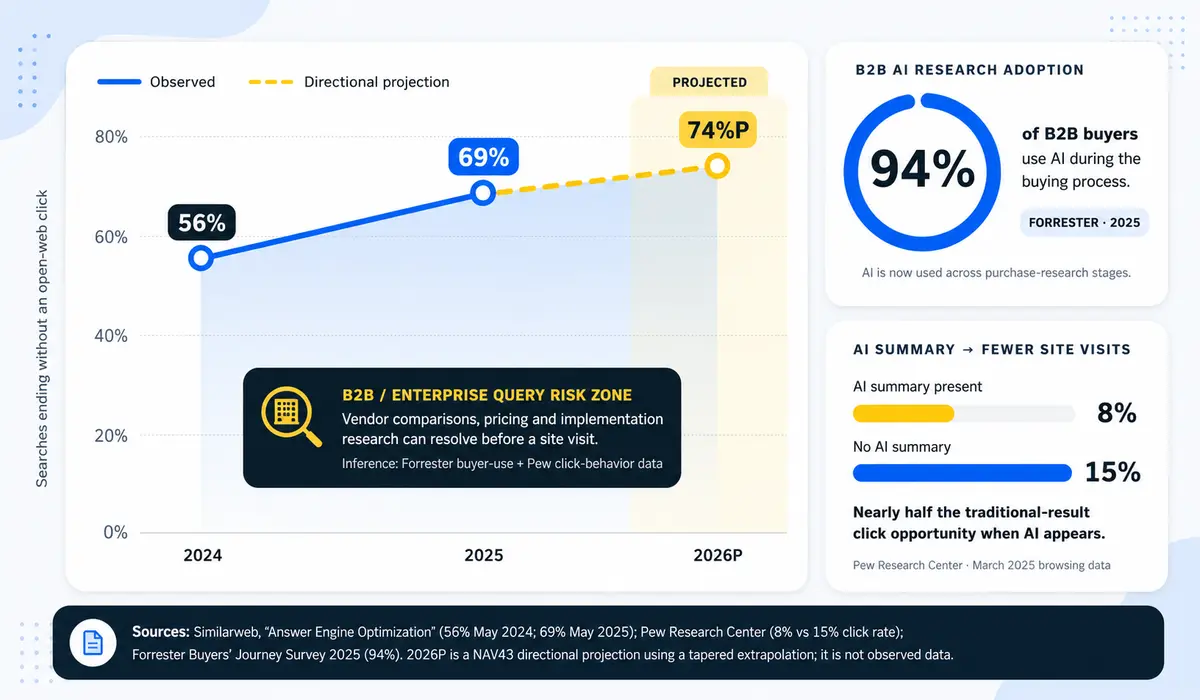
The data on zero-click searches is stark: 58.5% of all Google searches in the United States now result in zero clicks to any website (SparkToro/Datos, Q1 2025). Users get their answer directly from the search results page, through AI Overviews, featured snippets, or knowledge panels, and never visit a destination site.
For B2B technology queries specifically, the situation is even more pronounced. Google AI Overviews appear in approximately 70% of B2B technology searches (Codedesign, 2026). That means that seven out of ten times your ideal buyer searches for a solution in your category, Google provides an AI-generated summary at the top of the page.
If your brand isn’t cited in that summary, you’re not just losing traffic, but you’re losing consideration before the buying committee ever convenes.
But here’s where it gets interesting for strategic marketers: fewer than 10% of sources cited by ChatGPT, Gemini, and Copilot rank in the top 10 Google organic search results for the same query (eMarketer 2025).e organic search results for the same query (eMarketer, 2025). Read that again. The content AI engines cite is largely different from the content that ranks well in traditional search.
This means GEO isn’t simply an extension of your SEO strategy. It’s a parallel competition with different rules, different winners, and different optimization levers. Your SEO playbook got you to page one of Google. Your GEO playbook will get you cited in AI responses, and those are increasingly two separate outcomes.
The good news? AI search visitors convert 4.4 times better than traditional organic visitors in B2B contexts (Omni Marketing Agency, 2026). When you do earn an AI citation and that prospect clicks through, they’re significantly more likely to convert. They’ve been pre-qualified by the AI’s recommendation.
The challenge is getting cited in the first place.
The NAV43 B2B GEO Readiness Framework
After implementing GEO strategies for dozens of enterprise clients over the past 18 months, we’ve developed a systematic framework for assessing and building AI search visibility. This isn’t generic advice that applies equally to B2C and B2B. It’s specifically architected for B2B buyer journeys, enterprise technical requirements, and pipeline attribution.
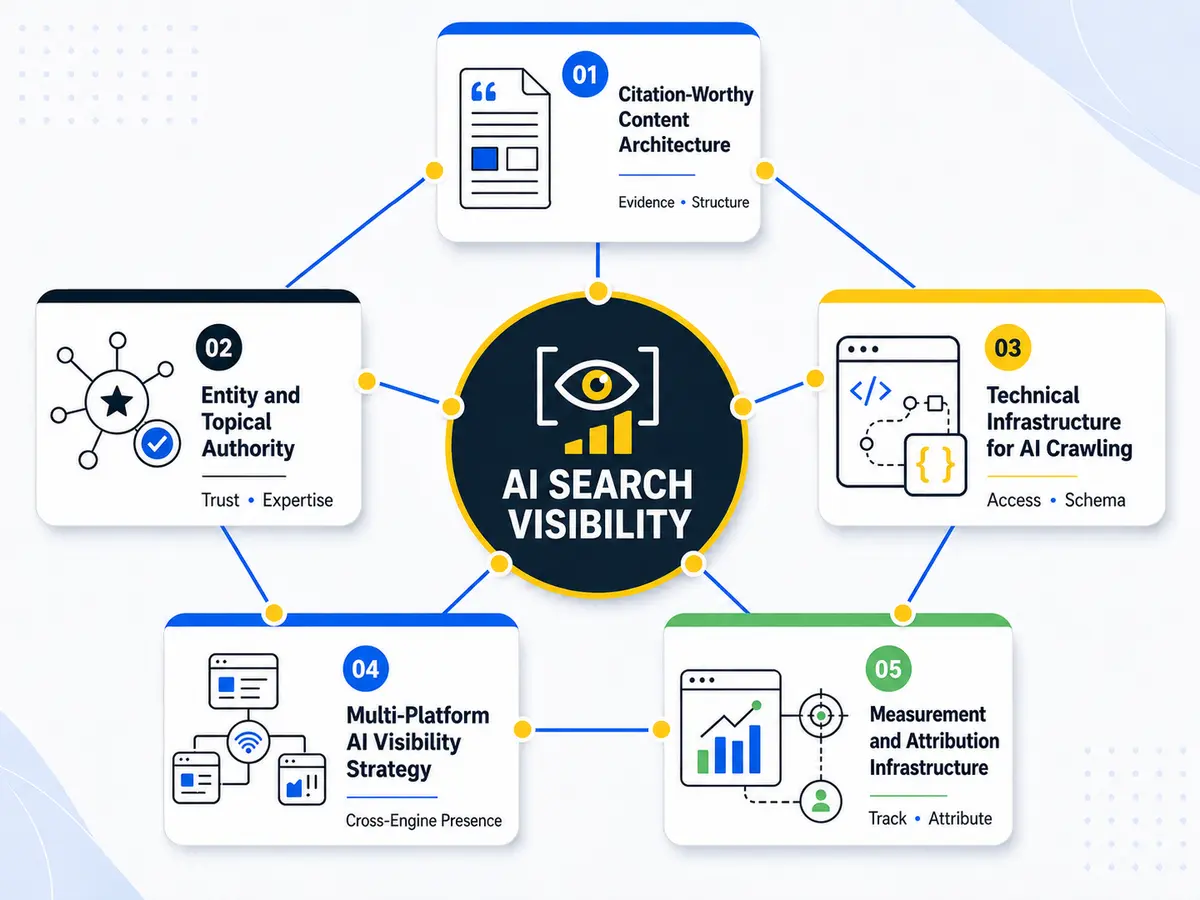
The framework has five pillars, each with specific checklist items detailed in the sections that follow:
The NAV43 B2B GEO Readiness Framework
| Pillar | Focus Area | B2B-Specific Requirement |
|---|---|---|
| 1. Citation-Worthy Content Architecture | Structure content to be directly quotable by AI engines | Address buying committee concerns (technical, financial, operational) in distinct sections |
| 2. Entity and Topical Authority | Build AI recognition of your brand as an authority | Associate your brand with specific problems you solve, not just product categories |
| 3. Technical Infrastructure | Ensure AI crawlers can access and interpret your content | Product documentation and technical specs must be crawlable and well-structured |
| 4. Multi-Platform AI Visibility | Optimize for all major AI platforms, not just one | Account for different AI preferences across technical vs. executive roles |
| 5. Measurement and Attribution | Track AI visibility and connect to business outcomes | Measure pipeline influence beyond direct attribution |
Let me walk you through each pillar in detail.
Pillar 1: Citation-Worthy Content Architecture
The fundamental shift in content strategy is this: you’re no longer writing to rank. You’re writing to be cited.
Traditional SEO content is structured to build topical depth, answer related questions, and keep users on the page as long as possible. The answer to the user’s core question often appears halfway through the article, after you’ve established context, built credibility, and covered background information.
AI engines don’t read content that way. They’re looking for immediately quotable statements, specific data points, and clear answers that can be extracted and presented directly to users. If your key insight is buried in paragraph seven, it won’t get cited.
The answer-first structure flips traditional content on its head: lead with your conclusion, provide supporting evidence, then expand into nuance and context. This is the opposite of how most B2B content is written, but it’s exactly what AI engines prefer.
Here’s what this looks like in practice:
Before (Traditional SEO Approach):
“When evaluating enterprise resource planning solutions, organizations must consider numerous factors, including total cost of ownership, implementation timelines, integration capabilities, and vendor support models. In this comprehensive guide, we’ll explore each of these considerations in depth to help you make an informed decision about your ERP investment. The ERP market has evolved significantly over the past decade, with cloud-based solutions now representing the majority of new deployments…”
After (GEO-Optimized, Citation-Worthy):
“The average enterprise ERP implementation costs $150,000-$750,000 and takes 6-18 months to deploy (Panorama Consulting, 2024). The three factors that most reliably predict ERP success are: (1) executive sponsorship with dedicated project ownership, (2) data migration planning begun at least 90 days before go-live, and (3) vendor selection based on industry-specific functionality rather than brand recognition.
Quick-reference ERP selection criteria:
| Factor | Weight | Key Question |
|---|---|---|
| Total Cost of Ownership | 25% | What are the costs of years 2- 5 beyond implementation? |
| Integration Capability | 25% | Does it connect natively to your CRM and BI tools? |
| Industry Fit | 20% | Does the vendor have 10+ clients in your vertical? |
The second version leads with a specific, quotable statistic. It provides an immediately actionable framework. It structures information in a format that AI engines can cite directly. The first version requires an AI to read 200+ words before finding anything citation-worthy.
The freshness imperative is critical for B2B. According to Amsive Research (2025-2026), 50% of content cited in AI search responses is less than 13 weeks old. Your cornerstone content needs to be refreshed quarterly – not annually. We’ve built content calendars for clients with specific refresh triggers: new data available, competitor positioning shifts, product updates, or simply hitting the 90-day mark.
For B2B specifically, your content must address buying committee concerns in distinct, citable sections. When a CFO asks AI about ROI considerations, that answer should be pullable from your content. When a CTO asks about integration requirements, that should be a separate, quotable section. When an operations director asks about implementation timelines, same thing.
One content piece, multiple citable sections for different stakeholders.
Pillar 2: Entity and Topical Authority
AI engines don’t just match keywords – they understand entities. Your brand, your executives, your products, your company – these are all entities that AI systems are trying to comprehend and categorize.
When Perplexity decides whether to cite your content in a response about “enterprise CRM solutions,” it’s evaluating whether your brand is a recognized entity in that space. When ChatGPT recommends vendors for “manufacturing inventory optimization,” it’s drawing on its understanding of which companies are authoritative in that domain.
Building entity recognition requires consistency across the web:
– Consistent NAP data (name, address, phone) across all business listings
– Executive presence – your leadership team should have LinkedIn profiles, speaking engagements, and content attributed to them
– Wikipedia presence where warranted (for larger enterprises)
– Schema markup that defines organizational relationships
Topical authority is equally important. AI engines evaluate whether you’ve demonstrated comprehensive expertise in your core domains – not whether you’ve published thin content across many topics.
Here’s a practical example: if you’re an inventory management software company, your topical authority signals should include:
– Pillar content covering the full scope of inventory management challenges
– Supporting content addressing specific sub-topics (demand forecasting, warehouse optimization, multi-location inventory, etc.)
– Internal linking that demonstrates relationships between these pieces
– External citations from industry publications and educational resources
For B2B specifically, your brand must be associated with the specific problems you solve, not just your product category. “Manufacturing inventory optimization” is more powerful than “inventory software.” “Supply chain visibility for automotive suppliers” is more powerful than “supply chain software.”
This problem-solution association is what gets you cited when prospects ask AI engines for recommendations.
Pillar 3: Technical Infrastructure for AI Crawling
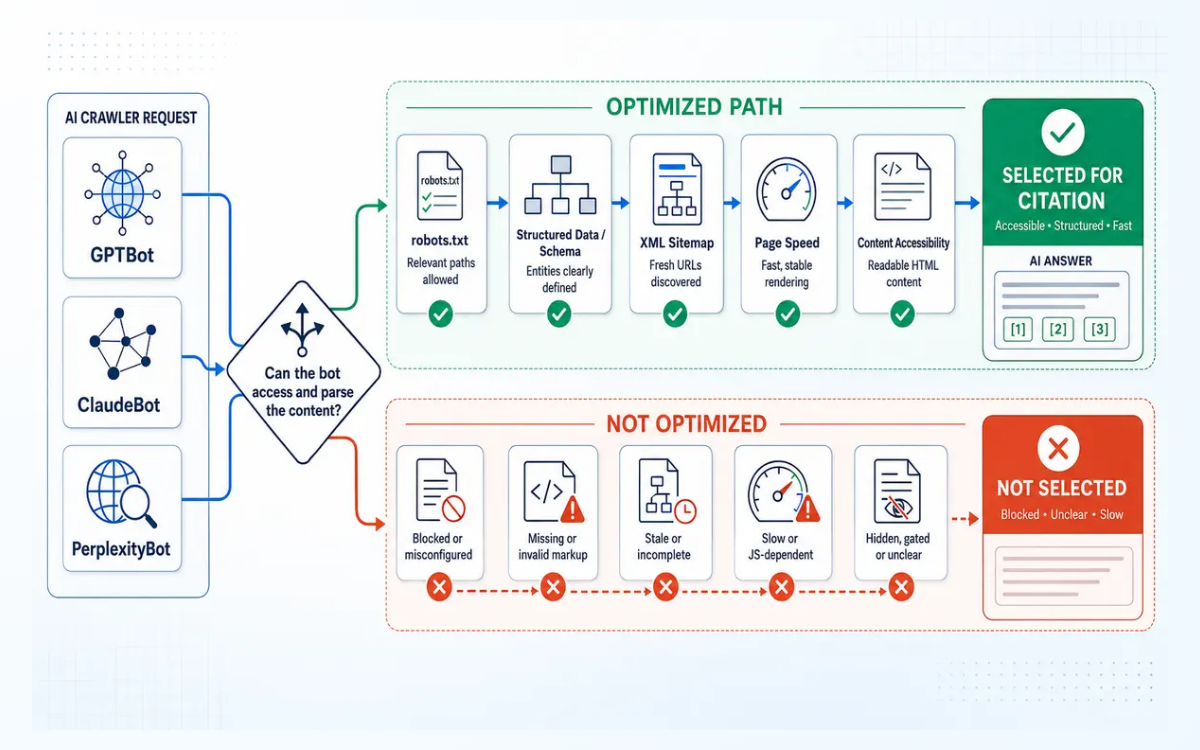
Your technical foundation must accommodate both traditional search crawlers and AI crawlers, and their behaviors differ.
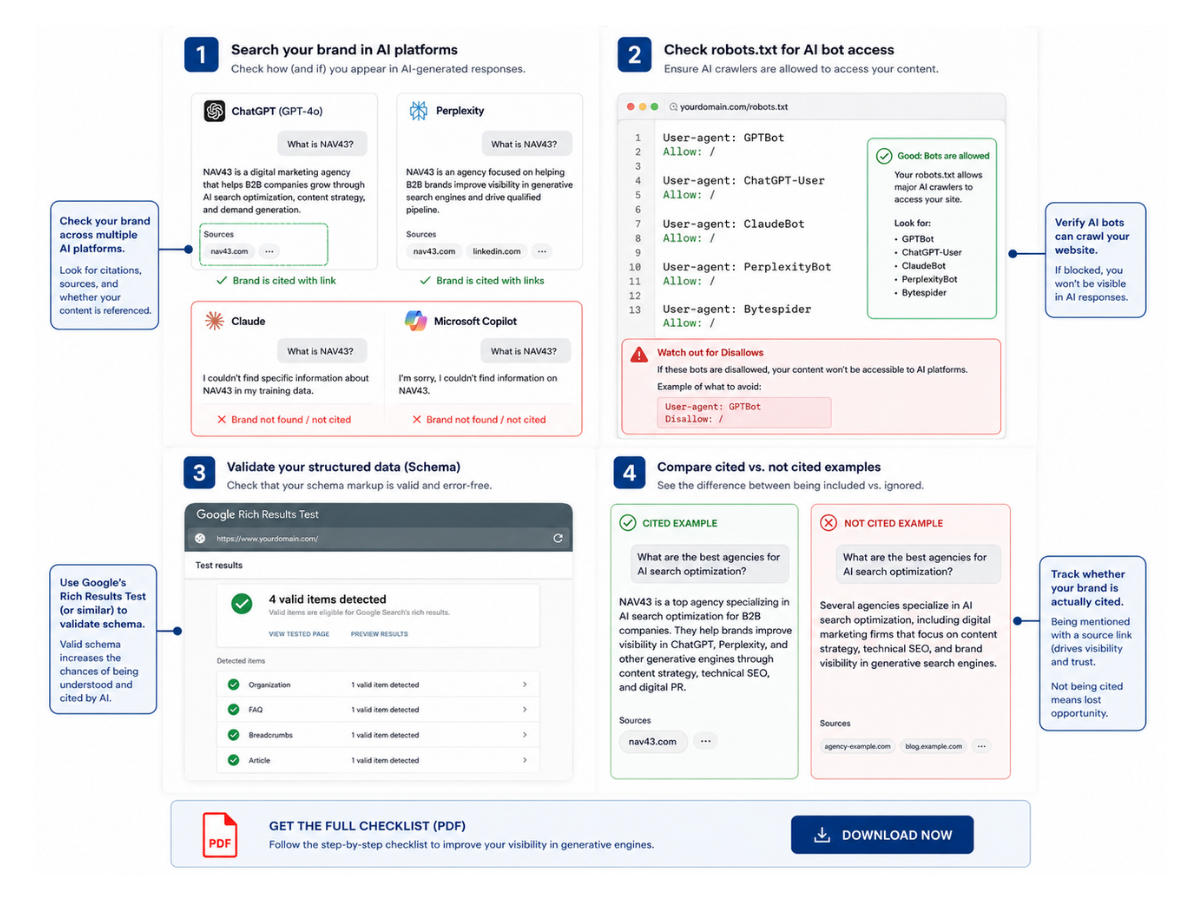
Crawler access is the starting point. AI crawlers (GPTBot, ClaudeBot, PerplexityBot, Google-Extended) may be blocked in your robots.txt without your knowledge. We’ve audited enterprise sites where IT teams had blocked “suspicious” crawlers that turned out to be major AI platforms. Check your robots.txt and make intentional decisions about access.
Structured data provides machine-readable context that improves citation accuracy. The essential schemas for B2B include:
– Organization schema – complete information about your company
– Article/BlogPosting schema – proper attribution for all content
– FAQ schema – for question/answer content
– HowTo schema – for process-oriented content
– Person schema – for author attribution and executive profiles
Page speed and rendering matter differently for AI crawlers. They may not execute JavaScript as thoroughly as Googlebot, which means critical content needs to be present in the initial HTML, not loaded dynamically.
For B2B specifically, product documentation, API references, and technical specifications are high-value sources for citations. When a technical evaluator asks AI about integration capabilities, the AI will look for authoritative technical content. Ensure your documentation is crawlable, well-structured, and includes the specific technical details your buyers need.
I’ve seen enterprise clients with excellent marketing content but completely inaccessible technical documentation – gated behind login walls or rendered in JavaScript that AI crawlers can’t process. That’s a massive missed opportunity.
Pillar 4: Multi-Platform AI Visibility Strategy
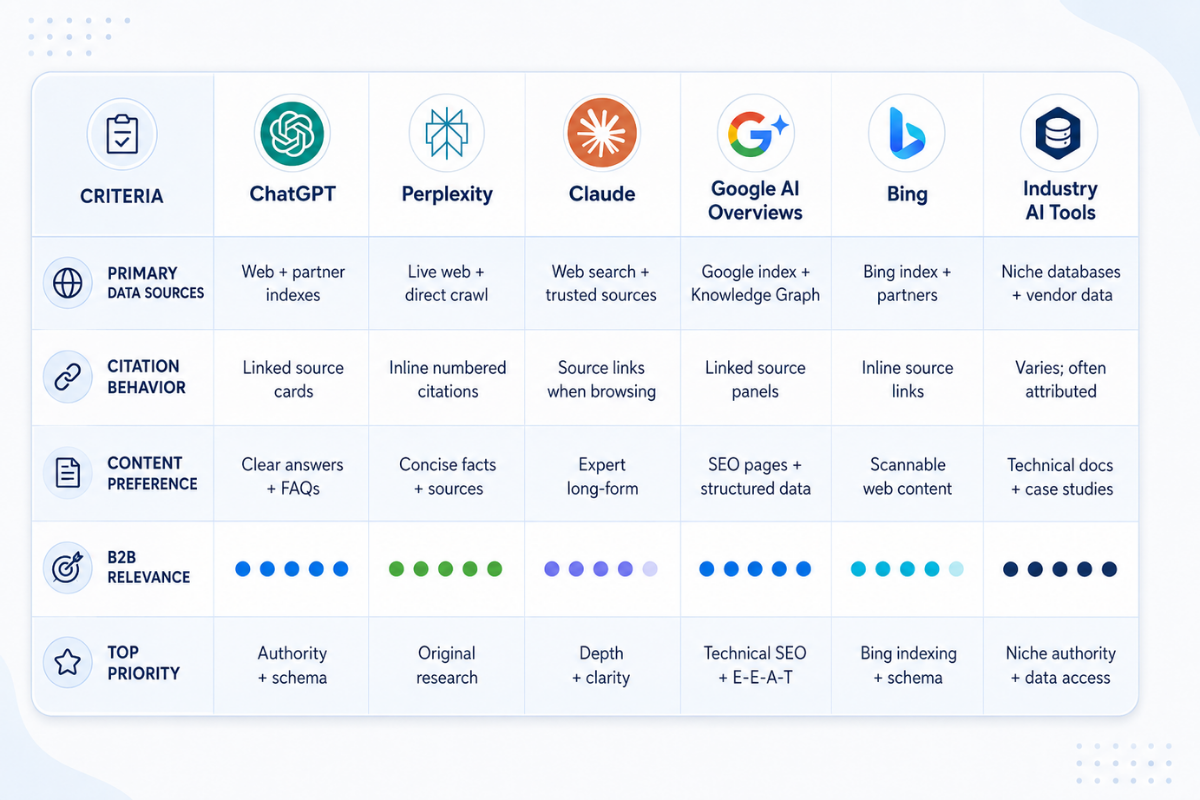
Your buyers are fragmenting across multiple AI platforms. ChatGPT, Perplexity, Gemini, Copilot, Claude – each has different behaviors and different source preferences.
ChatGPT favors recent, well-cited sources with clear authority signals. It doesn’t show source citations to users, so visibility here is about being part of the recommendation, not driving clicks.
Perplexity emphasizes real-time information and shows source citations directly in responses. Being cited here actually drives measurable referral traffic, unlike ChatGPT, where citation happens without linking.
Google AI Overviews draw heavily on top-ranking content, creating the most overlap with traditional SEO.
Copilot and Gemini have their own source preferences that are still evolving.
For B2B specifically, different AI platforms may be preferred by different roles in the buying committee. Our experience with enterprise clients suggests technical evaluators gravitate toward Claude for detailed analysis, while executives may use ChatGPT for quick recommendations. Your visibility strategy must be multi-platform.
Establish baseline visibility for your top 50 target queries across each major platform. This gives you a competitive benchmark and identifies which platforms represent the biggest gaps.
Pillar 5: Measurement and Attribution Infrastructure
You can’t optimize what you can’t measure – and GEO requires new metrics alongside your traditional SEO KPIs.
Key metrics to track:
– AI citation share – how often you’re cited vs. competitors for target queries
– AI referral traffic – visits from ChatGPT, Perplexity, Copilot, etc.
– Citation accuracy – is the AI representing your brand correctly?
– Overview visibility – % of target queries where you appear in AI responses
The attribution challenge for B2B is significant. AI visibility may influence deals where the prospect never clicks through to your site. A CFO asks ChatGPT for vendor recommendations, gets a list that includes your company, and later tells their team to “look into that company the AI mentioned.” You’ll never see that touchpoint in your analytics.
This means brand lift and shortlist formation metrics matter as much as direct attribution. Survey your inbound leads: “How did you first hear about us?” Track whether AI-sourced mentions correlate with pipeline formation, even without direct clicks.
Connect AI referral traffic to your CRM to measure pipeline influence. A visit from Perplexity that becomes an MQL, then a closed-won deal. That’s the attribution path you need to track.
For tooling, Ahrefs Brand Radar, Frase AI Visibility, and Profound are emerging solutions. But for the queries that matter most, manual monitoring remains essential. Query your top 20 keywords weekly across major platforms and document changes.
The Complete B2B Generative Engine Optimization Checklist
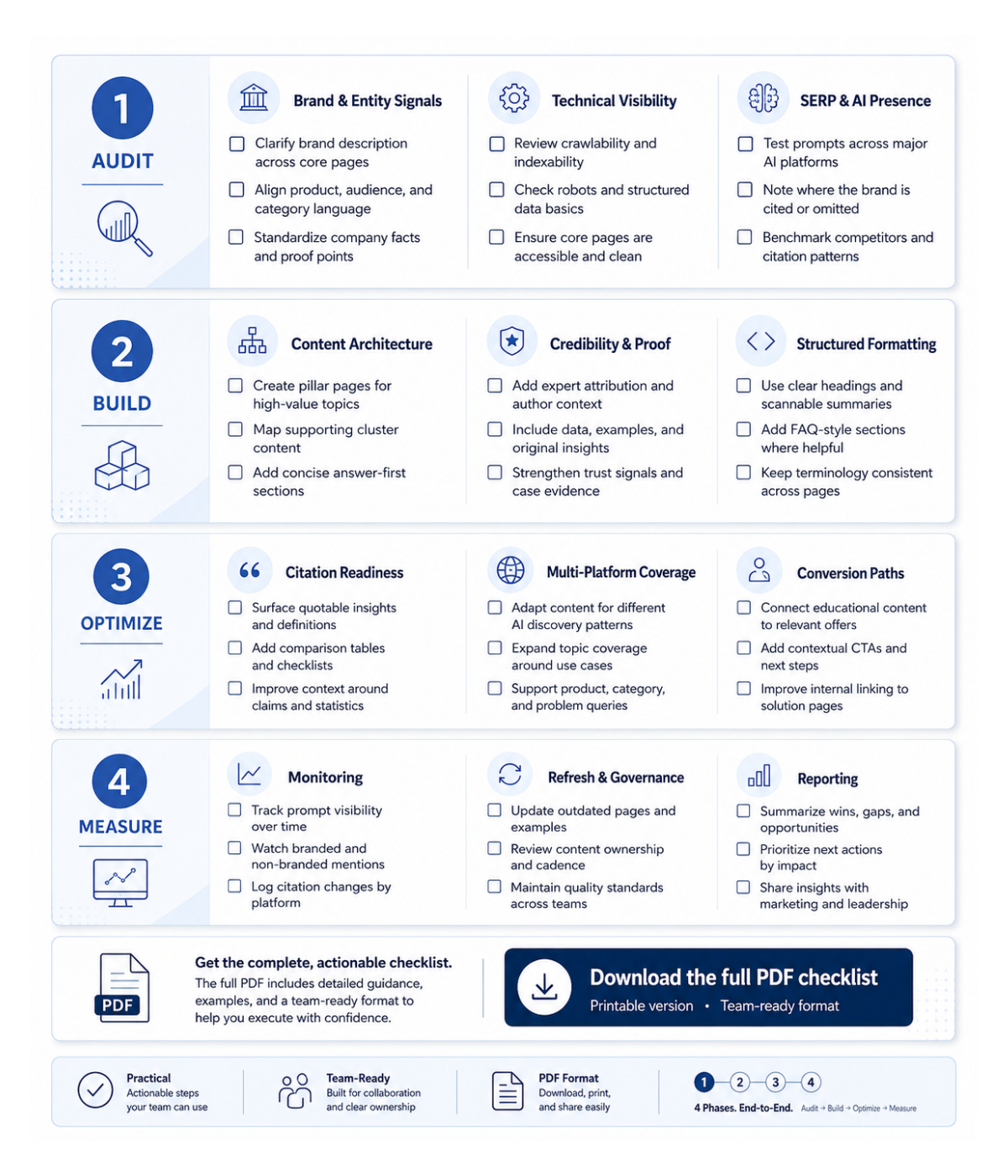
Now let’s turn the framework into action. This checklist is organized by implementation phase – work through it sequentially over the next 8-12 weeks.
Phase 1: AI Visibility Audit (Weeks 1-2)
Before you optimize anything, you need to understand your current state.
Audit Checklist:
- [ ] Query your top 50 target keywords in ChatGPT, Perplexity, Gemini, and Google (with AI Overview) – document where you are and aren’t cited
- [ ] Identify competitors who are being cited where you’re not – analyze what their content has that yours lacks
- [ ] Audit your robots.txt for AI crawler blocks (GPTBot, ClaudeBot, PerplexityBot, Google-Extended) – determine intentional vs. accidental blocks
- [ ] Review your Google Search Console for AI Overview appearances using the “Search Appearance” filter
- [ ] Benchmark your current AI referral traffic in Google Analytics (segment by source containing “chat,” “perplexity,” “copilot,” etc.)
- [ ] Document citation accuracy – when AI does mention your brand, is the information correct and current?
- [ ] Create competitor citation tracking – note which competitors appear for each query and what content is being cited
Audit Tracking Template:
| Query | ChatGPT Result | Perplexity Result | Gemini Result | Google AIO Result | Competitor Cited | Gap Analysis |
|---|---|---|---|---|---|---|
| [keyword 1] | Cited / Not Cited / Partial | … | … | … | [competitor names] | [what they have that we lack] |
| [keyword 2] | … | … | … | … | … | … |
This audit will reveal your biggest gaps and highest-priority opportunities. Clients often discover that their most valuable keywords, the ones driving real pipeline, have zero AI visibility.
Phase 2: Content Foundation (Weeks 3-6)
With your audit complete, focus on making your existing high-value content citation-worthy.
Content Optimization Checklist:
- [ ] Identify your top 20 pages by organic traffic and conversion value – these are priority GEO optimization targets
- [ ] Add “TL;DR” or executive summary boxes to the top of each priority page with quotable, statistic-backed statements
- [ ] Restructure content to answer the core question in the first 150 words – don’t bury the answer
- [ ] Add data tables that synthesize key information in citation-friendly formats
- [ ] Ensure every page has clear author attribution with proper Person schema and author bio
- [ ] Review and update any content older than 13 weeks – prioritize pages targeting high-value queries
- [ ] Create “definition” content for key terms in your space – AI engines frequently cite definitional sources
- [ ] Add FAQ sections with schema markup addressing specific questions your buyers ask
- [ ] Break content into distinct sections addressing different buying committee roles (technical, financial, operational)
- [ ] Add expert quotes and named attribution throughout – AI engines cite expert-attributed content more often
For detailed guidance on creating AI-ready content, see our definitive guide: How to Create AI-Ready Content: The Definitive Guide.
Before/After Example – B2B Product Page:
Before: “Our inventory management solution helps businesses streamline operations and reduce costs. With advanced features and intuitive design, we’ve helped companies across industries improve their supply chain efficiency…”
After: “Companies using [Product Name] reduce inventory carrying costs by an average of 23% within the first year of implementation (Customer Survey, 2025).
At-a-glance capabilities:
| Capability | Impact | Best For |
|---|---|---|
| Multi-location sync | Real-time inventory visibility across all warehouses | Distributed operations |
| Demand forecasting | Reduce stockouts by up to 34% | Seasonal or variable demand |
| ERP integration | Eliminates manual data entry from 6+ hrs/week to <30 min | Complex tech stacks |
The second version leads with a specific, quotable outcome and structures capabilities in a format AI can cite directly.
Phase 3: Technical Implementation (Weeks 4-8)
Technical infrastructure runs parallel to content optimization.
Technical Checklist:
- [ ] Implement Organization schema with complete information (name, URL, logo, social profiles, contact information)
- [ ] Add Article or BlogPosting schema to all content pages with proper author, datePublished, and dateModified
- [ ] Implement FAQ schema for all pages with question/answer content
- [ ] Add HowTo schema for process-oriented content (implementation guides, tutorials)
- [ ] Verify AI crawler access – test robots.txt rules against GPTBot, ClaudeBot, PerplexityBot user agents
- [ ] Ensure critical content is present in initial HTML (not loaded via JavaScript that crawlers may not execute)
- [ ] Implement proper canonical tags to consolidate citation authority
- [ ] Add speakable schema for content you want featured in voice responses
- [ ] Verify mobile rendering – AI crawlers use mobile-first indexing behaviors
- [ ] Create XML sitemaps that prioritize your highest-value content for crawling
For deeper technical guidance on implementation, our Structured Data for GEO guide covers schema markup in detail.
Example Schema Markup for B2B Article:
{
 "@context": "https://schema.org",
 "@type": "Article",
 "headline": "Enterprise CRM Selection: The Complete Evaluation Framework",
 "author": {
 "@type": "Person",
 "name": "Jane Smith",
 "jobTitle": "VP of Customer Success",
 "url": "https://example.com/team/jane-smith"
 },
 "publisher": {
 "@type": "Organization",
 "name": "Example Company",
 "url": "https://example.com",
 "logo": {
 "@type": "ImageObject",
 "url": "https://example.com/logo.png"
 }
 },
 "datePublished": "2026-03-15",
 "dateModified": "2026-04-01",
 "mainEntityOfPage": "https://example.com/blog/crm-selection-framework",
 "description": "A data-driven framework for evaluating enterprise CRM solutions, based on analysis of 200+ implementations."
}
Phase 4: Entity and Authority Building (Ongoing)
Entity and authority signals compound over time. Start these initiatives early and maintain them consistently.
Authority Building Checklist:
- [ ] Audit your executive team’s online presence – do they have LinkedIn profiles, author bios, and content attributed to them?
- [ ] Implement author pages with Person schema linking to social profiles and credentials
- [ ] Build an internal linking structure that demonstrates topical relationships between content
- [ ] Identify and pursue high-authority external citations (industry publications, analyst reports, educational resources)
- [ ] Ensure brand mentions across the web are consistent and accurate
- [ ] Develop thought leadership content from named experts (not generic “team” attribution)
- [ ] Create product/service comparison content that positions your brand alongside known entities
- [ ] Build resource pages that aggregate authoritative third-party sources in your space (positions you as a hub)
- [ ] Monitor for brand mentions and correct inaccuracies that could propagate to AI training data
- [ ] Establish relationships with industry analysts who influence AI training corpora
Our article on Entity SEO for AEO and GEO provides detailed tactics for building entity recognition.
Phase 5: Measurement and Optimization (Ongoing)
Measurement is where most B2B teams fall short. Build these systems from day one.
Measurement Checklist:
- [ ] Set up AI referral traffic segments in Google Analytics (ChatGPT, Perplexity, Copilot, etc.)
- [ ] Establish monthly AI visibility audits for the top 50 queries – track citation share over time
- [ ] Connect AI referral traffic to CRM to measure pipeline influence
- [ ] Create citation accuracy monitoring – alert system for incorrect AI representations of your brand
- [ ] Track content freshness and correlate with citation frequency
- [ ] Build competitive benchmarking dashboard – your citation share vs. top 3 competitors
- [ ] Establish quarterly content refresh calendar based on citation decay patterns
- [ ] Report AI visibility metrics alongside traditional SEO KPIs to leadership
- [ ] Survey inbound leads about AI-assisted research behavior
- [ ] Calculate AI visibility ROI based on pipeline influence, not just traffic
For a complete measurement framework, see our guide on How to Measure AI SEO & Win Visibility in the Age of Chatbots.
Common Pitfalls to Avoid
After implementing GEO strategies across dozens of enterprise clients, I’ve seen the same mistakes repeatedly. Avoid these:
Pitfall 1: Treating GEO as an SEO bolt-on. GEO requires different content structures, different success metrics, and often different content entirely. Fewer than 10% of AI-cited sources rank in Google’s top 10 (eMarketer, 2025). Optimizing your existing SEO content for GEO is necessary but insufficient.
Pitfall 2: Ignoring content freshness. With 50% of AI citations coming from content less than 13 weeks old (Amsive, 2025-2026), your content calendar needs built-in refresh cycles. Quarterly updates to cornerstone content aren’t optional.
Pitfall 3: Single-platform focus. I’ve seen teams obsess over ChatGPT visibility while ignoring Perplexity – even though Perplexity actually drives measurable referral traffic. Your buyers are distributed across platforms.
Pitfall 4: Missing the buying committee angle. B2B content that earns AI citations must address multiple stakeholders. Technical evaluators, financial decision-makers, and operational users ask different questions. Your content needs citable sections for each.
Pitfall 5: Measuring only traffic. AI visibility often influences deals where no one ever clicked through to your site. Pipeline influence and brand lift matter as much as referral traffic – sometimes more.
Pitfall 6: Blocking AI crawlers accidentally. Overzealous security settings or outdated robots.txt rules can make your content invisible to AI platforms. Audit crawler access quarterly.
Conclusion: Your GEO Implementation Roadmap
The shift from traditional search to AI-assisted discovery isn’t coming; it’s here. With 89% of B2B buyers using generative AI at every stage of the purchase process (Forrester, 2025) and AI-referred visitors converting 4.4x better than traditional organic visitors (Omni Marketing Agency, 2026), the ROI case for GEO investment is clear.
Key Takeaways:
- GEO is a parallel competition to SEO – fewer than 10% of AI-cited sources rank in Google’s top 10 (eMarketer 2025), meaning you need separate optimization strategies
- Content structure matters more than keyword density – AI engines need immediately quotable statements, data tables, and answer-first formatting
- Freshness is non-negotiable – with 50% of citations coming from content less than 13 weeks old (Amsive Research 2025-2026), quarterly refresh cycles are mandatory
- Multi-platform visibility is required – your buyers are fragmented across ChatGPT, Perplexity, Gemini, and Copilot
- Measurement must connect to the pipeline – AI visibility influences deals before prospects ever click through, so attribution models need updating
Next Steps
Week 1: Complete your AI visibility audit using the template in Phase 1. Query your top 50 keywords across all major AI platforms and document your current citation rate.
Week 2: Identify your 20 highest-value pages and prioritize them for GEO optimization based on organic traffic, conversion value, and competitive gap analysis.
Weeks 3-4: Begin content restructuring – add TL;DR boxes, move answers to the first 150 words, and create data tables that can be directly cited.
Weeks 5-8: Implement technical infrastructure – schema markup, crawler access verification, and proper author attribution.
Ongoing: Establish monthly monitoring cadence and quarterly content refresh calendar.
If you’re looking for a partner to help implement this checklist and build your AI visibility strategy, get a free growth plan and GEO audit from our team. We’ll assess your current AI visibility, identify your highest-priority opportunities, and build a roadmap specific to your B2B buyer journey.
The brands that act now will earn the citations that compound into market leadership. The brands that wait will wonder why their pipeline dried up despite strong Google rankings.
The AI search revolution isn’t waiting. Neither should you.
