AEO GEO Dashboard: Executive Framework for AI Search Visibility
I was on a call with a VP of Marketing last month who pulled up their GA4 dashboard to show me their performance metrics. “We’re crushing it on organic,” she said confidently. The charts looked impressive until I asked a simple question: “How are you tracking your visibility in ChatGPT, Perplexity, or Google AI Overviews?”
Silence.
Here’s the uncomfortable reality facing marketing leaders right now: AI referral traffic is converting at 4.4-5x the rate of traditional organic search (Starmorph, 2025), yet 62% of agencies lack centralized AI visibility dashboards (McKinsey, 2026). That’s not a metrics gap. That’s a measurement crisis.
The numbers tell a stark story. AI referral traffic grew 527% year-over-year across tracked GA4 properties in early 2025 (Starmorph, 2025). Meanwhile, Gartner projects a 25% drop in traditional search engine volume by 2026 due to AI chatbots. Your fastest-growing acquisition channel is also your least measured one.
This article delivers what your current reporting infrastructure is missing: a complete framework for building an AEO GEO dashboard that executives can actually use. We’ll cover the four-layer measurement architecture, specific KPIs and their data sources, tool recommendations segmented by company size, and the exact implementation plan to get this up and running within eight weeks.
Whether you’re reporting to a board that wants AI search visibility metrics or building measurement infrastructure for your marketing team, this is the playbook.
Why Your Current SEO Dashboard Is Lying to You
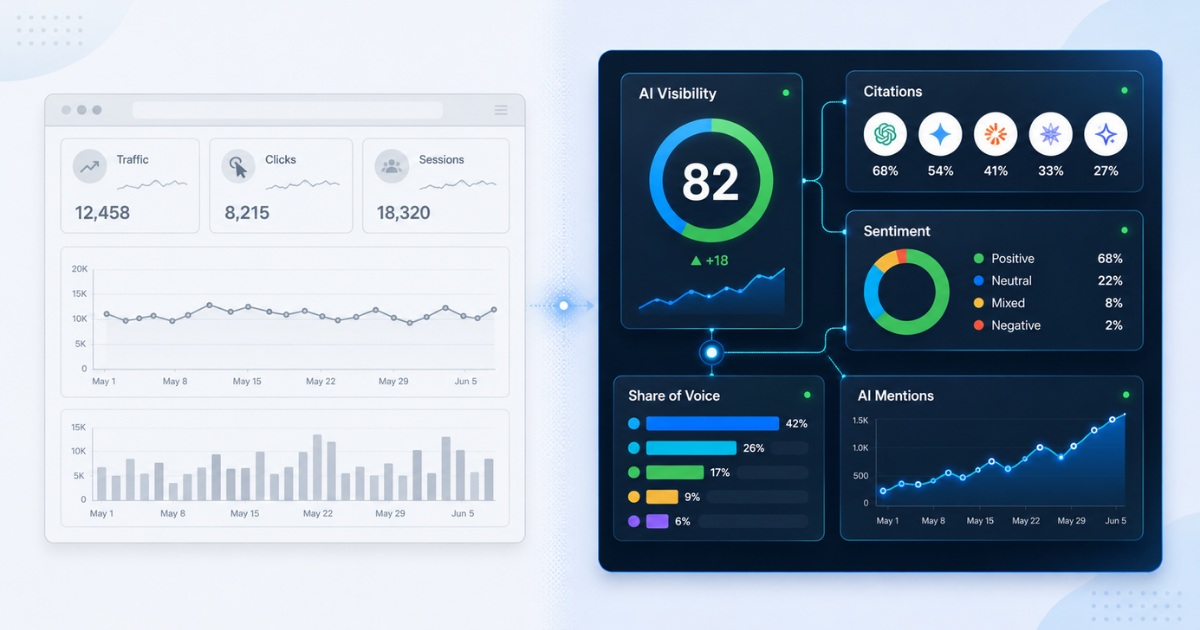
Traditional SEO dashboards were built for a world where success meant rankings and clicks. That world is disappearing faster than most marketing teams realize.
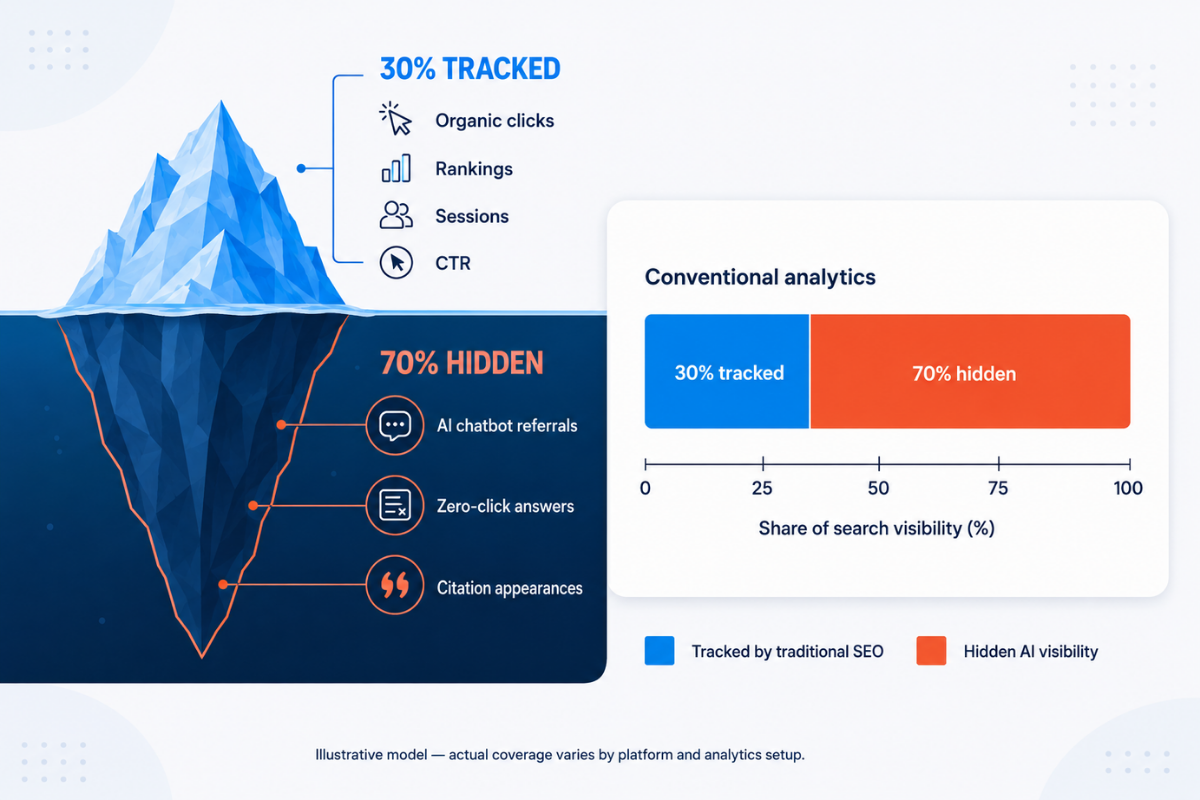
The fundamental problem is straightforward: AI search success happens before the click, or without one entirely. When ChatGPT recommends your brand as the solution to a user’s problem, that’s a conversion-driving event that never shows up in your analytics. When Google’s AI Overview quotes your content and the user gets their answer without visiting your site, your dashboard shows nothing.
The zero-click reality has reached a tipping point. According to industry research, 58.5% of US Google searches now end without a click to any website (YourContentMart, 2025-2026). More than half of your potential audience is getting their answers without ever landing on your site. If your dashboard only measures traffic, you’re measuring less than half the picture.
What’s even more concerning is the phenomenon of decoupling. In July 2025, 76% of AI Overview citations came from URLs ranking in the organic top 10. By February 2026, that number dropped to just 38% (Starmorph, 2025-2026). Rankings no longer predict AI visibility. Your position-tracking dashboard is telling you one story while AI search engines are writing a completely different one.
Then there’s the volatility problem. According to EMARKETER and Profound research, 40-60% of cited sources change month-to-month across Google AI Mode and ChatGPT. Dashboards built for the relative stability of organic rankings simply cannot handle this level of flux. A metric that swings 50% monthly requires fundamentally different reporting frameworks than one that moves 5% quarterly.
The Three Visibility Layers Your Dashboard Must Track
Layer 1: Traditional Organic – Rankings, traffic, and conversions from standard search results
Layer 2: AI Overviews – Citations and visibility within Google’s AI-generated answers
Layer 3: LLM Citations – Mentions and recommendations across ChatGPT, Perplexity, and Gemini
If your current dashboard only covers Layer 1, you’re effectively flying blind on the channels that will define search visibility for the next decade.
A Quick Note on Terminology
Before we dive into the framework, let’s clear up the confusion around the terminology that plagues this space. You’ll hear AEO (Answer Engine Optimization), GEO (Generative Engine Optimization), GSO, LLMO, AIO, and a dozen other acronyms, often used interchangeably.
At NAV43, we use these definitions consistently:
AEO (Answer Engine Optimization) focuses on featured snippets, People Also Ask boxes, and Google AI Overviews. It’s about being the direct answer to specific questions within traditional search interfaces.
GEO (Generative Engine Optimization) targets citation within generative AI systems like ChatGPT, Perplexity, and Claude. It’s about being referenced when AI assistants recommend solutions or explain concepts.
AI SEO serves as our umbrella term for both AEO and GEO, as well as the technical and content strategies that support visibility across all AI-influenced search experiences.
Why does this matter for your dashboard? Different tools use different terminology, and your reporting infrastructure needs to normalize these into consistent metrics. Throughout this guide, we’ll use these terms precisely to ensure your measurement framework is coherent.
The Four-Layer Executive Dashboard Framework
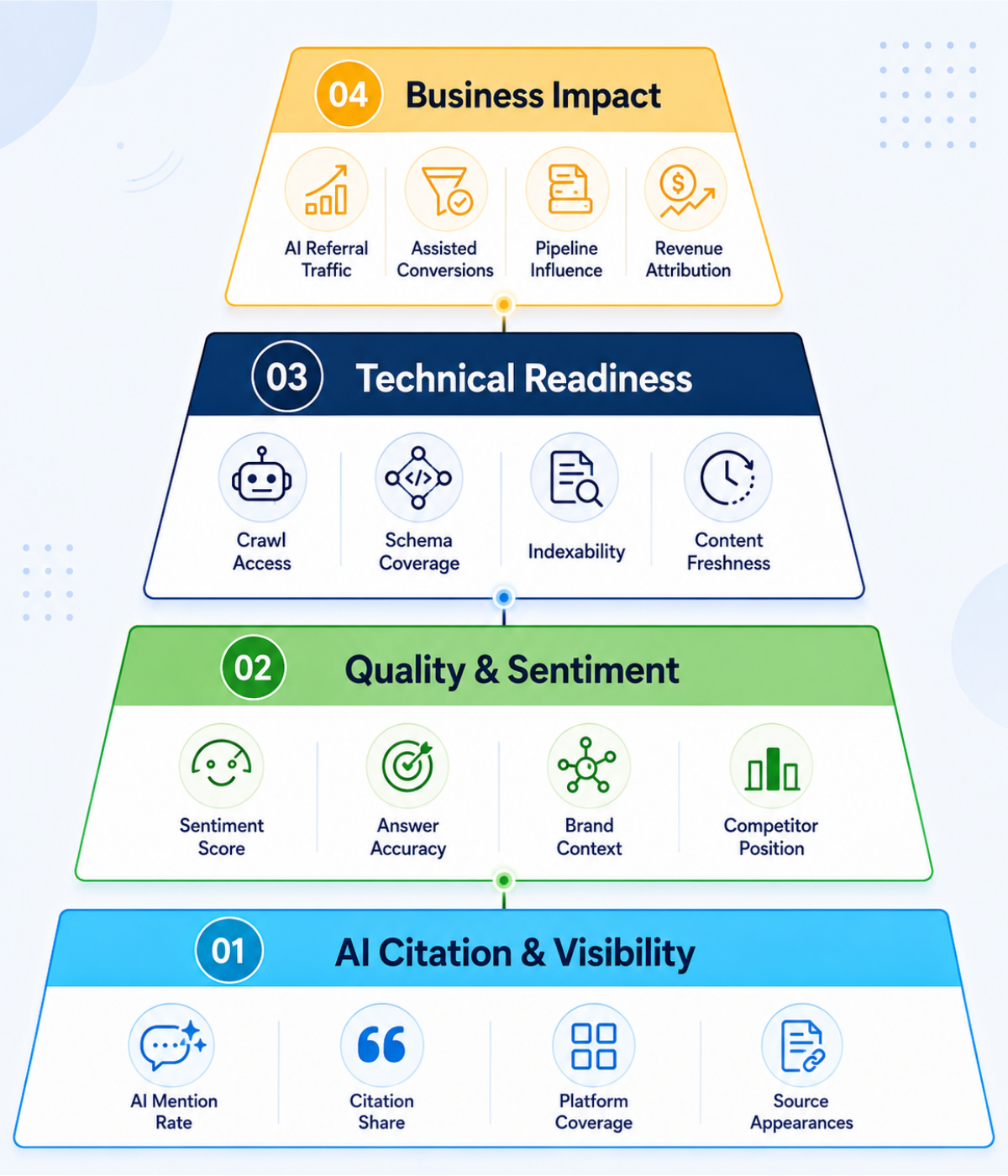
After building AI visibility dashboards for dozens of mid-market and enterprise clients, we’ve developed a framework that actually works for executive reporting. The NAV43 Four-Layer Dashboard Framework organizes metrics into distinct categories that answer specific business questions.
Most dashboards fail because they dump tactical metrics in front of strategic decision-makers. Executives don’t need to know about individual citation counts. They need to know whether the company is winning or losing in AI search, and what it means for revenue.
The four layers work together to tell a complete story:
| Layer | What It Measures | Executive Question It Answers | Update Frequency |
|---|---|---|---|
| AI Citation & Visibility | Brand presence across AI platforms | Are we being recommended by AI assistants? | Weekly |
| Quality & Sentiment | How we’re being positioned | Are AI mentions helping or hurting our brand? | Monthly |
| Technical Readiness | Infrastructure for AI citability | Can AI systems properly understand our content? | Monthly |
| Business Impact | Revenue and pipeline influence | Is AI visibility driving business outcomes? | Monthly |
Executives care about leading indicators (are we visible?) and lagging indicators (is it driving revenue?). This framework delivers both while keeping practitioner-level detail accessible for deeper investigation.
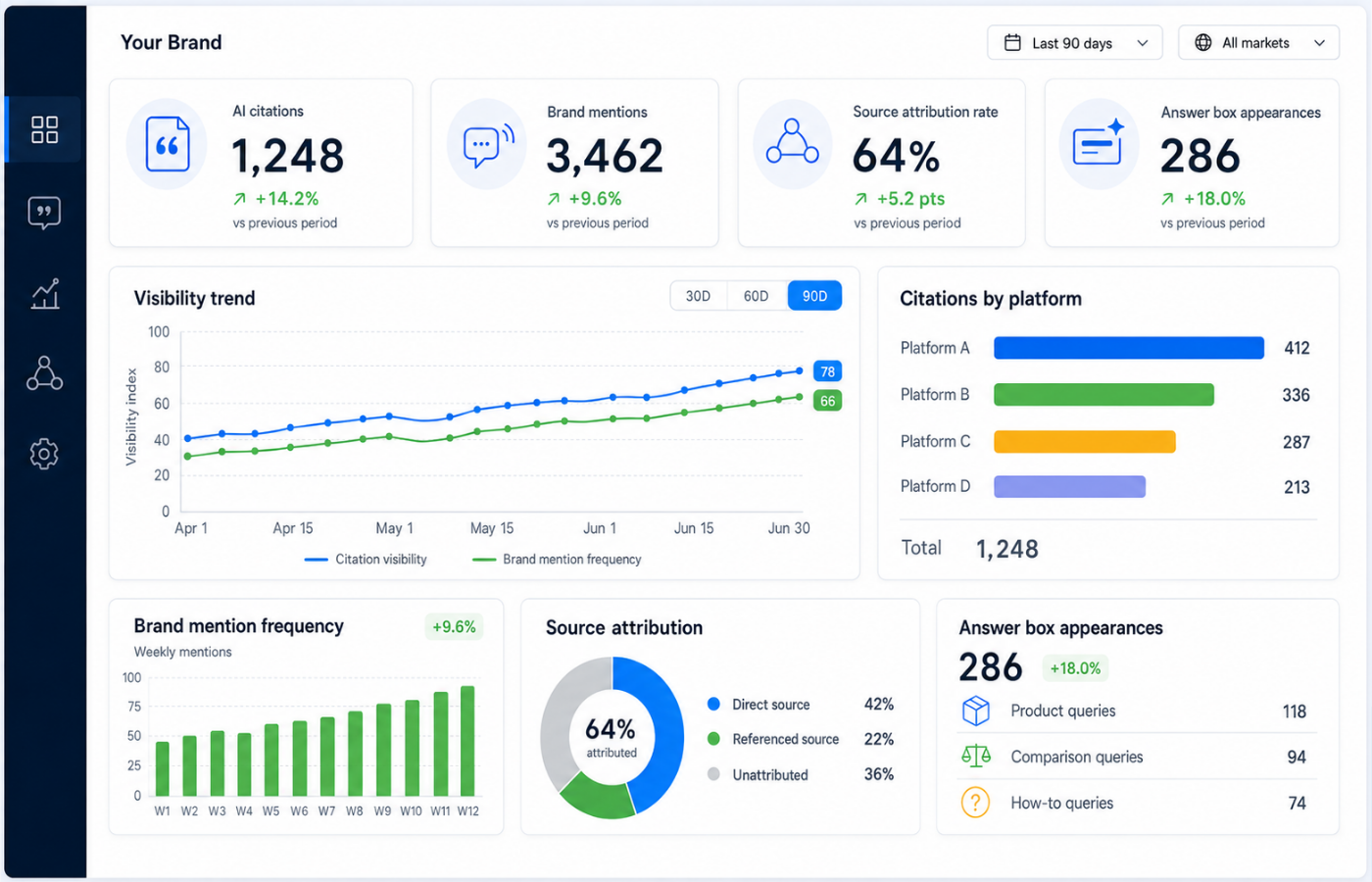
Layer 1: AI Citation & Visibility Metrics
This is where most teams start, and for good reason. Before you can optimize anything, you need to know where you stand. Layer 1 answers the fundamental question: “Are AI systems citing us when users ask about topics in our space?”
Core Metrics to Track:
AI Overview Inclusion Rate measures the percentage of your target queries that trigger AI Overviews that cite your content. AI Overviews now appear in about 18-21% of all Google searches worldwide (StoreTransform, 2025-2026), so understanding your inclusion rate within that subset is critical.
LLM Citation Frequency tracks how often ChatGPT, Perplexity, and Gemini reference your brand, content, or expertise when responding to relevant queries. ChatGPT alone drives 87.4% of all AI referrals (Conductor, 2026), making this the highest-priority platform for most B2B brands.
Share of Model Voice is your competitive visibility metric. When users ask AI assistants about your category, what percentage of recommendations mention you versus competitors? This is the AI equivalent of share of voice in traditional media.
Prompt Coverage Rate measures what percentage of your priority keyword list generates AI responses where you could theoretically be cited. Not all queries trigger AI answers, so understanding the addressable opportunity is essential.
Citation Volatility Index tracks month-over-month retention of your citations. Given that 40-60% of cited sources change monthly (EMARKETER/Profound, 2026), understanding your stability relative to the market helps put performance swings in context.
Tool Recommendations by Tier:
For enterprise teams ($2,000+/month budget), Profound offers the most comprehensive AI visibility tracking, competitive intelligence, and custom reporting. Conductor provides similar capabilities with stronger SEO platform integration.
Mid-market teams ($99-499/month) should consider Semrush’s AI Visibility module or Otterly.AI for more affordable citation tracking with adequate competitive benchmarking.
SMB teams with minimal budget can start with GA4 custom segments for AI referral traffic, Google Search Console for AI Overview performance (limited), and manual citation audits across priority queries.
Layer 1 KPIs Checklist
☐ AI Overview inclusion rate (% of target queries with citations)
☐ ChatGPT citation frequency (monthly count + trend)
☐ Perplexity citation frequency (monthly count + trend)
☐ Share of Model Voice vs. top 3 competitors
☐ Prompt coverage rate (% of keywords with AI answers)
☐ Citation volatility index (MoM retention %)
☐ Referral traffic from AI sources (GA4 segmented)
☐ New AI source detection (emerging platforms)
Layer 2: Quality & Sentiment Metrics
Being cited isn’t enough. Being cited negatively, with outdated information, or in an unfavorable competitive context can actively hurt your brand. Layer 2 answers: “When AI mentions us, is it helping or hurting?”
Citation Sentiment Analysis categorizes mentions as positive, neutral, or negative. When ChatGPT recommends your product, does it frame you as the premium choice, a budget alternative, or a legacy solution losing market share? The framing matters enormously.
Information Accuracy Rate tracks whether AI-generated answers about your brand contain factual errors. AI systems hallucinate, and incorrect information about your pricing, features, or positioning spreads through every conversation where you’re mentioned.
Competitive Framing Score measures how you’re positioned relative to alternatives in AI responses. Are you mentioned first? Positioned as the market leader? Listed as one of many options? The context of your citation shapes user perception.
Answer Completeness evaluates whether AI systems capture the full value proposition when recommending you, or if they focus on narrow features that undersell your capabilities.
The “context collapse” problem is real. AI might accurately cite your product, but in a context that doesn’t help. For example, being cited as “a solution that works for small businesses” when you’re targeting enterprise accounts actually undermines your positioning.
Manual Audit Protocol:
We recommend quarterly prompt testing across your top 50 target queries. Run each query through ChatGPT, Perplexity, and Google (for AI Overviews), documenting:
- Whether you’re cited
- Sentiment of the citation
- Competitive context
- Accuracy of information
- Position within the response (early mentions carry more weight)
This qualitative data complements the quantitative metrics from tracking tools and often reveals optimization opportunities the tools miss.
Layer 3: Technical Readiness Metrics
The best content strategy in the world won’t generate AI citations if your technical infrastructure blocks AI systems from properly understanding your site. Layer 3 answers: “Is our content technically optimized for AI consumption?”
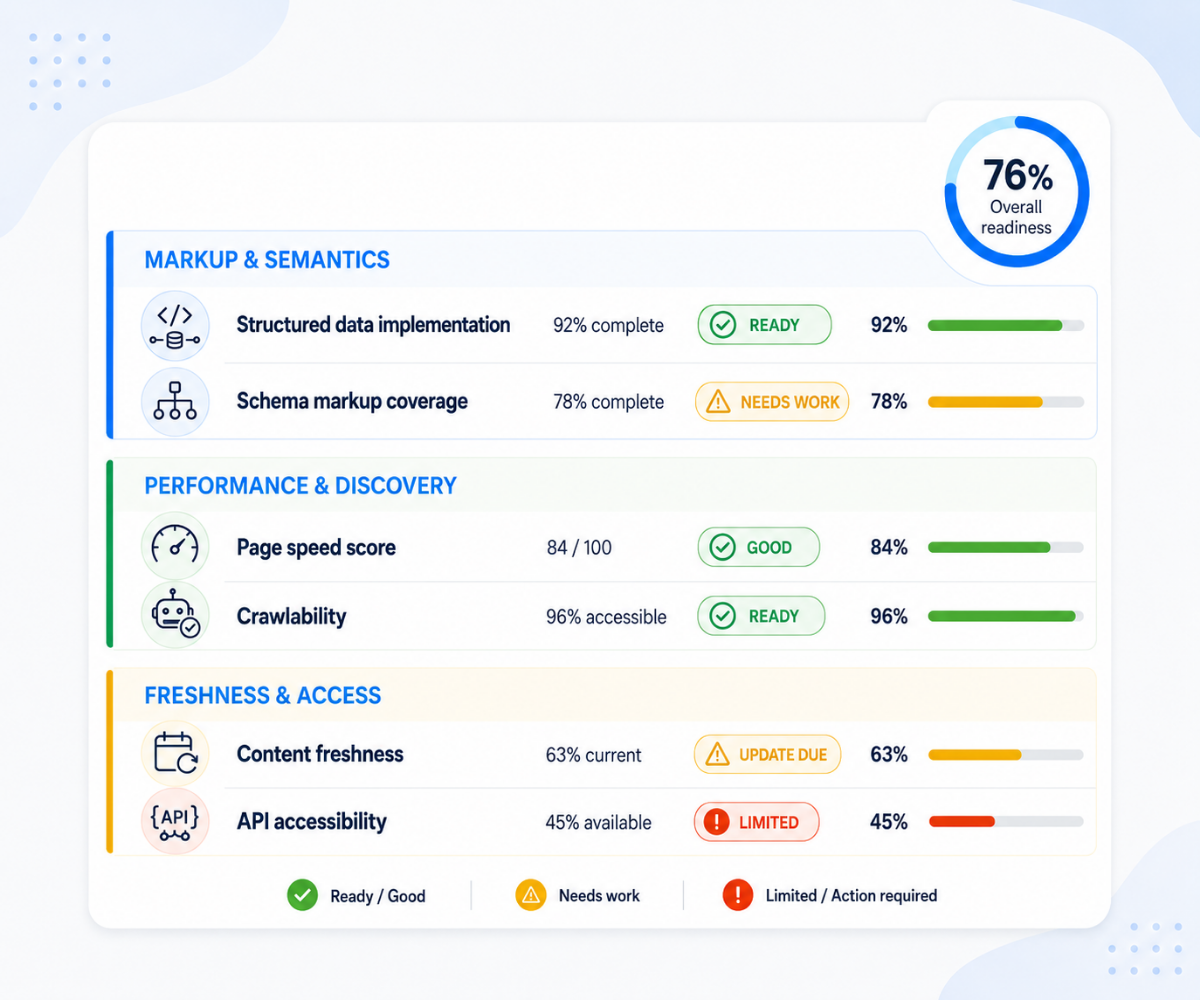
Schema Markup Implementation Rate measures the percentage of your key pages with appropriate structured data. Organization, Product, Person, FAQ, and HowTo schemas are essential for AI citability. They provide the machine-readable context that helps AI systems understand what your content actually means.
Content Freshness Score measures the recency of your published content. Pages refreshed within 3 months are 3x more likely to be cited in AI answers (YourContentMart, 2026). If your cornerstone content is stale, your AI visibility will suffer regardless of its original quality.
Structured Data Validation detects errors in your schema implementation that could impede AI’s comprehension. Invalid markup doesn’t just fail silently. It can prevent proper indexing by the systems that feed AI models.
Core Web Vitals Compliance still matters for AI Overviews since they pull from indexed pages. A page that loads slowly or shifts layout unexpectedly is less likely to be selected as a citation source.
Entity Coverage evaluates whether your key entities (people, products, concepts) are properly defined with structured data and interlinked across your site. AI systems understand entities, not keywords. If your content doesn’t clearly establish entity relationships, you’re speaking a language AI struggles to parse.
Technical Readiness Audit Checklist
☐ Organization schema on homepage and about pages
☐ Product/Service schema on all offering pages
☐ Person schema for author pages and leadership team
☐ FAQ schema on support and information pages
☐ HowTo schema on tutorial and guide content
☐ Schema validation passing (no errors in Google Rich Results Test)
☐ Content freshness audit (flag pages >90 days since update)
☐ Core Web Vitals passing on >90% of key pages
☐ Author pages with proper E-E-A-T markup
☐ Internal linking structure supporting entity relationships
☐ AI crawler access confirmed (check robots.txt for ClaudeBot, GPTBot)
☐ XML sitemap current and properly submitted
For a deeper dive into technical foundations, our technical SEO audit checklist covers the infrastructure that supports both traditional and AI search visibility.
Layer 4: Business Impact Metrics
This is where executive conversations live. Layers 1-3 establish visibility and readiness. Layer 4 answers the only question that matters to leadership: “So what? Is this driving revenue?”
AI Referral Traffic Volume is your most direct measure. Segment GA4 to isolate traffic from ChatGPT, Perplexity, and other AI sources. This requires proper UTM tagging and referral recognition, which we’ll cover in the implementation section.
AI Referral Conversion Rate compares the conversion performance of AI-sourced traffic against other channels. The benchmark is compelling: AI referral traffic converts at 4.4-5x the rate of traditional organic (Starmorph, 2025). If your numbers differ significantly, investigate why.
Branded Search Lift measures whether AI visibility is driving increased brand awareness. When AI assistants recommend your brand, users often search for you directly afterward. Correlating increases in AI citations with branded search volume reveals this downstream impact.
Pipeline Influence Attribution connects AI visibility to revenue. HubSpot saw 3x better lead conversion from AEO sources than other channels (HubSpot, 2026). Your CRM and attribution setup should tag leads that engaged with AI-generated content or arrived via AI referrals.
The Attribution Reality Check:
AI visibility often creates awareness that converts through other channels. Someone reads about your product in ChatGPT, searches your brand name, clicks a Google ad, and converts. That conversion gets attributed to paid search, but AI visibility initiated the journey.
Look for correlation, not just direct attribution. If AI citations increase in Month 1 and branded search plus direct traffic increase in Month 2, that’s the AI visibility flywheel at work. Set realistic expectations with stakeholders: AI visibility is a leading indicator. Revenue impact is a lagging indicator with a 30-90 day attribution lag.
The AI Visibility → Revenue Attribution Model
Stage 1: AI Citation – User encounters your brand in ChatGPT/Perplexity response
Stage 2: Brand Awareness – User now knows your brand exists and what you offer
Stage 3: Brand Search – User searches your brand name directly
Stage 4: Engagement – User visits site via organic, paid, or direct
Stage 5: Conversion – User converts (often attributed to final touchpoint)
Track increases in branded search as a proxy for AI visibility impact on early-funnel awareness.
How to Connect Your Data Sources Into a Unified Dashboard
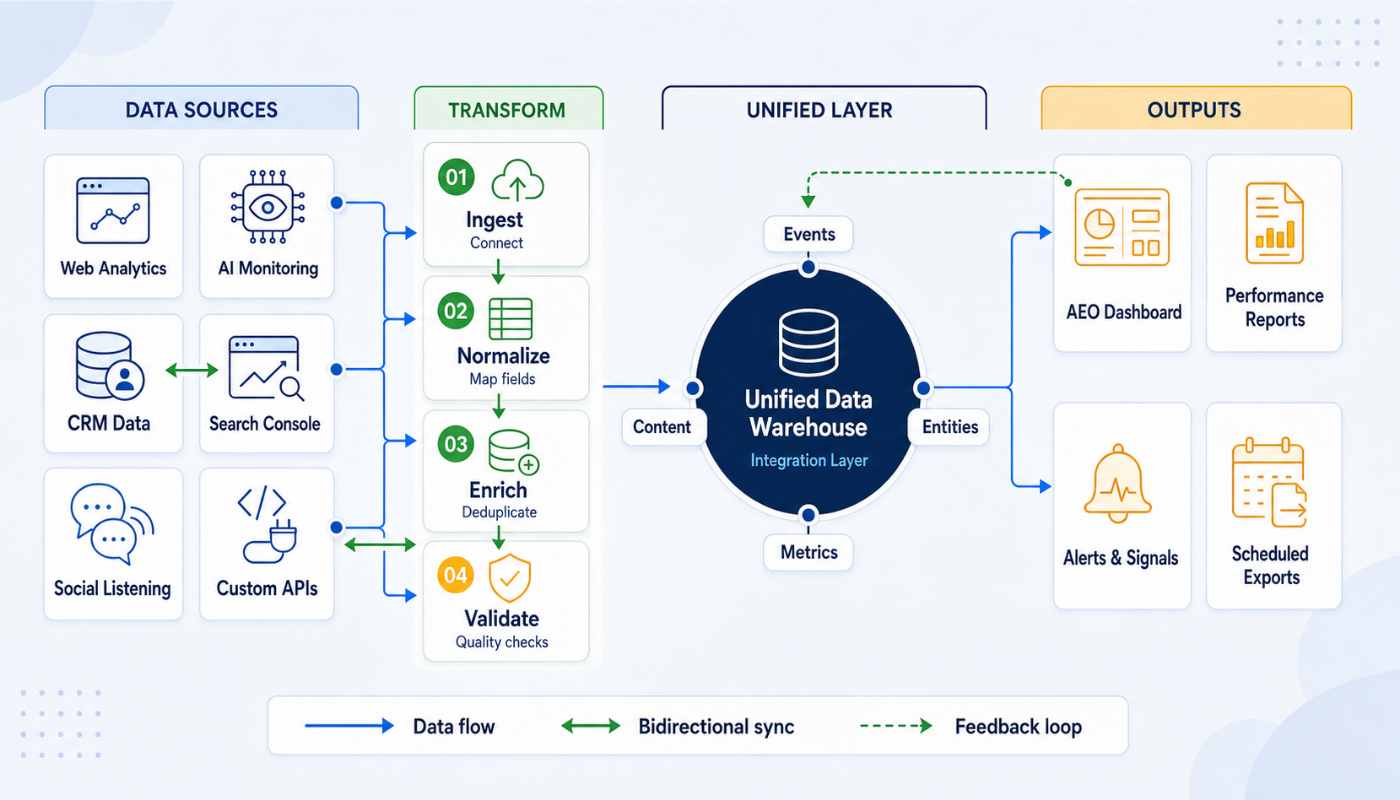
The biggest implementation challenge isn’t choosing metrics. It’s connecting disparate data sources into a single view that executives can actually use. Data lives in GA4, Google Search Console, Semrush, Profound, your CRM, and potentially half a dozen other tools. Executives need one dashboard, not seven.
Architecture Overview:
The flow is straightforward: Data Sources → Data Connector/Warehouse → Visualization Layer → Automated Reporting
Data sources include GA4 (AI referral traffic, conversions), GSC (query-level performance, AI Overview impressions), AI visibility tools (Profound, Semrush, Otterly.AI), CRM (pipeline attribution, lead quality), and manual audit data (sentiment, accuracy).
The connector layer depends on your level of complexity. For simple implementations, native API connections work. For enterprise needs, a data warehouse such as BigQuery or Snowflake offers greater flexibility.
The visualization layer is where your dashboard lives. Looker Studio (free), Tableau, or Power BI are the common choices. Each can pull from multiple data sources and create unified views.
Three Implementation Paths:
Path 1: Native Tool Dashboards (Simplest)
Use the reporting built into your AI visibility tool (E.g., Profound or Semrush) and GA4. Export data manually for executive presentations. Best for: Small teams, limited budget, quick wins.
Path 2: Looker Studio Integration (Mid-Complexity)
Connect GA4, GSC, and spreadsheet data (for manual tracking) to Looker Studio. Build custom visualizations with executive and practitioner views. Best for: Mid-market teams, monthly reporting cadence.
Path 3: Custom Data Warehouse (Enterprise)
Pipe all data sources into BigQuery or similar, build custom data models, and visualize in Tableau or Looker. Best for: Enterprise teams, real-time dashboards, multi-brand reporting.
Key Connection Points:
GA4 AI Referral Segmentation: Create a custom segment for AI-driven referral traffic. The referral strings to include: chatgpt.com, openai.com, perplexity.ai, bing.com/chat, bard.google.com (legacy), gemini.google.com. This segment serves as the foundation for your AI referral reporting.
GSC API Integration: Google Search Console provides query-level data, including AI Overview impressions (limited visibility). The API allows automated data pulls to populate dashboards.
Microsoft Bing AI Performance Dashboard: Worth noting that Microsoft now offers an AI Performance dashboard within Bing Webmaster Tools (Microsoft Advertising, 2026). While Bing’s market share is smaller, this provides insights into Copilot visibility that complement your Google-focused tracking.
Choosing the Right Tools for Your Dashboard
Not every team needs enterprise-grade tooling. Here’s our recommendation matrix based on company size and budget:
| Budget Tier | Primary Tools | Strengths | Limitations |
|---|---|---|---|
| Enterprise ($2,000+/mo) | Profound, Conductor, Custom Looker/Tableau | Full competitive intelligence, custom reporting, API access | Cost, implementation complexity |
| Mid-Market ($99-499/mo) | Semrush AI Visibility, Otterly.AI, Looker Studio | Affordable, adequate coverage, reasonable automation | Less competitive depth, some manual processes |
| SMB (Minimal) | GA4, GSC, Manual Audits, Free Looker Templates | No additional cost, builds foundation | Labor intensive, limited scale |
Tool Evaluation Criteria:
When evaluating AI visibility tools specifically for dashboard capability, prioritize:
- Data Freshness: How often does the tool update citation data? Weekly minimum.
- API Availability: Can you pull data automatically for dashboard integration?
- Export Capabilities: If no API, can you at least export data in usable formats?
- Competitive Tracking: Does it benchmark you against specific competitors?
- Multi-User Access: Can executives access dashboards directly, or does someone need to run reports?
For a comprehensive guide to measuring AI search performance, our article on measuring AI SEO and brand visibility in chatbots provides additional tool recommendations and measurement strategies.
Executive View vs. Practitioner View: Designing for Your Audience
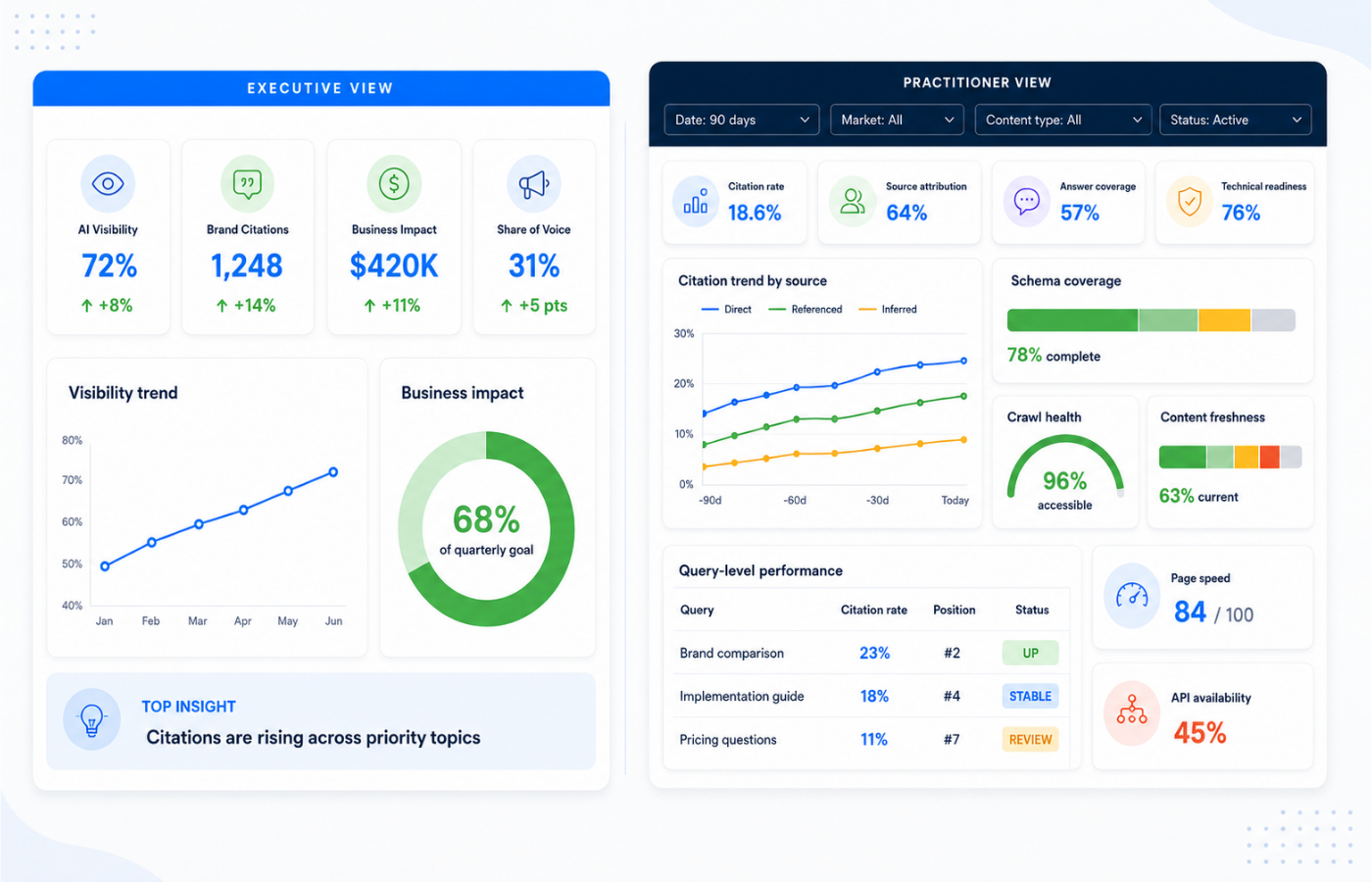
Here’s where most dashboard projects fail: teams build one dashboard that tries to satisfy everyone and ends up satisfying no one. Executives get overwhelmed by tactical detail. Practitioners can’t find the granular data they need. Both groups stop using the dashboard.
The solution is building two views within the same reporting infrastructure.
Executive View Requirements:
Executives need strategic context, not operational detail. Their view should include:
- Trend lines over absolute numbers – “AI visibility up 15% QoQ” matters more than “147 citations this month”
- Competitive positioning – Where do we stand vs. key competitors?
- Business impact connections – How does visibility connect to pipeline?
- Monthly/quarterly cadence – Executives don’t need weekly updates
- 5-7 KPIs maximum – Anything more creates dashboard fatigue
Executive Dashboard KPIs:
1. AI Visibility Score (composite metric combining citation frequency, Share of Voice, and inclusion rate)
2. Share of Model Voice trend vs. top 3 competitors
3. AI referral traffic volume and growth rate
4. AI referral conversion value (revenue attributed to AI traffic)
5. Branded search lift correlation
6. Content freshness compliance rate
7. Quarter-over-quarter trend summary
Practitioner View Requirements:
Practitioners need granular data to inform optimization decisions. Their view should include:
- Query-level detail – Which specific queries are generating citations?
- URL-level citation tracking – Which pages are getting cited most?
- Content optimization opportunities – What queries are we missing?
- Weekly cadence – Tactical work requires faster feedback loops
- 15-20+ KPIs – Depth over simplicity
Practitioner Dashboard KPIs:
| Metric Category | Specific KPIs |
|---|---|
| Citation Performance | Citation count by URL, citation trend by page, new citations this week, lost citations this week |
| Competitive Intelligence | Competitor citation comparison, Share of Voice by topic cluster, competitor new citations |
| Content Gaps | Queries with AI answers citing competitors only, uncovered topic opportunities, prompt coverage gaps |
| Technical Health | Schema validation errors, content freshness alerts (pages >90 days), Core Web Vitals degradation |
| Optimization Priorities | Pages with the highest citation potential, recommended refresh candidates, and new content briefs needed |
Build these as separate tabs or views within Looker Studio, Tableau, or your chosen visualization tool. Link them to the same underlying data sources so numbers always match. Allow drill-down from executive metrics to practitioner detail for stakeholders who want to go deeper.
Your 8-Week Dashboard Implementation Plan
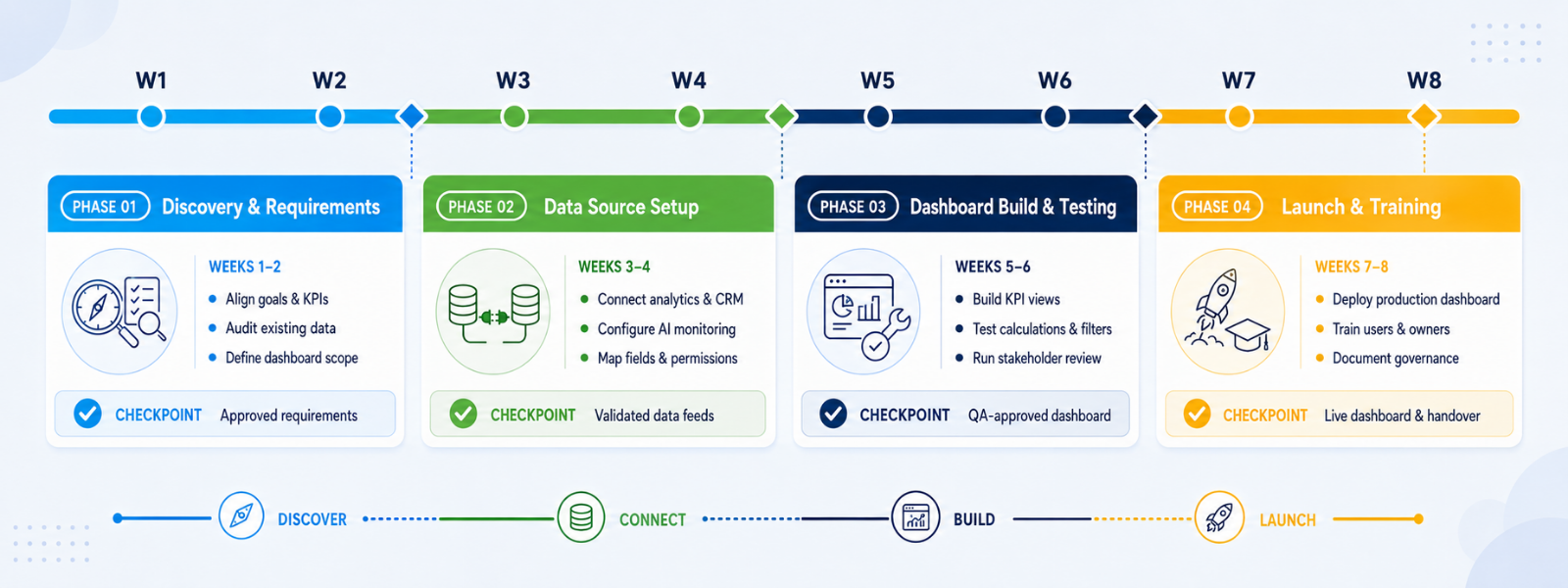
Building a comprehensive AEO GEO dashboard doesn’t happen overnight, but it shouldn’t take six months either. Here’s the phase-based implementation plan we use with clients:
Weeks 1-2: Foundation
This phase establishes your data infrastructure.
- [ ] Audit current tracking setup (GA4 events, GSC connection)
- [ ] Create GA4 custom segment for AI referral traffic
- [ ] Document all AI referral strings to track (ChatGPT, Perplexity, etc.)
- [ ] Select primary AI visibility tool based on budget tier
- [ ] Set up tool trials if evaluating multiple options
- [ ] Export current data to establish baseline metrics
- [ ] Create a shared spreadsheet for a manual tracking template
- [ ] Define executive stakeholder KPI requirements
- [ ] Document competitor list for Share of Voice tracking
Weeks 3-4: Layer 1 & 2 Implementation
This phase establishes visibility and quality metrics.
- [ ] Configure the AI visibility tool for your domain
- [ ] Set up competitive tracking for top 3 competitors
- [ ] Run initial citation audit across ChatGPT, Perplexity, Google AI Overviews
- [ ] Establish baseline Share of Voice metrics
- [ ] Create sentiment tracking template for manual audits
- [ ] Document accuracy issues in current AI mentions
- [ ] Set up weekly citation tracking workflow
- [ ] Configure automated alerts for significant citation changes
Weeks 5-6: Layer 3 & 4 Implementation
This phase connects technical readiness and business impact.
- [ ] Run a comprehensive technical SEO audit focused on AI citability
- [ ] Document schema markup gaps
- [ ] Audit content freshness across priority pages
- [ ] Connect CRM data for pipeline attribution (HubSpot, Salesforce)
- [ ] Create revenue attribution model for AI referrals
- [ ] Set up branded search tracking in GSC
- [ ] Establish correlation tracking between AI visibility and brand searches
- [ ] Document attribution lags expectations for stakeholders
Weeks 7-8: Dashboard Build & Launch
This phase assembles everything into usable dashboards.
- [ ] Build Looker Studio (or chosen tool) data connections
- [ ] Create executive view with 5-7 KPIs
- [ ] Create practitioner view with full metric set
- [ ] Configure automated data refresh schedules
- [ ] Build automated email reporting for executive distribution
- [ ] Conduct stakeholder training on dashboard interpretation
- [ ] Document data source refresh frequencies
- [ ] Schedule quarterly methodology review
Ongoing Maintenance:
- Weekly: Review practitioner dashboard, flag anomalies
- Monthly: Update executive dashboard, conduct sentiment audit
- Quarterly: Refresh baseline metrics, review methodology for updates, update competitor list
How to Report on Metrics That Change 40-60% Monthly
Traditional SEO reporting assumes relative stability. Rankings might fluctuate by a few positions, and traffic might vary by 10-15% month over month, but the overall picture is predictable. AI citations are fundamentally different. When 40-60% of cited sources change monthly (EMARKETER/Profound, 2026), your reporting methodology needs to adapt.
Strategy 1: Rolling Averages Over Point-in-Time
Instead of reporting “we had 147 citations in May,” report “our 30-day rolling average is 152 citations, up 12% from our previous 30-day average.” Rolling averages smooth volatility and reveal actual trends hidden within the noise.
For executive reporting, 90-day rolling averages work best. They’re stable enough to show meaningful trends without being so smoothed that they hide important changes.
Strategy 2: Trend Direction Over Absolute Numbers
Frame metrics in terms of direction and velocity. “Our AI visibility score improved 15% this quarter” is more meaningful than “we were cited 423 times last month, up from 398.” Executives care about trajectory, not absolute counts; they have no context to interpret.
Strategy 3: Volatility Bands
Establish normal fluctuation ranges based on historical data. If your month-over-month citation variance typically ranges from -25% to +30%, communicate that context. A 20% drop within normal variance is very different from a 20% drop when the variance is usually 5%.
Strategy 4: Competitive Context Always
Your volatility matters less if competitors are experiencing similar shifts. When the entire market experiences citation changes, that’s platform volatility, not performance decline. When your citations drop while competitors’ remain stable, that’s a signal that requires investigation.
Volatility-Aware Reporting Framework
Do: “Our 90-day average AI visibility score is 74, up 18% from last quarter. Normal monthly variance in our category is ±25%, so our month-over-month 15% decline is within expected ranges.”
Don’t: “We lost 23 citations last month.”
Context prevents panic. Absolute numbers without context create unnecessary alarm.
Common Pitfalls to Avoid
After building dozens of these dashboards, we’ve seen the same mistakes repeatedly. Here’s what to watch for:
Pitfall 1: Tracking Too Many Metrics
Dashboard fatigue is real. When executives see 20+ KPIs, they tune out entirely. Focus on 5-7 metrics that actually matter for strategic decisions. Everything else goes in the practitioner’s view. More metrics do not equal better decisions.
Pitfall 2: Ignoring the Attribution Lag
AI visibility today drives conversions 30-90 days later. Teams expecting instant correlation between citation increases and revenue spikes will be disappointed and may abandon AI visibility tracking prematurely. Set expectations upfront and look for lagged correlations, not same-month causation.
Pitfall 3: Over-Relying on Vendor Data
Profound, Conductor, and Semrush all produce valuable data, but their benchmark reports are inherently self-serving. They tend to highlight metrics where their tools perform well. Validate findings with multiple sources. Manual audits remain essential for ground truth.
Pitfall 4: Forgetting Google Still Dominates
Here’s a grounding statistic: Google still drives 210x as much traffic as ChatGPT, Gemini, and Perplexity combined (YourContentMart, 2026). That ratio was 345x in March 2025, so AI is growing rapidly, but traditional search remains the foundation. Your dashboard should track both, not abandon traditional SEO metrics entirely.
Pitfall 5: Building Static Dashboards
AI search evolves monthly. New platforms emerge, existing platforms change their citation behavior, and measurement tools release new capabilities. Your dashboard needs quarterly methodology reviews to stay relevant. What you measure today may not be what matters in six months.
Pitfall 6: Not Segmenting by Query Type
Informational, commercial, and transactional queries have different AI visibility patterns. AI assistants are more likely to provide direct answers for informational queries and recommend products/services for commercial queries. Your dashboard should segment performance accordingly, or you’ll miss optimization opportunities hiding within aggregate metrics.
In Practice: What We’ve Learned Building These Dashboards
Our experience building AI visibility dashboards for B2B clients has revealed several patterns worth sharing:
Observation 1: Third-Party Review Sites Dominate B2B Citations
For B2B software queries, G2 accounts for 22.4% of citations across ChatGPT, Perplexity, and Google AI Overviews (YourContentMart, 2026). Many clients discover their “AI visibility problem” is actually a review presence problem. Before investing heavily in owned content optimization, ensure your presence on key review platforms is strong.
Observation 2: Content Freshness Is the Fastest Lever
Updating your top 20 pages quarterly yields measurable improvements in citations within 30-60 days. Pages refreshed within 3 months are 3x more likely to be cited (YourContentMart, 2026). For clients wanting quick wins while building longer-term AI visibility infrastructure, content refreshes deliver the fastest.
Observation 3: Executive Buy-In Requires Revenue Connection
The dashboards that survive past initial launch are the ones that connect AI visibility to the pipeline. Abstract metrics like “Share of Model Voice” struggle to justify ongoing investment. Revenue attribution – even imperfect correlation-based attribution – makes the business case tangible.
Observation 4: Manual Audits Catch What Tools Miss
Every automated tool has blind spots. We’ve found critical sentiment issues, accuracy problems, and competitive positioning concerns that only surfaced through manual query testing. Budget time for quarterly manual audits even if you have comprehensive tooling.
Observation 5: The Dashboard Isn’t the Destination
The real value isn’t in the dashboard itself – it’s in the decisions the dashboard enables. Teams that use dashboard insights to drive content optimization for AI search see compounding returns. Teams that build beautiful dashboards but don’t act on the data waste the investment.
Key Takeaways
Building an executive-ready AEO GEO dashboard requires more than adding new metrics to your existing reports. Here’s what to remember:
- Traditional SEO dashboards are blind to AI visibility. The decoupling of rankings from AI citations means position tracking alone misses the new search landscape entirely.
- The four-layer framework provides structure. AI Citation & Visibility, Quality & Sentiment, Technical Readiness, and Business Impact layers ensure you’re measuring leading and lagging indicators together.
- Build two views, not one dashboard. Executives need 5-7 strategic KPIs with trend context. Practitioners need 15+ tactical metrics with query-level detail. Same data, different presentations.
- Volatility requires different reporting methods. Rolling averages, trend direction, volatility bands, and competitive context prevent false alarms when metrics swing by 40-60% each month.
- Connect visibility to revenue or lose executive support. Abstract AI metrics struggle to justify investment. Pipeline attribution – even correlation-based attribution – sustains stakeholder commitment.
Next Steps
If your current dashboard doesn’t tell you how visible you are in ChatGPT, Perplexity, and Google AI Overviews, you’re measuring an increasingly incomplete picture of your search presence.
Start this week:
1. Create a GA4 segment for AI referral traffic using the referral strings documented above
2. Run manual citation audits on your top 10 target queries across ChatGPT and Perplexity
3. Document your current baseline – you can’t measure improvement without a starting point
Start this month:
1. Select an AI visibility tool appropriate for your budget tier
2. Build your 8-week implementation plan using the checklist provided
3. Identify executive stakeholders and document their specific KPI requirements
Start this quarter:
- Launch your executive and practitioner dashboard views
- Present your first AI visibility report to leadership, using the volatility-aware reporting framework to contextualize the data
- Schedule your first quarterly methodology review to ensure your measurement approach evolves with the AI search landscape
The Bottom Line
The marketing leaders who will win the next phase of search are not the ones who tracked the most metrics, but they’re the ones who measured the right things and acted on what they learned.
Your competitors are likely still reporting on rankings and sessions while AI assistants quietly shape buyer awareness in channels that never show up in their dashboards. That gap is your opportunity.
The eight-week implementation plan in this guide gives you a concrete path from where you are today to a reporting infrastructure that reflects how search actually works in 2026. The tools exist. The framework is proven. The only remaining question is whether your organization will build this measurement capability before or after your competitors do.
Start with the GA4 segment. Run the manual audits. Document your baseline. The dashboard follows from there.
