AI for Content Creation – How to Scale, Automate, and Optimize Your Content Strategy
Last updated: May 2026. After working with hundreds of businesses on their content marketing strategies, I’ve noticed a significant shift in how successful companies approach content creation. The most innovative brands aren’t just hiring more writers or outsourcing content – they’re leveraging AI content creation tools to transform their entire content-production process.
TL;DR: AI content strategies have doubled organic traffic while reducing content production costs by up to 40%. This guide shows you exactly how to implement AI tools in your content workflow – covering tool selection, workflow integration, measuring ROI, and avoiding common pitfalls – without sacrificing quality or authenticity.
AI Seo Content Kaise Banaye: The Complete Guide to AI-Powered Content Creation
AI content creation uses machine learning tools to research, draft, optimize, and repurpose marketing content at scale. To create content with AI effectively, follow these core steps: (1) select the right AI tools for your content type, (2) train the AI on your brand voice and audience data, (3) use AI for research and first drafts while humans refine for authenticity, (4) optimize with AI-driven SEO recommendations, and (5) measure performance and iterate. Companies using this approach produce 4x more content with the same team size while improving engagement metrics by 30-45%.
AI is Changing Content Creation – Are You Keeping Up?
The content creation landscape has undergone a remarkable transformation. Just two years ago, creating high-quality, SEO-optimized content at scale required significant resources – large writing teams, extensive editing processes, and considerable time investments.
Today, AI tools can generate first drafts in seconds, optimize content for search engines, and even help ideate topics that resonate with your target audience. Companies that embrace these technologies gain a significant competitive advantage.
Why AI is the Future of Content Marketing
Many marketers initially approach AI skeptically, concerned it will produce generic, robotic content lacking the human touch. While this fear is understandable, it misses the transformative potential of AI when deployed strategically.
AI isn’t replacing human creativity – it’s enhancing it. The most effective content strategies use AI to handle repetitive tasks while allowing human creators to focus on strategy, storytelling, and brand voice. AI content generator tools play a crucial role in this enhancement by streamlining content creation processes and enabling marketers to adapt their strategies effectively. For deeper insights on how AI is reshaping the search landscape, see our analysis on the AI-driven search revolution and why SEO will never be the same.
During a recent client project, we transformed a labour-intensive content calendar that produced 4 blog posts monthly into an AI-assisted workflow that consistently delivers 16 high-quality articles each month without adding staff. The secret wasn’t replacing writers with AI but integrating tools that automate research, create content outlines, generate first drafts, and optimize for SEO.
The Role of AI in Streamlining the Content Creation Process
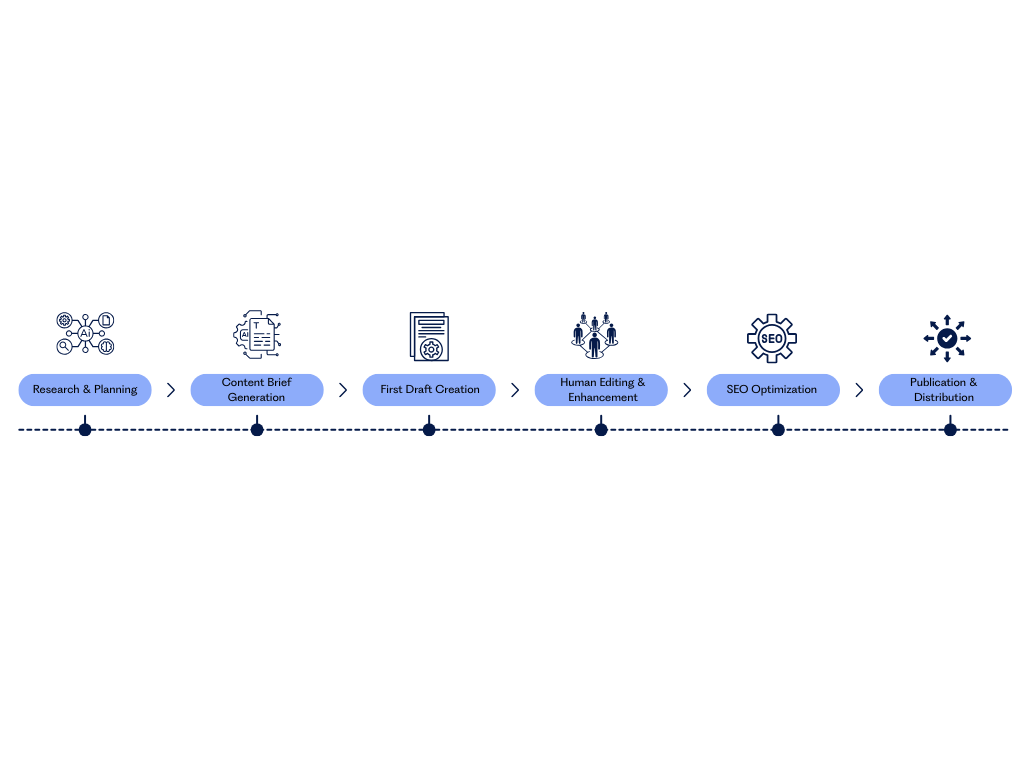
AI excels at systematizing content creation. Today’s tools can:
- Generate data-driven content briefs based on top-performing articles
- Create detailed outlines with suggested headings and subtopics
- Produce first drafts that follow your brand guidelines
- Optimize content for search engines and readability
- Repurpose long-form content into social media posts, emails, and other formats
- Utilize AI writing tools to generate relevant content for social media posts quickly and efficiently by analyzing user input, such as audience information and brand preferences
The most effective content teams establish clear processes where AI handles these routine aspects of content creation while humans provide strategic direction, editing, and the crucial personal touch that makes content authentic.
This balance between automation and human oversight means your team can focus on what humans do best – creativity, strategic thinking, and emotional connection – while AI handles what machines do best – data analysis, pattern recognition, and repetitive tasks.
Understanding Your Target Audience
Identifying Your Audience and Their Needs
Identifying your target audience is the cornerstone of any successful content strategy. To create content that truly resonates, you need to understand who your audience is, what they care about, and how they behave. Start by gathering data on your existing customers or followers. This can include demographic information such as age, gender, location, and job title, as well as psychographic data like interests, values, and pain points. Social media analytics tools can provide valuable insights into your audience’s behavior and preferences, while surveys and customer feedback can offer a more in-depth understanding of their needs. By compiling this information, you can create a detailed picture of your target audience, guiding your content creation efforts and ensuring your content is relevant and engaging.
Creating Buyer Personas for Content Creation
Once you clearly understand your target audience, the next step is to create buyer personas. Buyer personas are fictional, yet realistic, representations of your ideal customers. They help you understand your audience’s needs, goals, and behaviors, and serve as a guide for your content creation. To create a buyer persona, start by identifying key demographic details such as age, location, and job title. Then, delve into their goals and challenges – what are they trying to achieve, and what obstacles are they facing? Finally, consider their behavior patterns, such as how they consume information and what motivates them to take action. By developing detailed buyer personas, you can ensure that your content speaks directly to your target audience, addressing their specific needs and concerns.
Researching Audience Preferences and Behaviors
Understanding your audience’s preferences and behaviors is essential for creating content that resonates. Social media analytics tools can track engagement, click-through, and conversion rates, providing valuable insights into what types of content your audience finds most engaging. Surveys, focus groups, and customer feedback can offer additional information on your audience’s preferences and behaviors. Additionally, analyzing industry trends and benchmarks can help you understand what types of content are most effective for your audience. By continuously researching and analyzing your audience’s preferences and behaviors, you can create content that captures their attention and drives meaningful results.
The Key Benefits of AI for Content Creation
Implementing AI in your content marketing strategy offers significant advantages beyond simply producing more content. A content creation tool can help users generate various types of content quickly and effectively, streamlining the writing process. Let’s explore the most impactful benefits we’ve observed with our clients.
Save Time While Producing High-Quality Content
Content creation is typically time-intensive, with research, drafting, editing, and optimization consuming substantial resources. AI tools dramatically improve efficiency at each stage:
- Research time reduced by 60-70% through automated information gathering
- First drafts completed in minutes rather than hours
- SEO optimization automated through data-driven recommendations
- Content repurposing accelerated across multiple platforms
One of our e-commerce clients previously spent 6-8 hours creating each product description. After implementing our AI-assisted content workflow, they now complete descriptions in under 2 hours while maintaining consistent quality and improving conversion rates by 15%.
Companies using AI effectively produce more content without sacrificing quality. For example:
- HubSpot leverages AI to create educational blog content at scale, using human editors to ensure brand voice consistency
- The Washington Post uses AI to generate data-heavy news reports, freeing journalists to focus on investigative work
- Sephora employs AI to create personalized product descriptions based on customer segments
Generate Engaging Content Tailored to Your Audience
Modern AI tools can analyze vast amounts of data about your audience’s preferences, behaviors, and engagement patterns. This analysis enables you to create hyper-relevant content tailored to specific audience segments.
AI excels at:
- Identifying content gaps in your existing strategy
- Analyzing top-performing competitor content to understand what resonates
- Generating topic ideas based on search intent data
- Personalizing content for different segments of your audience
Machine learning algorithms continually refine their understanding of what works for your specific audience. This creates a virtuous cycle where your content becomes increasingly effective over time.
For example, a B2B software company implemented AI-driven audience segmentation that allowed them to create tailored content for different industries. The result? Their blog engagement increased by 37%, and lead generation from content marketing grew by 45%.
Enhance Your Content Marketing ROI with Data-Driven Insights
Beyond creation, AI provides invaluable insights that improve content performance:
- Real-time content performance analysis identifying which topics, formats, and approaches drive the most engagement
- Predictive content recommendations suggesting topics likely to perform well in the future
- Competitive content gap analysis revealing opportunities your competitors haven’t addressed
- Automated A/B testing of headlines, content structures, and CTAs to maximize performance
These insights allow you to continually refine your content strategy based on actual performance data rather than assumptions.
An example in the financial services sector used AI-driven content analysis to identify underperforming but high-potential content. After strategic optimization based on AI recommendations, organic traffic to these pages increased by 86%, and conversion rates improved by 34%.
📌 Looking to improve content performance? See how AI can transform your content marketing strategy.
AI Content Tools Comparison: Which Platform Fits Your Needs?
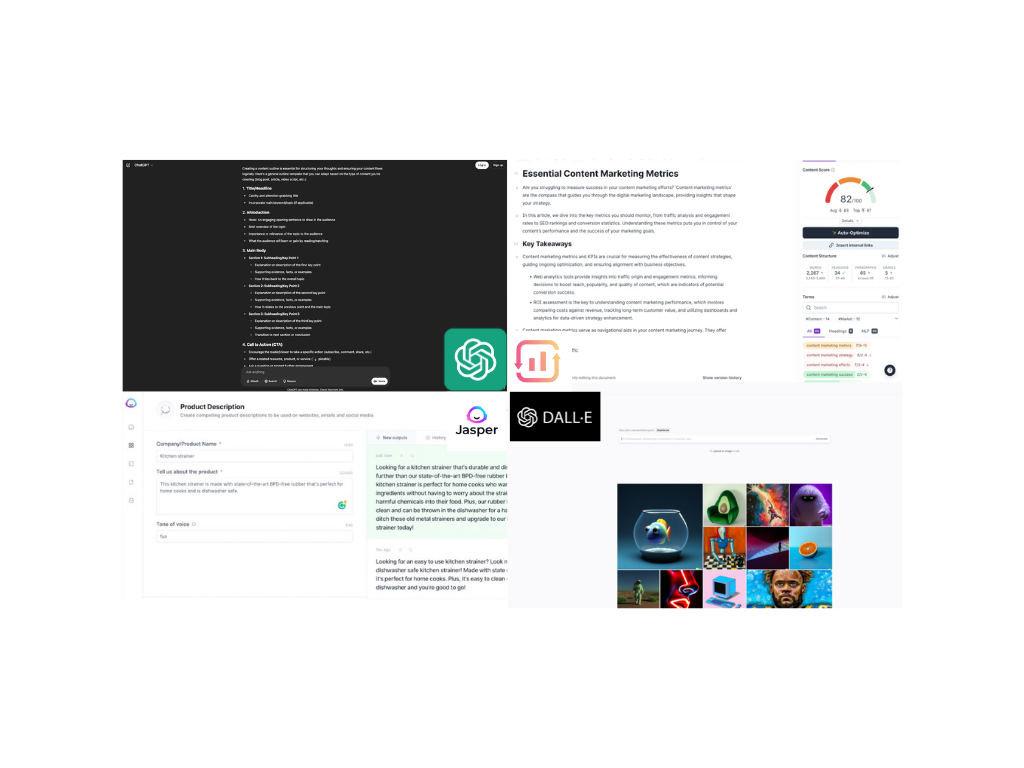
The AI content creation landscape continues to evolve rapidly. Based on our experience implementing these tools for clients across various industries, here’s a detailed comparison to help you choose the right solution:
| Tool | Best For | Pricing (2025) | Strengths | Limitations |
|---|---|---|---|---|
| ChatGPT (GPT-4) | Versatile content generation | $20-25/mo (Plus) | Natural language, broad knowledge, custom GPTs | Requires prompt engineering, no native SEO tools |
| Claude | Long-form content, analysis | $20/mo (Pro) | 200K context window, nuanced writing | Smaller ecosystem, fewer integrations |
| Jasper | Marketing teams, brand voice | $49-125/mo | Brand voice training, templates, team features | Higher cost, learning curve |
| Surfer SEO | SEO-optimized content | $89-219/mo | Real-time SEO scoring, SERP analysis | Focused on SEO only, needs content source |
| Frase | Research and briefs | $15-115/mo | Competitor analysis, content briefs, affordable | Generation quality varies |
Our recommendation: For most mid-market companies, we suggest combining ChatGPT or Claude for draft generation with Surfer SEO for optimization. This combination typically costs under $150/month and delivers 80% of enterprise tool capabilities. For more guidance on building a comprehensive content strategy, explore our SEO content marketing best practices guide.
How to Use AI for Content Creation: Step-by-Step Workflow
Overview of AI Content Generation Tools
AI content generation tools are revolutionizing how we create content, making it faster and more efficient. These tools leverage natural language processing (NLP) and machine learning algorithms to generate high-quality content tailored to your audience’s needs and preferences. Various types of AI content generation tools are available, each designed to address different aspects of the content creation process. For instance, blog post generators can help you create comprehensive articles in a fraction of the time it would take manually. Social media post generators can craft engaging posts optimized for different platforms, ensuring your social media presence remains consistent and active. Content optimization tools analyze your content for SEO and readability, providing data-driven recommendations to enhance its performance. By incorporating AI content generation tools into your workflow, you can save time and effort while maintaining a consistent brand voice and producing high-quality content that resonates with your audience.
The 5-Step AI Content Workflow
Here’s the exact workflow we use with clients to maximize AI efficiency while maintaining quality:
- Research Phase (AI-led): Use Frase or ChatGPT to analyze top 10 ranking articles, extract key topics, and identify content gaps – saves 3-4 hours per article
- Brief Creation (AI-assisted): Generate structured outlines with target keywords, word counts, and subtopic coverage requirements
- First Draft (AI-generated): Produce initial content using your trained AI tool with brand voice guidelines – typically 70-80% usable
- Human Refinement (Human-led): Editors add expertise, stories, data verification, and brand authenticity – critical 20-30% that makes content exceptional
- Optimization (AI-assisted): Run through Surfer SEO or Clearscope for final keyword and structure optimization
Real example: A SaaS client using this workflow reduced content production time from 12 hours to 4 hours per article while improving average time-on-page by 23% (NAV43 client data, 2024).
How AI Enhances Content Creation Across Different Formats
AI’s impact extends beyond blog posts to virtually every content format. Let’s explore how AI transforms the creation process across different content types.
AI for Blog Writing and Long-Form Content
Blog posts and long-form articles remain central to most content strategies. AI enhances this process through:
AI-powered research and first-draft generation: Tools like Frase and WriterZen aggregate relevant information from authoritative sources, helping writers quickly develop comprehensive content. AI can then generate first drafts based on this research, providing a solid foundation that writers can refine.
SEO-driven optimization using AI-based recommendations: AI tools analyze top-performing content for your target keywords and provide specific recommendations for:
- Optimal content length for your specific topic and audience
- Key subtopics to include for comprehensive coverage
- Semantic keywords to enhance topical relevance
- Content structure based on high-ranking competitor content
For example, a health and wellness client implemented an AI-optimized blog strategy. Their previous content struggled to rank despite being well-written. After applying AI-driven optimization:
- 88% of new blog posts ranked on page one for their target keywords
- Organic traffic increased by 134% over six months
- Time spent on page improved by 42%, indicating higher content quality
AI-Generated Videos and Visual Content
Visual content creation traditionally requires specialized skills and substantial resources. AI tools are democratizing this process:
How AI transforms text into high-quality videos in minutes: Platforms like Synthesia and Lumen5 can convert blog posts or scripts into professional-looking videos with:
- Realistic AI avatars that deliver your message
- Automatic scene selection based on content
- Dynamic text overlays highlighting key points
- Background music and visual effects
AI-powered image creation and design assistance: Tools like DALL-E, Midjourney, and Canva AI enable marketers to:
- Generate custom images based on text descriptions
- Create consistent visual branding across content
- Produce professional infographics without design expertise
- Develop custom illustrations that enhance written content
These tools dramatically reduce the resources required for visual content while maintaining professional quality. Implementing AI visual strategy reduced design costs by 60% while increasing social media engagement by 28%.
AI-Powered Social Media Content Creation
Social media demands consistent, engaging content across multiple platforms. AI excels at streamlining this process:
AI-generated captions, hashtags, and engagement insights: Tools can analyze your audience, trending topics, and historical performance to:
- Generate platform-specific captions optimized for engagement
- Recommend relevant hashtags based on current trends
- Suggest optimal posting times based on audience activity
- Predict potential engagement levels before posting
The role of AI in automating social media scheduling and trend tracking: AI helps maintain a consistent social presence through:
- Content calendar automation based on performance data
- Repurposing of blog content into platform-specific formats
- Real-time trend analysis to identify timely content opportunities
- Performance prediction to prioritize high-potential content
📌 Ready to level up your content marketing? See how NAV43’s AI-driven solutions can help you grow.
How to Measure AI Content Success: KPIs and Benchmarks
You can’t improve what you don’t measure. Here are the key metrics we track for AI content programs:
Production Efficiency Metrics
- Time per article: Benchmark is 4-6 hours with AI vs. 10-15 hours manual
- Cost per piece: Target 40-60% reduction from pre-AI baseline
- Output volume: Expect 2-4x increase with same team size
Quality and Performance Metrics
- Organic traffic growth: Healthy AI programs see 50-150% increases within 6 months
- Time on page: Should remain stable or improve (drop indicates quality issues)
- Keyword rankings: Track positions for target terms monthly
- Conversion rate: Content should maintain or exceed pre-AI conversion benchmarks
AI-Specific Quality Checks
- Originality scores: Run through Copyscape or Originality.ai – target 95%+ unique
- Factual accuracy audit: Spot-check 10% of AI-generated claims monthly
- Brand voice consistency: Score against brand guidelines quarterly
Pro tip: Create a monthly dashboard tracking these metrics. We’ve seen clients who measure rigorously achieve 2x better results than those who “set and forget” their AI content programs.
AI for Content Creation: What Works and What Doesn’t

Despite its power, AI isn’t a magic solution for content marketing. Understanding its limitations is crucial for effective implementation.
The Importance of Maintaining a Human Touch
While AI excels at data analysis and pattern recognition, it lacks the emotional intelligence and creativity that define truly exceptional content.
Why AI-generated content still needs human oversight: Even the most advanced AI tools can:
- Miss nuances in brand voice or audience sensitivities
- Generate factually accurate but contextually inappropriate content
- Produce content that feels formulaic without creative direction
- Miss emerging trends that haven’t yet generated sufficient data
How to balance automation with brand authenticity: The most effective approach combines AI efficiency with human creativity:
- Use AI for research, first drafts, and optimization
- Have human editors refine the content for brand voice and emotional resonance
- Apply human judgment for sensitive topics or controversial subjects
- Use AI as a collaborative tool rather than a replacement for human writers
How to Avoid Common Pitfalls of AI-Generated Content
Many organizations struggle with implementing AI effectively. Here are the most common challenges and how to overcome them:
Overcoming generic or robotic-sounding AI content:
- Develop detailed brand voice guidelines for AI tools
- Create custom templates that incorporate your unique perspective
- Use AI for structure and research, then inject human stories and examples
- Train AI on your best-performing content to learn your style
Avoiding factual errors and hallucinations:
- Always verify statistics AI generates – it can confidently cite non-existent studies
- Cross-reference claims with authoritative sources before publishing
- Use AI for structure, not facts – have humans add verified data points
- Implement a fact-checking step in your editorial workflow
Common Mistakes When Using AI for Content (And How to Fix Them)
After implementing AI content programs for dozens of clients, we’ve identified the most frequent failure patterns:
Mistake 1: Publishing AI Content Without Human Editing
The problem: Raw AI output often contains subtle errors, awkward phrasing, or generic statements that damage credibility.
The fix: Budget 20-30% of total content time for human editing. Focus editors on adding expertise, verifying facts, and injecting brand personality.
Mistake 2: Using AI for Topics Requiring Deep Expertise
The problem: AI struggles with nuanced industry knowledge, recent developments, or proprietary insights.
The fix: Reserve AI for well-documented topics. Use subject matter experts for thought leadership, case studies, and cutting-edge analysis.
Mistake 3: Ignoring SEO During AI Content Creation
The problem: AI generates readable content but doesn’t automatically optimize for search intent or keyword coverage.
The fix: Integrate SEO tools like Surfer or Clearscope into your workflow. Provide AI with target keywords and competitor analysis upfront.
Mistake 4: Failing to Train AI on Brand Voice
The problem: Generic AI content sounds like every other AI-generated article online.
The fix: Create detailed brand voice documents. Feed AI examples of your best content. Use custom instructions or fine-tuning where available.
Mistake 5: Not Measuring AI Content Performance
The problem: Without tracking, you can’t identify what’s working or justify continued AI investment.
The fix: Tag AI-assisted content in your analytics. Compare performance against human-only content. Iterate based on data.
The Future of AI Content Creation: What’s Coming in 2025 and Beyond
The AI content landscape evolves rapidly. Here’s what forward-thinking marketers should prepare for:
Emerging Capabilities
- Multimodal content generation: Single prompts producing text, images, and video simultaneously
- Real-time personalization: AI adapting content to individual reader preferences on the fly
- Voice and audio content: Podcast scripts and voiceovers generated and produced by AI
- Interactive content: AI-powered quizzes, calculators, and tools becoming standard
Strategic Implications
As AI content becomes ubiquitous, differentiation will come from:
- Original research and data: Content based on proprietary insights AI can’t replicate
- Expert perspectives: Human expertise and experience that adds unique value
- Brand storytelling: Authentic narratives that connect emotionally with audiences
- Community engagement: Content that sparks conversations and builds relationships
To understand how AI is transforming not just content creation but the entire search ecosystem, read our deep dive on the future of content creation with AI.
Conclusion: Your AI Content Action Plan
AI content creation isn’t optional anymore – it’s a competitive necessity. Companies that master AI-assisted workflows produce more content, rank higher, and convert better than those clinging to traditional methods.
Key takeaways:
- Start with the right tools: ChatGPT or Claude for generation, Surfer SEO for optimization – under $150/month total
- Build a hybrid workflow: AI handles 70-80% of production; humans add the 20-30% that makes content exceptional
- Measure relentlessly: Track production efficiency, content performance, and quality metrics monthly
- Avoid common pitfalls: Always edit AI output, verify facts, and maintain brand voice consistency
- Think long-term: As AI content becomes standard, invest in original research and expert perspectives that differentiate your brand
The brands winning with AI content aren’t replacing humans – they’re empowering them to do more strategic, creative work while AI handles the heavy lifting.
-
AI content can perform very well for SEO when properly implemented. Google has clarified that their algorithms focus on content quality rather than creation method. The key factors for success include:
- Ensuring content thoroughly addresses user intent
- Adding unique insights beyond what AI generates
- Incorporating first-hand experience when relevant
- Maintaining factual accuracy and depth
- Providing value beyond what competitors offer
-
The ideal AI tool depends on your specific content needs and workflow. For comprehensive content marketing, we typically recommend a combination of:
- A robust AI writing assistant (like ChatGPT, Claude, or Jasper)
- An SEO optimization tool (like Surfer SEO or Clearscope)
- A content research tool (like Frase or BuzzSumo)
- An editing assistant (like Grammarly or ProWritingAid)
For smaller teams or those just starting with AI, ChatGPT Plus combined with Surfer SEO provides an excellent foundation for AI-assisted content creation.
-
AI transforms social media content creation by:
- Generating platform-specific content variations from core topics
- Analyzing trending conversations to identify timely opportunities
- Creating optimized captions and hashtags based on performance data
- Recommending optimal posting times for maximum engagement
- Suggesting content ideas based on audience interests
Brands implementing AI for social media typically see 30-50% increases in engagement while reducing time spent on content creation by up to 70%.
-
No, AI doesn't replace human writers—it transforms their role. Rather than handling routine aspects of content creation, writers can focus on:
- Developing content strategy and brand voice
- Adding unique insights and experiences
- Editing and refining AI-generated content
- Creating emotional connections with readers
- Addressing sensitive or complex topics requiring human judgment
The most successful content teams use AI as a collaboration tool that amplifies human creativity rather than replacing it. This approach typically improves content quality while increasing production capacity by 3-5x.
