
AEO Publishing Checklist: What to Validate Before Content Goes Live
This AEO publishing checklist is the pre-publish validation workflow content teams need to confirm every piece is citation-ready for ChatGPT, Perplexity, and Google AI Overviews before it goes live. Here’s why it matters: 70% of marketing professionals believe AEO will significantly impact their digital strategy within one to three years, but only 20% have begun implementing it (Acquia/Researchscape, 2025). That’s not a knowledge gap. It’s an operational gap.
Teams understand what Answer Engine Optimization is. They’ve read the guides. They know AI search is reshaping how buyers discover brands. But when it comes time to hit publish, there’s no validation workflow. No checklist. No systematic way to ensure content is actually citation-ready for ChatGPT, Perplexity, or Google AI Overviews.
I call this the last mile problem. Content can be strategically sound, covering the right topics with the right structure, and still fail because it’s technically invisible to AI crawlers or unquotable because claims aren’t verifiable. The optimization happens in strategy meetings, but validation gets skipped at the publishing stage.
The data backs this up: 73% of sites have technical barriers blocking AI crawler access (Otterly.AI, 2026). That means nearly three-quarters of content teams create content that never gets a fair shot at being cited by answer engines, no matter how good it is.
This article delivers what’s been missing: a pre-publish checklist that makes AEO operational. We’ve built this into our publishing workflow at NAV43, and I’m sharing the complete validation system organized by three domains: technical access, content structure, and evidence quality. Each item includes priority tiers so you know what must pass before publishing versus what optimizes performance.
How to Use This AEO Publishing Checklist
This checklist is designed to run before every piece of content goes live. It’s not a quarterly audit or an annual SEO review. It’s a pre-publish validation workflow that catches citation-killing issues before they cost you visibility.
Embed it into your CMS workflows. Whether you’re using Notion, Asana, ClickUp, or publishing directly through WordPress or HubSpot, this checklist should be a mandatory gate before any content moves to “Published” status. We’ve seen teams add it as a custom field in their content calendar or as a checklist template that gets attached to every content task.
Priority tiers define your validation requirements:
- P1 (Must-Pass): These items block publishing. If any P1 item fails, the content stays in draft until it’s fixed.
- P2 (Strongly Recommended): These items significantly improve citation likelihood. Skip them only when you understand the trade-off.
- P3 (Optimization Layer): These items compound citation performance over time. Address them post-publish if needed.
Some items are one-time technical setup that applies to your entire site. Others are per-article validation that needs checking for every piece. I’ll note which is which as we go.
Assign checklist ownership. Not every validation step belongs to the same person. In most teams, technical access validation falls to a developer or technical SEO specialist, content structure validation falls to the content lead or editor, and evidence quality validation falls to the writer with editorial review.
Technical Access Validation: Can AI Crawlers Actually Reach Your Content?
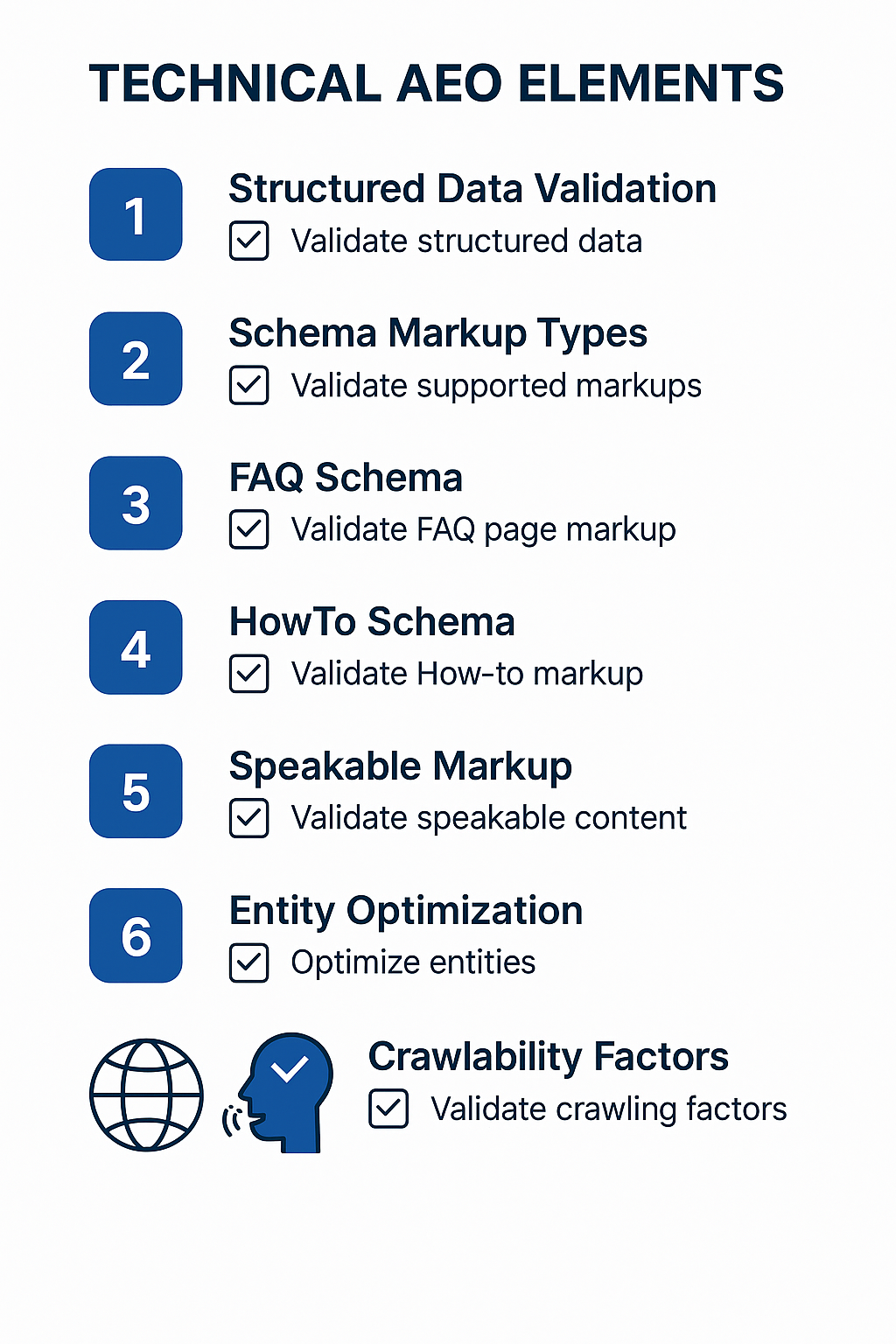
This is the silent killer of AEO performance. Content can be perfectly optimized for quotability, loaded with verifiable data, structured exactly how AI models prefer, and still be completely invisible because a technical barrier blocks crawler access.
Here’s what makes this more complicated in 2026: the crawler landscape has bifurcated. Search and retrieval crawlers (used for citation and answering user queries) and training crawlers (used for model learning) now exist. Teams must explicitly allow the former while making separate decisions about the latter.
Blocking GPTBot doesn’t mean you’re blocking ChatGPT from citing you. Blocking OAI-SearchBot does. This distinction matters, and most teams get it wrong.
P1: Robots.txt AI Crawler Permissions
Your robots.txt file is the first gate AI crawlers check. If you’re blocking them here, nothing else in this checklist matters.
Validation checklist:
- [ ] OAI-SearchBot is allowed (ChatGPT search retrieval)
- [ ] ChatGPT-User is allowed (ChatGPT direct browsing)
- [ ] Claude-SearchBot is allowed (Claude search retrieval)
- [ ] Claude-User is allowed (Claude direct browsing)
- [ ] PerplexityBot is allowed (Perplexity citation retrieval)
- [ ] Perplexity-User is allowed (Perplexity user-initiated browsing)
- [ ] Googlebot is allowed (Google AI Overviews)
- [ ] Bingbot is allowed (Microsoft Copilot and Bing)
- [ ] Google-Extended status is intentional (training crawler, separate decision)
Note: allowing OAI-SearchBot (search retrieval) is separate from allowing GPTBot (training). You can allow citation while blocking training data use. The same pattern applies for Claude-SearchBot versus ClaudeBot.
How to validate: Check your robots.txt file directly at yourdomain.com/robots.txt. Use robots.txt testing tools in Google Search Console. For most sites, the fix is adding explicit allow statements for the eight search and retrieval crawlers listed above.
This is a one-time technical setup item. Once configured correctly, it covers all content. But verify it hasn’t been changed during recent deployments.
P1: JavaScript Rendering and Crawler Access
AI crawlers vary significantly in their JavaScript rendering capability. Content hidden behind client-side rendering may be completely invisible to some answer engines, even if your robots.txt is configured correctly.
Validation checklist:
- [ ] Critical content renders without JavaScript (H1, body text, key headings)
- [ ] Structured data is present in initial HTML (not injected via JS)
- [ ] No client-side rendering delays exceed 5 seconds (crawlers timeout)
- [ ] Page tested with JavaScript disabled shows core content
ChatGPT’s browsing capability handles JavaScript reasonably well, but Perplexity’s web retrieval is more limited. Google AI Overviews rely on Googlebot’s rendering, which is strong but not instantaneous.
How to validate: Use Google Search Console’s URL Inspection tool to see the rendered HTML. Run your pages through Screaming Frog with JavaScript rendering enabled. For a quick manual check, disable JavaScript in your browser and see what content remains visible.
This is a per-article validation item for dynamic content, but largely a one-time setup issue for most static content sites.
P2: WAF and CDN Allowlisting
Web application firewalls and CDN configurations can block AI crawler user agents without your content team ever knowing. I’ve seen teams optimize content for months without realizing their Cloudflare configuration was blocking every AI crawler request.
Validation checklist:
- [ ] Cloudflare, Akamai, or Fastly rules don’t block AI search crawlers
- [ ] Rate limiting doesn’t throttle legitimate AI crawler requests
- [ ] No CAPTCHA challenges on content pages
- [ ] Bot management settings distinguish AI search crawlers from bad bots
The challenge is that many WAF configurations lump all “bots” together. You need to explicitly allowlist AI search crawlers in your bot management rules.
How to validate: Check your server logs for AI crawler user agent visits. If you see zero visits from OAI-SearchBot, ChatGPT-User, or PerplexityBot over 30 days, something is blocking them. Test by making requests with AI crawler user agents and monitoring for blocks.
This is a one-time technical setup item that requires coordination with your security or infrastructure team.
P2: Server Log Verification
Server logs are the only definitive proof that AI crawlers are accessing your content. Everything else is configuration that should work. Logs tell you what actually happened.
Validation checklist:
- [ ] Logs show visits from AI crawler user agents within past 30 days
- [ ] New strategic content gets log monitoring post-publish
- [ ] Pages with zero AI crawler visits flagged for investigation
- [ ] Log analysis scheduled monthly for content clusters
For new content, don’t expect immediate crawler visits. Monitor logs for two to four weeks after publishing to verify access.
How to validate: Export server logs filtered by AI crawler user agents. If you’re using a log analysis tool, set up a saved filter for AI search crawlers specifically.
This is a per-article validation item for new content and a periodic audit item for existing content.
Content Structure Validation: Is Your Content Formatted for AI Extraction?
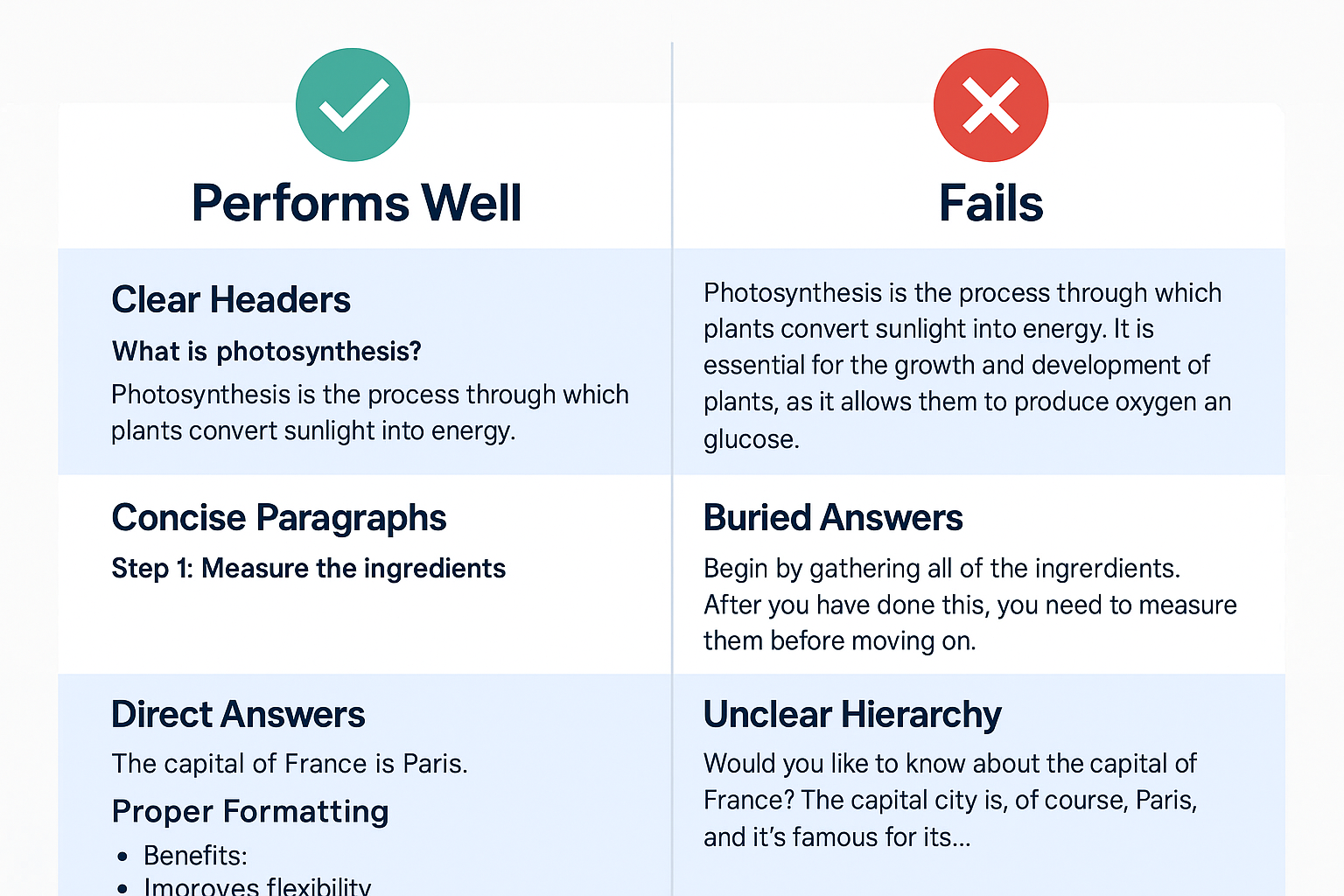
Technical access gets your content in front of AI crawlers. Content structure determines whether those crawlers can extract quotable passages.
AI models don’t read content the way humans do. They extract. They pull passages, synthesize answers, and cite sources that provided clear, quotable statements. Content structured for human consumption often fails extraction because answers are buried, hedged, or dependent on surrounding context.
Here’s the data point that should reshape how you structure content: 55% of AI Overview citations came from the first 30% of the cited page (CXL Research, 2026). If your answer is in the back half of your article, AI systems are less likely to extract and cite it.
P1: Answer Positioning and Quotability
AI models favor content that states answers explicitly and early. Not content that builds to a conclusion. Not content that “explores” a topic before committing to a position. Content that leads with the answer.
Validation checklist:
- [ ] First 30% of article contains direct, quotable answers to target query
- [ ] Each H2 section opens with a 2-3 sentence answer before expanding
- [ ] Key claims stated in complete, standalone sentences
- [ ] No “throat-clearing” paragraphs before reaching the point
- [ ] Answers don’t require surrounding context to make sense
Example of what works: “AEO publishing validation requires three categories of checks: technical access, content structure, and evidence quality. Each category addresses a different failure mode that prevents AI systems from citing otherwise-good content.”
Example of what fails: “In this section, we’ll explore the various aspects of what makes content ready for the age of AI search, considering multiple perspectives and the evolving landscape of how users interact with information retrieval systems.”
The first example can be extracted and quoted directly. The second example says nothing that AI can use.
How to validate: Read the first 30% of your article. Can you extract a complete, specific answer without reading the rest? If the answer is no, restructure before publishing.
This is a per-article validation item. Every piece of content needs this check.
P1: Heading Hierarchy and Scannable Structure
AI models use headings to understand content organization and locate relevant passages. Poor heading structure makes extraction harder and reduces citation likelihood.
Validation checklist:
- [ ] Single H1 that clearly states the topic (one only, never multiple H1s)
- [ ] H2s answer specific questions or describe distinct components
- [ ] H3s for logical subsections within each H2
- [ ] Heading every 150-300 words for scannable structure
- [ ] Keywords front-loaded in headings where natural
- [ ] No generic headings like “Overview,” “Details,” or “More Information”
Good H2 examples: “How to Validate AI Crawler Access Before Publishing” or “Why Content Freshness Determines Citation Eligibility”
Bad H2 examples: “Additional Considerations” or “Things to Think About”
How to validate: Export your heading structure. Does it read as a logical table of contents? Could someone understand your article’s argument from headings alone?
This is a per-article validation item that editors should check before publishing.
P2: Summary and Definition Blocks
AI models preferentially extract summary blocks, definition lists, and structured answer formats. Content that makes extraction easy gets cited more often.
Validation checklist:
- [ ] Key definitions formatted as standalone definition statements
- [ ] Summary or “quick answer” block near the top for definitional queries
- [ ] Lists and tables used for multi-part answers
- [ ] Multi-step processes formatted as numbered lists, not paragraphs
A note on FAQ schema: Google has removed FAQ rich results support for most sites. But FAQ-formatted content still aids AI extraction even without schema. Validate the content format, not just the markup. The structure matters more than the schema declaration.
If your content answers a common question, make sure that answer appears as a scannable block, not buried in paragraph text.
How to validate: Scan your content visually. Are answers in extractable formats, or do they require reading full paragraphs to find?
This is a per-article validation item.
P2: Structured Data Validation

Let me be direct about schema: recent research from Ahrefs (May 2026) found no significant citation uplift from adding schema to already-cited pages. Schema improves crawlability and indexing, but it doesn’t guarantee citations.
Include structured data for technical hygiene, not as a magic bullet.
Validation checklist:
- [ ] Article schema implemented with author, datePublished, dateModified
- [ ] Author schema linked to author page with E-E-A-T signals
- [ ] Organization schema for brand entity
- [ ] FAQ schema for genuinely FAQ-formatted content
- [ ] Schema validates with zero errors in Google Rich Results Test
Sites implementing structured data and FAQ blocks saw a 44% increase in AI search citations (BrightEdge, 2025). But note: this may reflect correlation with other quality signals, not schema alone. Sites that implement schema tend to do other optimization work too.
For a deeper dive on schema implementation, see our guide on Service Schema for AI Search: Organization, Author & Product Markup.
How to validate: Run pages through Google’s Rich Results Test. Check for errors and warnings. Verify author and organization entities are properly linked.
This is a per-article validation item for schema presence, with one-time setup for author and organization schemas.
Evidence Quality Validation: Will AI Models Trust Your Claims?
AI models cross-reference claims against authoritative sources. They evaluate whether statistics are verifiable, whether sources are credible, and whether content is current. Unverifiable claims get deprioritized or ignored entirely.
This is the validation category most content teams skip. They focus on structure and keywords while publishing content full of unsourced statistics and outdated information. AI systems notice, even if human readers don’t.
The freshness signal is particularly important: 83% of AI citations came from pages updated within the past 12 months (AirOps, 2026). Recency isn’t just a nice-to-have. It’s a dominant citation signal.
P1: Source Verification and Attribution
Every statistic needs a verifiable source. Every claim needs evidence. AI models can cross-reference your statements against their training data and real-time web access. If your claims don’t check out, you don’t get cited.
Validation checklist:
- [ ] Every statistic includes source name and year
- [ ] Sources are authoritative (industry reports, academic research, platform data)
- [ ] Claims are specific, not vague (“31.7% of clicks” not “about a third”)
- [ ] External links to source documentation where possible
- [ ] No invented or unverifiable statistics
- [ ] Industry benchmarks properly attributed (“Industry benchmarks suggest…” when no specific source)
Example of verifiable citation: “76% of pages most frequently cited by ChatGPT had been substantively updated in the previous 30 days (SE Ranking, 2026).”
Example of unverifiable claim: “Most websites see significant improvements when they update their content regularly.”
The first can be cross-referenced. The second is meaningless filler that AI systems will ignore.
How to validate: Highlight every stat and data point in your content. Can you trace each one to an authoritative source with a year? If not, either find the source, remove the stat, or reframe as an observation from experience.
This is a per-article validation item. Writers should verify during drafting; editors should check before publishing.
P1: Freshness Signals
Content freshness is now a dominant citation signal. AI models use recency as a confidence proxy, assuming newer content reflects current reality more accurately.
The data is compelling: 76% of pages most frequently cited by ChatGPT had been substantively updated in the previous 30 days (SE Ranking, 2026). Ahrefs found the average cited page was nearly a full year newer than those appearing in traditional search results (Ahrefs, 2025).
Validation checklist:
- [ ] dateModified in schema reflects actual last update (not original publish date)
- [ ] Content includes current-year statistics and references
- [ ] No outdated information contradicting current reality
- [ ] Refresh schedule assigned for strategic content
- [ ] Outdated stats replaced or removed
We’ve started treating refresh scheduling as part of the publishing workflow, not a separate audit process. When content goes live, we assign the next review date immediately. If it’s a strategic page, that’s 30-90 days out. If it’s evergreen reference content, that’s quarterly.
For more on building content freshness into your workflow, see our AI SEO Optimization Checklist: The Content Refresh Playbook.
How to validate: Check your dateModified schema value. Review all statistics for currency. Confirm any referenced tools, platforms, or processes still work as described.
This is a per-article validation item that should trigger scheduled reviews.
P2: Expert Attribution and E-E-A-T Signals
AI models evaluate author credibility and expertise signals. Anonymous content or content attributed to generic “Staff Writer” bylines carries less weight than content with clear expert attribution.
Validation checklist:
- [ ] Author byline with link to author page
- [ ] Author page includes credentials, expertise areas, published content
- [ ] First-person experience references where relevant (“In our work with clients…”)
- [ ] Expert quotes or references to recognized authorities
- [ ] Clear indication why this author is qualified on this topic
How to validate: Would a reader, or an AI model, know why this author is qualified to write this content? If the answer isn’t obvious from the byline and author page, strengthen the attribution.
For a comprehensive guide on building author authority, see our article on Author Pages, E-E-A-T, and AI Search Visibility.
This is a per-article validation item that relies on one-time setup of author pages.
P3: Third-Party Authority Signals
Here’s a data point that reshapes how we think about citations: brand mentions correlate 3x more strongly with AI visibility than backlinks, with a 0.664 correlation versus 0.218 (Otterly.AI, 2026).
Earned media and third-party validation now matter more than internal optimization alone.
Validation checklist:
- [ ] Content references or cites authoritative third-party sources
- [ ] Brand/author has external mentions AI models can cross-reference
- [ ] Internal linking to related NAV43 content reinforces topical authority
- [ ] Content contributes to broader topical cluster
This is harder to validate per-article, but it should inform broader content strategy. If you’re publishing content on a topic where your brand has no external authority signals, the citation likelihood is lower regardless of content quality.
How to validate: Search for your brand plus the topic in AI assistants. Do you appear in the context? If not, third-party authority building is the strategic gap.
This is a strategic audit item, not a per-article validation.
Platform-Specific Validation: Google AI Overviews vs. ChatGPT vs. Perplexity
Here’s the content gap most teams miss: strategies that win on Google AI Overviews often fail on standalone LLMs like ChatGPT. The platforms weight different signals differently, and optimizing for one doesn’t guarantee visibility on others.
2026 requires parallel optimization strategies, or at minimum, understanding which platforms your audience actually uses and validating for those specifically.
Google AI Overviews
Google AI Overviews pull heavily from traditional search signals. If you’re not ranking organically, you’re unlikely to appear in AI Overviews. This is the platform where traditional SEO foundations matter most.
Validation checklist:
- [ ] Page is indexed in Google Search Console
- [ ] No manual actions or indexing issues flagged
- [ ] Core Web Vitals passing (LCP, INP, CLS)
- [ ] Existing organic rankings for target queries
- [ ] Structured data implemented without errors
For AI Overviews, traditional SEO work remains the foundation. The platform-specific validation layer is confirming your organic search presence before expecting AI Overview inclusion.
For more on ranking in AI Overviews specifically, see our guide: How to Rank in Google AI Overviews.
ChatGPT and Claude
ChatGPT and Claude rely on real-time web retrieval through their search crawlers. The validation focus shifts to accessibility, extractability, and recency.
Validation checklist:
- [ ] Robots.txt allows OAI-SearchBot, ChatGPT-User, Claude-SearchBot
- [ ] Content renders without JavaScript dependency
- [ ] Explicit answers positioned in first 30% of content
- [ ] Recent dateModified signal (within 30-90 days for strategic content)
- [ ] Author attribution with linked credentials
ChatGPT in particular weights freshness signals heavily. Content updated within 30 days has a significant citation advantage over older content, even if the older content is more comprehensive.
Perplexity
Perplexity emphasizes source authority and citation-worthiness. It’s the platform most focused on verifiable, well-sourced content.
Validation checklist:
- [ ] Robots.txt allows PerplexityBot
- [ ] Clear attribution and sourcing for all claims
- [ ] Structured data implemented correctly
- [ ] Topical authority signals present (content cluster, related pages)
- [ ] External authority signals (third-party mentions, citations)
For a deeper dive on Perplexity optimization specifically, see How to Get Perplexity to Reference Your Content.
The Complete AEO Publishing Checklist
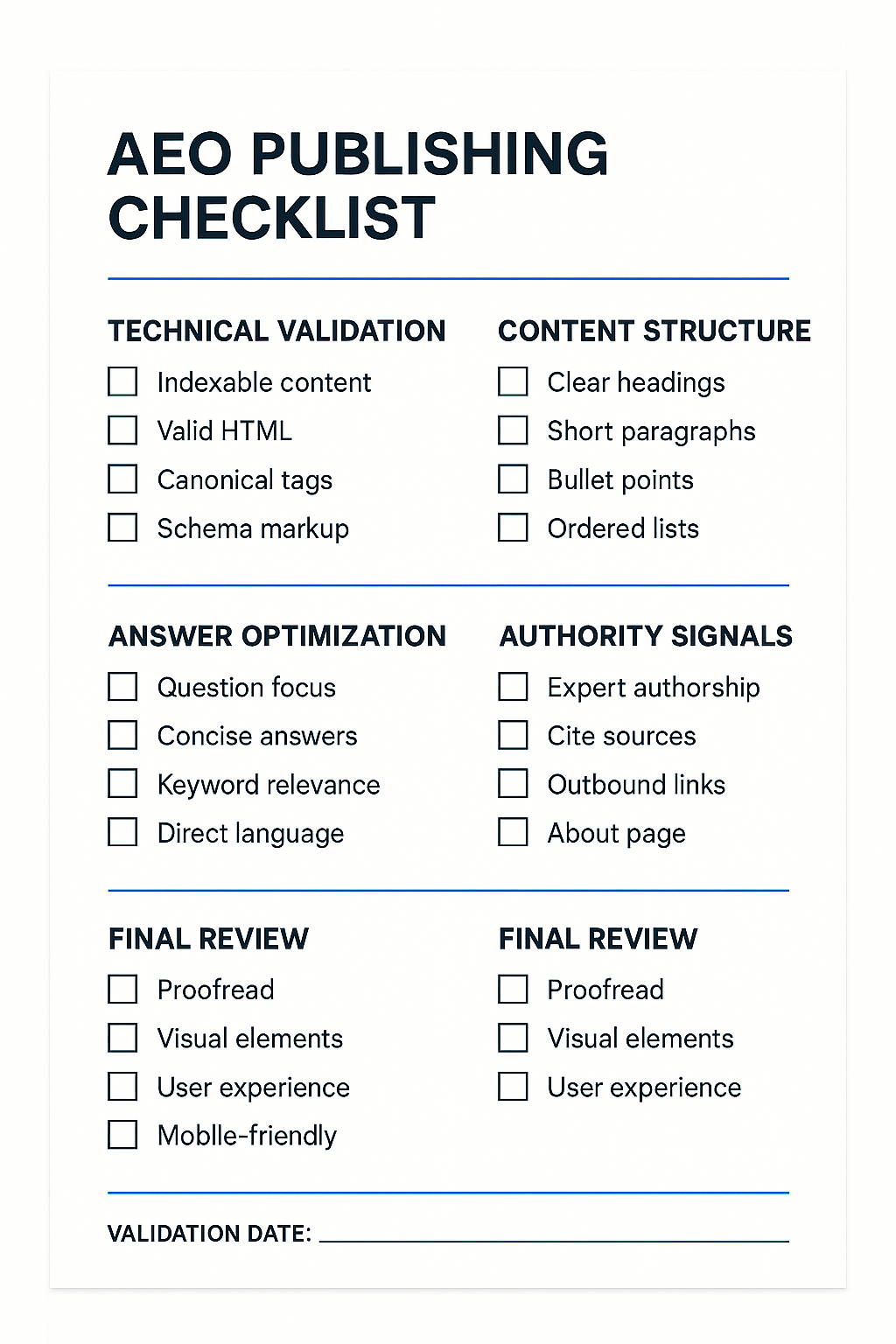
Here’s the consolidated checklist, organized by priority tier. Copy this directly into your publishing workflow.
P1: Must-Pass Before Publishing
- [ ] Robots.txt allows AI search crawlers (OAI-SearchBot, ChatGPT-User, Claude-SearchBot, Claude-User, PerplexityBot, Perplexity-User, Googlebot, Bingbot)
- [ ] Critical content renders without JavaScript
- [ ] First 30% contains direct, quotable answers to target query
- [ ] Single H1 with descriptive headings every 150-300 words
- [ ] Every statistic has source name and year
- [ ] dateModified reflects actual last update date
- [ ] No outdated information contradicting current reality
- [ ] Current-year statistics and references included
P2: Strongly Recommended
- [ ] WAF/CDN doesn’t block AI search crawlers
- [ ] Server logs confirm AI crawler visits (for existing content)
- [ ] Summary and definition blocks for key concepts
- [ ] Article schema with author, datePublished, dateModified, organization
- [ ] Expert attribution and E-E-A-T signals present
- [ ] Author byline with link to author page
- [ ] Core Web Vitals passing
- [ ] Lists and tables used for multi-part answers
- [ ] FAQ-formatted content for question-answer sections
P3: Optimization Layer
- [ ] Third-party authority signals documented
- [ ] Internal linking to topical cluster complete
- [ ] Content refresh schedule assigned
- [ ] Platform-specific validation complete (AI Overviews, ChatGPT, Perplexity)
- [ ] Content contributes to broader entity strategy
- [ ] External citation and mention opportunities identified
For teams building AI-ready content workflows, this checklist should become as routine as spell-check. The items that feel tedious today become competitive advantages tomorrow.
What to Do After Publishing
AEO validation doesn’t end when you hit publish. The monitoring and iteration phase completes the loop.
Post-publish validation checklist:
- [ ] Monitor server logs for AI crawler visits within 7 days
- [ ] Test target queries in ChatGPT, Perplexity, Google AI Overviews within 2-4 weeks
- [ ] Document citation wins and gaps for iteration
- [ ] Update content if initial testing reveals structure or evidence gaps
- [ ] Schedule content refresh based on strategic importance
Research from Princeton, Georgia Tech, and IIT Delhi found that GEO techniques can boost content visibility in AI-generated responses by up to 40% (Princeton/Georgia Tech/IIT Delhi GEO Study, Aggarwal et al., 2024). But that boost only materializes if you measure and iterate.
The teams that win in AI search aren’t publishing and forgetting. They validate, monitor, and refine based on what actually gets cited.
For a complete measurement framework, see our AI Search Visibility Dashboard guide.
Key Takeaways
- The AEO implementation gap is operational, not educational. Most teams understand AEO conceptually but lack a pre-publish validation workflow. This checklist closes that gap.
- Technical access validation catches silent failures. 73% of sites have barriers blocking AI crawlers (Otterly.AI, 2026). If you skip robots.txt and JavaScript-rendering checks, you waste optimization effort.
- Answer positioning determines extraction likelihood. 55% of AI citations come from the first 30% of content (CXL Research, 2026). Lead with quotable answers; don’t build to conclusions.
- Evidence quality is a trust signal. Unsourced statistics and outdated information reduce citation likelihood. Verify every claim before publishing.
- Freshness is now a dominant citation signal. 76% of frequently-cited pages were updated within 30 days (SE Ranking via ZipTie, 2026). Build refresh scheduling into your publishing workflow.
Next Steps
- Run the P1 checklist on your next piece of content before publishing. Note which items fail and why.
- Audit your robots.txt for AI crawler permissions. This five-minute fix unlocks everything else.
- Implement the checklist in your CMS. Add it as a required field, a linked document, or a status gate that blocks publishing until completed.
- Assign ownership for each validation category. Technical access to dev/technical SEO. Content structure to editors. Evidence quality to writers with editorial review.
- Set up server log monitoring for AI crawlers. If you can’t verify crawler access, you can’t diagnose citation failures.
If your team is ready to operationalize AEO but needs help building the workflow, systems, and measurement framework, request a free growth plan from NAV43. We’ll audit your current AEO readiness and show you exactly where the gaps are.
An AEO publishing checklist only works if you run it every time. The teams that win in AI search aren’t the ones who understand AEO best. They’re the ones who validate it before every piece goes live.
